The Grow Awards 2026 🏆
Likes
Comments
Share
Likes
89
Share
@Njanne
Follow
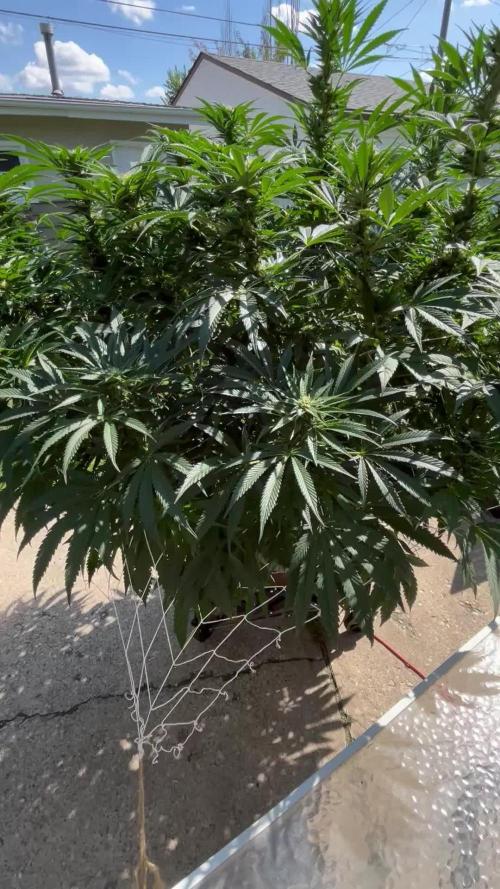
I found this seed in bud that I harvested from my Barney's Liberty Haze plant. It was grown in my grow room and you can see my GrowDiary log of that plant. I am not sure exactly how I ended up with seeds... maybe there was light or temperature stress which resulted in a herm. In any case, I decided to grow this seed as a fun experiment. I didn't even know if the seed would germinate... but it grew just FINE. I didn't top it, or give it any special treatment. I guess you could say she grew 'native' or 'au natural.' I have never grown outside before, but I had space in the garden, and the seedling looked healthy, so I hardened her off and popped her into the dirt. She ended up going into a huge monster of a plant. Standing over 9 feet tall I had to laugh out loud each time I climbed the ladder to inspect her top cola LOL. I had so much fun growing this plant. I called her Majestic Haze (we live on Majestic Drive) because I'm not sure if Barney's would want me calling her Liberty Haze. I can't verify the genetics for sure :) I wonder how plant breeders handle those kinds of things??... This bud is fun for parties and conversation. It starts out with an energetic vibe and then settles into a relaxed chill stoned feeling. We vaped our dried bud, and then we tried some of our hand rolled hash... then we settled in for the night. Woke up a sit high still LOL but it's Saturday and we don't need to go anywhere so it's all good LOL... This one is the bud of choice for house parties and silly Netflix watching. PS if you haven't see The Good Place... you need to get stoned and watch it. The total dried weight of bud from this plant was just under one pound @ 310g and we also ended up with around 120 g of frosty trim. We also rolled up about a gram of hash which has some serious kick :)
Likes
20
Share
Eine Reise geht zu Ende, wie ein Freund treffend sagte: "Sie werden so schnell erwachsen". 11 Wochen ist es her, dass ich dieses Tagebuch gestartet habe und bin ganz froh einen super entspannten Grow hinter mich gebracht zu haben. Die Pflanzen haben super auf das Topping reagiert und wuchsen danach mit schnellen Tempo weiter. Jetzt hängen sie zum Trocknen und in 5-6 Tagen weiß ich dann, wie viel es geworden ist.
Likes
19
Share
Switched to GH flora 3 part. Playing around with flood times. The are taking up water at an exponential rate. Started with 3, 3 minute floods, up to 6, 4 minute floods and they're still drying up the puddles within an hour. Plant 1 is ahead of plant 2 by a day but it is half the size🤷‍♂️ Topped day 16. Not obvious in the photos as I had hoped but they bounced back within minutes Thank to evryone who gave their input, every little bit helps🙌 After all your suggestions, I've, backed off the light, backed off the flood time and count. We will see if these girls perk up a little more👍 Day 17 I noticed progression of what I believe to be a calcium deficiency? That's on me, forgot the calmag originally🤦‍♂️ another thing I decided to look into was the twisting of the leaves as the plant 1 is also starting to show. Could my ph be alot higher than I think? 4 gal res I added a couple ml of phosphoric acid at the start and about 1ml a day since(I didnt prep my cube as well as I should of) seems like alot to me. The system would rise from 5.3 to 6.3 throughout the day. A flood cycle doesnt seem to affect the ph, more over time. I am constantly stirring the mix and no my meter is not yet calibrated. I have ordered what I need but I'm considering calibrating with the chemicals I have and doing a res change. Good news is, they do seem a little more lifelike after implementing all your suggestions. Okay drained and rinsed my res, ro water into the tank was holding 6.97ph, good enough for the girls I go out with🤷‍♂️ gonna mix up a batch, do a top feed to waste, and see what happens. It has been nearly 24h since my last flood. Also, struggling with lows of 30% humidity sometimes. Dont know if that plays a role here. Okay something was off.. I did a top feed to waste with fresh 5.3 nutes and the runoff came out at 7.5.. so I did it again...and again...maybe a half doesnt times to each block with no change. I started to reuse the runoff as I wrote off the batch at this point. I then switched to a pump and did recirc feed to each block aprox 20 litres at a time, stopping to rebalance. Literally 100s of litres later I am stable at 5.5....going to drain rinse and refill. The interesting part is that what ever was saturated in those blocks is non conductive, the ec didnt change the entire time🤷‍♂️ Spent the next couple days recovering. Looking better now. Sardine catcher installed.
Likes
15
Share
----- WEEK 9 ----- ----- Day 57 ----- Easy day of watching. Just 1 pic today so far. not much reason to go downstairs to take a pic yet. Glookies is turning Purple on sugar and fan leaves now. Harvest is very soon. I'd wager within 7 days now just going to depend on the High I get off tester nugs. ***Update*** I destroyed the trellis and took em out for some pics and vids. Trichs = Tropicana is ready Tuesday, Wedding Cake probably Friday or within that weekend. ----- Day 58 ----- Last couple days. Fed about 30ml of Cal/Mag and 30ml of Molasses. Wanted to just keep the photosynthesis process and the plant in general alive for reveg. Was getting a bit too yellow for my liking. Harvest soon. ----- Day 59 ----- Harvested Tropicanna Glookies today Deleted this week by accident trying to make it a harvest week, so remade it. Will add harvest week once plants are dry and tester has been smoked to give proper info Put some more photos in. Basically the tent is 4 feet wide and the ruler is 12 inches long from bottom of duct tape Really loving the colors of this plant. ------ Day 60 ----- Fed only the Wedding Cake - 5-10ml of Calimagic and 20ml of molasses (NO Liter level marked or PPM or PH, i could cut today its done but im just maturing the trichs) Tropicanna Glookies is a friggin BEAUTIFUL strain. Moved the Wedding Cake in the tent so largest nugs are furthest away from light and dropped light from 1000w to 600w to save electricity Chop on Wedding Cake happens at mostly amber trichs. Prob 5-6 days max for that i'll know when I check trichs tonight and update with photo. ----- Day 61 ----- Wedding Cake is about 5% amber... so prob 6 days or so. Slow day today. ----- Day 62 ----- Feeding is today, going to just use some CaliMagic and Molasses again. Trichs aren't golden yet, so not chop time ... 8-9 weeks is what it is supposed to take, but it's got at least another 5-8+ days until 30-40% amber trichs for Indica couch-lock effect to shine in the Wedding Cake. Tropicanna could still be going right now, but I did not want more than 5-10% amber gold trichs to prevent a couch-lock effect. This has worked very well. On day 64 I will post a smoke report and full harvest/trim details as Saturday/Sunday is trimming. Will have dry weight results of Tropicanna (per plant, and as a whole). Tropicanna being sent to lab for full analysis will post results when they arrive (Usually 2-3 weeks after sending sample via mail) ------ Day 63 ------ Nothing to talk about today, slow day. almost done. *Update* 1 pic, i think it explains everything.
Likes
3
Share
Big tops! She's got a lot of rocket colas thanks to the training techniques that were applied, she smells exactly like her sisters, very sweet and floral, I'm starting to feel the cherry 🍒 notes on the smell of the buds, very good strain to grow, only 2 of the 5 phenos are 100% percent purple but tje other ones show purple on the leafs like this one because of the cold temperatures
Likes
40
Share
6ª settimana di fioritura 💐 Il meteo è ancora molto variabile a causa delle continue scie chimiche... Ma la ragazza continua a far crescere i suoi fiori innevati💜🔝
Likes
10
Share
Likes
2
Share
Vamos familia, actualizamos la segunda semana de floración de estas Runtz Punch de Herbies. La temperatura que estuvo entre los 24-26 grados y humedad dentro de los rangos correctos. En cuanto a las plantas las veo verde sano, estiraron bien y ensancharon bastante también. Se nota que los nutrientes de la marca Agrobeta hacen sus funciones. Las flores empezaron a formarse, por el momento todo correcto, os dejé también alguna novedad y un cambio en la sala, agradecer al equipo de Mars hydro por el nuevo TSW2000. ( los últimos 5 años cultive solo con los leds de esta marca) Llevaba 10 años trabajando en sodio y fue un salto de gigantes cambiar a los Leds, jamás me arrepentiré de ese cambio. - os dejo por aquí un CÓDIGO: Eldruida Descuento para la tienda de MARS HYDRO. https://www.mars-hydro.com Hasta aquí todo, Buenos humos 💨💨💨
Likes
12
Share
@Gram_Solo
Follow
Looks like these are filling out now! Was worries about the look of 1 that wasn't getting any pistils hardly but seems to have kicked on! 💪 Smell is definitely increasing, lemony gassy power! 2 more weeks maybe and then we start some Overdrive and final flushing! Need some sativa Now!!! I am potato
Likes
52
Share
Lacewings seemed to have mostly killed themselves by flying into hot light fixtures. I may have left the UV on which was smart of me :) Done very little to combat if anything but make a sea of carcasses, on the bright side its good nutrition for the soil. Made a concoction of ethanol 70%, equal parts water, and cayenne pepper with a couple of squirts of dish soap. Took around an hour of good scrubbing the entire canopy. Worked a lot more effectively and way cheaper. Scorched earth right now, but it seems to have wiped them out almost entirely very pleased. Attempted a "Fudge I Missed" for the topping. So just time to wait and see how it goes. Question? If I attached a plant to two separate pots but it was connected by rootzone, one has a pH of 7.5 ish the other has 4.5. Would the Intelligence of the plant able to dictate each pot separately to uptake the nutrients best suited to pH or would it still try to draw nitrogen from a pot with a pH where nitrogen struggles to uptake? Food for stoner thought experiments! Another was on my mind. What happens when a plant gets too much light? Well, it burns and curls up leaves. That's the heat radiation, let's remove excess heat, now what? I've always read it's just bad, or not good, but when I look for an explanation on a deeper level it's just bad and you shouldn't do it. So I did. How much can a cannabis plant absorb, 40 moles in a day, ok I'll give it 60 moles. 80 nothing bad ever happened. The answer, finally. Oh great........more questions........ Reactive oxygen species (ROS) are molecules capable of independent existence, containing at least one oxygen atom and one or more unpaired electrons. "Sunlight is the essential source of energy for most photosynthetic organisms, yet sunlight in excess of the organism’s photosynthetic capacity can generate reactive oxygen species (ROS) that lead to cellular damage. To avoid damage, plants respond to high light (HL) by activating photophysical pathways that safely convert excess energy to heat, which is known as nonphotochemical quenching (NPQ) (Rochaix, 2014). While NPQ allows for healthy growth, it also limits the overall photosynthetic efficiency under many conditions. If NPQ were optimized for biomass, yields would improve dramatically, potentially by up to 30% (Kromdijk et al., 2016; Zhu et al., 2010). However, critical information to guide optimization is still lacking, including the molecular origin of NPQ and the mechanism of regulation." What I found most interesting was research pointing out that pH is linked to this defense mechanism. The organism can better facilitate "quenching" when oversaturated with light in a low pH. Now I Know during photosynthesis plants naturally produce exudates (chemicals that are secreted through their roots). Do they have the ability to alter pH themselves using these excretions? Or is that done by the beneficial bacteria? If I can prevent reactive oxygen species from causing damage by "too much light". The extra water needed to keep this level of burn cooled though, I must learn to crawl before I can run. Reactive oxygen species (ROS) are key signaling molecules that enable cells to rapidly respond to different stimuli. In plants, ROS plays a crucial role in abiotic and biotic stress sensing, integration of different environmental signals, and activation of stress-response networks, thus contributing to the establishment of defense mechanisms and plant resilience. Recent advances in the study of ROS signaling in plants include the identification of ROS receptors and key regulatory hubs that connect ROS signaling with other important stress-response signal transduction pathways and hormones, as well as new roles for ROS in organelle-to-organelle and cell-to-cell signaling. Our understanding of how ROS are regulated in cells by balancing production, scavenging, and transport has also increased. In this Review, we discuss these promising developments and how they might be used to increase plant resilience to environmental stress. Temperature stress is one of the major abiotic stresses that adversely affect agricultural productivity worldwide. Temperatures beyond a plant's physiological optimum can trigger significant physiological and biochemical perturbations, reducing plant growth and tolerance to stress. Improving a plant's tolerance to these temperature fluctuations requires a deep understanding of its responses to environmental change. To adapt to temperature fluctuations, plants tailor their acclimatory signal transduction events, specifically, cellular redox state, that are governed by plant hormones, reactive oxygen species (ROS) regulatory systems, and other molecular components. The role of ROS in plants as important signaling molecules during stress acclimation has recently been established. Here, hormone-triggered ROS produced by NADPH oxidases, feedback regulation, and integrated signaling events during temperature stress activate stress-response pathways and induce acclimation or defense mechanisms. At the other extreme, excess ROS accumulation, following temperature-induced oxidative stress, can have negative consequences on plant growth and stress acclimation. The excessive ROS is regulated by the ROS scavenging system, which subsequently promotes plant tolerance. All these signaling events, including crosstalk between hormones and ROS, modify the plant's transcriptomic, metabolomic, and biochemical states and promote plant acclimation, tolerance, and survival. Here, we provide a comprehensive review of the ROS, hormones, and their joint role in shaping a plant's responses to high and low temperatures, and we conclude by outlining hormone/ROS-regulated plant-responsive strategies for developing stress-tolerant crops to combat temperature changes. Onward upward for now. Next! Adenosine triphosphate (ATP) is an energy-carrying molecule known as "the energy currency of life" or "the fuel of life," because it's the universal energy source for all living cells.1 Every living organism consists of cells that rely on ATP for their energy needs. ATP is made by converting the food we eat into energy. It's an essential building block for all life forms. Without ATP, cells wouldn't have the fuel or power to perform functions necessary to stay alive, and they would eventually die. All forms of life rely on ATP to do the things they must do to survive.2 ATP is made of a nitrogen base (adenine) and a sugar molecule (ribose), which create adenosine, plus three phosphate molecules. If adenosine only has one phosphate molecule, it’s called adenosine monophosphate (AMP). If it has two phosphates, it’s called adenosine diphosphate (ADP). Although adenosine is a fundamental part of ATP, when it comes to providing energy to a cell and fueling cellular processes, the phosphate molecules are what really matter. The most energy-loaded composition for adenosine is ATP, which has three phosphates.3 ATP was first discovered in the 1920s. In 1929, Karl Lohmann—a German chemist studying muscle contractions—isolated what we now call adenosine triphosphate in a laboratory. At the time, Lohmann called ATP by a different name. It wasn't until a decade later, in 1939, that Nobel Prize–-winner Fritz Lipmann established that ATP is the universal carrier of energy in all living cells and coined the term "energy-rich phosphate bonds."45 Lipmann focused on phosphate bonds as the key to ATP being the universal energy source for all living cells, because adenosine triphosphate releases energy when one of its three phosphate bonds breaks off to form ADP. ATP is a high-energy molecule with three phosphate bonds; ADP is low-energy with only two phosphate bonds. The Twos and Threes of ATP and ADP Adenosine triphosphate (ATP) becomes adenosine diphosphate (ADP) when one of its three phosphate molecules breaks free and releases energy (“tri” means “three,” while “di” means “two”). Conversely, ADP becomes ATP when a phosphate molecule is added. As part of an ongoing energy cycle, ADP is constantly recycled back into ATP.3 Much like a rechargeable battery with a fluctuating state of charge, ATP represents a fully charged battery, and ADP represents a "low-power mode." Every time a fully charged ATP molecule loses a phosphate bond, it becomes ADP; energy is released via the process of ATP becoming ADP. On the flip side, when a phosphate bond is added, ADP becomes ATP. When ADP becomes ATP, what was previously a low-charged energy adenosine molecule (ADP) becomes fully charged ATP. This energy-creation and energy-depletion cycle happens time and time again, much like your smartphone battery can be recharged countless times during its lifespan. The human body uses molecules held in the fats, proteins, and carbohydrates we eat or drink as sources of energy to make ATP. This happens through a process called hydrolysis . After food is digested, it's synthesized into glucose, which is a form of sugar. Glucose is the main source of fuel that our cells' mitochondria use to convert caloric energy from food into ATP, which is an energy form that can be used by cells. ATP is made via a process called cellular respiration that occurs in the mitochondria of a cell. Mitochondria are tiny subunits within a cell that specialize in extracting energy from the foods we eat and converting it into ATP. Mitochondria can convert glucose into ATP via two different types of cellular respiration: Aerobic (with oxygen) Anaerobic (without oxygen) Aerobic cellular respiration transforms glucose into ATP in a three-step process, as follows: Step 1: Glycolysis Step 2: The Krebs cycle (also called the citric acid cycle) Step 3: Electron transport chain During glycolysis, glucose (i.e., sugar) from food sources is broken down into pyruvate molecules. This is followed by the Krebs cycle, which is an aerobic process that uses oxygen to finish breaking down sugar and harnesses energy into electron carriers that fuel the synthesis of ATP. Lastly, the electron transport chain (ETC) pumps positively charged protons that drive ATP production throughout the mitochondria’s inner membrane.2 ATP can also be produced without oxygen (i.e., anaerobic), which is something plants, algae, and some bacteria do by converting the energy held in sunlight into energy that can be used by a cell via photosynthesis. Anaerobic exercise means that your body is working out "without oxygen." Anaerobic glycolysis occurs in human cells when there isn't enough oxygen available during an anaerobic workout. If no oxygen is present during cellular respiration, pyruvate can't enter the Krebs cycle and is oxidized into lactic acid. In the absence of oxygen, lactic acid fermentation makes ATP anaerobically. The burning sensation you feel in your muscles when you're huffing and puffing during anaerobic high-intensity interval training (HIIT) that maxes out your aerobic capacity or during a strenuous weight-lifting workout is lactic acid, which is used to make ATP via anaerobic glycolysis. During aerobic exercise, mitochondria have enough oxygen to make ATP aerobically. However, when you're out of breath and your cells don’t have enough oxygen to perform cellular respiration aerobically, the process can still happen anaerobically, but it creates a temporary burning sensation in your skeletal muscles. Why ATP Is So Important? ATP is essential for life and makes it possible for us to do the things we do. Without ATP, cells wouldn't be able to use the energy held in food to fuel cellular processes, and an organism couldn't stay alive. As a real-world example, when a car runs out of gas and is parked on the side of the road, the only thing that will make the car drivable again is putting some gasoline back in the tank. For all living cells, ATP is like the gas in a car's fuel tank. Without ATP, cells wouldn't have a source of usable energy, and the organism would die. Eating a well-balanced diet and staying hydrated should give your body all the resources it needs to produce plenty of ATP. Although some athletes may slightly improve their performance by taking supplements or ergonomic aids designed to increase ATP production, it's debatable that oral adenosine triphosphate supplementation actually increases energy. An average cell in the human body uses about 10 million ATP molecules per second and can recycle all of its ATP in less than a minute. Over 24 hours, the human body turns over its weight in ATP. You can last weeks without food. You can last days without water. You can last minutes without oxygen. You can last 16 seconds at most without ATP. Food amounts to one-third of ATP production within the human body.
Likes
11
Share
@Sejnik
Follow
Poslední týden před sklizní. Ve čtvrtek naposledy zalito. V sobotu nechám naposledy rozsvícená světla a v úterý bude sklizeň.
Processing
Likes
1
Share
@Ferenc
Follow
Hi! In this diary I will grow 5 Sativa and Indica dominant Auto Feminized Strains: Sour Orange Auto Feminized Seeds (2 seeds.) By The Bakery Seed Co. Sour Orange Auto Feminized Seeds are a cross of the famous Sour Tangie and the Bakery’s in house Ruderalis. Also a 80% sativa dominant strain with 56 to 70 day flower period. Tested at 17% THC this genetic is highly stable and the Bakery are very happy with the results. This Auto Feminized seed can be cultivated indoors as well as outdoors but definitely prefers a slightly warmer climate to gain the best terpene profile possible. An uplifting effect with a sweet and sour aroma of tangerines. This auto flower seed is another great addition to the Bakery Seed Co’s Automatic Range Auto Critical Orange Punch Seeds By Dutch Passion. Auto Critical Orange Punch Seeds are Dutch Passions first Critical Autoflower. A cross of (Grandaddy Purps x Orange Bud) x XXL Auto Kritical Bilbo, creating an easy strain to cultivate. Expect a full life cycle of 75 days from sprout to harvest with impressive XXL yields. She thrives with 20 hours of light and can grow up to 70-100cm indoors. Certain phenotypes can flower for an extra week or so to gain the XXL yields! Sweet skunk aromas with a hint of rich Afghan hash. Sour Stomper Auto Feminized Seeds are an example of what careful selection can achieve with breeding. A fruity style pheno of the Sour Crack female crossed with the Grapestomper OG male from Gage Green then crossed with ruderalis by Mephisto. This 50/50 Indica Sativa hybrid has a great stretch contributing to large yields. Due to cooler conditions late in flower, this dense canopy can produce beautiful blues and purples. A great genetic for indoor and outdoor cultivation and all finished and ready to harvest in just 65 to 70 days. This hybrid is popular with extracts and has Grape aroma in bloom. Auto Lemon Zkittle Feminized Seeds are made from quality USA genetics. It is an Overall Highlife Cup Winner 2018!!! It has won 1st prize in Sativa category and also was awarded the Overall Highlife Winner Trophy. Lemon Zkittle Auto retains its high THC and yields even in automatic form. Due to the lineage, this hybrid is very simple to cultivate and a great choice for beginners. Fruit and skunk aromas combined with citrus flavors and long-lasting effects. 20 Hour light cycle is recommended as well as a minimum of 75 days from seed. Some phenos can take a week longer to produce the massive yields. Outdoors this variety can take up to 100 days from seed to harvest. With THC levels tested 21% as well as minimum yields of 400g/m2, this automatic hybrid is a great addition to Dutch Passion Automatic range. 24 hours light schedule, 90 percent humidity, trigger spray, no fertilization. 15th of August: Girls are ready for germination, tonight I will place the seeds to be in water at least for 12 hours :) 15th of August: I put the seeds in the water. 16 of August 2019: Seeds are placed between damp paper towel :) 17th of Augsut 2019: All good so far, They are ready to be planted tomorrow;) Day 1: They are in the soil. Hopefully they will come out soon :) 60W LED for 5 plants and the humidity is very high 98 percent. I give 5 ml water a day per plant and plus triggering to keep the humidity very high. All the holes are closed. Day 2: Non of them are out yet but I think by tomorrow it will happen:). Day 3: All out :) Day 5: Sour Stomper and Lemon Zkittle a bit slower but all of them grow nicely. Babies ❤️ Day 6: They are coming! Critical Orange Punch is growing very quick she is already 10 cm but the rest of them are 6-7 cm.
Likes
17
Share
Logramos rellenar casi todo el espacio, muy contento con el proceso siendo mi primer scrog.. esperamos que formen todos los puntos de floracion para realizar última defoliacion y raleo ✌️🏾👨‍🌾🏾
Likes
100
Share
Muy buenas gente, les muestro mi cultivo una semana mas. Como podeis ver ya faltan algunas cepas que he cosecha e ire mostrando por aquí y por mis cuenta de Instagram para que vean como quedaron. Espero que les guste, buenos humos
Likes
23
Share
Cepa muy estable y lograda, muy buen trabajo por parte del equipo de Zambeza. Indica con floración rápida 18% cruzada con Chemdawg x Lemon Thai x Pakistaní Kush 25 gramos por planta, viendo que solo eran centrales 👌. Cepa 100% recomendable SOG, desde esqueje o incluso desde semilla.
Likes
26
Share
Day 17 17/07/24 Wednesday De-chlorinated tap water pH 6 with calmag 5ml -5L. Very humid week, noticed a green turning colour on top of soils where the humidity has been far to high. I have installed door netting and recently left open all day and night now so they can condition over night in colder temps. All are doing well, one overdose slightly behind and looking ABIT swifted. But she'll come around 💪💚 Day 19 19/07/24 Friday Lite Feed today, 250ml each pot small run off. Seeing excellent start to these babies. Let's get it 👌💚 Day 21 21/07/24 Sunday De-chlorinated tap water pH 6 with calmag 5ml to 5L. Watering in 1L each day from now. Updated video