


Likes
Comments
Share


@midEastern
Follow
trichs are milky
this time i decided to chop as milky is peak thc and not wait to start amber
this way i see it buds stay green even after a few months in jars
Trimming initially only - and hang down in shaded ventilated place for 10-14 days
Then moving to jars wood boxes for olding process..


Likes
22
Share


@Kloud9gardenz
Follow
Doubled the nutes and the plant grew 8" in a week span and its not in flower. I may have to transplant to 20 gallons next week if it is measured around 40". I did a lot of defoliating to get rid of some huge fan leaves covering up bud sites and I also trained a lot. She is very wide and almost 3ft tall with a lot of pulling down, I'm very pleased

Likes
13
Share


@Silverback_Guerilla
Follow
12/9:
Fed today...I feel better and my plants are looking better....whew!
12/10:
Will switch to 12/12 tonight. and turn on the extra reds. Will also begin UVB stressing immediately.
12/11:
Flipped to flower.
12/12:
Fed today and sprayed with boom boom spray and axiom harpin proteins. I also added a tablespoon of Happy Frog Cavern Culture to the pots before watering it in.
Got the DIY CO2 generator going with a fresh batch of sugar and yeast.
12/16:
Fed today. Good week in the garden...plants are looking great...stretching has commenced.

Likes
9
Share

@BabyBilly
Follow
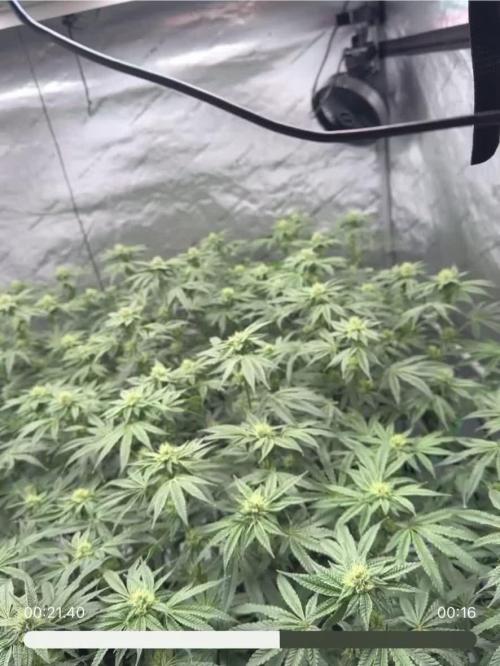
They are healthy and growing strong. Lowered EC slightly based on nutrient solution readings throughout week 4.

Likes
3
Share

@Vasilli_arg
Follow
Fue una cepa muy linda de cultivar, con un buen resutlado final, cogollos equilibrados, al haber 4 plantas se presentaron distintos fenetipos en cuanto a colores, una con aroma mas dulce que otra pero ambas bien logradas, estoy conforme con el tamaño, quizas en una carpa de 1c1 se hubiese trabajado mas comodo pero al haberlo hecho en un 80x80 logre coparla al 100%.

Likes
10
Share


@JiminyCricket
Follow
Been doing a lot of tweaking with the new gear and multiple sets of plants. Been quite a busy week and probably behind a bit on keeping track of everything. I'm currently working on trying to get better charts made to keep track of things like light schedules, detailed feedings, height change per day, etc.
My current setup is my oldest 1st set of plants (5plants) and my 3rd set (6 seedlings), in my new 4x4 Vivosun grow tent equipped with a Spider Farmer SF-1000.
I have kept my 2nd set of plants (4plants) in my original 4x2 Vivosun equipped with 600W Vivosun LED. These plants had been extremely stressed due to not having soil or containers available with shipping constraints. They've been doing a lot better since then and I'm hoping they make a full recovery. Fingers crossed!
Running 24hr light schedule.
Both tents equipped with temp/hygro high and low ranging from about 71-81°F with an average of about 78°F.
Watering by plant pot weight, according to GH FloraTrio + CalMag Schedule.
Mild LST via tucking of leaves blocking developing sites. No more than 3 leaves removed per plant, per day to avoid stress.
______________________________________
Can't wait to start upgrading the quality of my journals and to hear you all's feedback! Happy growing and good vibes as always 🌱
______________________________________
4/29/20 - Update
Okeydoke! Feel like I've been doing too much running around everywhere. Sorry for being so hectic the past week or so if anyone has been keeping up with this 😂
For the time being, I'm currently running all three sets of my plants in my 4x4 tent. It's running all three of my fans, both lights and has the carbon filter system and humidifier hooked up to it as well. I basically have the other 4x2 just sitting as a shell for the moment. Either planning to save it for climate control when curing the first harvest or sell it to invest in another Spider Farmer SF-1000 LED or equivalent and possibly another 4x4 tent.
I have started a grow chart that's still a little sketchy but if nothing else having it here hells me keep up with it that much better.
[April 24th @ 3pm]
Plant 1- (11in.)
2- (9in.)
3- (14.75in.)
4- (13in.)
5- (10.75in.)
[April 26th @ 1:30pm]
Plant 1- (11in.)
2- (9.5in.)
3- (18in.)
4- (14in.)
5- (11.5in.)
[April 27th @ 12pm]
Plant 1- (11.5in.)
2- (10.5in.)
3- (20.5in)
4- (15.25in.)
5- (11.5in)
[April 29th @ 4am]
Plant 1- (12in.)
2- (10.5in.)
3- (23in.)
4- (16in.)
5- (11.75in.)
[April 30th @ 3:30pm]
Plant 1- (12.25in.)
2- (10.5in.)
3- (25.75in.)
4- (16.75in.)
5- (12in.)
______________________________________
The most current batch of nutrient mixes for was made this morning about (2am 4/29/20) for the 1st and second set of plants.
The first set of plant's nutrients was made to 4gal of water. The mix is a ratio of
(Cal-Mag/GHMicro/GHGro/GHBloom)
It's mixed (for the 4gal) in order; 10mL, 5mL, 10mL, 10mL.
440ppm @ 98.5°F
890EC @ 2.2°F us/cm
This new nutrient mix was applied for the first time tonight and will run about a week. I'm running a bit behind according to the GH schedule I was following due to stunting the growth I felt like over a couple issues to where I have them an extra week of veg nutrients. As I have defoliated them and they have seemed to take it pretty well, I'm hoping the increase in bloom nutrients will kick the buds into overdrive for production and the plants will start to thicken up again.
The second mix follows the same order as the first set in regards to nutrient usage. This mix is only mixed to one gallon. It as follows; 2.5mL, 2.5mL, 1.25mL, 2.5mL.
500ppm @ 98.6°F
992EC @ 0.4°F us/cm
This is mostly following the same GH nutrient schedule as the first set only about 2 weeks behind. These plants suffered from being in too small of containers for too long and I believe this stunted their growth. I've had them in suitable new containers for a couple days now and hoping this new mix of increased nutrients will bring them back to life a bit and get them back in schedule.
I'm honestly not too sure still about the ppm and EC numbers but a few bud-dies have mentioned that it plays important roles in plant health. So until I can better research good numbers and how to control it for my set up, I'm at the very least trying to keep track of the data.
I apologise about this large chunk of text! I hope you enjoy the diary anyway in spite of the fact. I'm loving the look of the buds and everything seems to be going great. Only a few months to go! 😎


Likes
36
Share


@brownbae420
Follow
Day 42
- Nutes mixed and fed
- Have a bug to remove - awaiting Petratools Fogger
- Preflower is happening now
- Vibe: 😅
Day 44
- Ladies looking a bit droopy and sad
- Nutes given
- Most likely week 1 of flower for Gorilla Cookies and Wiz Stash Remix
- Vibe: 🍃😩🤞🏽🙏🏽
Day 46
- After advice provided from @GrowingGrannie & Others, I watered with purpose
- The really sad Gorilla Cookies took the most water, and was in fact dried out
- Did not see praying for at least 24hrs, but did eventually see praying in the top portion
- As well as lifting of the lower leaves from a curled position to a straighter position
- Vibe: 😰
- Readings
-- Lights 24/0 - Level 9
-- Temp: 70 (ideal) | 66.9 (avg)
-- Humidity: 55% | 53.4%
-- VPD: 0.8 | 1.03 kPa
- Vibe: 😳
"Persistence and resilience only come from having been given the chance to work though difficult problems." — Gever Tulley

Likes
6
Share


@ChewiestEndZa
Follow
This week saw an influx of flower sites all over the plant, cannot believe how many flower sites this girl started yielding!
Did some HST previous week and had wrangled the stems to create knuckles by breaking cell walls and forcing them to become thicker.
Pics of recovery and knuckle forming.

Likes
46
Share


@MrJones
Follow
OSS Sherbet Moonrocks
🔹⊱╮🔹╰⊰🔹 GROW Started 03.10.24 INFORMATION 🔹╰⊰´🔹⊱╮🔹
🌞Environment - Maintaining 80F and 65%Humidity
🌾Training - The girls are recovering from last week's Pruning and Defoliation,
⚱️2-Gallon 📊6.2 PH
💧 Feeding - Using Horti Bloom and Horti Cal 12-0-0
🌞Medic Grow Smart 8 760 Watts
🕷️ IPM - CannControl from Mammoth and Mosquito Bits as needed
🔹⊱╮🔹╰⊰🔹 PLANT UPDATES 🔹╰⊰´🔹⊱╮🔹
📝 Notes - On 🗓️05.11.24, This week, we are on Auto-Pilot and just Fertigating as needed; the ladies are stacking up nicely, and the leaves have grown back. I am not sure if it is the genetics or the new nutrients; I would like to see less and will evaluate if more defoliation will be needed.
📝Fertigation injects fertilizers into an irrigation system to supply dissolved nutrients to crops.
🗓️05.11.24 Just feeding daily, sometimes twice; today, fed with Hort-Bloom @ 2.7 GRMS Per Gal and Horti-Cal @ 2.5 GRMS Per Gal.
🗓️05.12.24 Just feeding daily, sometimes twice; today, fed with Hort-Bloom @ 2.7 GRMS Per Gal and Horti-Cal @ 2.5 GRMS Per Gal.
🗓️05.13.24 Just feeding daily, sometimes twice; today, fed with Hort-Bloom @ 2.7 GRMS Per Gal and Horti-Cal @ 2.5 GRMS Per Gal.
🗓️05.14.24 Just feeding daily, sometimes twice; today, fed with Hort-Bloom @ 2.7 GRMS Per Gal and Horti-Cal @ 2.5 GRMS Per Gal.
🗓️05.15.24 Just feeding daily, sometimes twice; today, fed with Hort-Bloom @ 2.7 GRMS Per Gal and Horti-Cal @ 2.5 GRMS Per Gal.
🗓️05.16.24 Just feeding daily, sometimes twice; today, fed with Hort-Bloom @ 2.7 GRMS Per Gal and Horti-Cal @ 2.5 GRMS Per Gal.
🗓️05.17.24
╰⊰🔹╰⊰´🔹⊱╮🔹╰⊰🔹╰⊰🔹STRAIN INFORMATION🔹⊱╮🔹╰⊰🔹╰⊰🔹╰⊰🔹⊱╮
Introducing our latest powerhouse, Sherbet Moonrocks, one of our strongest weed strains to date, setting a new bar for potency and effect. A combination of US genetics, Sherbet Cake, and Purple Moonbow create this potent sedative with THC levels above 30% that will take you to celestial bliss.
An exquisite terpene profile offers a tempting treat of sensational fruity tastes, flavors, and aromas that will seduce your mind and body and take you to a serene place of pure tranquility. Ocimene, Caryophyllene, and Limonene are the predominant terpenes; they produce an incredible array of sugary berry fruit flavors with floral hints and spicy undertones.
Growing these feminized seeds is effortless and straightforward regardless of your growing skills, and at harvest time, you will be generously rewarded. Plants will mature to a manageable height with a flowering period of 65 - 70 days and will develop thick, dense buds glossed in thick layers of THC resin crystals packed with indica power that will lure into a deep relaxation. Expect an indoor yield of 600 - 700 gr m2 and outdoor production of over 1 kilo per plant.
Translate

Likes
49
Share


@Roberts
Follow
RSV11 was starting to get a little pale and lighter colored this week. I did a solution change today. She is starting to bulk. Colas are collecting some resin around the sites. Everything is looking okay at the moment. Thank you Terpyz Mutant Genetics, and Spider Farmer. 🤜🏻🤛🏻🌱🌱🌱
Thank you grow diaries community for the 👇likes👇, follows, comments, and subscriptions on my YouTube channel👇.
Thank you Happy Growing 🌱🌱🌱
https://youtube.com/channel/UCAhN7yRzWLpcaRHhMIQ7X4g


Processing
Likes
62
Share


@DudeGrowsWeed
Follow
Week 2 and the girls are looking more yellow and funky than I like. I also think the Baox clones may have died. So far the plants looking the best are the Cherry, Blackberry (one of them) and the baby NYC Diesel. I'm pretty sure my soil is just way too hot. I tried flushing it through, but that just seemed to lead to general overwatering issues. I'm planning on transplanting to larger pots with more neutral soil this weekend and hope that will help straighten things out.


Likes
25
Share


@Jimmy89
Follow
All looking happy, photos taken day 33 of flower. Never got around to defoliating this week, been locked in trim jail
I take the photos with the lights dimmed right down, not sure how some of you get such good photos..
Happy growing ✌️

Likes
13
Share


@Krautbauern
Follow
In our greenhouse there are about 40 degrees Celsius if the sun is shining…
I think its to hot for the Ladies
Lets see how they will get
Likes
10
Share


@Decimotox
Follow
Harvested the Lung Busters on day 64. Was seeing about 5% amber on all plants, which is what I personally prefer. Looking like this will be a great harvest! These branches were chunky, and especially LB#2 was suuuper stacked with nodes. Super excited for the trim jail on these and the Miami Mamis. Will post more pics of both strains when I trim! Will also have dry weight numbers when I trim. I don't usually weigh my plants wet.


Likes
46
Share

@Roberts
Follow
Drunken Bitch Slap is doing okay. Nobtrwining this week. I had to neem oil treat everything. I had a russet mite issue in neighboring grow room. Figured I would treat everything in vegging to be safe. She got her first solution change today. Not much else has changed. She is doing well under the Hortibloom Solux 350 light. Thank you Aeque Genetics, and Hortibloom. 🤜🏻🤛🏻🌱🌱🌱
Thank you grow diaries community for the 👇likes👇, follows, comments, and subscriptions on my YouTube channel👇. ❄️🌱🍻
Happy Growing 🌱🌱🌱
https://youtube.com/channel/UCAhN7yRzWLpcaRHhMIQ7X4g


Processing
Likes
12
Share


@BudConnoisseur
Follow
Week 3 of flowering and its smelling really nice in there and they’re definitely packing on weight and resin now, overall happy with my progress and both phenos of the Peyote Critical so far, no sign of nute burn or bug infestation/ mould or mildew so everything is going great :)
However my oscillating fan died as I don’t have pot tray for the lsd and gave them a big drink and she drained out everywhere in the bottom of the tent and destroyed the fan haha, oh well.
LSD still not looking as good as both the Peyote but hey, it might surprise me.
Until next Week! Start giving them pk this week so now the real fun begins....
Likes
6
Share


@Ninjabuds
Follow
My 2 permanent marker plants they are loving the light being turned up they are praying constantly there internodes are so close together they have not stretched out very far yet. I'm thinking they are going to be on the short end but who knows some plants do complete opposite when they hit the flower strech. I still have not gotten the nutrients down for the one plant I'm thinking when I flip to flower it will it will turn around nicely I love the shaoe and look of it's leaves.
The day has come and it's time to flip these ladies to flower. I was planning on letting them go untill Friday and let the smaller ones grow just a bit more but they will be fine. I have the eternity cup contest in mind and I'm thinking timing so I need to get these lady done and out my tent lol. This past week I turned the light up alot getting them ready to flower they have grown a bunch inhavendone lst maybe 5 it 6 times on the branchs and they arw nit bendy anymore that will help durring flower.
