


Likes
Comments
Share


@Roberts
Follow
I am starting a Strawberry Amnesia from herbies seeds. I have scuffed the seed ends, and placed it in water. I will place the seed in the rockwool once it is showing a tail. Thank you Herbies seeds, and Spider Farmer. 🤜🏻🤛🏻🌱🌱🌱
Thank you grow diaries community for the 👇likes👇, follows, comments, and subscriptions on my YouTube channel👇.
❄️🌱🍻 Happy Growing 🌱🌱🌱
https://youtube.com/channel/UCAhN7yRzWLpcaRHhMIQ7X4g


Likes
9
Share


@garchol
Follow
Getting closer but not quite there yet. Still looking for some more amber trichomes. At least the clear ones are becoming fewer while the amount of white ones raises. Buds are very thick now and the smell is amazing! After the daily trichome check the magnifying glasses smell deliciously sweet and creamy like blueberry ice cream. Gonna leave her in her normal light cycle until I‘m happy with the trichomes.
Likes
5
Share


@InsideAz
Follow
Week 3/6 veg:
1/1/25
Just watering and twisting/bending branches every couple of days. Not putting a lot of effort into training in hopes of creating taller plants within my 6 week veg timeframe. They are loving the slow release nutrients and the extra space for roots
Veg tea in a few weeks
Light at 40% but will be increased next week
Likes
9
Share


@BudXs
Follow
Super busy with a move and a big garden reno. Sorry, this is the only update for this week
Likes
5
Share
@Lvnsource
Follow
Bloom is approaching for this one, this week I’m going to focus on getting her well fed before flipping to 12/12 , before I’ll very likely grab a clone or two


Likes
18
Share


@Onlygrow99
Follow
Bueno pues el sábado 4 y el domingo 5 de marzo realice las defoliaciones y el lunes 06/03/23 puse las luces a 12/12 para inducir la floración.
Las autos ya estaban en prefloración hace 1 semana. Son 12 plantas en macetas de 7L con 44 días desde que se empezaron a germinar las semillas.
Uso la gama completa de nutrientes, Boom nutrients
Están bajo la luz del panel LED 780W ResinX de GBLIGHTING
Pretendo poner una malla de scrog y en floración avanzada otra, para sujetar todo bien.


Likes
4
Share


@Ultraviolet
Follow
0.23v tuned to 7.83Hz Plants exposed to the Schumann resonance often show greater resistance to stress factors such as drought, diseases, and pests. It is possible that these natural electromagnetic waves strengthen plants' immune systems and increase their ability to resist disease.
Pretty neat, in the afternoon when the tent hovers around 84F the plants are 🙏, can visually see in time around 10 minutes after I opened the tent the temp had dropped to 76 pressure was lost, she is still chilling but she doesn't quite have that perk anymore.
*Salinity3.5% - 100ml H2O=100g The concentration of salt in a solution 3.5%= 3.5g in 100ml.
Growing well. Not going to top or do any training, I'll let the plant do its own thing, she is constructing foundations now for what she senses ahead. Smart girl. ✨️ Let her, do her thing, let me do mine.
The voltage that is needed for electrolysis to occur is called the decomposition potential. The word "lysis" means to separate or break, so in terms, electrolysis would mean "breakdown via electricity. Green hydrogen is hydrogen produced by the electrolysis of water, using renewable electricity. The production of green hydrogen causes significantly lower greenhouse gas emissions than the production of grey hydrogen, which is derived from fossil fuels without carbon capture.
Electrolysis of pure water requires excess energy in the form of overpotential to overcome various activation barriers. Without the excess energy, electrolysis occurs slowly or not at all. This is in part due to the limited self-ionization of water. Pure water has an electrical conductivity of about one hundred thousandths that of seawater. Efficiency is increased through the addition of an electrolyte (such as a salt, acid or base).
Photoelectrolysis of water, also known as photoelectrochemical water splitting, occurs in a photoelectrochemical cell when light is used as the energy source for the electrolysis of water, producing dihydrogen . Photoelectrolysis is sometimes known colloquially as the hydrogen holy grail for its potential to yield a viable alternative to petroleum as a source of energy. The PEC cell primarily consists of three components: the photoelectrode the electrolyte and a counter electrode. The semiconductor crucial to this process, absorbs sunlight, initiating electron excitation and subsequent water molecule splitting into hydrogen and oxygen.
Water electrolysis requires a minimum potential difference of 1.23 volts, although at that voltage external heat is also required. Typically 1.5 volts is required.
Biochar, a by-product of biomass pyrolysis, is typically characterized by high carbon content, aromaticity, porosity, cation exchange capacity, stability, and reactivity. The coupling of biochar oxidation reaction (BOR) with water electrolysis constitutes biochar-assisted water electrolysis (BAWE) for hydrogen production, which has been demonstrated to reduce the electricity consumption of conventional water electrolysis from 1.23v to 0.21v.
Biochar particles added to the electrolyte form a two-phase solution, in which the biochar oxidation reaction (BOR) has a lower potential (0.21 V vs. RHE) than OER (1.23 V vs. RHE), reducing the energy consumption for hydrogen production via biochar-assisted water electrolysis (BAWE).
BAWE produces H2 under 1 V while eliminating O2 formation: key word "eliminating". Air with a normal oxygen concentration of around 21% is not considered explosive on its own; however, if a flammable gas or vapor is present, increasing the oxygen percentage above 23.5% can significantly increase the risk of ignition and explosion due to the enriched oxygen environment.
The addition of ion mediators (Fe3+/Fe2+) significantly increases BOR kinetics.
Air:
Nitrogen -- N2 -- 78.084%
Carbon Dioxide -- CO2 -- 0.04%
Hydrogen in homosphere H -- 0.00005%
Hydrogen "GAS" H2 in homosphere - 0%
"Nitrogen, oxygen, and argon are the three main components of Earth's atmosphere. Water concentration varies but averages around 0.25% of the atmosphere by mass. Carbon dioxide and all of the other elements and compounds are trace gases. Trace gases include the greenhouse gases carbon dioxide, methane, nitrous oxide, and ozone. Except for argon, other noble gases are trace elements (these include neon, helium, krypton, and xenon). Industrial pollutants include chlorine and its compounds, fluorine and its compounds, elemental mercury vapor, sulfur dioxide, and hydrogen sulfide. Other components of Earth's atmosphere include spores, pollen, volcanic ash, and salt from sea spray."
Although the CRC table does not list water vapor (H2O), air can contain as much as 5% water vapor, more commonly ranging from 1-3%. The 1-5% range places water vapor as the third most common gas (which alters the other percentages accordingly). Water content varies according to air temperature. Dry air is denser than humid air. However, sometimes humid air contains actual water droplets, which can make it more dense than humid air that only contains water vapor.
The homosphere(where you live) is the portion of the atmosphere with a fairly uniform composition due to atmospheric turbulence. In contrast, the heterosphere is the part of the atmosphere where chemical composition varies mainly according to altitude. The lower portion of the heterosphere contains oxygen and nitrogen, but these heavier elements do not occur higher up. The upper heterosphere consists almost entirely of hydrogen, cool.
78%nitrogen as N2, a far too stable bond to be used by organisms.
20%oxygen
0.04%co2
0.00005% hydrogen
When lightning strikes, it tears apart the bond in airborne nitrogen molecules. Those free nitrogen atoms N2 nitrites then have the chance to combine with oxygen molecules to form a compound called nitrates N3. Once formed, the nitrates are carried down to the ground becoming usable by organisms. Will it react with the oxygen in the air spontaneously, the answer is no. The mixture is chemically stable indefinitely. A mixture with air near the release point can be ignited, but if this does not happen then when its concentration gets below 4% it will be unable to carry a flame. Taking a small detour into chemistry here, a key concept to understanding the health impact of nitrogen-based compounds is knowing the difference between nitrates and nitrites.
What Are Nitrates and Nitrites?
A nitrite (NO2) is a nitrogen atom bonded to only two nitrogen atoms. Very strong bond
A nitrate (NO3) is a nitrogen atom bonded to three oxygen atoms. Weaker bond The optimal pH for nitrate (NO3-) depends on the process and the type of bacteria involved.
Nitrification
The optimal pH for nitrification is between 7.5 and 8.6
Nitrification is the process of oxidizing ammonia to nitrate and nitrite
Nitrosomonas has an optimal pH between 7.0 and 8.0
Nitrobacter has an optimal pH between 7.5 and 8.0
Nitrification ceases at pH

Likes
47
Share


@GrowGuy97
Follow
Day 7 - All 3 ladies are doing great so far, extremely excited to how they turn out! Watering with PH at 6.3, Temp 81 RH 55%
Thanks for following & happy growing friends✌️🏼🌱

Likes
6
Share


@Hemposapien
Follow
This is the first week of flower for Tropicana Cookies F2 and Terple. Really excited about this next crop. Thinking it'll be my best yet!


Likes
Comments
Share


@Dankmark420
Follow
Well we thought something was wrong with our white widow being that from one day to the other she was crooked and looking Ill.. so we cut her way before time.. BUT (bud hehe) after closer inspection it was a block of in the autopot.. so she prolly could have bounced back..


Likes
8
Share


@Creme_De_La_Creme
Follow
Last week before turning on the utopot system !!
She is loving the high EC, everything looking perfect around here !!


Likes
68
Share


@Zengrower
Follow
Hey growmies, the Mimosa Orange Punch ladies are looking better by the day ✌️ The late bloomer is picking up speed and growing beautiful big buds. The other two plants already have massive colas and starting to color to nice purple pink shades.


Likes
2
Share


@Giftedwithgab
Follow
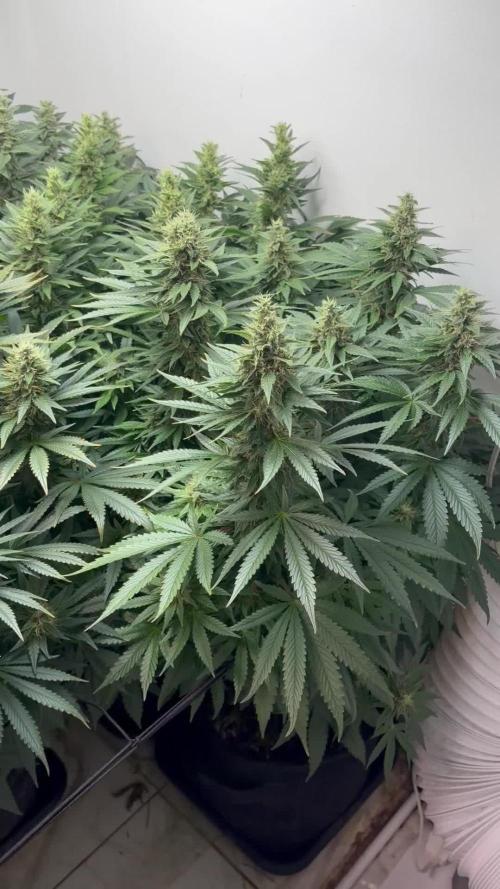
Week 7 was on auto pilot until I realized it was 1 more plant to transplant. Since I got to transplant(work), every plant went to the hair salon(LST, Defoli, Fiming). My first time and I must admit I regret it. 😅 my plants look naked, I felt bad so I added Kelp into the NUTE line up....... I have no idea what I'm doing but I'm doing it at 150mph.


Processing
Likes
43
Share


@DKBJJ
Follow
Defoliation complete. These ladies got a little spank this morning. But they always respond well after. They are ready to Flower now.
First long hours of lights off have commenced...I am counting up to 20 colas per plant on the 3 Cali OG Amnesia Haze X and 10-15 per plant on the Blue Cookies going into this.
This will only increase in the coming weeks due to defoliation that was just done.
I have been aggressively LST training and defoliating every day because of growth up to this point.

Likes
6
Share


@StoneyNugs
Follow
6/7: Topped off buckets and adjusted pH to 6.2
6/8: Topped off buckets and adjusted pH to 6.2
6/9: Light top defoliation of the canopy, topped off buckets and adjusted pH to 6.2.
6/10: Topped off buckets and adjusted pH to 6.2
6/11: Lollipop undergrowth, Topped off buckets and adjusted pH to 6.2
6/12: Topped off buckets and adjusted pH to 6.2
6/13: New DWC Buckets, adjusted pH to 6.2
