


Likes
Comments
Share


@Bluemels
Follow
Tag 18: Umzug in eine 2. Growbox.
Tag 19: Die Sorte scheint recht groß zu werden, ich behalte daher nur eine Pflanze.
Tag 20: Die Pflanze ist in die Blüte gegangen.

Likes
4
Share

@El-Goki
Follow
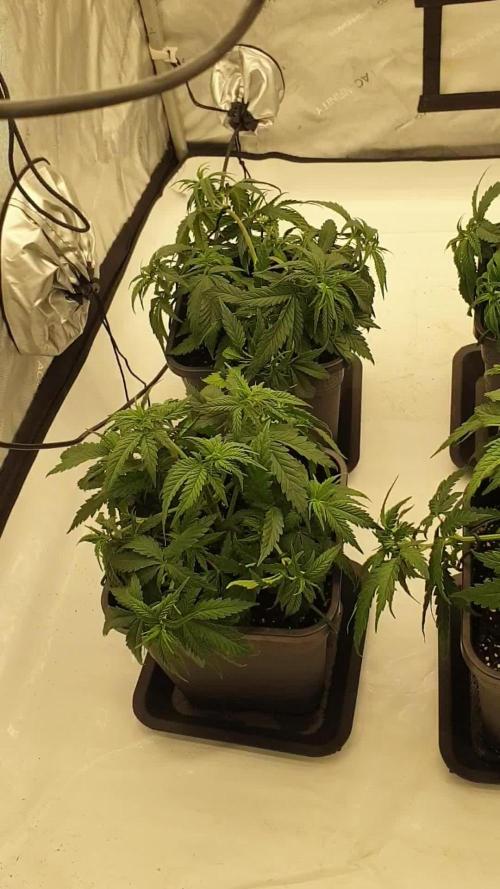
Vor einer woche habe ich alle pflanzen getoppt , und heute wurde zum ersten mal LST gemacht , normalerweise fange ich viel früher an aber diesesmal wollte ich es anders probieren, Dazu wurden die babies leicht entlaubt.
Jede 10 tage habe ich mit 1g/l recharge von realgrowers gegossen, sonst jede 2-3 tage mit 15% des topfvolumen gegossen.
Die ässte sind jetzt schon klebrig und die pflanzen duften leicht.
Bis jetzt alles problem und reibungslos :)

Likes
1
Share


@EUROGROW
Follow
Yuh*Yuh good week for the girls ! Added two Co2 bags and switched the lights to 12/12 yesterday. Let's go !

Likes
11
Share


@Marianolst
Follow
White fue trasplantada hace 2 semanas y va muy bien.
Las lluvia no han dejado que riegue.
en 2 días se pone fertilizante y se sigue con el LST.
38 CM alto
79 largo

Likes
23
Share


@GrowGuy97
Follow
Started flushing the biggest plant today the should have about another week & half left on it, all the other ones are still clear & cloudy! Fingers crossed everything goes good through harvest I have never flushed or done any of the harvest or cure process😅😬


Likes
1
Share


@RezaM
Follow
Everything was going well in the first week, but unfortunately, a mistake caused stress in the plant. The distance between the lamp and the plant was too short. This week, I gave the plants a small amount of root growth stimulant
Likes
96
Share


@DogDoctorOfficial
Follow
Greetings, fellow cultivators! Week 10 marks the zenith of our incredible journey with the Big Cheese Auto, and it's like witnessing a grand finale in a botanical symphony. A heartfelt salute to Seeds Mafia for the genetics that have led us to this captivating moment.
Our green queen is gracefully fading into the final chapters of her life, akin to the changing seasons. The Autopot system, our faithful companion, has been the guardian throughout this journey, ensuring a nutrient dance that sculpted the masterpiece before us. It's like the closing act of a green odyssey.
As we approach the grand finale, all additional feedings have come to a serene end. Our Big Cheese Auto is now sipping pure water, a gentle transition as she readies herself for the final curtain call. It's like allowing the plant to gracefully bow out, showcasing the culmination of her life's work.
The transformation is mesmerizing! The colors are shifting like the changing leaves of autumn, a poetic reflection of the plant's life cycle. It's like witnessing nature's artwork unfold, with hues of green, purple, and amber blending seamlessly. Each leaf tells a story, a testament to the plant's resilience and the seasons it has weathered.
The trichomes are now a sparkling crown, each one a testament to the plant's potency. Their production, color, and shape are in perfect harmony, signaling the imminent harvest. It's like a field of glistening diamonds, a visual ode to the journey we've embarked upon.
As a prelude to the final act, all feedings have ceased. Our Big Cheese Auto now drinks pure water, allowing her to express her true essence in these concluding moments. It's like letting her compose the last notes of her botanical symphony.
A profound thank you to Seeds Mafia for entrusting us with genetics that have flourished into this spectacular finale. Aptus Holland, your nutrients have been the invisible hand shaping this journey. Grow Diaries and the community, your support has been the heartbeat of this horticultural tale.
As we stand at the threshold of Week 10, the sense of accomplishment is profound. Our Big Cheese Auto, though reaching the end, leaves behind a legacy in vibrant colors and trichome-laden brilliance. It has been an honor to witness and share this remarkable journey with you all.
Let's continue to cultivate greatness together but first lets see how this one ends !
Genetics -Seeds Mafia Big Cheese Automatic
Light - LUMATEK ZEUS 465 COMPACT PRO
Food - APTUS HOLLAND
All info and full product details can be find in can find @
https://seedsmafia.com
https://aptus-holland.com/
https://lumatek-lighting.com/
As always, thank you all for joining me on this journey, for your love, and for it all. My horticultural odyssey would never be the same without you. Your love and support are cherished, and I feel both honored and blessed to have you in my life

Likes
49
Share


@masterofsmeagol
Follow
6/1 I'm anxious to get my plants in their final homes. Another 90 degree day today and then it will be cooling off with some showers. I plan to take advantage and utilize that to make the transition. I have some small burns on a couple plants bit considering the weather we've had its nothing. Temperature swings 50 degrees. I hope these girls do OK outside. I was tired and stoned last night and I accidently topped a plant I had already FIMed. Oh well. Transplants soon. Supports screwed in after the heat. Plants have been handling this weather like a champ. Big thick healthy stalks.
UPDATE PUT THE PLANTS IN AROUND 730. Cutting down on light hours I'm poverty close to where we are. It was 95 today. Plants have suprisingly little burning. My fan was taken so they go without that tonight too. In the next few days it's going to cool down and that's when I'll transplant. Only thing left before transplant is sanitizing trellis and supports. Easy peezy. Especially if it's supposed to be in the 50s. And people dent climate change lol. I'm hoping that all this adversity makes my flower a higher quality. I'm glad to have the quantity to pick the best phenos for the BIG POTS. Im trying to stay excited but it's just so dumb hot. Oh well. If the plants can do it so can I. I'm planning to give them some kelp me kelp you next watering and may start some light organic nutes.
6/2 Phone doesn't like uploading my videos. Broke record high temp yesterday 95 and tomorrow we will break the record low 50. Plants withstood the heat well and are doing great. Transplant soon. They were a little light but I held off on the water. Plan on it tomorrow. May transplant tomorrow. I have several videos that haven't uploaded. I thought they did but I was wrong. Oh well.
UPDATE: Forgot to water. Some were light and others could've held off. Did the half a powerade bottle ahain. A litt ke less on the heavier ones. However I'm looking to transplant into final homes tonight and into this weekend. I sanitized a fifty and a forty so my bags and two pots are sanitized. Cage is sanitized and ready and pallets are sanktized and in place. The 40 and 60 fit PERFECT in the small space left from the pallets. Plus the plants always lean the opposite direction so things should go smooth. Only thingvleft is sanitizing stakes, bamboo, plastic garden stakes and all the other plastic training stuff. I'll just soak it while I transplant. Gotta mix the soil first too though.
UPDATE. Heat went higher than expected and hit 90. I figured I'd go back around three and screw in suppirt stakes and begin getting everything ready for transplant (i.e. supports, mix soil, sanitize trellis) before I transplanted tomorrow MORNING was what I had planned. Unfortunately we got a huge thunderstorm with a shot ton of rain and it's gonna continue throughout the night. I think this is God's way of telling me to take a break. I can get up early and get those support stakes screwed in. Then when I get back from the wife's doctor's I can do the transplants. I'm trying to break the labor up into manageable chunks. Looking at my other diaries I can see that my plantscare fine in their three gallon homes. It'd a little disheartening seeing such big clones that I started so much earlier on the other diaries. However I always was fighting SOMETHING (usually more than one thing) and last year was a shit show. At least this year I stay away from anyone else's cannabis any clones and I'm extremely cautious. I've seen my cousin out perform me multiple times with healthy plants like this I'm excited to see how it goes. I really needed the break anyway but tomorrow morning the stakes will be in. Hopefully they'll be outside.
6/3 Broke the record for low days after breaking record for highs. I saw it 94 yesterday and the day before. On the way to my grow at 6am it was 44 degrees and it's not warming up much. Fifties at best. Rainy. I left the door closed. The big door on the otherside got opened as the other end of the garage neededcto he used. If the rain let's up I'm going to set up the grade stakes so I can transplant in the morning and throughout the day. I think I'm going to light dep a couple of them and leave them in the 3's. We'll see.
UPDATE: At 12:30 the temp today was 44. Yesterday it was 94. I can't believe this. Plants are doing great though and are in the garage under lights for the day. The BIG door was open part of the day. Didn't take any pictures (or even enter the grow area) as I sanitized the last 40 gallon pot and a bunch of grade stakes. I drilled the grade stakes to the pallets in the front. The first row is done. Just need to sanitize the plastic trellis itself and finish attaching the other grade stakes. I don't need the fill trellis up by transplant. I just need the bags to not knock over and have SOME support. I'll be back over there either to tonight to put more supports in or tomorrow when I actually plan to start transplanting. I'm getting excited. After dealing witb the stiff that I sanitized I didn't dare go fuck with my plants so I looked through the window. I'll finish sanitizing the net tomorrow. These plants look great. I'm wondering if doing the two diagonal I poles with zipties actually works. It would save me some kone for sure. I'll definitely update in the morning.
6/4 It's warmed up to a balmy 44 degrees. My plantsxare in the garage still. Weather sucks this whole week but after this heavy rain it should be perfect weather to transplant these girls. A little to chilly but it will warm up and I need to get this shit done. I'm trying to do to much at once. I need to just out dirt in bags and get them outside. I'm glad I waited until after this craziness. Breaking temp records for high one day then breaking it for low the next can't be good for the plants. I'll update what gets done today. I may mix soil or I might wait until tomorrow. It will let up some then. Plants still look fabulous 👌
6/5 50 degrees still raining like hell. Rain until Friday. Plants are inside under the onecworking light. Lots of indirect light through the massive windows though. I'm planning on mixing soil today and tomorrow and getting bags and pots half filled. Just trying to break the labor up into manageable pieces. It's probably a good thing I didn't put them in their huge containers before all this rain.
UPDATE: MIXED SOIL 1/3 of each (FOX FARM OCEAN FOREST, HAPPY FROG, AND ROOTS ORGANIC 707). I prepared I believe 11 containers for transplant. I need to sanitize two more containers and I'm good. I got a lot done. Might go back over. Set up extra cams too. I'm excited. Talked to my commercial buddy amd he motivated me. No reason my plants can't handle this shit. I've just had massive personal shit going on. Friday is the next GOOD day but these girls might go out earlier. I'm checking the forecast. I'll sanitize the other containers in the morning and fill them.
6/5 Today is usually my watering day but shit still seems heavy so I'm going to hold off. Despite that i need to transplant. I think they're wet enough. I could do it today. Plants are looking good and weather takes a better turn Friday. It's not raining hard though. It's just sprinkle right now. I may transplant some today depending on how things go. I'll keep the diary updated.
UPDATE: I went back over with the intent to just mix soil and let it acclimate. I decided to try to transplant one. I grabbed a 10th planet and started to go. I had done a bunch of manual labor already so i wasn't thinking. Of course the fucker was dry and didn't wanna come out ofcthe pot and the root ball pretty much decintigrated in my hand so I'm not sure how that will go. Tried again with the Blueberry Cheese Cake. I thought the roots just might not have been rootbound abdcthat could've been the case. After having another rough transplant I recognized I was tired, all the hard stuff is done and it's gonna keep raining until Friday. I wanted to transplant three and put them outside but with the wind and rain and the difficult transplant I let them sit under the light in the garage in indirect light. I had the doors open for a while. Should be open now but i don't want to have to go back over and shut it. Plus I'm not to keen on getting water on my light. Let's hope for a better day tomorrow. This was the only thing I had going good. Phrple punches are still behind. I've decided I'm oing to light dep ttwo of the plants in the 3 gallon pots. The two shittiest or smallest plants (probably purple punch will be light deped.
WENT BACK OVER AT FIVE AND IT APPEARS EVERYTHING IS ALRIGHT. WILL HAVE CHECK IN MORNING. Vid won't upload. Tried multiple times. I'll try again tomm.
6/6 Waiting for a doctor's appointment when I should be transplanting buy whatever. Everything is looking really good. Despite me disint9grating the rootball in my hands the two transplants look great! When I get back I'm planning to get some more work done. It's still lightly raining off and on but the door is up. I'm lettingvthe soil mix acclimate a little bit too. Hard labor is mostly done. Now the intricate part. Wish me luck. Not sure if it will be today bit I'm hoping.
WENT BACK OVER CAUSE IT WASNT RAINING BUT AS SOON AS I WAS CLOSE IT STARTED POURING SO THE PLANTS ARE UNDER THE ONE WORKING 150HPS AND THE AMBIENT LIGHTING FROM THE WINDOWS. TOMORROW IS TRANSPLANT DAY. I WONT HAVE A VEHICKE SO IT WILL BE TRICKY BUT IM GONNA MAKE IT HAPPEN. Opened doors at 530. Video still didn't upload
6/7 Still raining. It's off and on and a nice rain though. It's 53 degrees at noon. I transplanted two 10th planet's into 20 gallon pots. I transplanted these two a little differently. I put the bags in there final spot I side my cage andctransplanted in the misting rain. The first one came out and seemed to be heavier on the bottom and broke off. I tend to "throw" them in the hole before they collapse. With my anxiety I suck at transplanting. Plus these plants haven't filled the 3 gallon pots with roots yet but i want hem in their final homes and its time to go outside. I transplanted the other two plants indoors and let them have days in the garage with the door open and the light on then protection from the elements at night. I've been doing this for awhile. They would all be outside if the weather wasn't so shitty. This rain is supposed to stop. I'm curious as to what will be the fate of the two plantsci transplanted and left outside. I'm praying and hoping for the best. I also put my back tarp up so I have a wind break between rhe buildings. I stopped working because I didn't want to fuck anything up. Anxiety disorders suck. TOOK A BUNCH OF VIDS BUT THEY WONT UPLOAD. GOES FROM 9% TO 65% BUT ALWA7S TURNS RED "FILE FAILED TO LOAD". I'LL KEEP THE DIARY UPDATED. ESPECIALLY IF I GO BACK OVER. WAS ABLE TO LOAD A COUPLE VIDEOS. I GUESS ITS NOT AS BAD AS I THOUGHT. AT LEAST I HOPE. WENT BACK OVER AT 3 AND CHECKED THINGS OUT. THE TWO REXENT TRANSPLANTS I LEFT OUTSIDE SEEMED TO BE IMPROVING. DESPITE THE FACT I DUMPED A SHIT TON OF SOIL ALL OVER ONE OF THEM. IT SNAPPED A LITTLE BRANCH CLOSEST TO THE SURFACE. ITS STUFF I'LL REMOVE ANYWAY BUT STILL. IM REALLY CROSSING MY FINGWRS AND PRAYING THESE GIROS WILL MAKE IT. With everything i have going on tjis is my respite.IM GOING TO TRY TO SEE WHAT I CAN ACCOmplish TOMORROW. SOME OF THE PURPLE PUNCHES ARENT READY FOR TRANSPLANTING THOUGH. I ALSO ADDED TEO TARPS TO THE CAGECTO COVER THE WIND TOWER BETWEEN THE TWO BUILDINGS. THIS IS GOING TO BE A GOOD YEAR! Shut the door at seven. For some reason the two 10th planet's I transplanted (that fell all over the plant and I thought mightve broke it) look awesome lol. Despite the ridiculous pouring rain. It's going to let up soon and we are do fir some good weather. I'm trying to get everything (that isn't getting light depoed) into the cage. Four transplanted. Ten (I mean 8 more) to go.


Likes
23
Share


@BB_UK
Follow
This week has had amazing results, she was already growing at a fast pace and then started her pre flower stretch yesterday! She was first up and oh my does she show it 🙌🏽 She’s the example to the rest as they catch up to her vigorous desires to be “BIG bigbig VERY big bigbig” lol hope you’ve all had a great weekend BB_UK thank you for stopping by please hit that like button as it won’t hit itself 😉 thank you buddies appreciate you all


Likes
2
Share


@MT_Farmer
Follow
As this will be the last time I defoliate I took away quite a few of the leaves. Maybe a little too many as most guides reccomend not taking more then 30% of the leaves in a single defoliation


Processing
Likes
10
Share


@Dunk_Junk
Follow
Day 63 - Flowers just starting. They're looking nice. Through the week I've chopped quite a few leaves off her to allow light penetration.

Likes
16
Share


@PoshGrow
Follow
Welcome to Ultimate Auto Grow by PoshGrow!
🍀 Week #9 2020 October 26th. - November 2nd.
General Info:
When planted: 2020 September 1st.
Week: 9
Days: 56 - 63
Last Update Day: 2020 October 29th.
Plants:
4 x OG Kush Auto
3 x Amnesia Auto
5 xAlaskan Purple Auto
2 x Blueberry Auto
1 x Northern Lights Auto
Total: 15 girls.
NOTICE: Check week 1 for full equipment list!
UPDATE: I got 8 ltr. Or 2 gallon Spear&Jackson Pressure Sprayer to help me with watering.
Comment:
Hey guys! This whole week was tought, I think I fucked up with nutriens or schedule or both. Some of plants doesnt look happy, I can see some deficiency signs and in the other hand there are some excess signs too. I think Ill flush them and start over again this time triple checking everything.
Also seems that OG & Amnesia with Blueberry will be ready in few weeks., so flushing process begins on them till the end.
Stay tuned and happy growing! ✌️

Likes
9
Share


@FrostyCloudzz
Follow
First own legal grow 2024
26.Oktober
SpiderFarmer 90x90x180, SF G3000 (komplett Set)
Advanced Nutrients Starter Kit + ph perfect grow,bloom,micro
Biobizz lightmix
Jiffys
Samen im Glas circa 14 Stunden in Growbox und Dunkelheit vorgequollen danach in vorbereiteten Jiffy eingepflanzt.
Lampe leuchtet, Parameter im Norm.
Ab und Zu Box ausgelüftet zwecks Luftfeuchtigkeit.
Abwarten .
20 Stunden vergangen nächste Kontrolle (22:30)
27. Oktober 9:00 Uhr circa.
27. Oktober
4/5 Samen haben das Licjt erblickt alles super bis jetzt … Samen 5 kommt
wahrscheinlich auch noch (hoffe)
Parmaeter super zur Nacht auch
28. Oktober
4/5 weiter gewachsen , sehen gesund aus strecken sich Richtung Licht / Stufe erhöht etwas .
29. unverändert / weiterer Wachstum
4/5 / gebe ihm noch Chance meine 5er wird noch kommen. Fruchtigleit und Temperatur ist super / war ganzen Tag im spätdienst… alles lief gut soweit :)
umgetopf in 5 gallon Töpfe in biobizz light mix
30.10-02.11 Progress update coming
Likes
8
Share


@pzwags420
Follow
On day 1 I did another light defoliation. The plants are progressing as expected. The only issue I'm dealing with is fungus gnats... ugh. I will keep applying BTI weekly until the population is under control. On day 3 the plants are putting out more pistils and seem to have stopped or slowed down their "stretch" phase. On day 4 I'm starting to see some trichomes forming on the sugar leaves, no smell that I can discern yet. I also changed out my reservoir and applied a BTI soil drench. On day 5 I adjusted the PH of my reservoir down to 6.1. I also purged my blumat system to make sure there are no clogs as my reservoir has fertilizer particles due to my water heater causing separation. I must keep the water heater on as I am growing in the northeast coming into the cold time of the year and can't have my reservoir freeze on me. On day 6 I adjusted the PH of my reservoir down to 6.1. On day 7 I adjusted PH in reservoir to 6.1.
Likes
10
Share


@MadeInGermany
Follow
Harvest day 66
since time switch
to 12 / 12 h
Hey guys :-)
Finally it's time 💚
The lady is done the large leaves have been removed and hung upside down to dry in the dark drying room.
You can now stay there for 13-15 days at a temperature of 18-20 degrees and 55-62% humidity.
After 13-15 days it is neatly trimmed by hand and placed in jars with boveda packs 62.
After 4 weeks Boveda 58% come in and are ready for testing ;-).
After everything has been cut cleanly, the last update comes with the smoke report and the finished pictures.
Let's get to the plant 💚
Very nice phenotype with an extremely good smell.
Growth was normal after the initiation of flowering.
Looks beautiful with its jagged leaves 😃.
As always, the Green House fertilizer did a very good job and I can only recommend everyone to try it out🚀
Have fun and stay healthy 💚🙏🏻

Likes
15
Share


@Northern_Ent
Follow
June 7: This plant is growing fast. Lots of foliage building up inside the centre of the manifold so I cleared that out a bit. Adding more bamboo cross pieces to further open it up.
Check out coyowolves howling at dusk in video.
June 10: four inches of vertical growth in three days. 👍
