


Likes
Comments
Share



Likes
29
Share


@GrownwithLED
Follow
The MAC from TROPICAL TREES Seeds was the smallest plant in the tent, but harvested a surprisingly good 60,5 gram of dried bud. She was healthy all thru the cycle and had a BEAUTIFUL PURPLE FADE during flowering. The head-bud was insanely frosty and glistening with trichomes....VERY BEAUTIFUL! Her nugs are very compact and dense....simply DANK!


Processing
Likes
6
Share


@Smokwiri
Follow
Well, I've been comparing this with similar strains, untill now, i think she sugar kush is less profitable when using LST, but it works good, and the plant is nice and low
Likes
54
Share


@RastaGrow
Follow
Привет привет друзья как дела как настрой ??? Ну вот и долгожданный репортаж от Раста ;) неделя прошла без изменений, как обычно всю неделю поправлял ветки от 707 показывал им как надо и в какую сторону им надо развиваться, в переди ещё 3-4 недели и я уже думаю чем мне закрепить ветки так как на этом этапе шишки уже очень тяжело. А ещё они только набирают вес и силы 😍😁


Likes
43
Share


@Indica_Jones
Follow
aDiese Woche war entspannt ich konnte schön ohne Probleme meinen Babys zuschauen wie sie dicker werden :) Der Geruch ist sehr angenehm und lässt mich träumen :) bisher entwickeln sich sie Blüten sehr schön ab nächste woche kommt Phosphor Plus und Bopost hinzu ab da müssten sie in die Breite explodieren :) mittlerweile werden alle 3 Tage 200 L Wasser auf die vier Babys verteilt ! DIe Sonnensegel entferne ich auch fortlaufend :)

Likes
250
Share


@Ju_Bps
Follow
Hello my friends 👨🌾👩🌾👊,
Week was good with nice sun🌞🌞, a bit too much but plants looks good,
No rain,
I've found again lot of bugs on the #2 today.🤬🤬
Plants drink a bit more💧💧, cause hot temperature, next week will be very hot around 40°C 🔥🔥.
I've given this week,
#1 and #2
1× 1.2l water + canazym + sugar royal
1x 1.2l water + tera flores + canna boost
#3
1x 1.5l water + canazym + sugar royal
1x 1.5l water only
1x 1.5l water + tera flores + canna boost
PH@6
Pistils are more and more orange/brown, end is coming ✂️
Sorry not much pics this week I was a bit more busy.
See you next week, and wish me not a big storm 🌞🌞⛈️⛈️ after this hot temperature 🔥🔥

Likes
8
Share

@Philhsy
Follow
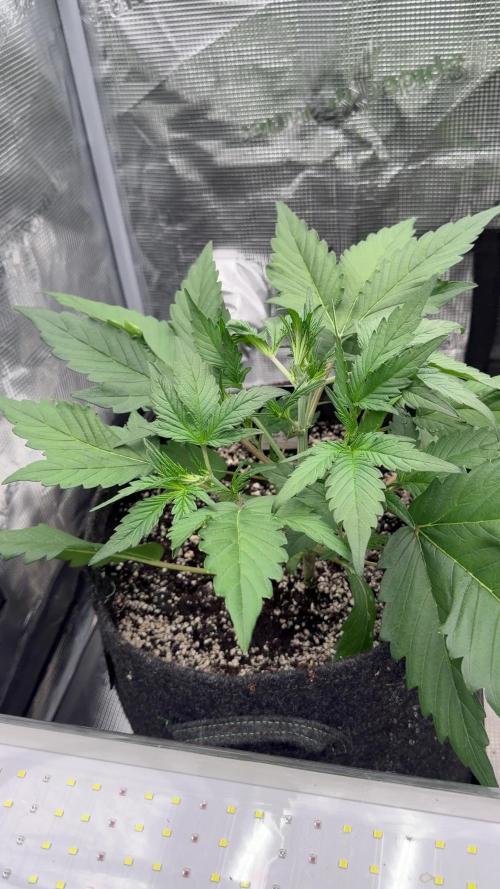
🍬 Guava Runtz Auto – Week 3 Update
Week 3 and Guava Runtz is making great progress! 🌱
This week she received a light feeding at around half strength, and the plant has responded exactly as hoped. Growth has remained steady, the leaves are a healthy green, and new shoots are developing nicely throughout the canopy.
The structure is becoming more defined each day, with strong side branching and a compact, bushy shape that should set her up well for the upcoming stretch. No signs of nutrient stress so far, which is always encouraging when introducing the first feedings.
Overall, everything is right on track. The roots appear well established, growth is accelerating, and the plant is showing the vigor you’d expect from quality Fast Buds genetics. Looking forward to seeing her transition into flower and start showing off those famous Guava Runtz traits. 🍬
So far, so good—healthy growth, happy plant, and another successful week in the garden! 🌿💚

Likes
56
Share


@Prilyfe13
Follow
May 17, 2024 Day 92
This is the last week of the Flowering phase. I'll be harvesting most likely next midweek or earlier. The goal is to harvest by the end of the week, but I don't think they will be done.
Banana Purple Punch A looks amazing! Her branches are nice and leaning. Not too much, just enough. She's also starting to show signs of fade. Or at least unhappy leaves turning yellow. One weird thing I noticed is the back leaves all have signs of nitrogen toxicity. What's weird is that I haven't used nitrogen in over a week and the last time I used it, I did a quarter dose. This should not be happening. I'm confused.
Other than that, it's the end and I'm not worried about it, but it's still weird. Any insight?
Banana Purple Punch B looks great as well. Tons of orange pistils and lots of frost. What's nice is that a lot of that frost is still clear trichomes. Imagine what they will look like in the end. I'm so excited!
Both plants still have water in their basins, so I'm going to let them drain out and most likely not water again. It should be about a week for them to dry out completely. Perfect timing for harvest.
I may put Banana Purple Punch A in a dark period while Banana Purple Punch B finishes up for a couple days. I'm doing the same thing with my Tropicana Cookies.
Lighting. Well, it hasn't changed. Lol. Duh. Hahahahaha. Another week of this light intensity.
I've all but given up on the environment. It's got tons of airflow and lots of light. The temp is fine. It's just the damned humidity. I give up. I'll just keep removing the plants from the tent as need be.
I didn't touch Banana Purple Punch A today though. She is propping up the last Tropicana Cookies for the next 2 days. I will however, make sure to inspect her as much as I can. And as soon as she is freed up, I'll be flipping her around. And pulling her away from the side of the tent. Same with Banana Purple Punch B. Both are squished for the moment.
I also managed to get all 4 Sour Diesel plants in the tent after pulling one of the Tropicana Cookies. So these ladies are a bit tight for now. But only for a couple of days. If that. I was considering putting the Sour Diesel in the back and keeping the Tropicana Cookies up front for ease of access, but that will just cause chaos with bendy floppy branches. So I'm leaving it. It all fits. Snug as the Tetris skills I had to use to make it happen.
Grow System Environment:
Temp: 76.4°
RH: 61.4%
VPD: 1.17 kPa
Quick update on lighting:
I had to increase the light power up to 80% for the Sour Diesels now in the tent. They were at like 16 mol/m²/d instead of the 20 to 25 mol/m²/d it should be. Anyway, so the light was increased. It didn't change much. Some spots went back up to 40 mol/m²/d, and some went up to 38 mol/m²/d. Overall the spread is 34 to 40 mol/m²/d. These 2 should t have any issues with the light increase. I wonder if it will help along the maturing process. I don't know science. Maybe the dark does? Maybe they both do and just in different ways. Yah, that's it.
May 18, 2024
Watering day. Both ladies got a full gallon reservoir refill of plain water today. No sense in running the Flawless Finish anymore. They have mere days left to maybe a week. I'll just keep extending the time until I'm right. Lol. Hopefully it will be the last watering. Neither plant is thirsty at all, so it should take around a week for the reservoirs to empty.
Banana Purple Punch A looks great! She is nearly ready. No fade yet though. I don't really understand. Is she not fading because she isn't done yet? Or is this just how it's going to be? Insight? Lol.
Banana Purple Punch B is coming along nicely. I don't think she is near done yet. I don't get why they are taking so long. Either way, when she's done, there will be some amazing bud.
The light isn't hurting anything that I can tell. So it will stay the same.
The environment is an absolute mess now. With more power to the light comes more heat. Now I'm stuck in the mid 60s for humidity and 78° for the temp. All bad. I've been checking each plant for mold, mildew, bud rot and anything else that doesn't look right. So far we're safe.
Grow System Environment:
Temp: 75.4°
RH: 64.2%
VPD: 1.06 kPa
Can you say horrible environment? I'm so screwed. Even if I don't get any issues like bud rot, the humidity is doing a toll on trichome production.
Update: After some research, I have found that high humidity can cause plant production to slow down significantly. That could be the problem I'm facing right now. My humidity is entirely way too high and the plants aren't able to take in water. And some other science I'm sure.
Also, I've noticed the leaves on Banana Purple Punch A are really shiny and clawing just like nitrogen toxicity, but I'm in the second week of plain water and flushing agent. What gives? If anyone knows, I would greatly appreciate a comment or a DM. Thanks!
May 19, 2024
Not a lot to do today. No watering or trichomes.
Banana Purple Punch A is being weird with this nitrogen toxicity during flush. How would that work? Anyway, her leaves are starting to die off a little but no fade. Still, she has huge buds that smell wonderful.
Banana Purple Punch B is starting to show a bit of color in her leaves. Just a hint of purple but just a hint. If she fades, it won't be for a bit.
But it's time I don't really have. Let's hope she starts to fade quickly. Both have been in plain water for a week and before that a week of Flawless Finish. Must be more nutrients in the soil.
Nothing to talk about with lighting. We all know where it's at.
The environment. I'm really confused. So a week of high humidity and my room is also humid. Today, it's low humidity and my room is still high. Even with the door open from outside it's still high. Why? What sorcery is this? Anyway, the tent is still stuck at 65% humidity and temps are down to 73°.
Grow System Environment:
Temp: 72.5°
RH: 68.3%
VPD: 0.84 kPa
May 20, 2024
We are starting to fade! Finally! Both ladies are starting to fade in their own way. No watering today. They definitely don't need it at all. Maybe a half gallon before the drying period.
Banana Purple Punch A is fading in her own messed up unhappy way. Her leaves are super shiny and clawing like she has nitrogen toxicity, but she's flushing. I don't get it. Leaves are canoeing and turning yellow. Maybe this is her fading in the most messed up way. But she's fading. Some of her leaves are starting to get a purple hue. Her buds are super fat and stinky. It's wonderful.
Banana Purple Punch B is the picture of a perfect small plant. She is fading like a normal plant. She's getting purple hues on her leaves, buds are developing purple as well. By the end, I hope to have a couple deep purple plants. I'm still wondering why it's taking so long. They should have been done weeks ago.
The lighting is the same.
The environment is the same. Although, it dropped to 40% outside yesterday and the humidity stubbornly stayed in the mid 60s. It makes no sense. Anyway, I'm stuck at 65% still and the temp is finally under control again. I have it a bit low for the last bit of flowering at 73° it's going to be hot today, so I'm hoping my room stays cool. Maybe the humidity will drop again and I can try to get the humidity to come down.
Grow System Environment:
Temp: 72.6°
RH: 67.7%
VPD: 0.86 kPa
May 21, 2024
Trichome day! Some good things happening today.
Both ladies are looking great! They finally have some fade going on. Not a lot, but some.
Banana Purple Punch A is almost out of water. I'm going to let her dry out a bit more and then add another half gallon to her reservoir. Her trichomes are starting to show more amber. Maybe 5% now? About 10% clear and the rest are cloudy. She still has a bit more time to go. I'd say another 5 to 7 days? Maybe slightly less? Hopefully slightly less.
Banana Purple Punch B has a saturated bottom. I think it's because the roots never grew out of the container, so the soil is sucking up all the water and I guess the roots are not? I'm not sure, but I can def say that she is barely drinking. I'll pull the wicks tomorrow.
Her trichomes are looking great. She has around the same as her sister plant. About 5% amber, 10% clear and the rest cloudy.
Both plants have huge dense buds. I can only imagine how much more dense they will get over the next few days while they finish up.
We finally got the central air on in the house. It made all the difference in the environment. Well, that was until it shut off and then my room needed assistance. In the form of wet cold air. Definitely not good there, but the AC will kick on in no time. It's 80° out today, so I expect the central air to kick on anytime now.
When it's on, the humidity drops to 56% and the temp stays at 74°. Very nice.
Grow System Environment:
Temp: 72.7°
RH: 62.9%
VPD: 1.00 kPa
May 22, 2024
Nothing to do today with these two. I might have to water Banana Purple Punch A in a little while. I was hoping I could get away with it, but I think she is dried up enough for another half gallon of tap water PHed to 6.1.
Banana Purple Punch A looks good but has clear signs of previous stress. Interesting. Her tops are leaning even harder now. Those buds must be super heavy. The branches are pretty thick.
Banana Purple Punch B looks amazing. Purple is coming in quickly. Her buds are definitely denser and fatter now. Probably as big as they will get. Now it's just time for her to mature.
I have a small problem. I have 1 Tropicana Cookies left and 4 Sour Diesels in pre-flower in the tent as well. Suffice it to say, I need to make room for the Sour Diesels to stretch. And that could start anyway now. I'm concerned I'm going to run into massive crowding and cause mold. As it is, the humidity is still really high, so I don't want to risk it.
All that being said, I might now be able to wait for perfect doneness with these ladies. I might have to harvest them in a matter of a couple days. The last Tropicana Cookies in the tent should be pulled either tomorrow or the next day, unless the Sour Diesels start to significantly stretch, then all three including these two will have to be pulled.
So there you go have it. My current issue is space for 7 plants in a 3x3 tent. I know, I'm ridiculous. But you gotta do what you gotta do.
On a side note, I'm wondering what I'm doing wrong to always have plants go way past their time. Seriously, it kind of messes with my schedule. For example the Sour Diesels. Those were planted on 4/20 and these ladies were supposed to be fully done a week later. But it's been 4 more weeks and they still aren't done. Total wrench in my plans. What could I be doing wrong?
The environment is still a mess. The central air hasn't kicked on yet, so I'm relying on my own portable AC. The problem with that is it blows out really humid air when the compressor kicks off. So my humidity is high again. Over 60% yet again. The temp is fine at 75°.
Grow System Environment:
Temp: 75.7°
RH: 59.4%
VPD: 1.20 kPa
May 23, 2024
Last day of the week and we have some real purple coming in now. Especially on Banana Purple Punch B. Most of her tops are now a nice deep purple. Leaves are also getting the nice purple hue as well.
Banana Purple Punch A looks great. Lots of leaning branches now. She should be ready for harvest in just a few days. Not as much purple as I'd hoped, but it's fine. Her buds still look fantastic.
Banana Purple Punch B is quite nice. She has super heavy tops and should be ready in maybe 5 days. There's still too many white pistils on the lowers. I can't express how nicely the purple is coming in. A little late from what I've seen in other grows, but here nonetheless.
She still hasn't finished her gallon of water and it's been well into a week. I think I'll turn off the bottom feed system for her tomorrow. It should be perfect timing for her last week of life.
I definitely cannot change the lighting for these two. The Sour Diesels need more of it. I'll have to drop it down soon, they are growing pretty fast and starting to seriously pray. Too much.
So the light will remain her for now. I might still lower the light and turn down the intensity. I'm not sure yet.
The environment is starting to calm down. Not quite fast enough for my liking to be honest. Currently the temp is around 76.5° and the humidity is still high at 61%, but it will drop in a little while. Maybe we can get down to 50% today.
Update: I've decided to give these two no more than a week to finish up. Both of the Tropicana Cookies are out now and they are taking around 5 days to dry, maybe 7. But no longer than that. The other reason is the Sour Diesels that are now sharing the tent are in pre-flower and will need the space ASAP.
Grow System Environment:
Temp: 76.2°
RH: 60.6%
VPD: 1.18 kPa
Likes
1
Share


@TheGreatMoog
Follow
Highlighted a few breaks that I wasnt able to repai and a few that I was. I was a bit rough learning LST

Processing
Likes
8
Share


@FoxyLoxy
Follow
i dont know, this plant appears so weak. like the leaves are flimsy and floppy growth is slow the bottom is maybe burnt? but ive defoliated those leaves because they really werent receiving light anymore. anyone have any suggestion to what i might do to liven this plant up? i really dont wanna see it not flower however its transitioning very slowly if at all.

Likes
Comments
Share


@TTerpz
Follow
One has a helmet hat gonna keep an eye out on her
Update: Helmet hat came off
2/16 update: all 3 doing well
Processing
Likes
10
Share


@mkrmkr
Follow
Completing the twelfth week.
Plant 1 - Completing the twelfth week of life.
Plant 2 - Completing the Eleventh week of life.
Plant 3 - Completing the Eleventh week of life.
Plant 4 - Completing the tenth week of life.
Completing the first week of flowering, I hope to know soon if they are females.
KeepGrowing.......!
Likes
27
Share


@RDWCGrowing
Follow
5/16/2023
Week 6- Day 1 of Flower (Day 103 overall)
I just watched them grow!!! Sometimes you really can sit back and enjoy the fruits of your Labors and just enjoy watching them Bud...
5/17/2023
Week 6- Day 2 of Flower (Day 104 overall)
Ground Hogs Day!
5/18/2023
Week 6- Day 3 of Flower (Day 105 overall)
Ground Hogs Day! Just let them grow and enjoying the fruits of my work upfront. I am keeping an eye on the Humidity. It was at 68 today I am currently running 2 dehumidifiers in the tent so will just keep a close eye on it.
5/19/2023
Week 6- Day 4 of Flower (Day 106 overall)
I found a couple Sucker buds trying to form so I plucked them out of existence. Other than that Water Change Day tomorrow.
5/20/2023
Week 6- Day 5 of Flower (Day 107 overall)
Water Change Day!! Since I am changing the water today I decided to do some heavy defoliation and make sure I take a really good swipe at all the sucker buds lower than the first net forming.
I added 36 gallons
Mammoth Silica = .5Mil/Gal= 18Mil
Root DRIP = 1Mil/Gal= 36Mil
CalMag= .5Mil/Gal= 18Mil
FloraMicro = 4.3Mil/Gal= 155Mil
FloraGro= 4.3Mil/Gal= 155Mil
FLoraBloom= 6.5Mil/Gal= 234Mil
LiquidKoolBloom= 2.5Mil/Gal= 90Mil
TPS SIGNAL= 4.0Mil/Gal= 144Mil
ORCA = .5Mil/Gal= 18Mil
Water Temp= 69.5
Tent Temp= 74
Humidity =66 ** I have two dehumidifiers running on Ink bird controllers to try and keep the humidity down as well as I did a heavy defoliation today. In late in flower I like to keep the humidity above 45 but below 60.
5/21/2023
Week 6- Day 6 of Flower (Day 108 overall)
They are looking Great!! Frost is coming in everywhere buds are developing nicely!! Brown hairs everywhere! I didn't do anything I just looked at them and apricated the ability to be able to grow today..
5/22/2023
Week 6- Day 7 of Flower (Day 109 overall)
Auto Pilot engaged.. Just sit back take a few pics and enjoy the Grow!!!!!
Got to do a whole bunch of nothing today but enjoy...

Likes
Comments
Share

@Kardo
Follow
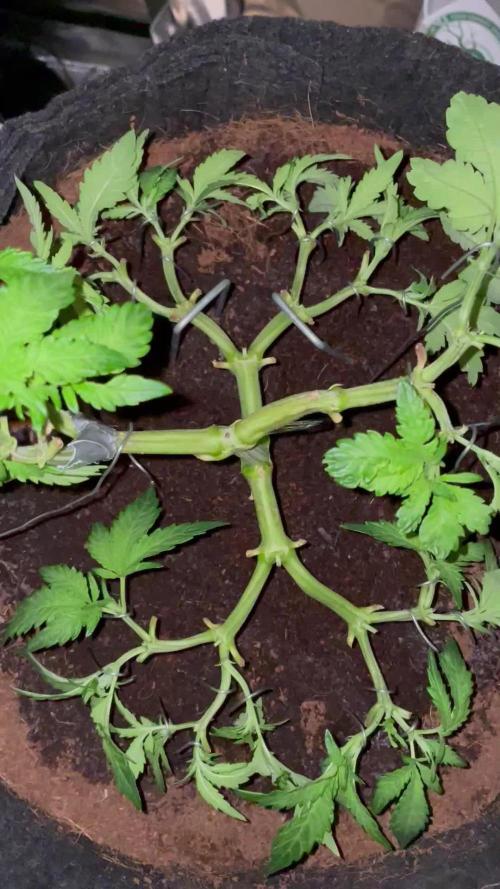
Die Triebe fangen an sehr interessant zu werden das Training tut der Pflanze sehr gut und die Farbe gefällt mir richtig gut


Likes
5
Share


@CalGonJim
Follow
3/3 MONDAY 12 am. They are doing great, the supplemental lights are helping. they cost about 60 for the AC Infinity germination kit. I think the 2 lights are enough so it’s cheaper to get another Germination setup with the lights for my 2.8x2.8 tents. 3pm they all took quite a bit of water. feeding into the bottom of the container is very beneficial to the plants. Wish I would’ve known about that sooner I made a video of how I do it.
3/4 4am looking good. 130pm

Likes
3
Share


@fabialien
Follow
3ra semana de vida. Fotos y videos del dia 2 de Agosto 2024, las cepas van bastante bien, una gorilla murio pero vendrán nuevas BSF


Likes
13
Share


@SzkolaZiola
Follow
Week 7 is over. They are more than ready for flowering. In 3-4 days I'll have free bloom tent and will transfer them there and flip to 12/12.
Most of them are doing very good - slight VPD issues but will be corrected.
Strawberry Cough still the biggest even after double topping and bending. Still looks weak-ish though. Stems and branches are very flexible comparing to other plants.
Grandpa's Cookies #6 are a failure. I'll see but I probably will discard it. It's very underdeveloped - small, slender, willowy. Leaves are still weird - it didn't grow out of it.


