


Likes
Comments
Share


@Ultraviolet
Follow
If you are lonely when you are alone, then you are in bad company.
Bee pollen is considered a “vitamin bomb” due to the presence of almost all vitamins with an average of 0.02–0.7% of its total content, with a higher amount of water-soluble than fat-soluble vitamins. Bee pollen contains vitamins A, D, E, B1, B2, B6, and C. It also provides minerals such as calcium, magnesium, phosphorus, potassium, zinc, copper, manganese, iron, and selenium, I mixed a bunch of that with some honey and RAW cane molasses to make a nice big bucket of tea. A family friend who is a beekeeper was kind enough to share some honey. The nutritional content of raw honey is impressive and includes high levels of protein, amino acids, B vitamins, calcium, manganese, potassium, magnesium, zinc, and iron, as well as various polyphenolic antioxidants.
I am loading up nature's finest sugars, and sweet things, Honey & Mollases.
UV-B-induced DNA damage (CPDs and 6–4 PPs) can be repaired efficiently by photolyases. Pyrimidine dimers can be repaired by nucleotide excision repair (NER), or bypassed by replicative polymerases (Britt 2004). The expression of the CPD photolyase (PHR) gene is induced by UV-B light dependent on UVR8 signaling pathway, and is also induced by blue and UV-A light (Li et al. 2015)
https://link.springer.com/article/10.1007/s44154-022-00076-9?fromPaywallRec=true
Old but gold.
The camera picks up far more light than there is during the night cycle, camera is showing bright pink violet collages but my eyes barely see a thing, about 0.25ppfd in that tent overnight. Have been tweaking the spectrum of moonlight/intensity and watching the responses overnight.
Tweak, tweak, tweak all week.
PAR is 400-700nm,
Overnight UVA in the tent is all 365nm and 385nm, so the meter only picks up a fraction of the light curve that makes it photosynthetically active past 400nm. Of the light in the tent, 0.25ppfd is from UVA
Looks like It makes them 🕺 🕺 💃 all night.
Better flower soon or ill be screwed for space, they are stretching, but is it "the stretch"? She has fire in her belly.
Growing crops with insufficient light (i.e., below “optimal,” as defined here) limits the yield potential, which in turn wastes the other production inputs including labour, water, nutrients and electricity. As lighting fixture is one of the most expensive investment of the production, what is the relationship between light intensity and yield?
Potter and Duncombe (2012) grew cannabis plants with varying canopy-level PPFDs during the flowering stage and found that increasing PPFD from 400 to 900 μmol·m−2·s−1 increased yield an average of 1.3 times higher, across seven cultivars, with no light intensity treatment effects on floral cannabinoid concentrations. Vanhove et al. (2011) found that cannabis yields were 1.3 to 3.1 times higher (depending on cultivar) when plants were grown under approximately 1000 μmol·m−2·s−1 compared to approximately 450 μmol·m−2·s−1 during the flowering stage.It was predicted that cannabis yield would exhibit a saturating response to increasing Light intensity, thereby signifying an optimum light intensity range for indoor cannabis production.
However, a new research from Morrison (2021), after 81 days‘ experiment, found that When plants grew under LI ranging from 1200 to 1800 μmol·m–2·s–1 provided by light emitting diodes (LEDs), inflorescence yield increased linearly as LI increased up to 1800 μmol·m–2·s–1.
"Cannabis will not stop flowering if the lights are turned on for a few minutes once or twice during the 2-month-long flowering cycle. If a light is turned on for 5 to 30 minutes—long enough to disrupt the dark period—on 3 to 5 consecutive nights, plants will start to revert to vegetative growth."
"Less than one half of one foot-candle of light (0.1ppfd) from sunlight will prevent cannabis from flowering. That is a little more light than is reflected by a full moon on a clear night. Well-bred indica-dominant plants will revert within three days. Sativa-dominant plants take four to five days to revert to vegetative growth. Once they start to revegetate, it can take from four to six additional weeks to induce flowering again!"
Guess ill find out my answer soon.


Likes
6
Share


@Headies
Follow
I topped and trained them two more times. I also lolipopped them, that is cut the bottom 2 sets of leaves and branches.


Likes
13
Share


@Herbz_Unkraut
Follow
what a resin monster! such beautiful plants! one of the 2 phenos had straight peanutbutter flavor!

Likes
11
Share


@GermGrowFox
Follow
18. Mai
Pflanze wächst sehr schnell. Untere Triebe plus Blätter großzügig entfernt
20. Mai
4l Wasser, davon 1l mit 1ml Bio grow
Pflanze zeigt erste Blüteanzeichen

Likes
20
Share


@Hawkbo
Follow
Sorry for the delay was in a wedding this weekend came home and been trimmin like a dog the past few days and didnt have time to do the update but I'll do another one before tuesday to get back on track. As of Friday sept 6 its day 46. In the video the plants from back left to right are ..
Gelato-> Cream Cookies -> Gelato
Middle row from left to right are Lemon A.K 1 -> 6 Shooter-> Lemon A.K
Front is Tester 5 -> Lemon A.K -> Tester 26

Likes
20
Share

@HinduGod
Follow
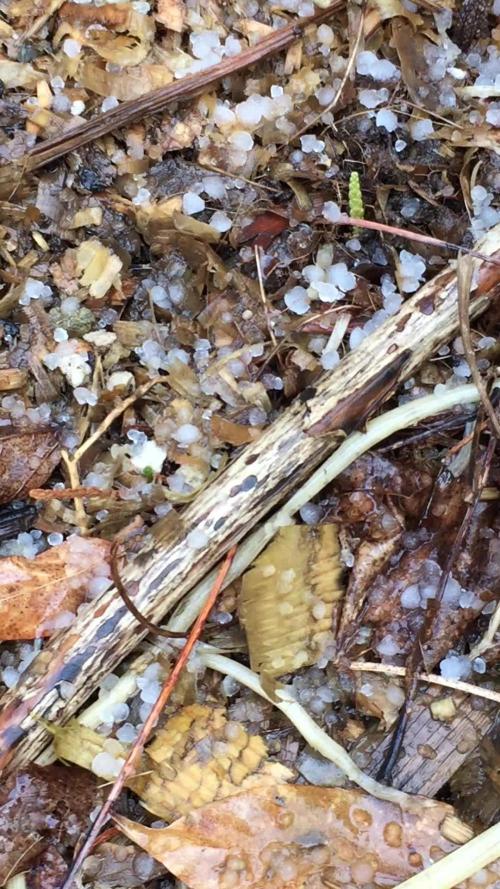
WOW LOOK AT DAT!!! DIS HAS BEEN A VERY VERY FCKED UP WEEK!!! DA WINDGOD AND DA HAILGOD PUNISHED DIS POOR GIRL!!! WINDGOD BLEW DA PLANT OVER!!! HAILGOD BEAT DOWN ON HER!!! JUST IN DA LAST 2 WEEKS FROST,WIND AND HAIL!!!! SHE IS VERY VERY TOUGH!!!! EVEN AFTER ALL DAT DA HINDUGOD DID A MAJOR DEFOLIATION AND ADDED SOME BUD CLIPS TO DAT PLANT!!!!! WHAT A TEST ON DIS CULTIVAR!!!! OUTDOORS IN DA LATE WINTER/EARLY SPRING BRING IT ON!!!!!
Likes
19
Share


@The_Lonely_Farmer
Follow
Hey growers I hope your all well ✌️
SHOULD I FLIP???
These girls are nearly 50cm and the one girl is around 35cm, I'm going too continue veg for 1-2 weeks longer and scrog in the meantime too gold back the 2 taller girl.
These girls are plodding into week 7 now so they are ready too flip but will see how my grow question goes before switching too 12/12 👌
They are happy and healthy and doing well under the shogun nutrients!
I have defoliate the odd top fan leaf too allow better air circulation.
We have very high heat atm but hopefully they uptake more 😉😅
Happy growing 🌱💚
Likes
4
Share


Processing
Likes
22
Share


@DankBudz
Follow
Well a few weeks left and they are starting to fall over.
Gonna be interesting holding then up for another few weeks.
LoL

Likes
49
Share


@Roberts
Follow
I thought I had major issues, and stunned this plant during growth. Apparently this plant is a very short strain. I didn't mess it up as bad as I thought. I did have issue with the grow. Bud smells very intriguing, and looks potent. I don't have much else to report, but am curious to how it smokes. Thank you Fast Buds, Athena, and Medic Grow. 🤜🏻🤛🏻🌱🌱🌱
Thank you grow diaries community for the 👇likes👇, follows, comments, and subscriptions on my YouTube channel👇. ❄️🌱🍻
Happy Growing 🌱🌱🌱
https://youtube.com/channel/UCAhN7yRzWLpcaRHhMIQ7X4g
If anyone needs to purchase fastbuds here is a link for my affiliate program
https://myfastbuds.com/?a_aid=60910eaff2419
Likes
13
Share

@cultivars
Follow
OCTOBER 11h to OCTOBER 17th
Sunrise: 08:20 | Sunset: 19:03 | Total Daylight: 10:43
This was another pretty good week for weather, however the last couple of days have been cloudy with rain, causing some spikes in greenhouse humidity. Temperatures for the most part have been good, with one overnight low in the greenhouse of 13C.
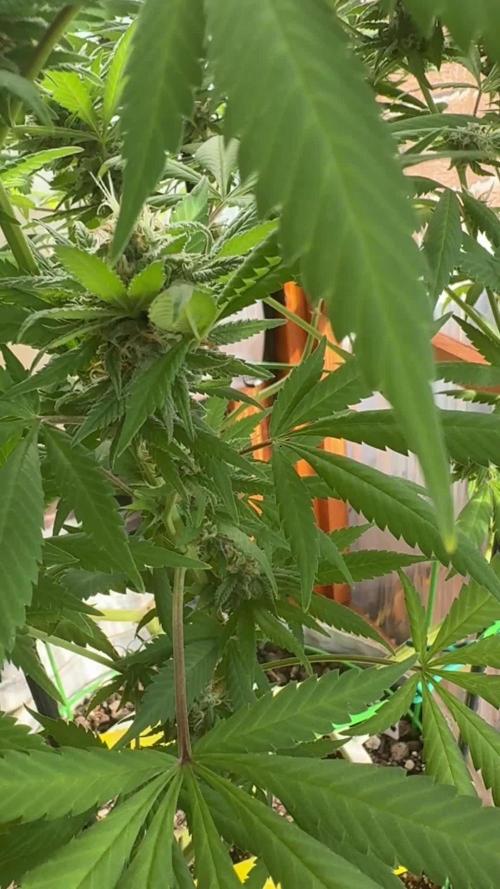
Both Blue Dynamite specimens are doing well. Blue Dynamite #1 has the larger flowers and has appeared by end of week to be nearing ripeness. Blue Dynamite #2 flowers are smaller than her sister, but sizeable nonetheless, an a little further away from fully ripening.
Greenhouse is emitting very strong smells now, mostly a sweet skunk scent.
Weather forecast appears as though it will be adequate and manageable temperature wise for the next week.
DAY 155
Greenhouse 13C in the morning, with outdoor temperatures down around 3C (frost evident on rooftops in area). 500mL drip of plain rainwater to all specimens.
DAY156
1L hand water BTI treated rainwater (no additives); Greenhouse held to 18C overnight, humidity a little high (51%) but dropped as sun rose; Overcast day.
DAY 157
Beautiful sunny day, with warm temps; Greenhouse was 18C in the morning.
DAY 158
-1C in the morning outside, 13C in the greenhouse, which is fine. Nice sunny day, drip watered 500mL of plain rainwater (cold) at 12:00 to both Blue Dynamite specimens.
DAY 159
Overnight low outside 5C, 17.5C in greenhouse, which is ideal. Humidity in check, at 41%. Cloudy, overcast day, with greenhouse heater working to maintain day-time temps of 21C (no solar energy to drive heating).
DAY 160
Greenhouse 14C in the morning, 3C outside. Humidity at 41%; Clear morning, with some sun, turning cloudy with light rain in the afternoon, resulting in a humidity spike in greenhouse to 50%.
DAY 161
Lots of rain overnight, causing spike in greenhouse humidity to over 60%; Will require monitoring; Temps in the morning 18C in the greenhouse, mild outdoors.
Likes
8
Share


@CrowMaster
Follow
Week 2 just finished de leafing everything gonna put net up this week….10k hps room 6-7 plants per light….apple fritter clones comes form a pack of Clearwater genetics I hunted last year


Likes
1
Share

@TTerpz
Follow
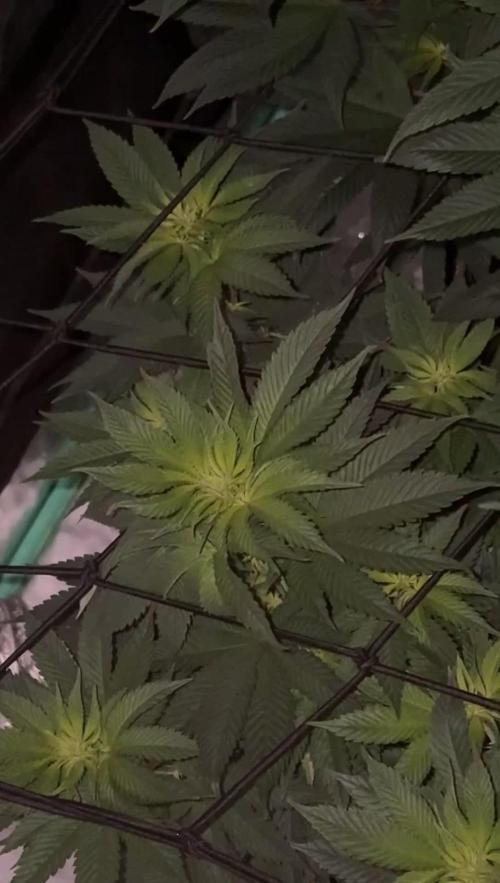
Two out of three were fed with nutrients today on 8/10
2/3 were fed with plain ph water on 8/12. Back plastic pot still drying from plain water feed on 8/10


Likes
118
Share


@SwissKush
Follow
Day 78 - Amazing Buds! WOW!
a. this plant's buds just keep maturing! Pistils are going red/orange/brown
b. the trichome heads are mostly white, not seeing amber yet
c. i cant believe how dense these buds are!
Day 79 - she drinks!
a. she is drinking 4L a day right now, slowing down a little
b. pistils are about 50% colored, and the trichomes are very milky, a few clears
c. she is ripening up nice in this flush, many fan leaves are being disconnected by the plant, she is near the end of her life, I am removing many fan leaves per day without force, they just fall off the bud
d. the effects are really good, I dried a small bud, and the effects are nice
Day 80 - ripening nicely
a. the buds are all maturing, pistils turning brown
b. the resin is building up on all the buds, the trichome heads are mostly milky white
Day 81 - DWC change
a. another change out for fresh water, the flush is making the buds so frosty and smell so good!
b. drinking about 4 litres a day still, 12/12 hours light is working well
Day 82 - real monster plant
a. her buds are as big as my arm, and the smell is so intense!
b. the fresh water flush is the way to go!
Day 83 - trichomes are 90% milky
a. she is ripening very nicely, has about 80% brown pistils
Day 84 - iced out
a. the amount of resin that is being produced is unreal!
b. I dont see any amber trichomes yet, she has some time!
Processing
Likes
20
Share


@UK420
Follow
Possibly transplanted into oxy pot a little early. But seems to be settling in now. Just need some more root development.
Root Update 27/8 - both oxy pot and 5 plants still in grow cubes, have all had a good increase in root development over night - 27 August
Root Update 28/8 - all grow cubes and one in oxy pot developing well.
Set up:
1 CFL 300w Dual Spectrum light with reflectors
1 kaizen carbon filter and air out.
1 eco fan air in
1 oxy pot
1 9 inch oscillating fan
