The Grow Awards 2026 🏆 










Likes
Comments
Share
@Dendegrow
Follow
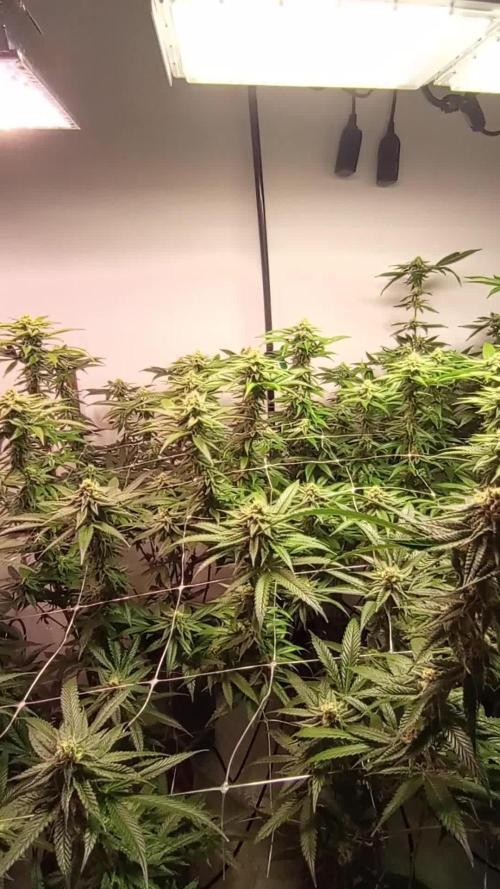
Woche 4 bricht an und es läuft hervorragend! Die Orange Sherbet bekommt diese Woche frischen Boden: eine Mischung aus Bio-bizz All-Mix und Greenhouse-Feeding, perfekt für die letzten Vegetationswochen und blüte. Zudem hat sich die Orange Sherbet sehr gut mit dem Backhefe-Buttermilch-Melasse-Experiment entwickelt, was zu einem starken CO2-Anstieg auf bis zu 1500 ppm geführt hat. 💨 Ich bin gespannt, wie sie sich in der neuen Umgebung entwickeln wird. Auf der anderen Seite explodieren die Frozen Black Cherries förmlich in der Hydroponik! 🌱 Die Entwicklung ist beeindruckend, und ich könnte nicht zufriedener sein mit ihrem Fortschritt. Die Blütephase rückt näher, und ich bin gespannt, wie sich alles weiterentwickelt! Ich halte euch auf dem Laufenden! 🚀
Week 4 is here, and things are going great! The Orange Sherbet is getting new soil this week—a blend of Bio-Beth All-Mix and Greenhouse-Feeding, setting her up perfectly for the final weeks of vegetation and . Additionally, the Orange Sherbet has responded well to the back yeast-buttermilk-molasses experiment, resulting in a significant CO2 increase of up to 1500 ppm. 💨 I'm excited to see how she adapts to her new environment. Meanwhile, the Frozen Black Cherries are absolutely thriving in hydro! 🌱 Their growth has been phenomenal, and I couldn't be more impressed with their progress. The flowering phase is getting closer, and I can't wait to see how everything unfolds! I'll keep you updated! 🚀

Processing
Likes
1
Share
@LymaGreen14
Follow
Finally up to date with the info! Well.. nearly. Will have more videos and detailed picture tomorrow for next upload. I believe these are a week old.

Likes
7
Share
@Cultivatorcarlos
Follow
december 14th gave her a feed of about 6 cups of dechlorinated tap water phd to 6.4 with 1/2 tsp of veg nutes to 3 gallons and 4 2 tsps of calmag to 3 gallons of water. I thought she was initially getting a calmag deficiency but it was just her switching to flower and needing diff nutes ig? I also tested runoff for the first time which i should've done from the beginning but it came out at 6.3 ph
december 17th 2021: gave her half a gallon of dechlorinated tap water phd to 6.4 with 1/2 tsp of veg nutes to each 3 gallons of water and 2 tsps of calmag to 3 gallons of water.

Likes
Comments
Share
@RatmanJR
Follow
June 21st update. 28 days since flip.
Plant is growing phenomenal. Was able to crank the lights up to 80% for the first time in this grow without her throwing a fit.
All of the banana peels I’ve fed her the last few weeks have disappeared and have been feeding my soil mites and my worms. I have not had any bad pests since I started using these predator mites I love it.
I can’t even begin to describe the smell of this thing. It’s like a raspberry tart mixed with just a little hint of gas. I’m so excited to give this a try when the time comes
Noticing Trichomes going all the way down some of the fan leaves so that is always cool to see.
Also I noticed this is common with living soil but I’m done bothering trying to defoliate. I will do one more in two weeks at day 42. But anything I remove at this point is just going to come right back.
As always nothing but water. Will give her some tea tmmr like every Sunday with some big 6, worm castings, molasses, and some cow cal 24.


Processing
Likes
7
Share
@Isle_of_dank
Follow
Start of week 2flower buds forming nicely will update at end of week
Updated 4th July 2020 really bouncing back after pH corrected

Likes
4
Share
@knnabisgrower
Follow
En la segunda semana de vegetación fertilizamos con un estimulante de crecimiento, aplicando 1.5ml / litro con p.h regulado en 5.8.


Likes
4
Share
@StonedRAGE
Follow
As stated above i have grown this pheno several times before. She never lets down when it comes to the way she grows, yield and quality of the end product.
There is a reason why i safed her. Really happy with that one.





Likes
6
Share
@mikheil007
Follow
Vanilla Latte from Huboldt Seed Company seems to be very stron strain! others still going very well...


Likes
38
Share
@DudeGrowsWeed
Follow
Moved these girls back inside this weekend. I started to see what looked like the start of bud rot outside. Its been cool and damp for the past couple of weeks and bud rot loves that. I cut off a couple of branches which showed signs so I would not bring any indoors (fingers crossed). I'm going to chop and dry 2 of the plants this week - once I'm sure there are not anymore signs of rot. The third plant still needs another week or two. The video shows my upcoming grows also. New diaries coming soon! 👍
Likes
93
Share
@PEAKYPLANTERS
Follow
Hi guys, Welcome back to Queen Peaky's Grasslands
This week we will dedicate it to just rinsing the soil to discard all excess nutrients😎
You can already perceive some excellent smells👻
I hope you l
Likes
11
Share
@TheMadHasher
Follow
Whats up everybody cheers to another week of growth for everyone!
This week the ladies buds started showing signs of progress. You can see them produce more and more resin every day thanks to the cold weather its really easy to keep a pretty dry environment. Can’t wait to do my final defo next week! Until then stay green!


Likes
15
Share
@Waveform
Follow
Day 17 (starting Aug. 2nd afternoon): Will water them with a lightly enhanced RO water that was imprinted with frequencies via a PEMF coli for about one day when their day starts.
After being away over the extended weekend, on day 20 ladies have grown very nicely. I topped nr# 1 and #2 after I took the photos and will give them a bit of water with Root Complex to compensate for the shock later. Sadly my brilliant control equipment has crashed completely and will not even take a photo currently. Yikes. Hope I can get it back alive this week again. Also turned the left light up by another 20%, now running at 40 W, and lifted it a bit. Eye inspection told me lights were lower here and ladies can get a bit more.
At the end of their day 20, they seem to have survived the topping well. I managed to cut right above the new nodes which are already growing. Ladies are at 20 cm height before going to sleep.
Day 21 shows great growth again, with lady #1 being at 22 cm now and lady #2, while being a bit less tall, extremely good side branch development. I hope that the rearranged lighting on the left side of the tent will make #1 grow a bit bushier too.
Besides from that, I am really happy I tested Hesi HPE. I had such enormous success with room plants that made me want to see how Cannabis plants react to it. It will not add much to salinity, so I dared to add it quite early. While the photos are processed to compensate the lighting, I did not add much to saturation, so leaves are indeed of a very vivid, luscious green and ladies looking extremely healthy. Speed of growth has increased too as the added video shows. It also tells me lighting is enough – they are turning their leaves away right at the end of their day. I am really uncertain if I will change to usual Hesi grow fertiliser at all …
Did a bit of LST to the lowest branches of lady #2 which spread almost to the border of her pot.
Both temporary girls will leave the tent soon, so that the competitors will have maximum space to develop.
Day 22, end of week 3:
Outside girl went to get fresh air from now on. Wishing her luck, good weather and not a single male in the vicinity.
I rearranged the lights and positioned them a bit higher. First preflower signs appeared on the ladies, so I will change the lighting phase when I return next week. Currently, I have them at 18/6, 45 cm above heads, with 80% running to a total of 80 W.
I wasn’t so lucky topping #2. She has only one "top side" branch now … But grows extremely well, so ok!

Likes
69
Share
@DogDoctorOfficial
Follow
🌸 Eternity Cup • Week 4 Flower • Runtz Phenos 1 to 5
Welcome back to the garden, my dear growers! This week, we enter Week 4 of Flower, and the energy is shifting — it’s subtle, like a foggy winter morning where everything is still, but alive with quiet anticipation.
Our beloved Runtz girls — phenos 1 through 5 — are beginning to reveal themselves fully, forming those early floral structures (the “ears,” you know the ones 🌱💚), and each one is expressing her beauty in unique, yet strikingly similar ways. This kind of uniformity only proves how stable and powerful these Zamnesia genetics truly are. They are fulfilling the scrog like queens — compact, bushy, and ready for the next phase.
This week, I noticed a slight decoloration in the leaves — just a whisper of pale green — and it felt like the perfect moment to adjust the feeding to bring out that lush vibrancy again. We’re now running the following dosages in our reservoir:
• Regulator: 0.15 ml/L
• System Clean: 0.25 ml/L
• RO Water Conditioner: 0.8 ml/L
• All-In-One Liquid: 2 ml/L
• Plagron Green Sensation: 1 ml/L
This blend brings us to an EC of 2.225 and a pH of 6.07 — right in the sweet spot. Let’s see these ladies rise up and glow 🌞
Since it’s been a little cold — temps started the week around 16°C and are now slowly climbing up to 23°C, with a humidity of about 50%, this gives us a VPD of around 1.50, which is still looking great considering the lower ambient conditions. CO₂ is sitting at 1000+ ppm, and light intensity is cruising around 550-600 PPFD, which we’ll increase in the coming weeks to match their needs as they bloom.
The Autopots keep our medium at 53% moist like clockwork, but I’ve added a water heater to the reservoir — aiming to gently raise soil temperature by warming the solution. That 16°C in the substrate wasn’t doing us any favors, so let’s bring the roots a little cozy love. Everything we do, we do with intention and care.
Visually, this week feels like a quiet fog has settled — like watching the garden through a soft lens. The atmosphere is calm, with the girls standing strong and steady under the ICL 300s and the Model Ones, which are doing a phenomenal job creating the perfect stage for this show.
Let’s take a moment to thank this beautiful community — the lovers, the learners, the OGs, the curious ones just passing by — your presence means everything 💚
Massive gratitude to Zamnesia for the incredible genetics, Zamnesia, Plagron and to Grow Diaries for hosting this Eternity Grow Cup. And of course, deepest thanks to all the sponsors making this magic possible:
Aptus Holland, Grove Bags, TrolMaster, ThinkGrow LEDs, Promix, Cannakan, FOG and Ziggy Papers — your support grows more than plants, it grows stories, friendships, and futures.
P.S.
Before we wrap it up for the week, I just wanted to add a note about one of the biggest tasks we tackled — the defoliation. It was time. The girls had grown into a dense jungle of love and leaf, and it was clear they needed more room to breathe. More airflow, more light. More photons reaching deep into their hearts. That’s what we aim for.
So, leaf by leaf, gently, carefully — with respect for each one — I went in. Four, maybe five hours of focused silence (with my jam on the back ground), removing what needed to be removed. It was a lot. And as I moved through them, it became clear: the Scrog net, too, had done its part. But now? It was just in the way. These girls are so compact, so thick, so full of presence and power — they can hold themselves.
So, I took the bold move. I freed them. No more net. Just them, as they are, open to the light and thriving on their own terms. It was a beautiful moment — one I wanted to share with you here, just quietly, before we say goodbye for now.
🌬️ Until next week — stay warm, stay growing, and let the fog roll gently through your garden.
Genetics - Runtz https://www.zamnesia.com/6000-zamnesia-seeds-runtz-feminized.html
Nutrients - Plagron https://plagron.com/en/hobby
- Aptus Holland https://aptus-holland.com/
Controls - Trol Master https://www.trolmaster.eu/
LED - https://www.futureofgrow.com/en
LED - https://www.thinkgrowled.com
Soil - https://www.promixgardening.com/en
Germination - Cannakan https://cannakan.com/?srsltid=AfmBOopXr-inLXajXu3QFgKXCXXos4F1oEvScjMKIB5MR5dk8-GJ-F49
DOGDOCTOR 15% off
Smoking Papers - https://ziggioriginal.com/
Terpene saver - https://grovebags.com/
As always thank you all for stopping by, for the love and for it all , this journey of mine wold just not be the same without you guys, the love and support is very much appreciloved and i fell honored with you all in my life
With true love comes happiness Always believe in your self and always do things expecting nothing and with an open heart , be a giver and the universe will give back to you in ways you could not even imagine so
As always, this is shared for educational purposes, aiming to spread understanding and appreciation for this plant. The journey with nature is one of discovery, creativity, and respect. Let’s celebrate it responsibly and continue to learn and grow together!
Growers Love To you All 💚
#EternityGrowCup #RuntzHunt #GrowersLove #CannabisCommunity #AptusHolland #ProMixSoil #TrolMaster #Zamnesia #Plagron #ZiggiPapers #Grovebags

Likes
45
Share
@Ultraviolet
Follow
New week. 55-65 DLi.
I am that, I am.
Dodecahedron is the only platonic solid that has infite numerical pathways,
(γνῶσις, gnōsis, f.)
Likes
25
Share
@Danger90946
Follow
Welcome to week two.
Day 8 05/10 So far the two plants in Down to Earth seem to be doing better. Hopefully this week goes better.
Day 10 05/12 all for plants growing one of them very weak but will let it go till it gives on its own. Feeding all four plants a cup a day of water for two and the other two get FoopCanna everyday following schedule. Other than that Down To Earth seems to be kicking butt.
Day 14 05/16 so we come to the end of the week and again Down To Earth seems to be kicking ass. Both plants in DTE are twice as tall and busier.
Likes
31
Share
@Reaper
Follow
week 2 flowering.
no calmag issues so far the one i transplated in the 20L pot looks much better than the one left in 12L. the pot with 20L was filled at the bottom and around the edges of the old soil with 3 month fertilized soil. flowers already showing on both plants
they were both vegged for 5 weeks
august 20th: day 14 flower
see last video of this week
Likes
9
Share
@TheGreenGroomer
Follow
UPDATE ON MY RUN SO FAR,
She has been growing tremendously i did run into some problem/deficiency i could not indicate what exactly it was but if i had to guess id say it was calmag issue but since ive upped my calmag i think the problem has came to a end and i have tackled it as i do not see it getting any worse ect ect,
up to know this run has been a flight in the clouds using the ac infinity set up controlled everything from my phone so i could dial in that VPD the only thing i would say is abit of a problem is humidity the rh in my house has raised due to weather outside i guess, i did buy a dehumidifier and it brought the humidity down from 73% to 60% in the night it fights quite hard as temps drop but its not to high max 70%
but as im preparing for flower i do need to be bringing it down allot id be comfortable at the mind if it could drop and be withing 50-60 mostly 55 but hopefully as the weather gets better it should drop the rh in my house just in time for flower hopefully!
today i did some defoliation for better airflow as she was quite bushy and leaves were settling on other leaves and i couldn't tuck/hide also it was so awkward when watering especially with the clips/ties for (LST) hence why i made my decision to defol.... the videos are a (before and after defoliation)
she has been no more than 500ppfd light all the way up to week 4, tomorrow i am going to up the light slightly to around 550ppfd as i am planning on flipping to flower in 2weeks if im happy with her growth and i wanna make sure i start bumping up that light intensity for flower ;)
Come Week 5 i will be here to post another update on her growth