


Likes
Comments
Share


@DeepRootsGrowTrees
Follow
JOANNE'S CBD / ROYAL QUEEN SEEDS
WEEK #20 OVERALL
WEEK #8 FLOWER
This week she's looking good and she's doing great her buds are getting bigger and they even got a little trichome coverage just a few more weeks!! Stay Growing!!!
Thank you for stopping by and taking a look it's much appreciated!!!
THANK YOU ROYAL QUEEN SEEDS!!!
JOANNE'S CBD / ROYAL QUEEN SEEDS

Likes
18
Share


@Jays_Not_Here_Man
Follow
More to come once I think this over, and finish up the dry and cure 🌱💨


Likes
12
Share


@CANNASIM
Follow
A lot of rain and wind, continuously. Temps have dropped as well.
I’m reading another week or two to chop this plants.
Sativa dominant hybrids did the best, the Fastberry and the banana purple punch did not really develop as the other two.
In specifics the cbd crack developed sizable buds, and the blue dream as well, the flowers are not as developed tight and dense as in the indoor grow. A bit of fox-tailing nothing too expressive.
Minimal work, as per the setup chosen, an no extra nutes this week.
Likes
77
Share


@Roberts
Follow
FBT2309 is flowering nicely. She gas a sweet, fruity flowery aroma at the moment. She has a great layer of trichromes on her. She is in bulking and doing great. Thank you Fast buds. 🤜🏻🤛🏻🌱🌱🌱
Thank you grow diaries community for the 👇likes👇, follows, comments, and subscriptions on my YouTube channel👇. ❄️🌱🍻
Happy Growing 🌱🌱🌱
https://youtube.com/channel/UCAhN7yRzWLpcaRHhMIQ7X4g
If anyone needs to purchase fastbuds here is a link for my affiliate program
https://myfastbuds.com/?a_aid=60910eaff2419
Likes
57
Share


@Clutch
Follow
Hello everybody
Welcome to the review week 😁
(Harvest pictures previous week)
What can i say. Another very fun year doing this hobby. Grow number 5 since I'm here on growdiaries and ever year I improved because ofvall the knowledge here.
Last year my NL'S started fantastic but it went horribly wrong during flowering.
I was very motivated for this revenge round since NL is great strain and I knew where the mistakes were made in the previous grow.
Made a well fed soil, added lots of RQS nutrients and made it extra airy by adding about 20 to 25 % extra perlite.
Germination was made in a soil plug. Soaked the seed for 24h and then 12h in a moisted paper napkin . After the root came out a little bit i put her directly in the soil plug
After 2 days she put her head out 🙏
Vegative phase was fun but she was stunted from the cold in the first weeks outside. With photoperiods that's not a problem but with autoflowers u end up with a small plant. Gave some neem oil spray too every week. No bugs have been seen on the plant. Fantastic product
I did my first LST training and that was so fun to do. I fucked up here and there and should have spread the canopy more open but i give myself 6,5/10 for the first time 😁
Didn't break anything and she reacted well on my inexperienced hands.
Will always do this from now on but with adjustments of course 😁 we grow to learn
In flowering she did well but she stayed on the small side, wasn't very bushy and didn't completely filled up the space she had.
But the plant was healthy and what she had did very well and delivered super nice buds. In the final 2 weeks she really bulked up a lot and gave me my first handsized buds ❤️🙏
I had Budrot because of high humidity in the morning and 2 small rains.
It was extremely warm here during July and August but during the days we had 30° to 40° Celsius with low humidity and at night 15°Celsius with night and morning humidity of 80% to 100% 🤷♂️ 🙄
talk about a challenge
Every plant will develop problems in such swinging climate conditions but the NL did pretty good. Lost about 20% of the plant unfortunately but that's life
After 16 weeks she looked done for me. Chopped her and had to dry her in warm weather. The tent was around 23°Celsius, couldn't get it lower. After 5 days the smaller buds were on the verge of just a bit too wet but close to dry and i know it's better to put them in a little bit more wet instead of too dry because it's harder to add moisture than the other way around. Opened the jars 4 times daily the first week and it was okay. The handsized more wet buds were added after 7 days of drying and didn't have any problems.
An overall very smooth grow untill the budrot problem. Will grow this one again since i have 10 seeds left of them 😁
(small note for RQS if they read this : mix up the free strains guys 😂 1 Royal Jack and 13 NL here)
Thanks for the help and comments
Another year were i learned a lot from everyone here 🙏
Happy growing 🙏
Likes
11
Share


@Barbagrows
Follow
Day 65 -
Maria got some needed defoliation to expose lower nodes to light and increase air circulation through the canopy. She is growing bushy with short internodes.
Juanita's new growth looks slightly better, even though growth has slowed down and is very stretchy. Thinking of putting her soul to rest, she's turning out to be a headache in the current tent situation.
Day 66 -
Maria's growth exploded after yesterday's defoliation.
Both plants showed pre-flowers and are both confirmed ladies. 🙂
Day 70 -
Both ladies got 1 litre each of plain water.
Maria got her lower skirt lollipopped. Also defoliated her from top to expose lower growth to more light. She is still growing very dense.
Juanita is showing signs of recovery, new growth is green and purple stems are slowly turning green again I don't like the way she is growing though, internodes are too long. Will have to see what to do with her.

Likes
4
Share

@Ninjabuds
Follow
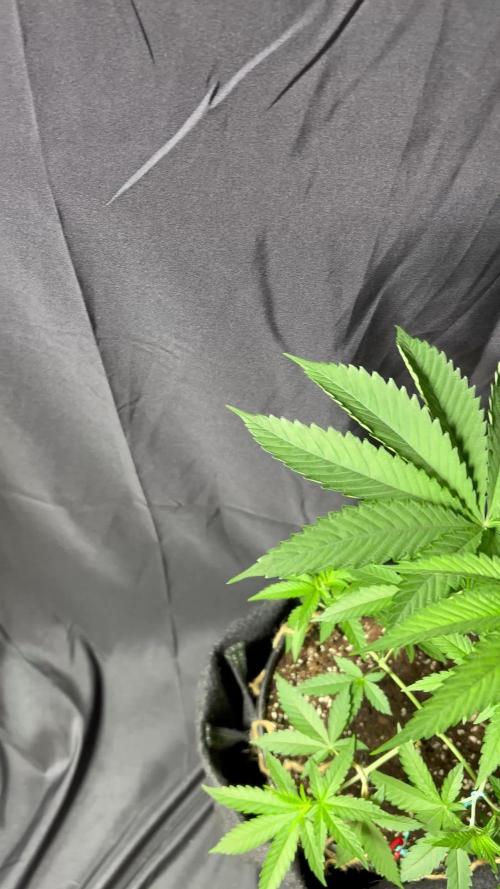
It's been two weeks since i started using the UAP 1500 light, and the results are definitely showing! The 'Peyton' papaya seems to love it. The leaves have this amazing vibrant green, and the whole plant looks so healthy and strong.
Lemon Cherry Runtz is looking fantastic! The buds are dense and frosty, with those beautiful purple hues peeking through. You can tell it's a high-quality grow. The aroma must be incredible – that sweet, citrusy smell with a hint of cherry. It's definitely living up to its name!
The plant seems super healthy, and the trichome coverage is impressive. It looks like it's getting close to harvest time.
Likes
Comments
Share

@DogDoctorOfficial
Follow
🌸 Folder 11B | Pink Rosay Auto
Week 2 – Small Frame, Big Potential
Welcome back to another chapter of the 8×8 Adventure, where every phenotype tells its own story and every plant has the opportunity to reveal its unique character.
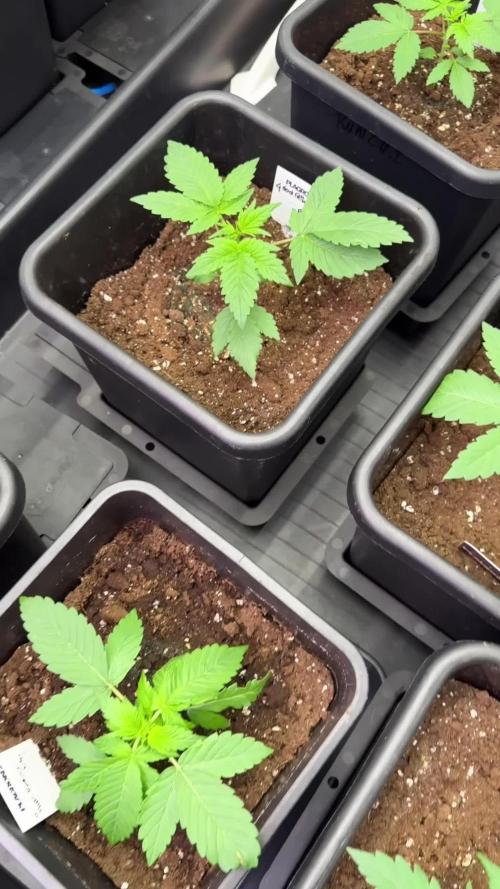
This week we’re following Pink Rosay Auto 09B, and while she shares the same genetics as her sister, she’s already proving that siblings can have completely different personalities.
Where Pheno A immediately stretched her branches outward, Pheno B has chosen another path.
Compact.
Dense.
Strong.
Every day she seems to reinforce her structure before adding more height, creating the impression of a little powerhouse preparing for something much bigger.
Sometimes the quietest plants become the biggest surprises.
⸻
🌿 Growing Conditions
Pink Rosay B continues growing alongside the rest of the project under identical environmental conditions, ensuring each phenotype can express its natural characteristics.
Environmental Conditions
* 🌡️ Day Temperature: 27°C
* 🌙 Night Temperature: 25°C
* 💧 Relative Humidity: 55%
* 🌱 Root Zone Temperature: 21°C
* 💦 Nutrient Solution Temperature: 20°C
* ⚡ EC: 1.3
* pH: 6.0
* 💨 CO₂: 666 ppm
* 💡 Light Schedule: 12/12 From Seed
* ? Pot Size: 15 Litres
The stable environment continues providing excellent conditions for vigorous root expansion and healthy vegetative growth.
⸻
🌿 Feeding Program
Pink Rosay B received the same balanced Plagron Terra feeding schedule throughout the week.
Weekly Feeding
* Terra Grow — 1.8 ml/L
* Power Roots — 1 ml/L
* Pure Zym — 1 ml/L
* Sugar Royal — 1 ml/L
* pH Plus — when required
* Lemon Kick — when required
The focus remains on developing a strong root system while supporting healthy vegetative growth before flowering begins in earnest.
⸻
🌱 Plant Development
This phenotype has been a pleasure to watch.
Rather than racing upward, she has concentrated on building a compact, incredibly symmetrical framework.
The internodal spacing is noticeably tighter than her sister’s, giving the plant a dense appearance with very little wasted space.
Every new node emerges neatly stacked above the last, while the stem continues to gain thickness and strength.
Her fan leaves are broad, beautifully coloured and remain perfectly turgid, indicating that both the roots and overall plant health are progressing exceptionally well.
Despite her more compact stature, growth has been anything but slow.
Each day reveals another layer of healthy new growth hidden beneath the canopy, quietly preparing for the weeks ahead.
She may be smaller today, but she certainly doesn’t feel behind.
She simply has her own strategy.
⸻
🌿 Training Progress
This week focused on gentle canopy management while allowing the plant to maintain its naturally compact structure.
Leaf tucking became increasingly important as the dense foliage began shading the developing secondary branches beneath the canopy.
Small adjustments throughout the week allowed light to penetrate deeper into the plant without causing unnecessary stress.
One particularly encouraging observation has been her response to training.
Although naturally tighter than her sister, every adjustment quickly resulted in fresh vertical growth from the lower branches.
Rather than resisting the training, she appears to be steadily building a beautifully balanced canopy that should become increasingly productive as flowering progresses.
Patience with this phenotype feels like it’s going to pay off.
⸻
📸 Behind This Week’s Photos
The photographs tell the story of a phenotype that prefers quality over speed.
Early overhead shots reveal a compact young plant with outstanding symmetry and broad, healthy fan leaves radiating evenly around the stem.
As the week progresses, the canopy fills in noticeably while maintaining its tight structure.
The close-up images beautifully showcase vigorous new growth emerging from every node, with fresh shoots pushing confidently toward the light despite the naturally dense foliage.
The side profile highlights a thickening main stem supporting an increasingly complex canopy, while the final macro photographs capture the first signs of a plant preparing to transition into its next stage of development.
Every image reinforces the same impression.
Compact.
Healthy.
Confident.
⸻
🌸 Looking Ahead
The next week should be particularly interesting.
As the lower branches continue catching up beneath the canopy, I expect this compact structure to gradually transform into a dense, evenly distributed crown of flowering sites.
Her naturally tight internodes may ultimately become one of her greatest strengths, potentially allowing her to produce an incredibly uniform canopy filled with closely stacked buds.
She’s developing at her own pace.
And right now, that pace looks extremely promising.
⸻
💚 Thank You
Thank you for following another week of this incredible journey.
One of the greatest joys of phenotype hunting is discovering how two sisters can express the same genetics in completely different ways, each with its own strengths and personality.
A heartfelt thank you to GrowDiaries for giving growers around the world a place to document, learn and share their passion.
A huge thank you to Plagron for providing the Terra nutrient line, delivering healthy, vigorous growth and making it possible to let each phenotype express its full potential.
To the breeders behind these beautiful genetics, thank you for creating plants that remind us every grow is an adventure filled with new discoveries.
And finally, thank you to everyone following along.
Your support, curiosity and encouragement continue to make the 8×8 Adventure something truly special.
The journey continues…
One phenotype.
One discovery.
One beautiful plant at a time.
Growers Love 🌱💚

Likes
10
Share


@teabee
Follow
When I swapped out fans I accidentally plugged it into the wrong power bar so it has been turning off with the lights.... humidity has still been high..I found 2 colas on a blue dream with budrot, I cut off the colas effected, fixed the fan so it'll run 24/7 again and hoping I get lucky and they are the only 2 I'll have to throw away.
One blue dream is fox tailing...I'm not sure if it's heat/light stress, even the lower colas and ones not directly under the light are. It's only on the one plant, the other blue dream has colas closer to light and aren't fox tailing at all.

Likes
3
Share


@Rinna
Follow
Unfortunately, the Blue am and dynamighty (also due to their long flowering periods) didn't make it. Told my roommate to cut the plants when I saw that video and those pics but it was far to late already..

Likes
3
Share

@Northern_Ent
Follow
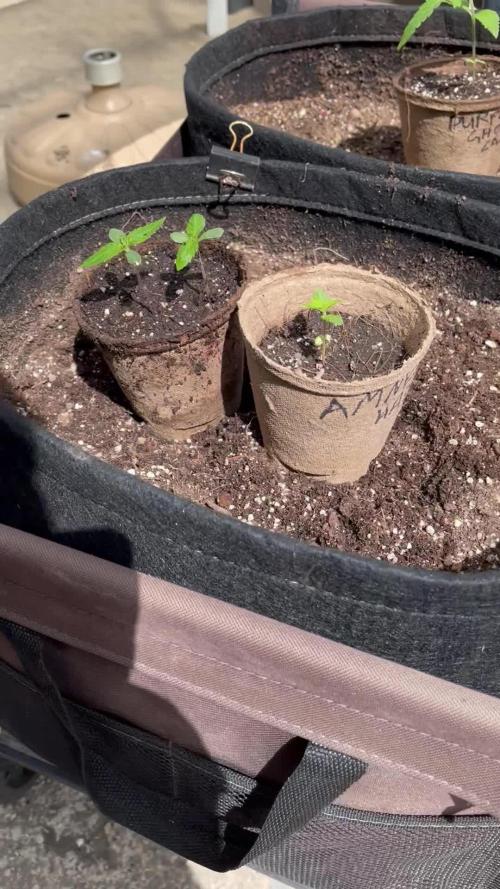
May 23 Day 22: transplant day. The two backup seedlings are stronger than the first seeds I started. The backups were planted into 7 gallon grow bag after I took the bottom off the peat pot and tore open the sides. The backups are about two weeks younger than my other plants but I’ll leave the week numbering the same.
watered in using 28 C water with soluble seaweed extract at half strength.
May 24: picked a seedling. Culled the one with the more purple stem indicating P deficiency and therefore that it might not handle colder weather.
May 29: this from a backup seed and is actually about 2.5 weeks and not 4. Doing fine and next week she’ll likely grow quickly.



Likes
32
Share


@FlynnRyder
Follow
Alrighty, Guys I'm coming to some new realizations lol. Plants are doing way better with new root growth coming from the net pot sides horizontally. I was confused because it seems that a bit of the roots had died or rotted for no real reason. I have suspected the amino treatment and root accelerator was gunking them up. Needless to say, I am almost out and decided to exclude those additives and see what happens. I also ran out of Multi zen and decided to up the base nutrients to compensate. It would be great to get opinions on it all, The prices are so steep and honestly, I practically had the whole line up and it didn't really impress at all. Strangely I have some dc buckets in the center and they are doing really well on just micro, bloom, and cal-mag so save me from making some baizes haha. I noticed that the growth is a bit spread out but they are all from seed so I guess that expected. the bushiest of plants has some discoloration on the leaves but it seems to be killing it so I'm not too worried. At this point, I'd love to get any harsh criticism or to narrow down where I am making these mistakes. I came in expecting to flip from veg in 4 weeks but that doesn't seem possible from seed. I know a lot can be a strain but I still feel like even though I have all these controls I'm missing something. Oh everyone got topped for the first time and aside from some interesting patterns its all gravy baby. Let me know if I need to do something about that missing 400 ml of multizen haha.


Likes
7
Share


@fabialien
Follow
Lunes 11 de marzo 7 am de 2024:
Se dejaran hidratando las semillas por 24 hrs.
Martes 12 de marzo 7 am de 2024: pasamos a papel dejamos por 24 hrs.
Miércoles 13 de marzo 10 am de 2024: revisamos las semillas y vamos preparando macetas pequeñas para transplante.
Miercoles 13 de Marzo 3:30 pm se traspasa a tierra.
Viernes 15 de marzo 11:47 pm 2024, ya que abrieron bien se pone bajo lámpara 100w a 30 cm de distancia, tienen domo protector! El lunes en la nueva semana subimos el avance, hasta el Lunes...
Sábado 16 de marzo 2024, de las 3 semillas la 1 ya abrió completamente, 2 y 3 están por abrir completamente.
Likes
12
Share


@thonhash
Follow
Esta semana añadimos el otro led ts 1000 para seguir regulando (añadiendo más potencia lumínica)
Agregamos paja,para una mejor retención de la humedad y no se seque primero la parte superficial de la tierra (uno de nuestros mayores errores al querer calcular si todo el cepellon está seco o sigue teniendo algo de humedad,por consecuencia,al volver a regar ,sigue con ese pequeño exceso de humedad) ,con el objetivo de conseguir una mejor vida en nuestro suelo ,con todos los nutrientes orgánicos y la clave,enzynabis,crearemos una buena simbiosis,y lo más importante,natural.

Likes
43
Share


@MadeInGermany
Follow
Hey everyone 😊.
The last 2 weeks of flowering have come and I can't wait to harvest them 🤗.
The Ec is turned down a little every week, and next week the water is completely changed again to rinse 👍.
They have developed very well, are just getting their full load of resin, and smell exactly as they should smell .
Otherwise there is nothing to report this week.
I wish you a lot of fun with the update, stay healthy 🙏🏻 and let it grow 🍀
You can buy This Strain at :
www.Zamnesia.com
☝️🏼☝️🏼☝️🏼☝️🏼☝️🏼☝️🏼
Strain
Gelato clone from mother (Zamnesia )
☝️
Genetics: Wedding Cake x Gelato x Gelato 33
👍
Vega lamp: 2 x Todogrow LED CXB3590 COB 55 W
1 x Sanlight S2W 62 W
💡
Flower lamp : 2 x Todogrow LED CXB3590 COB 55 W
1 x Sanlight S2W 62 W
💡 ☝️
Grow Aero System : Growtool 0.8
☝️
Fertilizer:
Canna Aqua Vega A + B , Canna Aqua Flores A + B , Rizotonic, Cannazym, CANNA Boost, Pk 13/14, Canna Cal / Mag, Canna Ph - Grow, Canna Ph-Bloom
☝️🌱
Water:
Osmosis water mixed with normal water (24 hours stale that the chlorine evaporates) to 0.2 EG. Add Cal / Mag to 0.4 Ec Ph with ph- to 5.5 - 5.8
💦 💧
Likes
7
Share


@Naujas
Follow
wow, she's amazing:) with the conditions she has, this is a super result :) the weather is not spoiling us - every day, little sun - lots of clouds + almost half a balcony :D :D she has 3 more weeks - then I'll go on a long vacation :) everything didn't go as planned,:) I think she needs more time:) there will be a renewal until the finish :).


Likes
10
Share


@BossHogg6
Follow
The roots are still looking great. I cleared the old water out and only put 2 gallons in and not the 4.5 I was putting in previous weeks. Starting to get a weak smell from the plant.
