


Likes
Comments
Share


@Hashy
Follow
********************************************
Growdiaries Grow 22
********************************************
Welcome to my 22nd grow on growdiaries. I'm going to be stricter on this grow as i have been a bit lax on the last few and let them get out of control.
My plan is no more then 12 colas between the 2 plants. I'm going to have a shorter veg period to keep them at a reasonable height. I'm also going to try to keep them away from the sides of the tent more then I normally do.
Because I may be going away shortly I'm going to start in the final pot because sods law I'll be away when they need potting up.
I'm running 2 photoperiods again, they are both from the MSNL catalogue. Plant #1 Lemon cherry gelato will be on the left looking in the tent and #2 Zoap will be on the right.
This diary is focusing on
#1 Lemon cherry gelato
Nutrients.
Ecothrive Neutralise
Shogun Katana roots
Plagron Terra grow (3-1-2)
Plagron Terra Bloom (2-2-4)
Plagron green sensation (0-9-10)
Plagron power buds (0-0-0)
Equipment on Smart plugs.
1. Light= Viparspectra Xs2000
2. Feed= water pump.
3. Extractor= Ac infinity
4. Oscillating fans= 2 on ext.
5. Cameras= 2 on ext.
6. Humidifier= ram 5L
7. Dehumidifier= 2L
8. Radiator= 1KW
Tent settings.
Light cycle=24/0
Light Power=100W (42%)
Photone app has been Calibrated, and I have done a ppfd map over a 40cm×40cm area.
Extractor controller settings
High temp= 26c
Low temp= c
Temp step=0c
High Rh= 69%
Low Rh= %
Rh step=0%
Speed max=10
Speed min=1
Smart controller settings (during lights on).
Radiator on= -20c
Radiator off= +21c
********************************************
Germination/Prepwork.
********************************************
📅1/10/24 Tuesday
📋 Prepared 12L fabric pots, filled with biobizz lightmix, then gave 2L water Ec=0.25 PH=7.0/6.7. Then 1L water with katana roots @5ml/L Ec=0.3 PH=6.3/6.3
No runoff.
Placed pot into tent with no light on.
📅2/10/24 Wednesday
📋 Dropped the seed into 40ml of water with 5ml/L katana roots and 0.1ml/L neutralise at 5.00pm.
5.00pm turned light on @ 100w 80cm above the soil, Ppfd=197, 24hr DLI=17.0
10.00pm placed seed into moist paper towel.
📅3/10/24 Thursday
📋 7.30pm tap root breaking through the side of the shell so put the seed into 12L fabric pot, and placed in the tent under constant light. Can't recall ever having a tap root coming through the side before.
📅4/10/24 Friday
📋 9.00pm looks like movement.
📅5/10/24 Saturday
📋 9.00pm not broke ground properly but cotyledons are visible and looks stuck in part of the shell casing. Day 0
********************************************
Germination summery.
📋 Didn't take that long for the Lemon cherry gelato to start breaking ground, she seems to be struggling to open up at the moment and is a funny yellow colour. I'll give her a few more days and see if I need a backup seed..
Back soon.
Take it easy.
********************************************


Likes
207
Share


@Experimentgreen
Follow
This was a good week,
Its was my first learning experiment that an under watered plant=dry, droopy, unhappy leaves. A properly watered plant= happy smooth, fluffy, lush leaves. I hopefully won't mess up again.
The presence of a missing bit of leaf indicates that a bug was enjoying being on my leaf..I had caught an elm bettle and immediately grabbed it, but it must be had lunch first. I hope it was an isolated incident. However probably a good washing/wiping of the leaves is overdue.
I added the @Foxfarm Open sesame into the nutrients as I read a couple diaries that reported an increase in bud sites.
I also added an additional cfl light to keep trying to bulk the middle.
Ill need to start hardening off the plant as outdoor planting time is roughly 2 weeks away.
I added a short video of my very basic and simple setup, for anyone anywhere to begin a grow. My apologies at not having one on my first week documentation.
Happy growing to everyone, and best of luck to the outdoor crews.

Likes
14
Share


@GoldenWeedGrower
Follow
D36/V32 - 06/05/23 - SCROG net added. Some LST
D37/V33 - 07/05/23 - LST on SCROG
D38/V34 - 08/05/23 - LST on SCROG
D39/V35 - 09/05/23 - LST on SCROG
D40/V36 - 10/05/23 - LST on SCROG
D41/V37 - 11/05/23 - 👉 Water Change - Pure water for 2 days she's going to bloom
D42/V38 - 12/05/23 - 👉 second day of flush

Likes
3
Share


@clstr8
Follow
4-12-20: last week before she goes 12-12. i wish i didnt have to limit the lights but shes in with some photos.

Likes
25
Share


@PacMan420
Follow
I started this week off with Topping and Lst training, only the lsd-25 are getting lst trained. I just tucked some of the leaves on the Lsd plants. The smaller blackberry is showing signs of deficiency, this plant been struggling the whole time. the gorilla cookies was either nute burned or too much fertilizer. So today i just watered all my plants with just plain R/o water


Processing
Likes
14
Share


@Wicked_Stix
Follow
The orange sherbet is the smallest of the bunch, but she is doing well. She is younger than the others but not the size they were at her age. I switched the feed to maxibloom this week since the other plants are flowering. Everything is still running smooth. I noticed a couple of the plants start dropping in the evening so I cut the lights back to 18 hours to give them a break. She is starting to pop some pistols so hopefully she will be flowering before the end of next week. I couldn't be happier with the grow so far.
Likes
11
Share


@ButterfliesLittleFarm
Follow
Hello Diary,
He finished the first week of flowering.
Apollo F1 is the smallest on "my little farm", but that's why it's also my favorite.
The shape of the plant is round without pronounced main cola.
The leaves grow thickly, so from time to time I remove a leaf so that the plant can breathe better.
The flowers have started to form little by little, now we will see at what speed.
Watering is a little more frequent, this week I added bio flowering booster with one watering.
I don't always add supplements when watering, about once a week.
The temperature at the Farm has risen slightly, around 28 degrees, while the humidity is around 50%.
Here's what it looked like last week.
23/05/2023 - Day 24.
Watering. I prepared 8 liters of water, lowered the pH. to 6.0 and added the first two components of the bio flowering booster. I watered all three plants on the farm with that amount.
27/05/2023 - Day 28.
Watering and photography. This time I watered with clean water, I just lowered the pH. on 6.0.
Apollo F1 - 31 cm
That's all for now, see you soon.
Likes
37
Share


@RickJames_Mcdank
Follow
Well I found out that she is having a bit of Cal Mag defficiency thats why the leaves are getting too yellow and fast.
But so far so good. I hope she stays all good.
I think this week she will be ready to harvest.



Likes
11
Share


@Mr_Motalovah
Follow
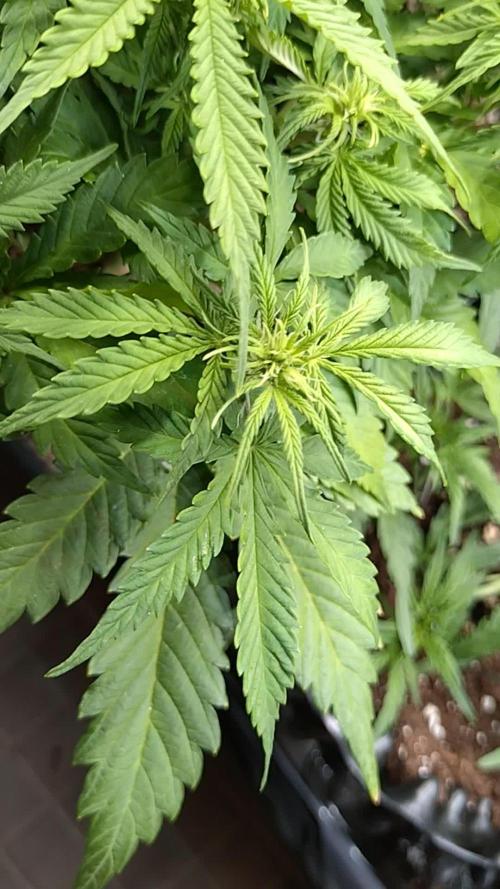
OMG! (Oh My Growers) what an adventure we have here!
Looks like in a few weeks we'll be deep in a zenzational jungle! 😍
They're definitely comfortable, I can notice the roots and mycorrhiza combo just taking over the soil.
Leaves are branching out and getting think which is great to see, not as thick as I'd expected though.
Next week they'll be transplanted to final 11L fabric pots.
Happy Growing!



Likes
38
Share


@FrulaFrulaki
Follow
A lot of spreading this week. They basically doubled in size if not more and are now starting to grow up. Due to this incredible growth I've cut some leaves of the bottom; they've just gotten over grown by other leaves and the top to let more light in.

Likes
2
Share


@High_Grade_Dadli
Follow
She is flourishing beautiful...now she's in mid flower gonna send her to the gym...let's see how she bulk up...#happy growing
Likes
27
Share


@Smokepurple137
Follow
I'm happy with the progress they have made, all have responded well to defoliation and LST. I'll be adding a few more light nutrients at some point this week. The gorilla zkittles is shorter than the rest but looks very sturdy and has plenty of bud showing already, I think this is because it started flowering maybe 7days before the rest and in them 7days the rest shot up rapidly! I'll update daily and try get some nice videos with lights out.

Processing
Likes
71
Share


@Witty420
Follow
Ok sorta lost track. Of acctual age. But she is huge mWveg lease ended and this photo was going onnly i did my whole grow with. Out a carbon filter.
To scared to flower.
So she will sit in
Amy. Ideas on what kind of yeild i am looking at. Cureently this 150.
At 24 hours.
Likly will flower with. This and another. 150.
Yeild estamites. Ideas.
I am just gonna bush her and defoilate. For air flow
Likes
11
Share


@RhodiesGrow
Follow
Day 30: Let grow, no water no feed. Tent Temp: 77º RH: 53º PPFD: 700 VPD: .67 kPa
Day 31: Do-Si-Dos Auto looking really good. Great node spacing and structure. Excited to see how she stretches in the coming weeks. Fed 4ml FloraMicro, 4ml FloraGro, 6ml FloraBloom, 2ml CALiMAGic, 1ml RapidStart, 2.5ml ArmorSi, 1ml Floralicious Plus, 1ml Liquid KoolBloom and 5ml FloraNectar. Solution Temp 70º PH: 5.8 PPM: 950 Tent Temp: 77º RH: 52% PPFD: 750 VPD: .66kPa
Day 32: Same as she ever was... on fire. Doing well today. Tent Temp: 77º RH: 51% PPFD: 800 VPD: .67kPa
Day 33: Let grow, no water no feed. Tent Temp: 77º RH: 52% PPFD: 750 VPD: .67kPa
Day 34: Do-Si-Dos received a slight hair cut. Just removed some small bud sites from the bottom and a few fan leaves. Watered .5gl RO water PH: 6.1 Tent Temp: 75º RH: 55% PPFD: 750-800 VPD: .58 kPa
Day 35: Looking healthy and happy. Starting to get a slight skunky smell in the tent. Tent Temp: 75º RH: 55% PPFD: 750-800 VPD: .58 kPa
Day 36: Ready for feed again. Cutting out FloraMicro on this feed, Cosmo and + Speed(s) showing slight signs of nitrogen toxicity. Fed 4ml FloraGro, 6ml FloraBloom, 2mg CALiMAGic, 1ml Floralicious Plus, 2.5ml Armor Si, 1ml RapidStart, 1ml Liquid KoolBloom and 10ml FloraNectar PH: 6.1 Solution Temp: 71º PPM: 925 Tent Temp: 76º RH: 52% PPFD: 750-800 VPD: .67 kPa
Likes
2
Share

@eldruida_lamota
Follow
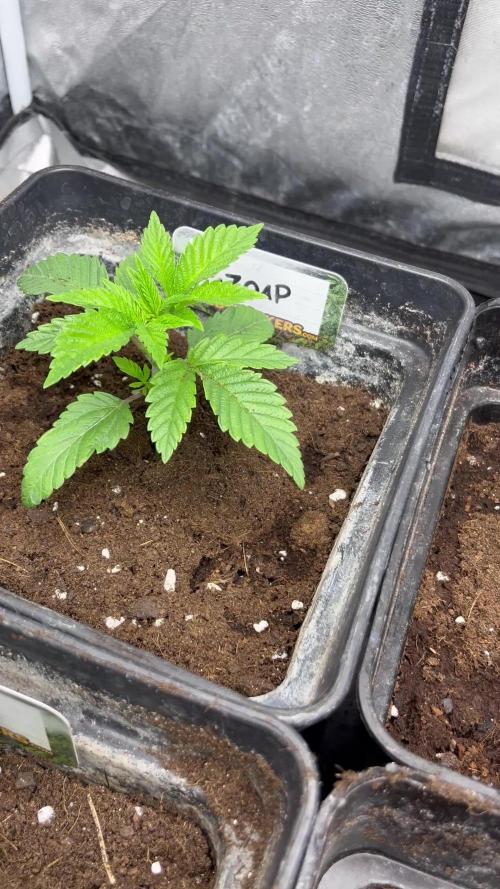
Que pasa familia, vamos con la tercera semana de vida de estas Fishy Zoap feminizadas de Seedstockers.
Vamos al lío ,se trasplantaron en macetas de 7 litros definitivamente.
El ph se controla en 6.0 , la temperatura la tenemos entre 24/20 grados y la humedad ronda el 50%.
El ciclo de crecimiento puse 16h de luz, el foco está al 50% de potencia.
De momento van creciendo a buen ritmo y tienen un buen color, estaban muy bien enraizadas al realizarle el trasplante se notaba la abundancia radicular.
- os dejo por aquí un CÓDIGO: Eldruida
Descuento para la tienda de MARS HYDRO.
https://www.mars-hydro.com
Hasta aquí todo, Buenos humos 💨💨💨
Likes
574
Share


@TOTEM
Follow
Hello everybody! This week will be the hardest one. I’ll have to work a lot inside the room, and even on GD to document all the changes. Last week I topped for the last time (in reality this happened the first day of this week), and finally stopped with high stress training. From now on, our attention will fall totally on ScrOG.
Day 43: Topped the 4 colas at the extremities. Red blood came out from them (see the photos). Amazing! Sorry for the bad quality, but I got just the phone with me when I did the job. When I took the second photo (a few hours later), the plant had already sucked up all the lymph. You can still see the red blood by the way.
Day 44: Set the timer to start with 12/12 from midnight of day 45.
Day 45: SO MANY THINGS HAPPENED TODAY. Flowering started, baby! 🤩 Today, in the evening, I worked for about 4 hours to prepare the ScrOG environment.
- Improved the LST before placing the grid.
- Took some photos.
- Removed the humidifier.
- Since my LED panel has half of the blue lights broken (this happened three weeks ago), resulting in 100W less of total potency, I added 3 new lights pointing where the panel is broken (2x 36W led bulbs and 1x 30W COB led light). I uploaded a photo and a video to better understand what I’m talking about. I even tried changing the broken LED driver, but it didn’t work, so now I’ll have to wait until the end of this cycle to send it to maintenance.
- Put 20gr of BatMagno (which is bat guano), 10gr of “Farina di Neem” (Neem Flour), and 50gr of Alghe, all of them over the soil. I’ll write something about these fertilizers at the end of the comment.
- 4.5L of tap water (corrected to PH6.5), which gave zero runoff. Haha, she’s drinking like a camel.
- Placed the grid.
- Took a few photos.
- Little defoliation.
- Took all the other photos.
- There we go!
I preferred not to add the bloom fertilizer now because I’m a little worried about overfertilizing this baby. During veg, she showed me she doesn’t like nutrients, so I’m just listening to her requests. I’ll add the bloom one as soon as she seems hungry again. By the way she’s just 20cm tall (I’m so proud of this result) and the grid is located a few centimeters above her. Let’s see if I switched to 12/12 at the right time: I heard this strain usually stretches for about 6 weeks!!! 😱😱
Let’s talk about the ferts I placed on the surface of the soil.
- BatGuano: it’s a mixture of organic fertilizers of natural origin and suitable to produce a high amount of organic nitrogen and phosphorus that can be assimilated at 100%. It’s a natural slow-release fertilizer for flowering: the raw materials used (guano, dried borlanda with ammonium salts, kieserite of natural origin, flagpole, meat meal, bone meal and dried poultry) are the result of a careful selection which ensures a low salinity and a gradual transfer of the elements. The phosphorus content in BatMagno (being organic) does not undergo insolubilization.
- Alghe: they are a portentose substrate activator made of a mixture of algae of the species Ascophillum, Fucales and Laminariales, obtained through a process of dehydration and grinding without the use of any chemical substance. They can be used during the preparation of the soil, and increase and strengthen the formation of the root system, mobilize the nutrients in the soil, reinvigorate the plants, protecting them from adverse weather conditions, help plants to overcome stress conditions and improve the quantity and quality of production. All of this is possible thanks to the presence of betaine, cytokinins, vitamins, auxins and alginates polysaccharides.
- Farina di Neem (Neem Flour): it’s a vegetable product based on Neem seeds, obtained from the extraction of Neem Oil through a process of cold-squizzing out, which increases crops, improving both growth and flowering, as well as strengthening the roots of the plants. The Neem Flour is mixed with nitrogen fertilizers, that slow down the conversion and leaching of nitrogen. Repeated interventions improve the endogenous resistance of plants to pathogens, creating an unsuitable environment for the development of insects and cryptogams. Due to the presence of important trace elements for plant life, it prevents imbalances and nutritional disorders. It also protects plants from Nematodes, ants, insects and soil larvae.
Let’s say Alghe is the most smelly product. My room now smells like seaweed! I need to figure out how to give her water now that the grid is on. I think I’ll plug a 2m pipe at the end of my watering can. That’s the most easy and cheap way to fix this problem. I just need to find the right size of the pipe. I’ll show you my solution next week.

