


Processing
Likes
Comments
Share


@Teamdirtbag3
Follow
This update is dedicated to @greenmachine.
Slurricane blast with Butane.
Dimonds and sauce.
Is there anything more to say?
It came out BEAUTIFUL. 🔥💎🔥💎🔥💎😁


Likes
169
Share


@Hattiwatti
Follow
Hola mosquitos.
14.5 Week has pass and these girls like to grow. Spare is couple days late for a reason. I think i wait maybe week more or when ever spare is ready to be topped and top it first and others couple days later. If others are growing main tops while spare can grow those 4 branches couple days it might catch others. Never tried so dont know does it works. Lets see how it go. Purple Nutz is biggest still 💪
16.5 couldnt keep my hands and do just opposite than planned. Topped all others but not spare. I left 6 branches for each of those three so i can choose the best 4 of them. But NO.
Purple nutz have skipped one shoot so it goes with 4 first. Second ones are thick and growing huge. Might be polyploids A.K.A leafy fuckers.
Green is just normal. Only that has those 6 branches.
Edge had 1 shitty and 1 abnormal branch at those first ones so those get cut and lives now with 4 branches.
Spare still untouched. Somekind of issues on leaves. Lets see in couple days if its ready for topping.
Didnt graft these to trunkenstein cause doesnt know how good it works. Took just clones and maybe next try go with 4 x clones from the best one in this grow.
18.5 topped spare and cut 2 extra branches from Green. Roots look great. Branches starting to take their places. Purple nuts is crazy. Those 2 abnormsl branches growing huge 🙏 cuttings all lookkng great. Purple Nutz branch is growing 5 nodes instead of 2. Crazy Girl.
With High Hopes 🍀
Processing
Likes
27
Share


@Hawkbo
Follow
Day late on the update, pics/vids were taken on time tho just been a crazy week of harvests and trimming and keeping up with these. I linked up with Rain Science Grow Bags on Instagram and got them to offer all my followers and friends a discount of 10% off entire order from their site with the code ' bangdang ' so if anyone is in the market for a pot upgrade use that code. I got them in the mail 3 days after I ordered. Reason I went with Rain Science is because they offer identical air flow for rapid growth as the radicle bags, just using a different material and a tighter knit so water doesnt flood out the sides during feeds and when you pick these up when the coco is dry, it wont fly all over the tent like with the radicles. They're the optimal bag for autoflowers especially. I figured out why the one stayed so short compared to the others, the base of the stem did a 360 so it's like a loop then it grew vertical.

Likes
18
Share


@maneaura
Follow
I really want to harvest it but the trichomes dont feel ready. Its pissing me off cuz i'm scared of harvesting too early. I flushed it though

Likes
8
Share

@DogDoctorOfficial
Follow
Mango Kush – Week 2 Flower (Week 6 from Seed)
Bloom boosters, high temps, new lights, and a little tribute to nature
Grower: Dog Doctor
Strain: Mango Kush (Pheno #1 & Pheno #2)
Environment: 8×8 Grow Room
Control System: Full TrolMaster ecosystem (Tent-X brain + WCS substrate sensors and more)
Lighting:
• ThinkGrow Model One
• ThinkGrow ICL-300 (x2 inner canopy lights)
• Future of Grow Black Series 600W
• Lumatek Zeus 465W Compact Pro
⸻
🌸 Week 2 Flower – Transition Mode
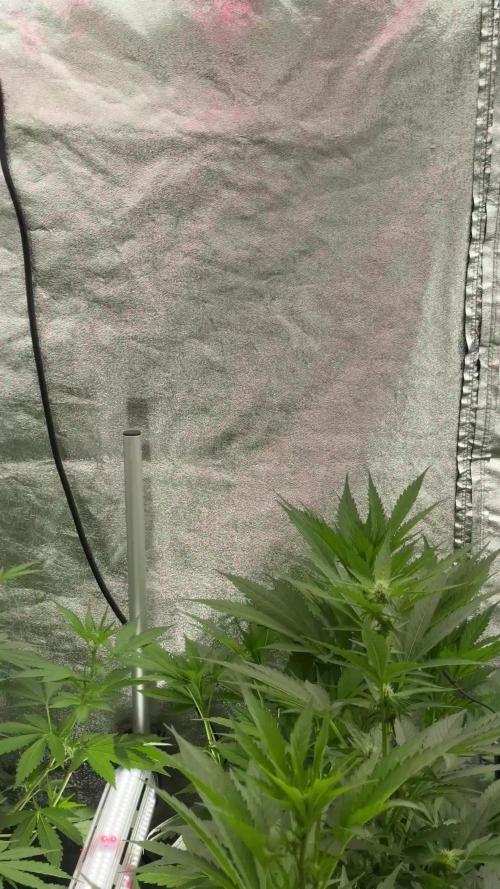
The Mango Kush sisters are looking absolutely stunning, even if this week was busier for me and I only managed a few photos. 🌱 Instead, I recorded a video walkthrough so everyone can see the whole room vibe, happy, lush, and full of energy.
Both phenos are pushing beautifully into flower:
• Pheno #1: Taller, branchy, already stretching into her flower frame.
• Pheno #2: Started later, but catching up fast, morphing gracefully into bloom.
The morphology shift is very visible this week, especially with the introduction of new bloom-focused nutrients.
⸻
💧 Feeding Update – The New Recipe
This week we swapped Start Booster → Top Booster and introduced a few Plagron classics to complement the Aptus base:
Water Mix (per liter):
• Aptus Regulator – 0.15 ml
• Aptus CalMag Boost – 0.25 ml
• Aptus Top Booster – 1 ml
• Plagron Power Buds – 1 ml
• Plagron Sugar Royal – 1 ml
• Plagron Green Sensation – 1 ml
We paused All-in-One Liquid for now, letting the slow-release pellets in the super soil do their work. The idea: less redundancy, more synergy.
💡 Experiment in Progress: I’ve used Plagron successfully in the past, but this is my first time weaving their trio (Power Buds, Sugar Royal, Green Sensation) into an Aptus base. It’s improvisation, yes, but that’s where discoveries are made. Let’s see how the Mango Kush girls respond!
⸻
🌡️ Environment – Riding the Highs
• Temps: Sometimes peaking at 34°C (🌬️ AC unit on the way soon!)
• Humidity: 60–70% at times
• VPD: ~1.89 kPa
• Soil Moisture: Watering when down to 19–20%
• Monitoring: TrolMaster WCS Substrate Sensor → feeding me EC, moisture, and root zone data in real time
⚠️ It’s not a “perfect” VPD chart this week, but the Mango Kush girls are handling it like champs. Sometimes stress teaches resilience, and these ladies are showing strength.
⸻
💡 Lighting the Room
The canopy is now supported by a serious multi-light orchestra:
• ThinkGrow Model One – Main engine, full spectrum power
• ThinkGrow ICL-300 – Inner canopy lights bringing energy to lower branches, helping all bud sites shine
• Future of Grow Black Series 600W – Supporting spectrum balance
• Lumatek Zeus 465W Compact Pro – Newly added, boosting the footprint and canopy penetration
Together, this creates an even distribution of photons across the room, minimizing shadow zones and preparing the girls for heavy bloom stacking.
⸻
🧠 TrolMaster Ecosystem – Grow Room Brain
The Tent-X controller, paired with WCS substrate sensors, has become my right hand:
• Live feedback on soil moisture, EC, temp, and RH
• Smarter watering decisions (no guessing, just data)
• Automation ready → The dream of a fully self-regulating grow room is coming closer
For now, I still hand-water, but soon automation will take over. Until then, it’s hands-on love every day.
⸻
🐝 A Tribute to Bees – Nature’s Pollinators
While we manage indoor canopies with LEDs and controllers, let’s not forget the simple magic of nature. Outdoors, it’s the bees that keep the cycle of life moving.
One photo I’m sharing this week is of a bee pollinating a flower, a reminder that without them, much of our food (and medicine) would vanish.
Bees are not just workers; they are guardians of biodiversity. 🌍💛 Let’s honor them in every grow, even indoors, where they cannot reach.
⸻
🔄 Recap So Far – From Seed to Now
• Week 0–2: Germination & seedling stage, Aptus Start Booster for early vigor
• Week 3–4: Veg growth, branching in Pheno #1, Pheno #2 catching up
• Week 5: Flip to flower, stretch begins, PPFD raised to 766
• Week 6 (Now): Morphology shift, bloom boosters added, lights upgraded, temps testing resilience
The Mango Kush girls have evolved beautifully every step of the way , two different phenos, one journey, one story.
⸻
🔮 What’s Next
• AC installation → stabilize temps into the sweet 26–28°C range
• Closer monitoring of Plagron + Aptus synergy → expect denser flowers
• Watch for first true pistils and bud formation in Week 3 Flower
• More light power on standby as the canopy fills out
⸻
📹 This week’s highlight: A video tour of the full room (since fewer photos this time).
📸 A few shots are included to show just how happy the Mango Kush girls are.
🌱 Thank you everyone for reading, learning, and growing along with us!
Join us on YouTube and Instagram for the full behind-the-scenes journey.
📲 Don’t forget to Subscribe and follow me on Instagram and YouTube @DogDoctorOfficial for exclusive content, real-time updates, and behind-the-scenes magic. We’ve got so much more coming, including transplanting and all the amazing techniques that go along with it. You won’t want to miss it.
• GrowDiaries Journal: https://growdiaries.com/grower/dogdoctorofficial
• Instagram: https://www.instagram.com/dogdoctorofficial/
• YouTube: https://www.youtube.com/@dogdoctorofficial
There’s a new series blooming and it’s more than just plants. It’s about process, patience, and paying attention.
⸻
Explore the Gear that Powers My Grow
If you’re curious about the tech I’m using, check out these links:
• Genetics, gear, nutrients, and more – Zamnesia: https://www.zamnesia.com/
• Environmental control & automation – TrolMaster: https://www.trolmaster.eu/
• Advanced LED lighting – Future of Grow: https://www.futureofgrow.com/
• Root and growth nutrition – Aptus Holland: https://aptus-holland.com/
• Nutrient systems & boosters – Plagron: https://plagron.com/en/
• Soil & substrate excellence – PRO-MIX BX: https://www.pthorticulture.com/en-us/products/pro-mix-bx-mycorrhizae
• Curing and storage – Grove Bags: https://grovebags.com/
⸻
We’ve got much more coming as we move through the grow cycles. Trust me, you won’t want to miss the next steps, let’s push the boundaries of indoor horticulture together!
As always, this is shared for educational purposes, aiming to spread understanding and appreciation for this plant. Let’s celebrate it responsibly and continue to learn and grow together.
With true love comes happiness. Always believe in yourself, and always do things expecting nothing and with an open heart. Be a giver, and the universe will give back in ways you could never imagine.
💚 Growers love to all 💚
P.S.- Why These Plagron Additives? – A Deep Dive
I’ve decided to complement the Aptus base with three Plagron boosters. Each one has its own role in the flowering process, and together they form a very balanced support system for the Mango Kush ladies.
🌸 Power Buds (1 ml/L)
• Purpose: Early flowering stimulator
• What it does: Power Buds encourages the plant to initiate bud development faster. It shortens the “transition phase” from veg into bloom, helping flowers form sooner and more consistently across the canopy.
• Why now: We’re in Week 2 Flower, the exact point where we want to signal the plants: “It’s time to build flowers.” Power Buds sends that hormonal nudge.
⸻
🍯 Sugar Royal (1 ml/L)
• Purpose: Enhances resin, aroma, and stress resistance
• What it does: Sugar Royal contains amino acids that stimulate the plant to produce more chlorophyll and secondary metabolites. In plain terms: richer terpene profile, stickier resin, stronger smell, deeper taste.
• Extra benefit: It also reduces stress from heat or drought, very useful right now since our temps have been spiking up to 34°C.
• Why now: As stretch continues, plants need to stay strong and not waste energy on stress. Sugar Royal helps them thrive despite less-than-ideal VPD.
⸻
💎 Green Sensation (1 ml/L)
• Purpose: All-in-one bloom enhancer for the second half of flower
• What it does: Green Sensation is a powerful 4-in-1 booster that improves:
• Flowering: denser, heavier buds
• Resin production: frostier flowers
• Nutrient uptake: more efficient feeding
• Soil health: stimulates beneficial microbial activity
• Why now: Even though it shines brightest in late flower, starting early allows the soil ecosystem and plant metabolism to adapt gradually. By the time we hit peak bloom, the system is fully primed.
⸻
🌱 How They Work Together
• Power Buds → Kickstarts flower sites
• Sugar Royal → Enhances resilience + resin quality
• Green Sensation → Boosts density and overall flower performance
The trio works like a team of specialists: one accelerates the start, one polishes the quality, and one pushes yield potential. Combined with the Aptus base (Regulator for strength, CalMag Boost for structure, Top Booster for bloom push), it’s a balanced, experimental, but very promising recipe.
💚 Growers love to all 💚

Likes
42
Share


@Hashy
Follow
Grow diary 11.
This grow I'm running 4 diaries, one for each strain in the tent. So my plan is instead of a week being 7 days, my weeks are most likely going to be every 10 days. I think I'm going to take pictures every 5 days so there is a mid week and end week shot.
I'm germinating in my propagation tent which is secret jardin dp60. I soaked the seeds in water for 15 hours. The seeds sank so i took that as a good sign. After the seed had soaked for 15 hours I then soaked the rockwool cube for 30 mins in PH 5.8 water with 0.5ml/L hydroguard. Gave the cube a shake and let it drain for 30 mins before placing the seed pointy side down so the top of the seed is level with the cube. Covered seed with a loose bit of rockwool. Placed into propagator with the sunblaster t5 lights on constant. After 71 hours the seed popped
TEMP
MAX 34.2C
AVG 30.1C
MIN 25.8C
HUMID
MAX 86.3%
AVG 80.3%
MIN 57.2%
VPD
MAX 2.07
AVG 0.83
MIN 0.64
Hopefully back in 10 days.
Likes
59
Share


@Salokin
Follow
These ladies continue to develop very nicely and lucky stopped stretching pretty much in the beginning of this week and the buds are forming super nicely. Since I also don’t observe a stretch in flower anymore, I decided to feed pk13/14 for the next week. It continues to surprise me how hungry these autos are, much hungrier than my glookies fro example. Unfortunately I realized that the plant on the very right of the box produces much smaller buds than the other two. I am pinning that on the fan right above her, so have pointed it slightly higher, but I guess the damage is done:(.
Likes
3
Share

@PapaTerps
Follow
Black Cherry Gushers - Barney's Farm x Backpack Boyz
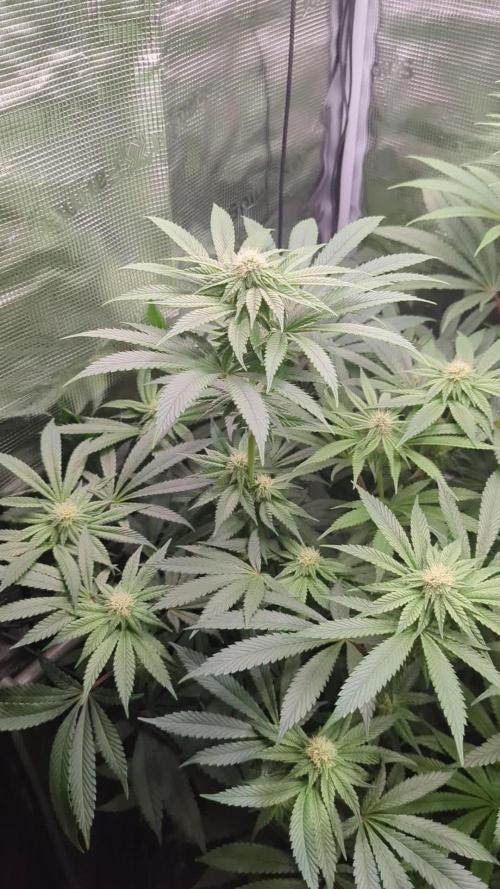
Day 74 - Watered with 3 liters of RO tap water with defined nutrients, pH'd to 6.3. This week, this beauty stopped stretching and started developing her flower, and I can easily say, shes got some of the most beautiful bud sites I've seen in my own personal grows - shes absolutely beautiful! As for working on her, not much other than removing a couple of fan leaves to improve light... shes easy going man 👌

Likes
45
Share


@Alpengrower
Follow
(CHOPPED AT DAY 100 ) great strain - long branching - strong lemon pledge smell - gigantic buds - pest resistant
this is the only pheno i grew , but i would definatelly try Lemon-Ak again


Likes
12
Share


@MrRaid
Follow
Water from day 50 abit early but everytime I grow fastbuds they are fast lol usually 65 days for me but that's with my advanced nutrients I've grown other strains like blue cheese exdous cheese chronic big buddha cheese pineapple express power plant with little to no food for the whole like of the plant and still got nice colas not as meny but very good smell and taste end results if I can get decent yeild with just these nutrients il be very pleased fast buds kush is doing really well possible 2.5oz of organic weed not bad conditions are budget effort made was low and still shows great growth
Likes
6
Share


@Izlti_ocelopilli
Follow
Cruising along, adding more fermented inputs, and WSC, will be flipping into preflower aug 1st and reducing my greenhouse light schedule from 5am to 6am and adding more red to the spectrum.


Likes
9
Share


@Kanabas
Follow
Unpopular Ankos Farm Sour diesel fem, smells skunky and has a scent of diesel, cant wait to taste her buds to see if its effects are good like her growth is.
Likes
9
Share


@Moonsmoker420
Follow
Ich denke die 2 Bruce Banner und die Critical kommen noch. Die sehen prächtig aus.

Likes
18
Share


@Dictator
Follow
I need to dry the buds in the dark at 20 degrees in 50% humidity, then transfer them to jars and continue curing 💨

Likes
8
Share


@Herbman420
Follow
Week 21 well just steal the same old water and PH 6.5 using bioby's nutrients she's looking happy plant starting to show a bit purple on the stems already and in the leaf stems as well so very nice venotype tune in for next week and thank you for looking at the diary


Likes
40
Share


@Dingle
Follow
Happy with everything this week no issues so far and both girls have started the stretching phase of flower.
Some defoliation over the week to help light penetration and airflow get to the lower parts of the plant.
Not much else to report
Peace ✌️
Likes
9
Share


@TiRobotProds
Follow
8e Semaine de floraison impeccable grossi bien chargé en résine irrigation a l'eau uniquement durant les 2 dernières semaines. J'ai vérifié les colas es celle-ci c'est fait polinisé par le male Sour tangie dawg mais rien de grave quelques graines, cela me permettra d'avoir une nouvelle génétique issue de ces deux plantes donc a voir ne pas ce précipiter. Elle dégage une plus douce odeur durant ces derniers jours.


Likes
8
Share


@MistaOC
Follow
18.02. F30
Day 30 of flower — and this run just keeps getting better.
Today I finally applied Bio-PK. Each plant received 1 liter with 10 ml Bio-PK. Slightly later than the official feeding schedule — maybe 2–3 days behind — but honestly, no big deal. The plants are in peak condition, deep green from top to bottom, no yellowing anywhere — not even in the shaded lower areas. That alone says a lot.
I’m expecting the Bio-PK to give the bloom phase another serious push from here on out. If things continue like this, the coming weeks should be explosive.
I did a very light defoliation today and removed a few leaves that showed minimal signs of powdery mildew. It was extremely minor and fully under control. The environmental conditions simply don’t allow it to spread. Still, I’ll be upgrading airflow soon — two additional AC fans will definitely go in. Prevention is key.
Thrips are completely gone at this point.
And here’s the crazy part: this whole run started as a simple test. I popped a random seed, selected it as a potential mother without knowing what to expect, took clones — and what we’re seeing now are those exact cuttings. A total mystery box… but one that performs on an exceptional level.
Current height: 1.37 meters. Only about 10 cm away from the light. I could raise it a little more, but they’re handling it perfectly. No stress, no bleaching — just pure pressure.
They’re pushing hard. Real hard.
This is, without question, the strongest run I’ve had so far 🌱.
