The Grow Awards 2026 🏆
Likes
Comments
Share
@GrowFunMD
Follow
I am now putting my weekly comments in the videos. Watch the videos for updates.
Likes
47
Share
All content on this diary is for inspirational and educational purposes only. The ideas shared are not a substitute for professional advice. This diary/account is not officially affiliated with Alan Watts or his estate. All materials are used under the principles of fair use. I honor the legacy of Alan Watts by sharing his wisdom respectfully and with the intention of inspiring awareness and self-understanding. 2nd net is up. Early bud formations are promising. holding up to the extremes pretty well, some leaves taking minor damage, but overall, she is holding up, gave her 1 night at 50F see how she would react, stressful. Not advised as it messes with her metabolism, but I want to see if it triggers any anthocyanin response. Love to see her purp up but no signs yet. Remember, For every molecule of glucose produced during photosynthesis, a plant needs to split six molecules of water. This process provides the hydrogen needed for synthesizing glucose and other organic compounds, while oxygen is released as a byproduct. Homework. If Rubisco activity is impaired and it cannot properly function or regenerate its substrate, the plant's leaves are likely to turn a pale green or lime green, a condition known as chlorosis. Essentially, Rubisco activity is highly regulated and susceptible to various environmental and metabolic factors that can cause it to become inhibited, leading to an apparent failure in RuBP regeneration due to a lack of consumption. Rubisco regeneration is intrinsically linked to nitrogen supply because Rubisco is a major sink for nitrogen in plants, typically accounting for 15% to over 25% of total leaf nitrogen. The regeneration phase itself consumes nitrogen through the synthesis of the Rubisco enzyme and associated proteins (like Rubisco activase), and overall nitrogen status heavily influences the efficiency of RuBP regeneration. RuBisCO is a very large enzyme that constitutes a significant proportion (up to 50%) of leaf soluble protein and requires large investments in nitrogen. Insufficient nitrogen supply limits the plant's ability to produce adequate amounts of RuBisCO, thereby limiting the overall capacity for photosynthesis and carbon fixation. Maintaining the optimal, slightly alkaline pH is crucial for the proper function and regeneration of Rubisco. Deviations in either direction (too high or too low) disrupt the enzyme's structure, activation state, and interaction with its substrates, leading to decreased activity and impaired RuBP regeneration. (Lime/yellowing) Structural Component: Nitrogen is an essential building block for all proteins, and the sheer abundance of the Rubisco protein makes it the single largest storage of nitrogen in the leaf. Synthesis and Activity: Adequate nitrogen supply is crucial for the synthesis and maintenance of sufficient Rubisco enzyme and Rubisco activase (Rca), the regulatory protein responsible for maintaining Rubisco's active state. Nitrogen deficiency leads to a decrease in the content and activity of both Rubisco and Rca, which in turn limits the maximum carboxylation rate, Vmax, and the rate of RuBP regeneration Jmax, thus reducing overall photosynthetic capacity. Nitrogen Storage and Remobilization: Rubisco can act as a temporary nitrogen storage protein, which is degraded to remobilize nitrogen to other growing parts of the plant, especially under conditions of nitrogen deficiency or senescence. Nitrogen Use Efficiency (NUE): The allocation of nitrogen to Rubisco is a key determinant of a plant's photosynthetic nitrogen use efficiency (PNUE). In high-nitrogen conditions, plants may accumulate a surplus of Rubisco, which may not be fully activated, leading to a lower PNUE. Optimizing the amount and activity of Rubisco relative to nitrogen availability is a target for improving crop NUE. Photorespiration and Nitrogen Metabolism: Nitrogen metabolism is also linked to the photorespiration pathway (which competes with carboxylation at the Rubisco active site), particularly in the reassimilation of ammonia released during the process. To increase RuBisCO regeneration, which refers to the process of forming the CO2 acceptor molecule Ribulose-1,5-bisphosphate (RuBP) during photosynthesis, the primary methods involve optimizing the levels and activity of Rubisco activase (Rca) and enhancing the performance of other Calvin-Benson-Bassham (CBB) cycle enzymes. Biochemical and Environmental Approaches: Optimize Rubisco Activase (Rca) activity: Rca is a crucial chaperone protein that removes inhibitory sugar phosphates, such as CA1P (2-carboxy-D-arabinitol 1-phosphate), from the Rubisco active site, thus maintaining its catalytic competence. •Ensure optimal light conditions: Rca is light-activated via the chloroplast's redox status. Adequate light intensity ensures Rca can effectively maintain Rubisco in its active, carbamylated state. •Maintain optimal temperature: Rca is highly temperature-sensitive and can become unstable at moderately high temperatures (e.g., above 35°C/95F° in many C3 plants), which decreases its ability to activate Rubisco. Maintaining temperatures within the optimal range for a specific plant species is important. •Optimize Mg2+ concentration: Mg2+ is a key cofactor for both Rubisco carbamylation and Rca activity. In the light, Mg2+ concentration in the chloroplast stroma increases, promoting activation. •Manage ATP/ADP ratio: Rca activity depends on ATP hydrolysis and is inhibited by ADP. Conditions that maintain a high ATP/ADP ratio in the chloroplast stroma favor Rca activity. Enhance Calvin-Benson-Bassham (CBB) cycle enzyme activity: The overall rate of RuBP regeneration can be limited by other enzymes in the cycle. •Increase SBPase activity: Sedoheptulose-1,7-bisphosphatase (SBPase) is a key regulatory enzyme in the regeneration pathway, and increasing its activity can enhance RuBP regeneration and overall photosynthesis. •Optimize other enzymes: Overexpression of other CBB cycle enzymes such as fructose-1,6-bisphosphate aldolase (FBA) and triose phosphate isomerase (TPI) can also help to balance the metabolic flux and improve RuBP regeneration capacity. Magnesium ions, Mg2+, are specifically required for Rubisco activation because the cation plays a critical structural and chemical role in forming the active site: A specific lysine residue in the active site must be carbamylated by a CO2 molecule to activate the enzyme. The resulting negatively charged carbamyl group then facilitates the binding of the positively charged Mg2+ion. While other divalent metal ions like Mn2+ can bind to Rubisco, they alter the enzyme's substrate specificity and lead to dramatically lower activity or a higher rate of the non-productive oxygenation reaction compared to Mg2+, making them biologically unfavorable in the context of efficient carbon fixation. The concentration of Mg2+ in the chloroplast stroma naturally increases in the light due to ion potential balancing during ATP synthesis, providing a physiological mechanism to ensure the enzyme is activated when photosynthesis is possible. At the center of the porphyrin ring, nestled within its nitrogen atoms, is a Magnesium ion (Mg2+). This magnesium ion is crucial for the function of chlorophyll, and without it, the pigment cannot effectively capture and transfer light energy. Mg acts as a cofactor: Mg2+ binds to Rubisco after an activator CO2 molecule, forming a catalytically competent complex (Enzyme-CO2-Mg2+). High light + CO2) increases demand: Under high light (60 DLI is a very high intensity, potentially saturating) and high CO2, the plant's capacity for photosynthesis is high, and thus the demand for activated Rubisco and the necessary Mg2+ cofactor increases. Mg deficiency becomes limiting: If Mg2+ is deficient under these conditions, the higher levels of Rubisco and Rubisco activase produced cannot be fully activated, leading to lower photosynthetic rates and potential photo-oxidative damage. Optimal range: Studies show that adequate Mg2+ application can enhance Rubisco activation and stabilize net photosynthetic rates under stress conditions, but the required concentration is specific to the experimental setup. Monitoring is key: The most effective approach in a controlled environment is to monitor the plant's physiological responses e.g., leaf Mg2+ concentration, photosynthetic rate, Rubisco activation state, and adjust the nutrient solution/fertilizer to maintain adequate levels, rather than supplementing a fixed "extra" amount. In practice, this means ensuring that Mg2+ is not a limiting factor in the plant's standard nutrient solution when pushing the limits with high light and CO2. Applying Mg2+ through foliar spray is beneficial to Rubisco regeneration, particularly in alleviating the negative effects of magnesium (Mg) deficiency and high-temperature stress (HTS). While Mg can be leached from soil, within the plant it is considered a mobile nutrient, particularly in the phloem. Foliar-applied Mg is quickly absorbed by the leaves and can be translocate to other plant parts, including new growth and sink organs. Foliar application of: NATURES VERY OWN MgSO4 @ 15.0g L-1 in a spray bottle. For those high-intensity workouts when 1 meal a day is just not enough! Foliar sprays are often recommended as a rapid rescue measure for existing deficiencies or as a supplement during critical growth stages, when demand for Mg is high. Application in the early morning or late evening can improve absorption and prevent leaf burn. The plant was getting a little limey yellow in the centre. Shortly thereafter, she was back in business, green mostly regenerated. The starting point [of creativity] is curiosity: pondering why the default exists in the first place. We’re driven to question defaults when we experience vuja de, the opposite of déjà vu. Déjà vu occurs when we encounter something new, but it feels as if we’ve seen it before. Vuja de is the reverse—we face something familiar, but we see it with a fresh perspective that enables us to gain new insights into old problems. Confidence is evidence... nothing more. You are confident because you have driven 10,000 times, you are confident because you have spoken 10,000 times. People think confidence is a feeling, but it's not. If you want more confidence, then you need to create evidence, take more shots, collect more data, build more experiences, take more risks; fail, confidence doesn't come first; it is the reward you get for doing the work. no one else wants to do.
Likes
126
Share
Yo my fellow gromies what’s cooking✌️ Day 56 has arrived and these pineapples are filling out nicely now. All starting to pack on some weight. They smell so good! These ladies will now be on plain water for the next 2 weeks to flush and finish up. It’s not great as one of them is a little behind but my drying tent is also my grow tent so I just hope they are all going to be ok the window for harvest. They should be. Big shout to all you for the love likes and comments through this grow. Until next time ✌️👊🏻
Likes
29
Share
------------------------------------ ~SEEDSMAN PEYOTE GORILLA~ ------------------------------------ Peyote Gorilla is a cross of Gorilla Glue #4 (Chem Sister x Chocolate Diesel) and Peyote Purple, a colorful phenotype of Bubba Kush. The potent, medicinal effect of the Gorilla meets the stimulating and uplifting high of the Peyote Purple. With a flowering time of around 70 days Peyote Gorilla has a typically Indica structure, medium-sized with large, broad leaves. Yields are exceptionally good; indoors growers can expect to yield between 500 - 650 gr/m2 while outdoors as much as 1500 gr/m2 can be realized. Resin levels are very high and this means that it is very suitable for making extracts and concentrates with. This strain's scent is sour with lemon, petrol, earthy and woody notes and these properties are reflected back in the taste. THC production is very high at between 22 - 26% with CBD at just 1%. The effect is a very potent, uplifting high which gradually evolves into a physically relaxing state that will be almost certain to ease any aches and pains. __________________________________________________________________________________________________________________________________________________________________________________________________________________________________________________________________________________________________________________________________________________________________________________________________________________________________________________ -Strain Characteristics- BREEDER/BRAND: Seedsman PRODUCT TYPE: Seeds THC GENETICS: Gorilla Glue #4 (Chem Sister x Chocolate Diesel) x Peyote Purple (Bubba Kush purple pheno) VARIETY: Mostly Indica FLOWERING TYPE: Photoperiod SEX: Feminized THC CONTENT: 22 - 26% CBD CONTENT: 1% YIELD: Indoor: 450-600 g/m2; Outdoor: 1500 gr/plant PLANT HEIGHT: 80-160 cm GROWS: Indoors, Outdoors FLOWERING TIME: 70 days HARVEST MONTH: September MEDICAL CONDITIONS: Fatigue, Insomnia, Pain, Stress TASTE / FLAVOR: Berry, Earthy, Fruity, Petrol, Sweet EFFECT: Euphoric, Powerful, Relaxing, Uplifting _________________________________________________________________________________________________________________________________________________________________________________________________________________________ _________________________________________________________________________________________________________________________________________________________________________________________________________________________ THE SETUP: ~Planted into Jiffy Peat Pellets that were hydrated with de-chlorinated water with SuperThrive added then ph'd to 6.0 @ 80℉ ~Grown 100% organic in 10g fabric pots with Mother Earth 70/30 Coco/Perlite medium amended with 2tbs/g of Down To Earth 4-4-4 / 2 cups/g of Earthworm Castings / 1tbs/g of Dr. Earth Flower Girl 3-9-4, 1tbs/g of Dr. Earth Bat Guano, 3/4 cup of Down To Earth Azomite and 1 tsp/g Down To Earth Fish Bone Meal. ~24hr light cycle during Germination / 19/5 light cycle for Vegetation and 12/12 for Flower ~Straight water ph'd @ 6.2-6.8 when needed and weekly Compost Tea's. __________________________________________________________________________________________________________________________________________________________________________________________________________________________________________________________________________________________________________________________________________________________________________________________________________________________________________________ Weekly Updates: 10/4- Week Eight of flower is here and we're only a couple weeks away from wrapping things up with this girl! Her flowers are continuing to bulk up and are covered in glistening trichomes. She appears to be starting to fade which is exactly what I'm hoping to see, meaning that she's just about used up the nutrients in her medium. I watered today with 1.5g of de-chlorinated water which was then ph'd to 6.6 @ 72℉ turned her pot and shot a few pictures of her. 10/6- Today I watered her with 1.5g of her usual straight de-chlorinated water that's ph'd to 6.5 @ 72℉ and turned her pot. She's definitely starting to fade, is still stacking her flowers, bulking up and has an incredible amount of trichomes which I'm beginning to monitor daily. 10/8- The routine of watering every other day continues like clockwork. Yesterday was a 'no water' day and I did a basic check over of the plant, removed a couple of yellowed lower leaves and turned her pot. Today she got the usual 1.5g of straight de-chlorinated water that's ph'd to 6.5 @ 72℉ and had her pot turned. I've also begun to check her trichome development with a digital USB microscope to try to identify the ideal harvest time which will be here in around two weeks +/-. 10/10- Well, Week Eight has come, gone and has been a trial once again of my patience with this Ten Week cultivar! She's so freaking frosty that I've wanted to chop her several times but, I know from experience, good things come to those who wait... then wait a bit more. I anticipate that she's not going to make the 70 days in flower 'suggested' by the breeder and will probably go in the dark later this coming week, but we'll have to see what her trichomes have to say! I've cut the wattage back on the HLG 650R to 500w at the wall now to simulate the way that sunshine becomes weaker as fall approaches due to the lower angle of the sun in the sky. This helps outdoor plants to know that winters on the way and they need to hurry up and complete their life cycle. Cutting the wattage back creates the same effect on the indoor plants, especially when coupled with lowered temperatures in the tent. I have also noticed that her water uptake has slowed. After her heavy watering on the 8th, her pot still had some weight to it and she was looking great so I went ahead and skipped watering her today, watering her tomorrow at lights on with her usual. Next week promises to be exciting so don't forget to check in! Harvest time is right around the corner and I'm getting stoked to see the results! 😎🙏💚 ~Thanks so much for checking out my diary! This epic run is in the home stretch with harvest fast approaching...Stay lifted and be Blessed! 😎🙏~
Likes
13
Share
A few weeks into flower now for the original Malt MIlkshake MM#1 with heavy purple punch face off terps and the MM#2 is smelling like a sweet gassy waffle cone DO NOT SLEEP ON CLEARWATER GENETICS!
Likes
16
Share
@nonick123
Follow
Día 15 (27/01) Ha reaccionado bien al trasplante. A ver como se desarrolla en los siguientes días! Día 16 (28/01) Muestra un buen desarrollo con las primeras ramas formándose Día 17 (29/01) Subo a DLI 40 Muestra un color verde estupendo 😍 Día 18 (30/01) Tras subir el DLI la temperatura en el indoor ha subido a de 22ºC a 26 ºC, de modo que va a acelerar las necesidades hídricas Se sigue desarrollando estupendamente 😁 Día 19 (31/01) Seguimos a buen ritmo Creo que debería haber regado este día... (Visto como estaba de seca al día siguiente...) Día 20 (01/02) Elimino las ramas más inferiores (1er nudo) que siempre suelen quedar débiles en el stretch Riego con 350 ml H2O RO Día 21 (02/02) Empieza a estirarse! 😍 Está sedienta! Riego con 350 ml H2O En una semana a floración! FastBuds 15% DISCOUNT code "NONICK" 2fast4buds.com @fast_buds_official_ @fastbuds.official 💦 BioTabs 15% DISCOUNT code "GDBT420" biotabs.nl/en/shop/ @biotabs_official 🌱Substrate PRO-MIX HP BACILLUS + MYCORRHIZAE @promixmitch @promixgrowers_unfiltered 💡2 x Mars Hydro FC1500 EVO Led Grow Light (2024 NEW FC 1500-EVO Samsung LM301H 150W LED) - https://marshydro.eu/products/fc1500-evo-led-grow-lights/ - https://www.amazon.de/dp/B0CSSGN5D8?ref=myi_title_dp
Likes
7
Share
Beginning of week 9, the usual SST foliar and and 5l via drip, also 5l of rain water into the reservoir yesterday . I’ll probably veg week 10 & 11 maybe , want to fill the scrogg and stretch the tops after flip
Likes
9
Share
@MistaOC
Follow
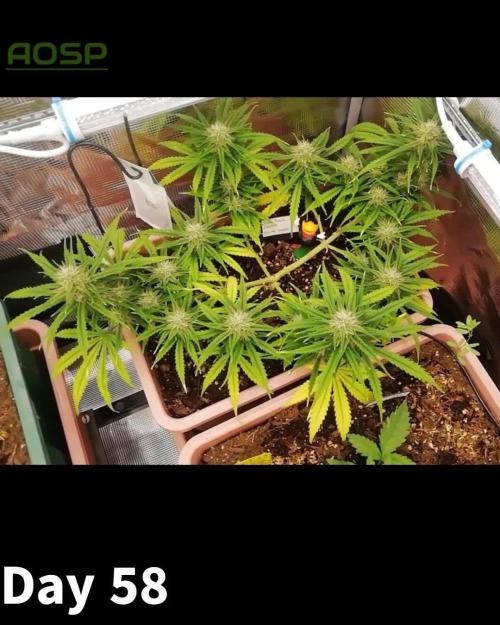
21.09.Update – Day 54 • We’re now deep into flowering, and unfortunately the thrips problem has not improved. • On the contrary, the population has completely taken over and has had a strong negative influence on this run. ⸻ Pest Situation • Despite thorough cleaning before the run and multiple measures during the grow (Neem, Nematodes, Predatory Mites), the thrips kept spreading and finally took control. • The infestation has weakened the plants noticeably, reducing their potential and overall performance. • For the next cycle, I will need to take even stricter preventive steps to avoid a repeat of this issue. ⸻ Plant & Bud Development • Even though the plants were heavily affected, the buds themselves are still relatively solid: • They are compact, firm, and nicely structured. • The terpene profile is very appealing, with a rich and delicious aroma. • Yield will certainly be lower than expected, but there is still a chance for a satisfying end product. ⸻ Notes & Outlook • This run shows how devastating thrips pressure can be, even under careful preparation. • Nevertheless, the buds are giving hope for a decent harvest in terms of quality and flavor. • The plan now is to finish strong, harvest what can be saved, and then prepare carefully for a fresh, hopefully pest-free start. ⸻ 🌱 Day 54 – Thrips have dominated the run, but compact buds and great terps keep the outlook positive for harvest quality.
Likes
158
Share
The week passed like in the movie * Leon * when he ran with his ficus from one location to another, like a partisan hiding and saving his flower 😂 I wanted to start cutting, but there are a lot of new stigmas on the buds, it was decided to leave for another week 🤙
Likes
17
Share
Day 120 - Getting closer to harvest day for this lady. She's huge and full of buds towards the top, smaller somewhat fat buds in the middle, and larfy buds at the bottom. I should have lollipopped her 1 or 2 more nodes up, especially for the colas that did not end up stretching as far as the others. Fed the lady water amended per this week's diary. Still seeing white pistils on her main colas so still 2 weeks away or so from harvest. I think this will be her last full nutrient feeding and for her next watering she'll get her last Cal-Mag feeding. I'll probably do 2 more plain water feedings from there and harvest once the soil is dried out after her last plain water feeding. I'm seeing a few of the lower buds of the lowest colas show some spots on the leaves so I just cut those parts off and hung to begin drying. It doesn't appear to be spreading but I'll keep an eye out these next few days. Day 123 - Fed the lady her last Cal-Mag amended feeding. Trichomes are looking more cloudy now on the middle buds. Will give 1 more plain water feeding instead of 2, I want to see how this bud will smoke with minimal flush versus the first lady harvested that was flushed more. Day 127 - Decided to skip completely flushing her to compare versus an over flushed plant. Harvested her today with the soil nice and dry.
Likes
29
Share
@Grileon
Follow
Did another topping today. Hope there will be 8 strong main branches. Also raised temperature and humidity a little and plant looks much better now. Roots still healthy and white. UPDATE: Did defoliation for big fan leaves and LST for all 8 branches.
Likes
6
Share
Plant is doing amazing! This is my first grow & I am so excited , I’m in the process of practicing LST , I am not the best but you learn as you go! Let me know what you all think! Do you think my light should be highered?
Likes
18
Share
If you like the sweet and fruity smell and taste this is the strain for you. But only if you grow organic thats when the taste and smell comes out strong.
Likes
12
Share
@Enki_Weed
Follow
Die letzte Woche vor der Ernte gibt's nur noch Wasser, CalMag und einen Tropfen SuperVit. Die Buds sind so schwer, dass die Pflanze schon schräg hängt, und der Duft ist einfach mega lecker!😋 The last week before harvest will only involve water, CalMag, and a drop of SuperVit. The buds are so heavy that the plant is already leaning to one side, and the scent is just incredibly delicious!👍
Likes
5
Share
Transplanted and separated into a 4x8 and 5x5 started to get deficiencies I think either cal or mag maybe even a little of both I flushed the soil in case ph was off in the soil then a couple had nitrogen deficiency so I gave them a tea last night will see how they look tonight when I’m off work once they are healthy I’ll flip to flower
Likes
Comments
Share
Day 25 of 4th week of Flowering Plants coming along nicely and seem happy with their environment. The smell is still really low as the room is vented 24/7 and this strain doesn't stretch much making it ideal for indoor cultivation, Although the strain does prefer a "Mediterranean climate" Meaning I'm having to run a 1.5 kw heater!
Likes
Comments
Share
Nute mix is now 150ml A, 150ml B, 50ml PK13/14, 100ml Rhizo, 25ml CalMag and 25ml cannazyme. Nute mix information PH: 6.4 EC: 2.0 Temp: 21c They are doing far better than I would have thought but the proof's in the pudding. Not that smelly except for lights off.
Likes
9
Share
@cannanova
Follow
Day 14: This week I'm increasing the humidity inside the tent with a wet towel and containers with water. I also removed the half bottles that were over the plants to generate extra humidity, because they got burned because of that, as you can see in the leaves, there are some brown snipes. Day 15: I added a towel and containers with water inside the tent to increase humidity, I managed to bring it up to 67% in some parts of the day. Day 16: I'm convinced Mario has thrips. I will add Potasium Soap in a couple days to kill any thrips possibility, and also add a moistmeter in the soil to know exactly if I'm overwatering or not. Day 18: Started with the feeding. Rizothonic + Vega at 25% of the recommended dosage. Added just 12ml of water on each plant. I don't want to overwater. Also added a new fan to the setup. Day 19: Added Potasium soap to the leaves during the dark hours. They look better already. Day 20: Added water + Solution of water with 25% nutrients I already created on day 18. I'm going reeeally slow with nutrients. D21: Forgot to make photos. Sprayed potasium soap solution at 2% over the plants, to avoid any pests.
Likes
3
Share
Semana 3 (1/8/22 - 7/8/22) Plantulas mostrando un buen enraizamiento. Se preparo una solucion de Elite 91 Myco Jordan iniciando la semana con: -PPM : 80 -pH : 5.8 3/7/2022 se transplanto a cubos de lana de roca de 15cm x 15cm. Los cubos fueron submergidos bajo una solucion de Mills Start R con: PPM : 100 pH: 5.7 En el transplante se uso Elite 91 Myco Jordan en forma de polvo para cubrir el hueco del cubo y cubrir las raizes de las plantulas para reducir el estres del transplante.
Likes
44
Share
@RakonGrow
Follow
Note : + jegliches Zubehör wird in der GermniationsWoche aufgelistet . Zeitraffer Videos folgen immer nachträglich. + videos werden so geschnitten das nur ein geschlossenes Zelt erscheint , ergo Fehlen paar reale Minuten (ca 1 Std) . Sanlight Tageslichtzyklus in Lebenswoche 6 : + 200PPFD - 1h - 750PPFD - 16h - 750PPFD - 1h - 200PPFD = DLI 46.60 + + Formel : DLI = PPFD * h * 0.0036 + + in LebensWoche 6 ist der Max-DLI ohne CO² : 45.0 Dazu kann man sich gerne die Zeitraffer angucken . Die Pflänzchen brauchen schon Ihre Zeit auf touren zu kommen . Ergo ist Sonnenaufgang und Untergang reines Stromsparen . Day 36: + 2Liter Flaschenwasser + + Dünger für Büte + + + Canna Terrar Flores (Achtung wirkt wie PH-) + + + Canna Boost + + + Cannazym + + + Canna Rhizotonic + Final : PH 6.2 Nach dem die Mangelerscheinungen wie gewünscht aufgetreten sind, gehts jetzt mit Blütedünger weiter . Sie hat sich prächtig in die neue Umgebung eingelebt. Wetter werte sind hier Super , also ist auch im Zelt super Stimmung :)) Videos folgen in den Tagen . Day 37: Sie wächst gerade noch paar Zentimeter :)) Blühten werden mehr . Day 38 : Und wieder das Licht etwas höher händen , den Sie wächst noch immer !!! Day 39 : + 2Liter Flaschenwasser + + Dünger für Blühte + + + Canna Terrar Flores (Achtung wirkt wie PH-) + + + Canna Boost + + + Cannazym + + + Canna Rhizotonic + + + Greenhouse Feeding BioEnhancer als PH+ + Final : PH 5.5 (das Urgesteinsmehl zieht das sowieso auf mindestens PH 6.5) + etwas Entlaubung der defiziet Blätter. Day 40: Day 41: + 2Liter Flaschenwasser + + Dünger für Blühte + + + Canna Terrar Flores (Achtung wirkt wie PH-) + + + Canna Boost + + + Cannazym + + + Canna Rhizotonic + + + Greenhouse Feeding BioEnhancer als PH+ + Final : PH 5.5 (das Urgesteinsmehl zieht das sowieso auf mindestens PH 6.5) Day 42: + 2Liter Flaschenwasser + + Dünger für Blühte + + + Canna Terrar Flores (Achtung wirkt wie PH-) + + + Canna Boost + + + Cannazym + + + Canna Rhizotonic + + + Greenhouse Feeding BioEnhancer als PH+ + Final : PH 5.6 , Drain PH 6.89