


Likes
Comments
Share


@Budz_Bunny
Follow
Grow Journal Week 3: Bloom Phase Progress 🌼
Hello dear growers and growerettes,
I’m thrilled to share the third week of the bloom phase in our grow journal! Here are all the details for Week 3:
Weekly Progress
We are at the end of Bloom Week 3, and the plants are thriving! Even our previously problematic plant has made a full recovery. My favorite plant, the one on the left, has claimed an entire half of the tent for itself. The stretch phase has now concluded, and I am very pleased with the results.
Watering and Control Systems
The watering system is operating smoothly, even with the increased water consumption of the ladies. The Blumat and TrolMaster systems are working without any issues.
Challenges
In Week 2, I performed a heavy defoliation since I had some time that day. Although it was a bit early, the ladies have recovered well. Due to limited time over the past two weeks, and this likely continuing until the end of December, I've been doing my best to keep the journal as current as possible.
Goals and Expectations
In the next two weeks, I expect my buds to start swelling, and I am very excited about this development.
Thank you for following along, and stay tuned for more updates! 🌿✨

Processing
Likes
13
Share


@Terp_Djiny
Follow
The new week has started. Right at the beginning I topped plants 1 and 2. Apparently 3 and 4 will follow on Friday. I have now also set the fertilizer to 0.6g per liter. The repotting unfortunately has to wait a day because my mycorrhiza order has not yet arrived.
Day 30: The dynomyco mycorrhiza arrived today. So i decided to repot the plants. The picture of the roots confirms my decision.
Day 32: I decided to tie down a few leafs.
Day 35: After topping you can see in 2 of the 4 plants that new shoots form from the interface. I am happy to see that the small plants have such a growth tendency. The awnings have already overtaken the size of my palm.
The plants became 3 times this week 300ml of water with 0,6g/l Hybrid Powderfeeding by Greenhousefeeding.


Likes
3
Share


@Kushizlez
Follow
Day 40-47 (May 31st- June 7th)
(Day 41) For the first time in this grow these plants are looking halfway decent. Smell is ramping up too. I finally feel optimistic about this grow.
(Day 42) The two jacks and the chunky blueberry are showing early signs of N/Mg deficiencies. I know it’s late in flower but since I’m experimenting with this tent, I’m going to give them one final feeding of nature’s pride 2-5-5.5 (tbsp) along with a teaspoon of oyster shell flour and some rock dust. Everything else I’m going to give a teaspoon of rock dust and oyster shell. There is no way these amendments will fully break down in time to be used by the plant but they could at least use the pH buffering and trace amounts of minerals after their recent leach.
Everything but the BAOGC is covered in pistils that don’t really match their bud size. I hope they fill into their pistils because an over abundance of hairs drops the bag appeal like crazy.
Over the last few cycles, indoor and outdoor, I’ve definitely learned that different strains and phenotypes mature at different times. Sometimes really radically too.
(Day 43) None of the plants are fading at all but they’re still looking good. Black garlic I know should be fading but remains dark green and toxed. I popped a developing seed out of the main bud too. I wonder if that blueberry herm branch pollinated it at all. It seems like plants don’t really like that Destiny dark matter soil by itself. I find it works better mixed with coco or promix 1:1.
(Day 44) I’m starting to think I might be mixing up the TWOG and BAOGC. BAOGC took forever to fatten up last round and the 2 phenos I suspected already look done. I was thrown off by the similar terps. The beauty phenos are definitely TWOG
(Day 45) God these Jack Herer’s smell good. Nothing but fruity funk. Almost like a vanilla or blueberry yogurt. I would say this stuff has the most overpowering smell in the tent now. I’ve noticed they’re starting to foxtail like crazy. Blueberry#1 too.
I’m watering a final low strength feeding of seaweed extract on everything.
(Day 47) Everything really fattened up this week. Even at the beginning of the week I was saying I didn’t think they would fill out. Jack Herer and BAOGC specifically made some big gains and nearly doubled their density and still have quite a way to go on them too! The smell has ramped up and finally, everything is looking happy and healthy.




Likes
4
Share

@Mrdub
Follow
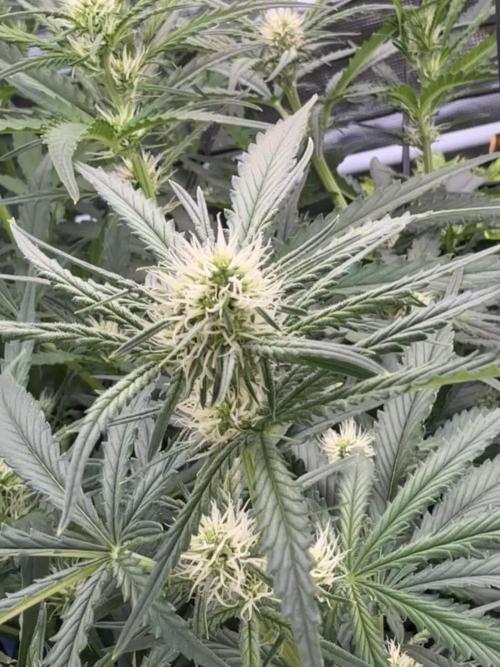
This should be the last week for this girl super loud got a soapy floral smell with some citrus on the backend colas swelled up nicely trichome coverage is thick thick looking like she got hit with a glitter bomb move it head a certain way super fat bracts and unlike the other two this one doesn't have the foliage barely had to defoliate her under canopy lighting is making the bottom colas looking gorgeous she taking a little longer cause if the cooler temps but the purple tips are coming out nicely tricomes nice n milky jus waiting for a little bit of amber to come in hitting her with a carbo flush then the last couple days I'll give her plain ol phed water I have loved watching this girl haven't had any problems with other then burnt tips and low temps kinda made her lag behind can't wait to get her dryer and inna grove bag so here's to another week of growing lfg

Likes
15
Share


@HighOhioAn
Follow
Growing for FastBuds420 has truly been an honor their genetics are truly Best in the world in my book strange our name beautifully mimicking the smells and appearances of their names. Pineapple express is one . They nailed the name right on the head. This plant truly smells just like a pineapple and almost looks like a pineapple once the fade starts one of the biggest autos I’ve ever grown truly thankful for the opportunity to grow this plant
FastBuds420. 4 Life 🌿💨💯


Likes
10
Share


@Stickygreens420
Follow
1/8/2024: so far the grow is not off to a great start. The browning that started on the cotyledon has spread to the other leaves and her growth has definitely slowed a bit. I used some water that sat out for a few days, so that may have been the issue, but I'm not sure why that would cause a problem. The ph was at 6.2. I also foiler fed them with some Tweetmint, which i think is the issue. I may hav3 not diluted it enough, causing the buring. I'm laying off anymore IPM until the olants bounce back. I also turned the lights down until i can get the plants back on track. It may just be the soil is too hot, but I have other plants in different soil that are showing the same symptoms, so it makes me think it's not the soil. I'm not giving up yet, but if things don't improve soon, I may just pop a new seed. This is my biggest issue with auto flowers. If the grow isn't perfect I could end up stunting the plant too much. I guess we will find out.
1/10/2024: Day 10 - the new growth is coming in healthy. I'm pretty sure the foiler spay I used last week is what caused the issue. I went back and realized I used way more of the concentrate than I should have, which likely burned the leaves. Let's hope that is the only mistake I make on this grow and it doesn't stunt the plant too much.
1/14/2024 - Day 14: she is looking so much better. All the new growth is as healthy as can be. I added a new light today. Replaced the Spider Farmer SF2000 with the AC Infinity Ionboard S44. I originally had the S44 in my 4x4, but recently bought a light with more Watts and better coverage for the 4x4. The S44 is probably overkill for the 2x4, but it fit, so I figured I'd give it a try. Only have it on at 60% at the moment and I'm getting about 500 ppfd, with a DLI of 30. Dropped the light cycle down to 18 on and 6 off as well. I have some photo period plants in the 2x4 as well, and I wanted to shift them to 18/6, so the auto is going along for the ride.
Likes
6
Share


@russrahl
Follow
Plants are really blowing up! Forgot what day I flipped these girls exactly but I’m guessing there just under 2 weeks into flower now. Cheers 💨

Likes
2
Share


@Comfrey
Follow
Diese Woche musste ich am Ball bleiben, ein krasser Stretch machte ein fast tägliches LST und eine dezente Entlaubung notwendig. Um einen schönen Ertag für zwei zu generieren, habe ich mich aufgrund der Lage unseres Balkons entschieden, alle Pflanzen kräftig runterzubinden. Zwei Ziele habe ich dabei verfolgt. Zum Einen haben wir hier maximal sieben Stunden mit direkter Sonneneinstrahlung. Durch LST erhoffe ich mir eine gleichmäßige Blütenbildung und Konzentration von Terpenen. Zum Anderen liegen wir mit unserem Balkon mitten im Dorfzentrum mit regem „Publikumsverkehr“. Das deutsche Cannabis Gesetz sieht vor, dass der Anbau nicht öffentlich einsehbar sein darf. Ohne das herunter Binden könnte man die Damen allerdings sehen. Die Anordnung der Pflanzen ist auch so vorgenommen worden, das sich eine Art Sonnenfalle bildet. Jede Pflanze und insbesondere die Blüten bekommen das maximal Mögliche an Sonneneinstrahlung. 🌞
Gegossen wird nun morgens und abends nach Gefühl.
Purple Punch Auto fühlt sich ganz wohl hier. Die Vorblüte sieht vielversprechend aus.

Likes
3
Share


@Luke_Lee
Follow
—————————————————————
WEEK 6 / DAY 37-43
Mars Hydro FC-E3000
Floragard Professional GrowMix
11L Plant bag made of fleece
Light: 50cm
Schedule: 18/6;
PPFD: 686-700 umol/m2/s
20° C - 50 RH
1L per Plant
PH 6,5-7
2ml BioGrow; 1ml TopMax ; 1ml BioBloom
1ml CalMag
#1 Royal Critical Automatic
#2 Royal Critical Automatic
Fan, extractor and pump ON 24/0.
—————————————————————
-24.02.2025
The first week of flowering begins today.
The light will be switched to an 18/6 light cycle from today.
The distance is 55cm with a value of 686 PPFD (PhotoneApp).
TopMax and BioBloom will also be added to the irrigation water from this week.
I am curious to see how the plants will develop in the coming weeks.
-01.03.2025
The plants are developing very well. They were watered on Tuesday 27.02 and today 01.03 with 1 liter of water each (2ml BioGrow; 1mlCalMag; 1mlBioGrow; 1mlTopMax).
The LST was adjusted again and a few leaves and popcorn buds were removed.
Total Time-1031:04h
Total Energy-166,72kWh
Likes
4
Share


@UKFieldNinja
Follow
Plants are comming up to finish, defoliated all fan leaf leaving sugar leaf only.
Plants given water only as plenty or residual nutes still in the soil.
Possiably going to harvest end of the week as new set are starting to stretch and need to be placed in the tent.
Likes
5
Share


@Virginia_Nugz_540
Follow
Okay so I’ve been slacking a bit on the grow-diaries, only because I’ve had a lot going on and also because I don’t feel obligated to do so because this isn’t a sponsored grow. It’s been nice to have a little break but I think I’m ready to come back at it full force again.
These girls are living their best lives, they are all the same age and they are all thriving. Floraflex nutrients, as well as some Silica, Regina-root, and a trichome enhancer called “Grease”!! Seems like the real deal. Watering every other day and let me tell you these girls are very thirsty. Defol as needed!
My new HLG Blackbird lamp fixture is out of this world. My 3 autos that you can also find in my profile absolutely blew up. I typically fit 4 autos in my 3x3 but now it’s essentially one Purple punch from Fastbuds and I had to cram 2 more inside basically because they are going crazy. Unfortunately I had to move them from under the blackbird and put them under a HLG350R and they are still going crazy. Basically what I’m saying is HLG Lamps=Crazy growth and amazing lamps!! HLG has a lifetime customer!
That’s it for now but check in next week to see the progress!
Thanks for tuning in. Until next time and as always, Stay Smokey my Friends!!! 💨💨💨
Instagram: Virginia_nugz_540
Sponsors:
Horticulture Lighting Group
HLG-Blackbird
HLG-600RSpec
HLG-350R Diablo (X2)
Discount code: Virginia_Nugz
Petra Tools
LTPRO 2.0 Backpack Sprayer
Trimbag
Standard Trimbag
Discount Code: Virginia_nugz
Fastbuds
Fastbuds Genetics
Goat and Monkey
Hydrokulture Store
4x4 Gorilla Tent
Likes
12
Share


@Homestickycannabis
Follow
Wow 😲 I was thinking this was going to be a total runt. As if turns out I am starting to think of it as having a lowryder auto. I know I know 🤣 it's not a lowryder. She's actually a Northern light crossed with Big Bud Auto from Seedsman. This little lady was barley 3 weeks old when I noticed her transitioning to flower. I was about to pull the plug and decided otherwise. I mean what could it hurt to grow her out. Anyway she's more than doubled in size and her bud sites are well formed, stacked up and just looking good.
Question? Would it be better to turn my 250 true watt down and move the light closer?,or run it full power and set it higher ?
Likes
8
Share


@MadeInGermany
Follow
Hey guys :-)
They are developing very well :-) .
Was watered twice this week with 1 l each (nutrients see table above)
Maybe I'll train them this week.
But I'll think about that spontaneously for reasons of space :-) .
Otherwise everything is going according to plan and I wish you a lot of fun with the update and stay healthy 💚🙏🏻
👇🏼👇🏼👇🏼👇🏼👇🏼👇🏼👇🏼👇🏼👇🏼👇🏼👇🏼👇🏼
You can buy this Nutrients at :
https://greenbuzzliquids.com/en/shop/
With the discount code: Made_in_Germany you get a discount of 15% on all products from an order value of 100 euros.
👇🏼👇🏼👇🏼👇🏼👇🏼👇🏼👇🏼👇🏼👇🏼👇🏼👇🏼👇🏼
You can buy this strain at :
Clearwater Seeds
Water 💧 💧💧
Osmosis water mixed with normal water (24 hours stale that the chlorine evaporates) to 0.2 EC. Add Cal / Mag to 0.4 Ec Ph with Organic Ph - to 5.8 - 6.5
MadeInGermany


Likes
24
Share


@GWSD82
Follow
*** RESULTS ARE IN ***
Final results are in! Updated with pics of dry-trim and weigh-in :)
Total yield was 228g of bud + 45g trim to be used for tincture. Total weight 273g / 9.75oz
This was way beyond what I was expecting! Was hoping to get around 6oz from this grow, so the final result has absolutely blown my mind.
But more importantly, it's a !!REALLY!! good smoke :) I've taken half oz off the top and put the rest into mason jars for curing, but even without a cure, the taste is good - sweet and creamy. The smell has come on LOTS through the drying process. When I chopped, the smell was fragrant, but not too strong. Now, you can smell it across the house and no mistake.
It packs a punch too, very potent high - Can't wait to share with a few friends :)
**********
Well, this has been an awesome experience for my first grow. Thankfully, these girls were super strong - they took a LOT of abuse in terms of high temps (up to 38C some days) and survived me being an idiot in the early days and not really knowing what I was doing. But here we are!
Almost didn't want to chop them down..... but I got over that pretty quick. Total wet weight from both was 1339g (47.8 oz), of which about 150g is popcorn / larf. Super impressed with the yield :) My aim is to be self sufficient, in terms of yield being able to last long enough for another grow cycle to complete. With a rough estimate of 3 months per cycle, and based on my current usage of approx half oz a week, I would need this to result in about 6oz when dried, and I think this could be achievable. I will update the dry weight in due course.
Can't speak to the quality yet. As tempting as it is to quick dry a test nug for a cheeky toke, I'll wait for it to dry properly, so I can really appreciate it. I've waited this long to harvest, another couple of weeks won't kill me. Also, I still have some of my current stash (hopefully the last weed I'll ever have to buy!). It's really difficult to be patient though, because DAMN it looks good. I'll give the buds a good manicure and dry trim when they're ready.
It smells really good too! The smell is not overly powerful, it doesn't slap you in the face like some weed does, but it's delicious! Fresh, bursting oranges, with just an undertone of that unmistakable weed smell......It's like The Man from Del Monte is stood behind you in a queue, and he has an eighth of dank in his pocket that he doesn't think anyone else can smell.
If I had to say I've learned anything along this journey, it's that it's better to be prepared. Research things that COULD happen and have necessary stuff on hand when you need it. Don't wait until that deficiency shows before ordering what you need and finding out it'll take 2 weeks to ship (fuck you, covid-19).
And there we have it.... will report back once dried for the final weigh-in and smoke report.
Stay safe, stay high :)
Likes
5
Share


@pzwags420
Follow
Cantaloupe haze needed a good flush brought runoff from 2000 ppm to 1100ppm will continue to monitor.
