


Likes
Comments
Share


Likes
2
Share

@DisTentAint4Campin
Follow
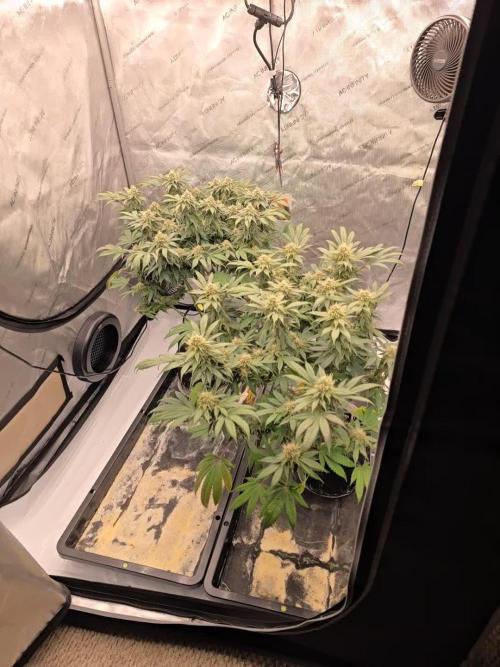
No complaints here they both swelling up really fat and dense im getting sweet mixed slight funk that hits you when you unzip both of these phenos DO NOT stretch at all in flower she literally stayed the same size as you can see in earlier veg pics 🤙⛺️ happy new year
Likes
1
Share

@Skynets_Growing
Follow
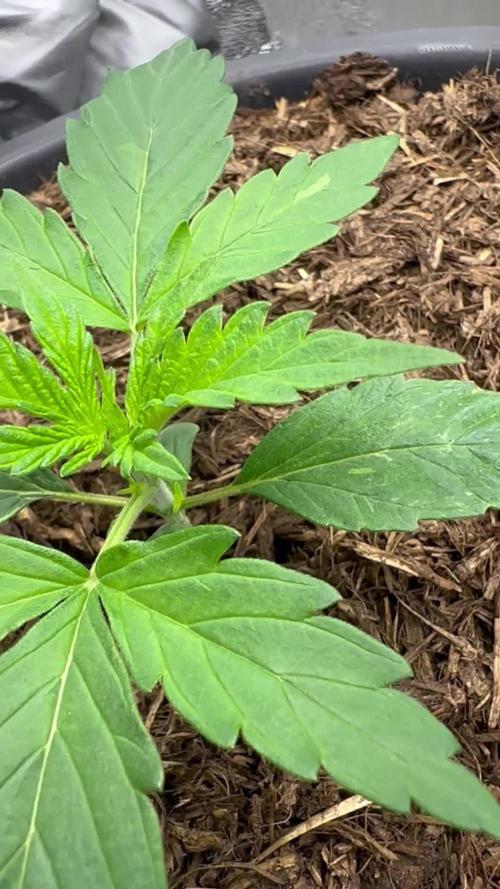
Little Elsa my Ice princess Start in her 3 week and you can see she grow every day more and more with her leaves. Until day 20 i give her a light LST for 2 Leaves. The plan to do nothing to her except watering is blowing away … That will be not the only thing…you will see the next weeks. ^^

Likes
5
Share

@psychonaut420
Follow
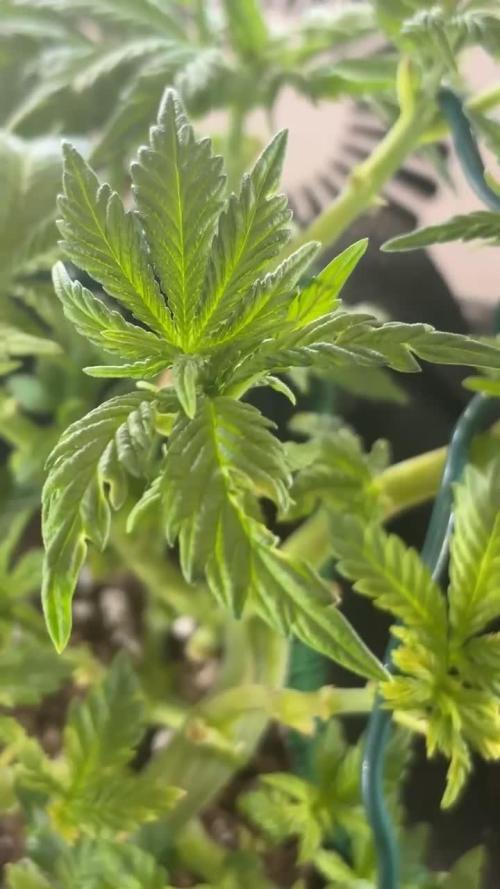
As December is near the growth is slower than would like but is still thriving with more stretching happening for the side branches and the mini side branches start to stretch as well one side branch I recently topped is recovering at a decent rate hoping for some start of preflowering signs within the week or 2

Likes
12
Share


@Kirsten
Follow
16.2.25:
I decided to check out the lower canopies of all plants to see if I need to get rid of any foliage.
I did get rid of a few small branches and leaves.
However, whilst I was doing this, I saw more garden pegs from my LST remaining.
There were about 6 or more in Pink Mist alone. Additionally, on Watermelon, there were some left in, too.
I'm so annoyed to see that because the plants are really stretching, and I could've potentially disrupted this by leaving the pegs in for all this time without realising it.
🤞 that I haven't compromised things too much. We'll see.
I watered today with 2ltrs of dechlorinated water PH'd to 6.3 containing the following nutrients;
♡ .8g Green Leaf Nutrients PK booster
♡ .5g Ecothrive Biosys
I ordered quite a few things for the garden. I got Greenleaf Nutrients Sea K(elp) and Mega Crop Parts A+B. To go with their PK Booster I got last month. I'm excited to try it all together. Next run, maybe just using these. We'll see how it goes.
18.2.25:
The plants are going crazy for water! Everything is getting used right up so fast!
Today, I decided to add some more Black Strap Molasses to add some carbs and other micronutrients. I'll add the jar with the label in the photos section above.
I watered a very small amount to each plant.
What I put in:
♡ Black strap molasses 150g
♡ 2g Sea K(elp) Greenleaf nutrients.
I dissolved everything in 4ltrs of dechlorinated water PH'd to 6.4.
19.2.25:
I received the majority of the garden purchases that I made. I'm still waiting for the Ecothrive Life Cycle. I wanted to top dress, but it's been delayed unfortunately.
I am using my Greenleaf nutrients products which I bought on Amazon. I got the Mega Crop 2 part system Part A and Part B. I have the Sea K(elp), and the bud explosion PK booster.
I really wanted to get some of their sweet candy asking read many positive reviews. Unfortunately, for me, this is unavailable to buy currently. So that's a little disappointing.
I needed to do a good watering so when my nutes were delivered today, I got excited 🤗
I watered 2ltrs of dechlorinated water per plant, PH'd to 6.4, containing the following nutrients:
♡ 1g Mega Crop Part A
♡ 1g Mega Crop Part B
♡ .5g Sea K(elp).
The plants drank this up within a few hours.
I'm going to try and hold off on watering in hopes that my Ecothrive Life Cycle will arrive so I can top dress and water it in then.
20.2.25:
My Ecothrive Life Cycle arrived yesterday, and the plants are ready for their top dress and a good watering in.
I have some Biobizz Light Mix, Canna Coco,and perlite. I'm going to use this as a base to mix my amendments in.
I'm going to fill my 5 gallon bucket with about 4.5 gallons of my top dress mix. I will distribute this across 6, 4-5 gallon pots. Then I will water in well with Greenleaf nutrients Mega Crop Parts A+B and Sea K(elp).
I've made a crude attempt to video mixing my top dress. Don't listen to the audio. lol, my YouTube didn't stop playing whilst I recorded this 😂
So anyway, I added the following amendments to the above base mix of 4.5 gallons;
♡ 3 TBSP Ecothrive Life Cycle
♡ 3 TBSP Vitalink Bat Guano
♡ 3 TBSP Ecothrive Charge
♡ 1 TBSP RHS Mycorrhizal Fungi granules
♡ 6 TBSP Ground Cinnamon.


Likes
31
Share


@MisterForestgreen
Follow
Erde ist eine sehr luftige aus einem Garten Fachgeschäft, welche sehr leicht vorgedüngt ist, mit einem NPK Dünger.
Möchte versuchen alles aus dieser Sorte heraus zu holen. Beigesetzt habe ich 1 Sack mit 10 Litern Plagron Perlit, welches vor der Zugabe gründlich abgewaschen wurde.
Eine ganze Packung Royal Queen Seeds Easy Boost habe ich von Anfang an der Erde beigemischt. Dann wurde der gesamte Airpot mit seinen 38 Litern Volumen, einmal mit Wasser gefüllt, damit der Organische Dünger aufquellt.
Dieser wurde dann mehrmals von mir durchgemengt, damit die aufgequellten Organischen Düngerteile sich möglichst gleichmäßig in der Erde verteilen.
Nachdem die Erde nach über 1 Woche durchgetrocknet war, wurde diese erneut aufgelockert. Dann kam der Samen Zamnesia Banana hinein, welchen ich 4 Tage vorgezogen habe.
Der Samen ist sehr, sehr Gut, da er von vorne herein eine sehr starke, praktisch absolut gerade Wurzel nach Unten gebildet hat.
Das weiß ich, da ich den Samen in einem gereinigten, durchsichtigen Plastikbehälter vorgezogen habe, in dem vorher geiles Minzeis aus dem Aldi drin war.
Start war der 07.11.2020. Habe Gestern das erste mal einen Hauch von dem Plagron Flüssigdünger auf 1 Liter Wasser gemischt, ca. 0,5 ml. Die kleine mochte die Dosis sehr. Mit PH Down habe ich den Wert von der Mischung auf den PH Wert 6.6 eingestellt.
Lampe ist ein SMD Chip mit 65W, genauer der Cree CXB 3590. 1
Der Photonenstrom liegt bei 137,5 µmol/s, was ich für einen Einzelnen Chip in dieser Größe für sehr ordentlich halte.
Auf den Wert komme ich, aufgrund der Angabe einer 4 er Lampe, die 4 solcher Chips enthielt. Diesen Wert habe ich dann durch 4 geteilt.
Das habe ich wiederum getan, weil ich keine Angaben mit einem Strahlungsdruck Messwert zu diesem Chip im Internet fand, nicht einmal in dem Herstellerdatenblatt.
https://proemit-576b.kxcdn.com/shop/media/pdf/b9/c8/eb/ds-CXB3590-1.pdf
https://www.ledrack-growled.com/wp-content/uploads/2018/08/Produktdatenblatt18-LedRackPlusKit-TechLed_Swiss.pdf
1
Weiter im Text,
dieser ist erfahrungsgemäß stark genug, für 1 Pflanze auf 500mm x 500mm.
Growbox ist ein Eigenbau aus OSB Platten mit 12 mm Stärke, welche 4 140 mm Lüfter mit Vorwiderstand, welche durch ein Universales 12V Netzteil versorgt werden, verwendet.
Reflektoren sind eine Rettungsdecke und Alufolie.
Ich bin gespannt wie der Grow wird, denke ich werde mehrere Triebe durch Topping und später durch Entlaubung.
Likes
114
Share


@GMSgrows
Follow
First off. I DO NOT USE TERRA AQUATICA NUTRIENTS. I USE FLORANOVA GROW AND FLORANOVA BLOOM
Girls are lookin pretty. The Gelato is one big fat lady. She is trying to overtake the Breakup Cake and the Silver Widow. No problems to mention except the weight of this plant. Stems grow out and ge weighed down by their size. Measured one of the side branches. 6ft 3" on the side branches. If you could straighten them out, this plant would be over 12ft wide.
The Silver Widow is 6ft now and the Breakup Cake is over 7.
Thanks for the looks like and interest in my grows.

Processing
Likes
17
Share


@greennug
Follow
plants looking great dinafem standing out from the crowd.my stardawg cuttings are thriving and a few of the fastbuds strains look beautiful.should be kicking into flower late next week. daily updates until harvest!


Likes
12
Share


@Greccobudz
Follow
Day 29 of flowering, she's filling out nicely. The video is Day 30 of flowering.
Likes
35
Share


@Chedderbob112
Follow
This weeks the ladies are looking lush a must say av had an issue with heat had to hav windows open because it’s roasting also as av explained until a find a safe base an expansion is out the question for now but will work towards it fuk that’s ma wanes xmas in that tent fingers crossed n a smoke n a wage ho ho ho here wee Fukin go @chedderbob112
Likes
13
Share


@KirbyFarm
Follow
This week i did LST on the gorilla cookies. The nugs are starting to fatten on a couple. Looking good so far 😎. Also the yellowing went away after a good few days of flush. Now rhey are on half of the recommended does of nutes.
Likes
1
Share


@Vincentmad
Follow
End of week 3, last week we removed bottom node and this week removed last node from bottom tpp, heavy lollipoping for pre veg for 2/3 weeks then flip to 12/12
Likes
20
Share


@THCanbisGrower
Follow
This is first week. i cover those plant with plastic glass.
because from my expierence. from the old day. there are many enermy of your plant such mouse or many insect can get in your grow tent.
so it's bad thing for me when the rat in my house come and ate all of my little plant when it age 1 weeks.
so it should not happen again. before your plant strong. this state of plant is weakest of your plant. this time must very be careful.


Likes
38
Share


@Green_Mountains
Follow
Another good week!! I defoliated the smaller of the 2 plants mid-week... I think she is doing very fine.
A small hiccup with the feed that same night. Only a few leaves are showing any sign on nutrient burn. I went ahead and fed them again today.
I plan on watering them in a day or two... they were very thirsty this afternoon!! So, I definitely need to up the watering. I've still been feeding 3 quarts twice a week.
Otherwise, all seems to be going well!!
They are frosting up very nicely!! So exciting!!
Peace!!
Update for grow question: @The8thChevron thanks!!! I pulled them and will hope for the best for now. So close to the finish line. If I see more trouble brewing I will pull the plant. I don't know how to answer directly to you on the grow question.... Thanks again!!
Likes
10
Share


@TheMedicatedFarmer
Follow
Day 23 of Veg: after watching the video I fully soaked my fabric pot for the first time too little to no run off. Since I am running organic I want to make sure not to lose those precious nutes. I had to place a space heater because the cold kinda snuck up on myself. With adjustment to the lights output the tent was at a cooler temp. So I had to substitute with a oscillation heater. So right now 59% humidity and 78 degree temp is set in the tent with 300ppfd. 2 oscillating fans and a 6 in exhaust fan. The LST on the 2 plants recovered great so far and adjusting the temp and light has shown a more deeper green the base of the main trunk is pretty solid. Thicker than my first grow for sure. I feel I was able to get the LST on the main trunk almost to a 90 to get that even canopy.
Day-24
New A/C infinity controller and fan installed, removed some components in the tent to clean it up. Wiped down the floor. The sock had so much dust in the filter from not having an air filter on the inlet. It’s crazy how much dust can be in a tent. The controller is set and seems so seem less. Tested ppfd again sitting right 310.
Day 25 New A/C infinity setup is working like a champ. So impressed. No watering today the medium is still moist to the touch. The LST has really stretched the bud sites out. My only other grow being Girl Scout cookies and Northern Lights the plants were a lot taller or maybe I just LST them later in their grow cycle. Also could’ve been the strain. Feeling good about this grow. Hopefully the timed amendments get me to the end. I am 90% positive I am suppose to feed and top dress 30 days into flower.
Day 26LST again today. I feel like this strain is short and bush and I am LSTing them too much. The plants are green and I hooked them up with 6.4ph water.
Likes
25
Share


@Tetiana_Riz
Follow
The week has passed quite normally, and our girl continues to delight us with her growth. She has already grown by a whole 10 cm, and her leaves have become even wider and greener thanks to the Xpert Nutrients fertilizers that we use with pleasure.
However, we encountered some unpleasant situations related to Sensi Seeds. We reached out to them with an issue of seed germination, not only with Skunk but also with other strains from Sensi Seeds. We provided them with all the necessary information about the purchase, although the receipt was not saved due to various circumstances. But, to our great disappointment, Sensi Seeds denied us, citing the lack of a receipt. We provided them with the date and place of purchase, videos, and photos, but it was not enough.
Honestly, we feel deep disappointment from Sensi Seeds' attitude. We were ready to immerse ourselves in the world of their genetics, knowing that many legendary strains were bred from their seeds. But now we are disappointed not only with the quality of their product but also with the lack of honesty and support. We no longer want to have anything to do with Sensi Seeds and will seek other ways to fulfill our dreams.
People, please take a look at the photos and videos and share your opinion. Did I provide enough evidence to Sensi Seeds, or should I have provided a receipt as well? I believe that integrity should come first. Sensi Seeds, you have shown your lack of integrity. People, I appeal to you: no honest and self-respecting grower can stand aside. I ask each of you to voice your opinion.

Likes
8
Share


@Elguacho420
Follow
Buenas a tod@s... Bueno otra semanita más para las niñas... Las dark devil... De momento va todo bien, todo en orden, las eh pasado a la maceta de 7 lt para q ya estén ahí, un buen sustrato y un poquitito de nutrientes para las raíces... A esta altura no podemos hacer mas q darles cariño y dedicación... De momento esto, luego más y mejor, a seguir trabajando duro... 💪🏻💪🏻 Buenos humos para tod@s... 😎⚕️💪🏻💪🏻
🇦🇷🤝🏻🇪🇦