The Grow Awards 2026 🏆
Likes
Comments
Share
@Kirsten
Follow
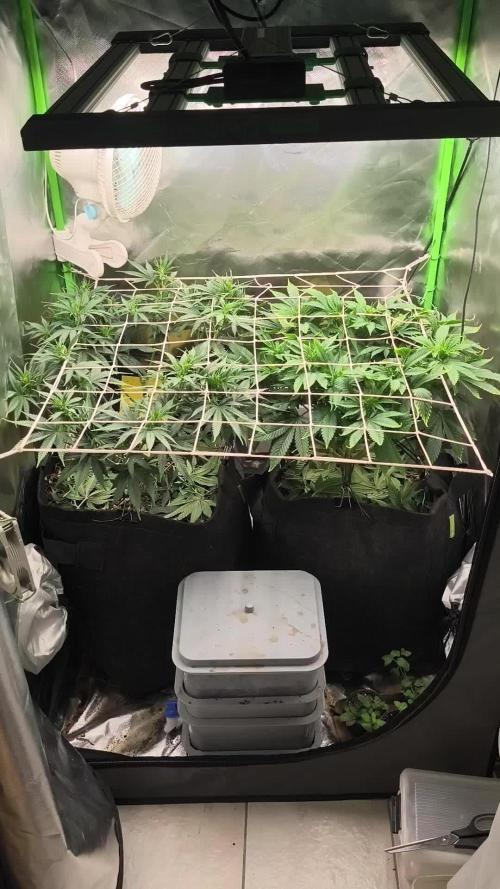
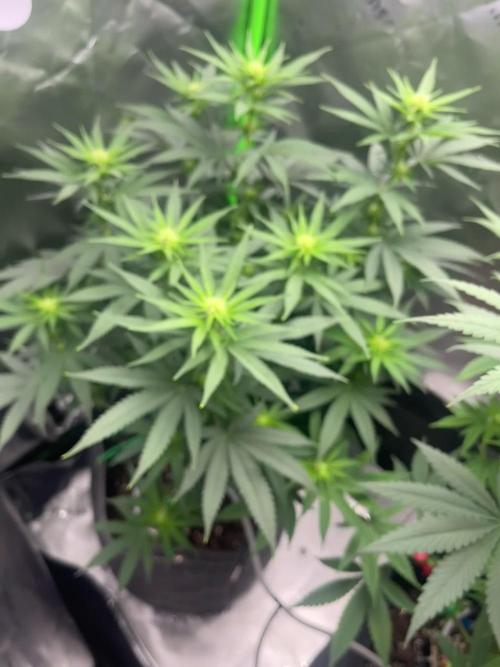
26.12.24: I have noticed light stress on my plants. I had moved the lights further away and increased the light intensity to 70%. Unfortunately that created some issues. Namely severe palour of the leaves. To try and rectify the situation, I've dimmed the lights to about 30%, staying at the same distance, about 30 inches away. I measured the par levels, after I did this. They should a reading of anywhere between 40 and 150, at the canopy of the plants. They are all different sizes. This seems to have improved the colouring on all plants. After this evenings watering, I will monitor recovery and increase lighting intensity again slowly. I am also using the light cycle of 21/3, so the plants have many hours more light to absorb, than for example 12/12 or 18/6. I am pleased with the progress, considering all of my mistakes! 29.12.24: So I finally gave LST a shot, it's probably a bit too late, however I really want to get the most of the triploid pheno, and I went a little crazy and LST'd all plants except 2, as they're too small. I did that late last night, this afternoon I was amazed to see the plants turn their leaves back to the light source. I'm glad I overcame my fear of trying it. I'm very excited to see them adapt and progress! 😁 there are videos above with before and after of my LST process. Thanks for checking out my diary 🍃 ✌️
Likes
21
Share
Fast Eddy Week 4 So ive been doing LST to get better light coverage and intensity on all parts of the plant :) this one was very small and bushy which made it hard to get all leaves a place to sit comfortably... ive also been watering using less water but watering more often to get oxygen to the roots :) these autoflowers dont care what i throw at them. fast eddy is alot smaller than my quick one plant but has a nice veg smell from the cheese x juanita the tearful. cant wait to get into heavy flowering! Finally im hoping to get 20-25g off this plant. and as its medical weed im really excited to try this. if it works then goodbye high thc strains! Thanks for following my diary :) it means alot! happy growing people!
Likes
18
Share
Green light is radiation with wavelengths between 520 and 560 nm and it affects photosynthesis, plant height, and flowering. Plants reflect green light and this is why they appear green to our eyes. As a result, some growers think that plants don’t use green wavelengths, but they actually do! In fact, only around 5 – 10% of green light is reflected from leaves and the rest (90 – 95 %) is absorbed or transmitted to lower leaves [1]. Green wavelengths get used in photosynthesis. Chlorophyll pigments absorb small amounts of green wavelengths. Light that doesn’t get absorbed is transmitted to leaves that are shaded out from direct light. This means that leaves at the bottom of the canopy get more green light than leaves at the top. A high proportion of green wavelengths compared to other colors tells lower leaves that they are being shaded out, so they are able to react accordingly. Lower leaves may react by opening or closing their stomata or growing longer stems that help the leaves reach brighter light [1, 2, 3]. When it comes to growing cannabis, many cultivators are interested in the quality of light used for the flowering stage. In many plants, flowering is regulated by two main photoreceptors: cryptochrome and phytochrome. Both photoreceptors primarily respond to blue light but can also respond to green, although to a lesser extent. Green can accelerate the start of flowering in several species (although cannabis has yet to be tested) [1, 4, 5]. However, once flowering has begun, it’s important to provide plants with a “full spectrum” light that has high amounts of blue and red light, and moderate amounts of green, in order for photosynthesis to be optimized. Green light mediates seed germination in some species. Seeds use green wavelengths to decide whether the environment is good for germination. Shade environments are enriched in green relative to red and blue light, so a plant can tell if it is shady or sunny. A seed that senses a shaded environment may stay dormant to avoid poor growing conditions [1]. Some examples of plant species where researchers have documented this response are: ryegrass (a grass that grows in tufts) and Chondrilla (a plant related to dandelion) [1, 6]. Although green wavelengths generally tell plants NOT to germinate, there are some exceptions! Surprisingly, green wavelengths can stimulate seed germination in some species like Aeschynomene, Tephrosia, Solidago, Cyrtopodium, and Atriplex [1, 6, 7]. Of course, light is not the only factor affecting seed germination – it’s a combination of many factors, such as soil moisture, soil type, temperature, photoperiod, and light quality. When combined with red and blue light, green can really enhance plant growth [1, 8]. However, too much green light (more than 50% of the total light) can actually reduce plant growth [8]. Based on the most current research, the ideal ratio of green, red, and blue light is thought to be around 1:2:1 for green:blue:red [9]. When choosing a horticultural light, choose one that has high amounts of blue and red light and moderate amounts of green and other colors of light. Not many studies can be found about the effect of green light on cannabis growth or metabolism. However, if one reads carefully, there are clues and data available even from the very early papers. Mahlberg and Hemphill (1983) used colored filters in their study to alter the sunlight spectrum and study green light among others. They concluded that the green filter, which makes the environment green by cutting other wavelengths out, reduced the THC concentration significantly compared to the daylight control treatment. It has been demonstrated that green color can reduce secondary metabolite activity with other species as well. For example, the addition of green to a light spectrum decreases anthocyanin concentration in lettuce (Zhang and Folta 2012). If green light only reverses the biosynthesis of some secondary metabolites, then why put green light into a growth spectrum at all? Well, there are a couple of good reasons. One is that green penetrates leaf layers effectively. Conversely red and blue light is almost completely absorbed by the first leaf layer. Green travels through the first, second, and even third layers effectively (Figure 2). Lower leaf layers can utilize green light in photosynthesis and therefore produce yields as well. Even though a green light-specific photoreceptor has not yet been found, it is known that green light has effects independent from the cryptochrome but then again, also cryptochrome-dependent ones, just like blue light. It is known that green light in low light intensity conditions can enhance far red stimulating secondary metabolite production in microgreens and then again, counteracts the production of these compounds in high-intensity light conditions (Kim et al. 2004). In many cases, green light promoted physiological changes in plants that are opposite to the actions of blue light. In the study by Kim et al. blue light-induced anthocyanin accumulation was inhibited by green light. In another study it has been found that blue light promotes stomatal opening whereas green light promotes stomatal closure (Frechilla et al. 2000). Blue light inhibits the early stem elongation in the seedling stage whereas green light promotes it (Folta 2004). Also, blue light results in flowering induction, and green light inhibits it (Banerjee et al., 2007). As you can see, green light works very closely with blue light, and therefore not only the amount of these two wavelengths separately is important but also the ratio (Blue: Green) between these two in the designed spectrum. Furthermore, green light has been found to affect the elongation of petioles and upward leaf reorientation with the model plant Arabidopsis thaliana both of which are a sign of shade avoidance symptoms (Zhang et al. 2011) and also gene expression in the same plant (Dhingra et al. 2006). As mentioned before, green light produces shade avoidance symptoms which are quite intuitive if you consider the natural conditions where the plants grow. Not all the green light is reflected from the highest canopy leaves in nature but a lot of it (50-90%) has been estimated to penetrate the upper leaves at the plant level ((Terashima et al., 2009; Nishio, 2000). For the plant growing in the understory of the forest green light is a signal for the plant of being in the shade of a bigger plant. Then again, the plants growing under unobstructed sunlight can take advantage of the green photons that can more easily penetrate the upper leaves than the red and blue photons. From the photosynthetic pigments in higher plants, chlorophyll is crucial for plant growth. Dissolved chlorophyll and absorb maximally in the red (λ600–700 nm) and blue (λ400–500 nm) regions of the spectrum and not as easily in the green (λ500–600 nm) regions. Up to 80% of all green light is thought to be transmitted through the chloroplast (Terashima et al., 2009) and this allows more green photons to pass deeper into the leaf mesophyll layer than red and blue photons. When the green light is scattered in the vertical leaf profile its journey is lengthened and therefore photons have a higher chance of hitting and being absorbed by chloroplasts on their passage through the leaf to the lower leaves of the plant. Photons of PPFD (photosynthetic photon flux density) are captured by chlorophyll causing an excitation of an electron to enter a higher energy state in which the energy is immediately passed on to the neighboring chlorophyll molecule by resonance transfer or released to the electron transport chain (PSII and PSI). Despite the low extinction coefficient of chlorophyll in the green 500–600 nm region it needs to be noted that the absorbance can be significant if the pigment (chlorophyll) concentration in the leaf is high enough. The research available clearly shows that plants use green wavelengths to promote higher biomass and yield (photosynthetic activity), and that it is a crucial signal for long-term developmental and short-term dynamic acclimation (Blue:Green ratio) to the environment. It should not be dismissed but studied more because it brings more opportunities to control plant gene expression and physiology in plant production. REFERENCES Banerjee R., Schleicher E., Meier S. Viana R. M., Pokorny R., Ahmad M., Bittl R., Batschauer. 2007. The signaling state of Arabidopsis cryptochrome 2 contains flavin semiquinone. The Journal of Biological Chemistry 282, 14916–14922. Dhingra, A., Bies, D. H., Lehner, K. R., and Folta, K. M. 2006. Green light adjusts the plastic transcriptome during early photomorphogenic development. Plant Physiol. 142, 1256-1266. Folta, K. M. 2004. Green light stimulates early stem elongation, antagonizing light-mediated growth inhibition. Plant Physiol. 135, 1407-1416. Frechilla, S., Talbott, L. D., Bogomolmi, R. A., and Zeiger, E. 2000. Reversal of blue light -stimulated stomatal opening by green light. Plant Cell Physiol. 41, 171-176. Kim, H.H., Goins, G. D., Wheeler, R. M., and Sager, J. C. 2004.Green-light supplementation for enhanced lettuce growth under red- and blue-light emitting diodes. HortScience 39, 1617-1622. Nishio, J.N. 2000. Why are higher plants green? Evolution of the higher plant photosynthetic pigment complement. Plant Cell and Environment 23, 539–548. Terashima I., Fujita T., Inoue T., Chow W.S., Oguchi R. 2009. Green light drives leaf photosynthesis more efficiently than red light in strong white light: revisiting the enigmatic question of why leaves are green. Plant & Cell Physiology 50, 684–697. Zhang, T., Maruhnich, S. A., and Folta, K. M. 2011. Green light induces shade avoidance symptoms. Plant Physiol. 157, 1528-156. Wang, Y. & Folta, K. M. Contributions of green light to plant growth and development. Am. J. Bot. 100, 70–78 (2013). Zhang, T. & Folta, K. M. Green light signaling and adaptive response. Plant Signal. Behav. 7, 75–78 (2012). Johkan, M. et al. Blue light-emitting diode light irradiation of seedlings improves seedling quality and growth after transplanting in red leaf lettuce. HortScience 45, 1809–1814 (2010). Kasajima, S., et al. Effect of Light Quality on Developmental Rate of Wheat under Continuous Light at a Constant Temperature. Plant Prod. Sci. 10, 286–291 (2007). Banerjee, R. et al. The signaling state of Arabidopsis cryptochrome 2 contains flavin semiquinone. J. Biol. Chem. 282, 14916–14922 (2007). Goggin, D. E. & Steadman, K. J. Blue and green are frequently seen: responses of seeds to short- and mid-wavelength light. Seed Sci. Res. 22, 27–35 (2012). Mandák, B. & Pyšek, P. The effects of light quality, nitrate concentration and presence of bracteoles on germination of different fruit types in the heterocarpous Atriplex sagittata. J. Ecol. 89, 149–158 (2001). Darko, E. et al. Photosynthesis under artificial light: the shift in primary and secondary metabolism. Philos. Trans. R. Soc. B Biol. Sci. 369 (2014). Lu, N. et al. Effects of Supplemental Lighting with Light-Emitting Diodes (LEDs) on Tomato Yield and Quality of Single-Truss Tomato Plants Grown at High Planting Density. Environ. Control Biol. 50, 63–74 (2012).
Likes
2
Share
@Dsant
Follow
D33 - 19/02 Haven’t changed the reservoir this week yet. A few burnt tips on Northern Lights #2, will probably go a little lighter on nutes next feed - she’s definitely more sensitive to them than the other ones. Overall great looking girls and nice growth. The #2’s are higher than the #1’s, nodes developing nicely and the scrog is definitely helping with lateral growth as well. — D35 Mixed a new reservoir with roughly 19L, at around 70% strength. pH 6.0 and EC 1.1 Humidity has risen a bit, so I installed the dehumidifier again. Apparently the tip burning has stopped, or at least slowed, which is good. #1’s are at around 25cm height, while #2’s are around 40cm height. — D36 Did another defoliation session as the girls really needed it. Cleaned a lot of the big fan leaves, airflow and light penetration is way better now. A few hours after and they’re super happy again.
Likes
10
Share
📅 D36 - 19/09 📜 I start a Flowering week, even if Lucy is actually in pre flowering stage. Adjusted SCroG and added 1,5 L of water. She drinks a lot, more than 2,5 L per day. Tomorrow I will receive an affordable EC meter and I will change the res. ✍️ 1,3 EC ♒ 5,8 pH 🌊 9,5 L 📏 20 cm 📅 D37 - 20/09 📜 Today I made a big defolation and adjusted LST and SCroG. A new res with higher EC (1,8) and pH 5,7. I put 12 L. to satisfy Lucy's thirst. ✍️ 1,8 EC ♒ 5,6 pH 🌊 12 L 📏 25 cm 📅 D38 - 21/09 📜 Nothing to report today. Lucy seems ok and she's growing fast. No signal of any problem on the leaves, even if the EC is almost 2. Tomorrow I will give her some more water. ✍️ 1,9 EC ♒ 6 pH 🌊 11 L 📏 31 cm 📅 D39 - 22/09 📜 pH and EC both falling down, so I decide to add 2 L. of pure water. I also put under the SCroG net some buds. ✍️ 1,9 EC ♒ 6 pH 🌊 11 L 📏 36 cm 📅 D40 - 23/09 📜 Lucy grown over the SCroG net and she started the flowering stage. According to the data sheet, from now to the harvest it should take about 7-8 weeks. Today I added 2 L. of pure water in order to lower the EC and raise the pH. I will keep this res until the new week and then I will change it, increasing Flora Bloom and lowering Flora Grow. ✍️ 1,8 EC ♒ 6 pH 🌊 10 L 📏 40 cm 📅 D41 - 24/09 📜 Nothing to report today ✍️ 1,8 EC ♒ 6 pH 🌊 10 L 📏 44 cm 📅 D42 - 25/09 📜 Lucy is flowering, so I will change tomorrow the res. I'm not sure about the EC level, I will see browsing around my favorites diaries. ✍️ 1,8 EC ♒ 5,8 pH 🌊 10 L 📏 48 cm
Likes
17
Share
@Naujas
Follow
To tell the truth, I am very surprised myself, how amazing she is FastBuds Gorilla cookies, she copes well with a small space:) she drinks 1 liter every day :) everything looks better than expected:) good luck to everyone.
Likes
34
Share
Welcome: thanks for dropping by. Drop a like so I can check out your grows, or not, I'll leave it down to you. So, the fun begins with Kosher Cake. Have 6 in the ground FB seeds in the ground only 1 kosher. The 2 Strawberry Gorillas are still not there with germination. Have started these on the 3 nutes above. These are best known as Voodoo Juice, tarantula and Piranha. These versions are from the ppl who hold the pattens and make a lot of ANs formulas. They have just improved upon most of the AN line up but they kept these the same. As they are tried and tested. Going to be running this lady on the full 19 Terra Power Line up. You can check these out on led-grower.eu/terra-power/ and read up on them for yourself. I'll be adding what's in them as for these 3 if you are interested look up Voodoo, T&P. Hopefully soon you'll be able to click on them and look em up when they join GD in the next wk or so. Happy with how the nutrients are holding a stable PH at 6 and these aren't even their PH perfect nutrients. So no PH - + needed. Sprayed each plant expect 1 gorilla zkittlez, for that 1 I used ANs line. These recommend 1ml/l for seedlings, AN I used 1.5ml/L. I use to use 2ml/L but they are seedlings so it's enough. Just a waiting game now. Will update as soon as these ladies start a popping. I laid a damp towel around the pots hopefully it'll up the RH. (Don't soak the towel it needs to be able to dry easily and in turn increase RH) Sprayed each 5 plants with this line up to start them off. As soon as leafs show I'll start them on a very very light feed. Will feed again in 2 days with the same mix. Another 100ml 1ml/l of each 3ml/l total 627ppm 6ph 21c temp. Have the smart intake fan at no 4 on 100% of the time. If I can't get desired RH after a day or 2 I'll turn the intake fan on 20/20 on/off and it'll make the RH be above 70% by doing this alone in a small space like 70x70. I really don't think I'm gonna have an Issue with low RH, but I have a feeling I'm gonna pay to have a low RH environment. 30/4/22 VD1. Have started her on jungle juice trio and a mix of terra Power enzymes and all there bud/resin enhancers will be used in conjunction with half strength recommend jungle juice dose. The feed is so low I've made up a 1l mix and that will do this and the 2 banana purple punches also. And I'll move that up to 1ml/L x3 of the jungle juice products next week. But for this week what's up above will be given every 2 days or when needed. 1/5/22 Slow growth on VD2. She's the runt most are reaching 2.5cm 3+ nearly on 2. Let's see what happens she's out of the ground and showing fan leafs, yday she had a crusty head. So all in all, going well. 6-8 FB seeds are up and thriving. 2/5/22 She's picked up fine. Got some height to her. Will continue the same course and watch her grow. Will update once more on on size and daily pics. 4_5_22 All Jungle juice&Terra Power grows are showing deficiency signs. I'm going to push up the EC this week I think. I do not want to stall them but I really think EC will be high in jungle juice because of the micro it has SO MANY TRACE nutrients it's crazy and it sends the EC sky high but there's so much of little bits of this and that I really think it can handle a higher EC. I'm going to 2x it or up it by a 1/3 for their watering 2moro as they were only fed yday. I've added biobizz calmag to help as my tap water is lacking cal mag when it comes into summer or so it stays on our water reports. It drops by 20%. 6/5/22 So, it's begun. I've created a negative pressure environment, 1st time, let's see if it makes an impact. On wk 3 onwards I'll be running the intake extraction for 5mins every 30mins and I'll have 2 co2 bags up. If the RH becomes a problem or temp I'll put the extraction/intake back on 100% of the time. The extraction fan/intake is set at a ratio of 2 to 1. (100% extraction 50% intake) making a negative pressure environment, best way to show you have done this, the walls in your tent should bow in lightly. Same Day. Okay, so this my last update. Going to run fans the same right up until flower and then I'll be sealing up my tent and adding 2 co2 bags. And will be adding a dehuimifier and setting at 45% And it checks every 30mins and if it's gone up it'll turn back on and bring down to 45 or set RH, so no co2 will escape. The temp will be bordering 30-33c and then when they go into their rest window they'll be transferred to to a negative pressure environment with low temps and 45-50%RH. I'll only be able to do this for the 3 weeks of pre flower. And maybe some more, it depends how hard the dehuimifier will be working, but i want dense buds and only way to improve that is by introducing Co2 and then a negative pressure cold environment for terps. Then I'll be putting them back into full negative pressure environment and the Co2 will be useless, again all depends how it's gonna affect my bottom line. That and I only have 2 intake fans. I'll be going into detail about my Co2 adventures the week before I'll be prepping them to be able to withstand high temps, so I'll gradually bring up the temps the last wk of veg 28c max and that way when I push it to 30-32c in pre flower she won't stress as much Thanks for reading, this will be it as for updates for this week other than her final 7th wk day. Will adjust EC 5th higher or so. gottagrowsometime
Likes
2
Share
@fabialien
Follow
Semana sel 2 de septiembre al 8 de septiembre 8 de septiembre, fotos del dia Jueves 5 de septiembre 2024. Se regaron con Floralicius plus adicionado con Hidrol-pez + vitaminas.
Likes
15
Share
@420keef
Follow
I used a macro lens from a fish eye kit you can buy for any phone to make that macro video, i highly recommend them it’s so easy to see when i can harvest , these are also very cheap but you do need a steady hand haha. I smoked some smaller buds about a week after harvest & it already tastes amazing almost like a reaalllyy sweet banana haha & the burn is good also i was suprised it was smokeable so fast. Fat banana is one of my favourite strains from now on! I also had 1 Sour Diesel in the tent but i’m still curing that one
Likes
9
Share
These girls are done.im just doing the final flush then I will have a smoke report in 3 weeks.im overall pretty satisfied with this grow.my plants would have been better but I had some unseen circumstances.
Likes
10
Share
@P_Silas
Follow
This one didn't do as well as her sister in a smaller pot but can't wait to try her out
Likes
11
Share
Finally found a balanced Nute mix 3-4 ml cal-mag 3-4 ml floranova bloom. The smell outside is wonderful where the vent exhausts. old leafs are being used up for energy, as the buds fatten looks normal for this plant. Whole this is top heavy now when it comes time to water the 3gal pot hardly keeps it upright. This is a 20% soil mostly coco mix so watering daily 1-2 times with 1.25gal.
Likes
13
Share
@Prakimi66
Follow
Amazing high. And the bud never smelled like hay. Not even at 85% rh . Still had smelled berries and gas. I am still curing on it and I am very happy with the results. Buds are hard as rock. Not having a big long cola but many big buds, was also good, good trichome production. When smoked cali kush and gorilla glue terpenes profile are felt instantl. It is a delifghyful experience that comes in wjth a cerebral high and turns later into a relaxed body high that leaves you smiling
Likes
2
Share
@fabialien
Follow
Semana del 9 al 15 de septiembre 2024. Las Positronics auto aun no Entran a Floración, y ya van bastante avanzadas, mientras las otras, unas van muy flacas y otras si van bastante gordillas.
Likes
8
Share
Likes
9
Share
Another really wet week The small one on the front right is not in a good shape I tried to add more water and to let it dry more but she didn't change The buds at in the center of the tent are growing crazy It does not smell too much (and I have allergies haha)
Likes
3
Share
@BossHogg6
Follow
I dropped the nutes from 4ml to 3ml and the yellow leaves were trimmed down. I added water in week 9 but didn't update the journal. It's been getting warmer and humidity has been rising. A dehumidifier was added last week to the outside room. I changed the system to have a lower humidity setting for the flower phase.
Likes
5
Share
Likes
13
Share
@Rob691
Follow
D-56 : The girls are great, beautyful and starting to stretch fast. No deficiency, no watering or feeding trouble, the temperature is a bit high but this variety are really comfortable with temperatures between 27 and 30°C, so I maintain it around 27-29°c during the day time. The horizontal space is fully occupied already. But, I hope the Choco Haze won't be too bushy, even if I'll continue to reasonably defoliate to let light and fresh air go through the canopy. As I start the second flowering week, the flowers should apear... can't wait to see the first ones ! One of the four ChocoHaze is growing a bit slower. What is weird, is that it's the one in the center of the grow room. Isn't it supposed to be the one that have the bigest amount of light ? I guess it comes from this specific phenotype.... we'll see, maybe she'll explose in the next days ! Who knows !
Likes
Comments
Share
@loyallion
Follow
PPFD 300-400 PPFD Start brewing compost tea 10/10 at 1500, for 24hrs.