


Likes
Comments
Share


@Glen1818
Follow
Led runs on 74watt, grow very fast
Removed some large leaf,
On day 28 removed again larger leafes , think i will send them in the flower in a few days

Likes
37
Share


@XperencdGmanXG
Follow
now that the plant has fully recovered it is growing nicely, i will leave it for min. 2 more weeks before I flip to flower. I have decreased light intensity to encourage some stretch.

Processing
Likes
1
Share


@420organicpharmacy
Follow
we are known for our legitimacy , discreet delivery ,shipping and vacuum sealed packages and we have tons of customers ordering their medication from our website , currentline we have top grade A rated medications for you all free to visite our site and place your orders
current we have
-vape pen
-cartridges
-marijuana oils
-top garde strains
website...... 420organic-pharmacy.com
or wickr organicphamacy


Processing
Likes
3
Share


@Fergie
Follow
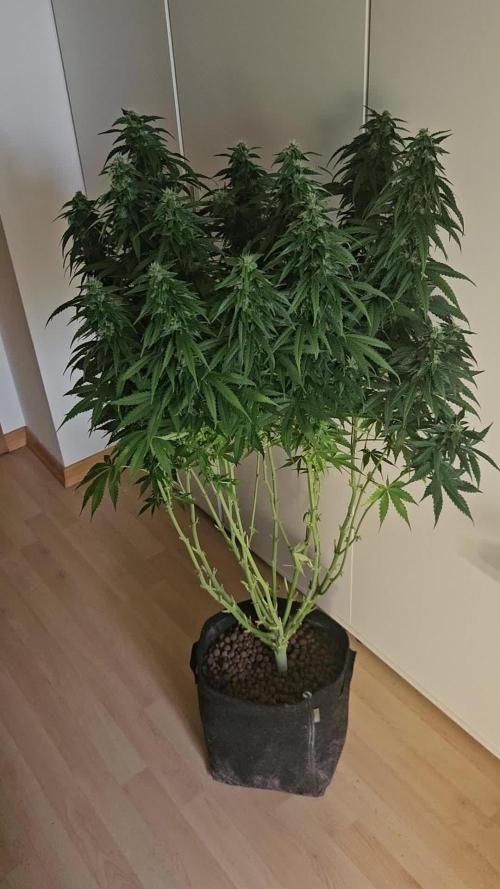
Hey guys so here is my blue cheese mutant . Finally bushing right out and the pre flower is well under way . Really looking forward seeing how the lady turns out as I have always had good results mutants in past .
Likes
37
Share


@OrganicPower
Follow
It’s warming up outside so the a/c and dehumidifier are working a bit. Got the lights on during the night so just a few hours at lights on they work a bit hard. Cleaned up underneath removing any sucker shoots and leaf that was near the soil. Not much really. Mostly on #3 as I didn’t train out the branches as much and she grew tighter together, so I removed mostly all inner growth blocking light and that allowed a lot more penetration and flow. Left a few leaves below to die off naturally…more the better. Gonna put some Grub Grenades in the pots with some yellow sticky cards. Not because I see anything, just being cautious. I do see what looks like Springtails but don’t seem to be an issue yet. Still looking green and healthy so I’m happy!
Grow on!
Update
Made a few adjustments. I let the tops grow into the tsw2000, 18” to tops. I didn’t like how they looked so I raised it back to 24” where I’ll keep it. The “Kind LED” I know from previous grows that it can’t get closer then 24”. But this is my first run with “Mars” so I’m still figuring out the distance for my setup with additional overlapping light intensity from other lights. With that being said another pod failed so I’m down 2-Kind LED’s now. Gonna remove all old tech and use all newer TS series lighting. All Mars moving forward. Seems to be a great light and when compared to other quality lights you can’t beat the price!

Likes
3
Share


@GrownwithLED
Follow
The plants are growing like and hell and some plants more than others. I therefore have to super-crop the plants, which is a method promoted by SOMA from SOMA-Seeds. I take the stem of the plant at appr. 20 cm under the top, directly above an internode, and squeeze it hard between my fingers. So hard that I can feel the fibers brake inside the stem. I squeeze in a circle around the whole stem and then bend the stem sidewards until the whole top of the plant is bent 90 degrees to the side or even points downwards. This way I dont have to top the plants and save the big top buds. The stem will heal and the plant will continue to grow, just at a lower height. I use this method since many years and it works GREAT. The BIO-TABs nutrients still do thier job VERY WELL, all plants have a healthy green color. The SANlight EVO4-120 LED-lamps are still hung at 75 cm distance from the top of the pants and do an OUTSTANDING JOB.


Likes
3
Share


@BLAZED
Follow
Germination (4-6 to 16-6)
Royal Queen Seeds - Haze Berry.
Genetics: Blueberry x Shining Silver Haze.
20% THC, 40% Indica, 60% Sativa.
9 to 11 weeks flowering time.
Taste: Blueberry, Earthy, Fruity, Pepper.
Effect: Long Lasting, Physically Relaxing, Powerful.
I chose this strain because i planted one seed a couple of years ago in my yard, it grew very tall (long internodes) and the end product was one of the best tasting weed i smoked till this day.
The blueberry taste was far on top! So i decided to try this strain out once again. I'm praying i will have that gem with those terps again!
4-6
Today i put 2 Haze Berry seeds into a wet coffee filter to germinate.
6-6
After 48 hours the 2 seeds are ready to be put into a 0.5L pot filled with some Plagron Lightmix.
The lightmix has some nutes for the first 3 weeks or so, i will feed nutes when i transplant them into 18L AutoPots with 70/30 Coco-Perlite.
I made a feed with 0.5 gr Calcium and 0.2 ml Rootstimulator per liter. EC: 0.4 PH: 5.8, and watered the pot a bit.
I let them stay in the dark untill i see them above the soil.
7-6
After 24 hours they are above the ground and i removed the plastic foil covering the pots.
8-6
Temperature: 19.5 to 24.1 degrees
Humidity: 41% to 70%
Watering: 20 ml.
9-6
Temperature: 18.8 to 23.4 degrees
Humidity: 62% to 74%
10-6
Temperature: 19.4 to 23.9 degrees
Humidity: 60% to 74%
11-6
Temperature: 19.4 to 25.2 degrees
Humidity: 43% to 71%
Watering: 25 ml.
12-6
Temperature: 21.2 to 25.4 degrees
Humidity: 44% to 60%
13-6
Temperature: 22.2 to 25.9 degrees
Humidity: 44% to 71%
Watering: 15 ml.
14-6
Watering: 60 ml.
A week later and today is the last day of the germination phase. They are starting to grow faster from now on.
Likes
29
Share


@Myrcene_Dream
Follow
-Watering a bit once a day
-Noticing a bit of yellowing on bottom leaves so I think it’s time for a little top dress soon
-Started showing a few pistils already

Likes
9
Share

@Hempcules
Follow
WEEK 11
My OG Kush really kicked into high gear this week. The flower volume has increased massively, and it looks like this trend will continue for a while. With the insanely high number of shoots and buds, this is definitely going to result in an incredibly strong yield.
The only thing worth criticizing is the high leaf density, but we’ll see how that develops over time. I increased the nutrients because the plant is genuinely very hungry. This grow is making me truly happy.
PPFD: 1000µmol/m²/s
Water: 3x water 2x nutrient solution
Vpd: 1,8Kpa

Likes
13
Share


@ArtisticGrown
Follow
This week has been great.I'm glad that I was able to pull the plant when I needed to. The weather out here isn't always the best coming towards the end of October. How ever i handle it the best we can. What ive learned to do is wet trim before hang dry. Heres some phots of these glossing nugs. Iknkw ill lose a bitin water weight but im happy none the less. Fire 🔥
This has been a great grow, I learned a lot from Growing out here in new mexico. It was amazing to be able to train these plants 4 into one using training techniques. LST, HST, Defolation & topping all play a roll. It is fun to learn and sharpen my skills.
I hope everyone enjoys my diary.
Thank you so much Divine seeds. I appreciate the free seeds and the friendly community competition 👌
There's a lot of good growers outthere and I wanna learn from all. Much love ❤️ I'll be back with a smoke review soon


Likes
15
Share


@Huckleberry39
Follow
Today is the start of GC's 4th week. I started tying her down...evening up the canopy a little bit. I usually get rid of the 1st and/or 2nd node, but hers are long enough I went ahead and kept them. Her canopy really opened up nicely, and everything is pulled down pretty evenly. She is going to be really nice. I haven't introduced any nutes except what is in the FFOF soil. I will start with a small feeding in the next week or so depending on what she tells me. So far I. Super impressed with 420 Fast Buds!!!!
Likes
25
Share


@Kindbudz
Follow
This was an enjoyable and amazing learning experience and I look forward to trying to use coco again in the future. Thank you to Grow Diaries for making an amazing platform for people to gather and support one another! And thank you to the community for helping me through this experience!
Likes
22
Share


@SirBudAlotts
Follow
I don't know what I done 😕..
But she started flowering already 🙄..
I mean it's not like I'm not happy about that..I just wanted to pack on more size..
But hopefully that will happen in the remaining weeks ahead.


Likes
11
Share


Likes
18
Share


@Stonyways
Follow
They’re still doing their thing so it’s chill time, until I have to chop em because the place I’m renting will be on the market and shown starting Monday. I already have 1 plant in a drying tent on day 4. So it’s candles and candles and hope for more amber by Sunday.
HARVESTED!!!!!
harvested the remaining two plants on 3/6/21
ill update when I have the answers
3/13/21 Still curing, still hanging, and today I just had to sample a tier 2 bud. Everything seems to be on point.
Likes
3
Share


@Lazuli
Follow
One of the best smelling plants ive had wow what a terpenes, its like bubblegum

Likes
8
Share


@GrowingABushWithButch
Follow
NFSOT It's Day 08 For my 02 Kombucha Cream by atlasseed and it's Day 07 For my Snow White and SpliffStrawberry By Spliff Seeds Amsterdam . Last Night when I got Home from work I Blasted (Foliar Spray) all 04 Plants With Some F2 FOLIAR by Quad.Ag. I mix 1L Of Smart Water ph at 6.4 ppm at 146. This Morning was Feeding Day Kombucha Cream 02 and My Snow White received .5ml of Emerald Harvest Nutrients 2-Part Nutrients and 1ml of Quad.AG Products Fulonic Ph at 6.4 and I did a mistake on the video ppm is at 236 not 218. Now Kombucha Cream 01 and My SpliffStrawberry Received .5 of Emerald Harvest Nutrients 3-Part Nutrients and 1ml of Quad Ag Fulonic ph at 6.4 ppm at 346.All 4 Plant received about 100ml . On my next Feeding I will introduce them to the RootWizard and Hygrozym by Hygrozyme 4 Growers .
Happy Growing Growmies 🤘🏻

