


Likes
Comments
Share


Likes
28
Share


@Belverde
Follow
Hi everyone
Welcome 🙂
In the end I collected this plant on day 61 of flowering
The trichomes, at the time of cutting, were around 10/15% amber
The aroma it gives off is very good, but generally , for me , it has a Kush soul..
And I love it ❤️🔥🌱
In smoke it is earthy, but not too much, with a basically sweet base..
Sometimes it is pungent..
Smoke made with organic filter and paper and obviously only ganja 👌
Using the vaporizer, especially in the Kush or cmq the herbs tend to be less fruity, I appreciate much more the flavors that are more complex, delicate and less pungent..
Temperatures from 180 ° up to 192 °..
Maybe making the first 184 ° pitch is the best..
Test in this case done with mighty
The effect is pleasant and relaxing, but not too much.
Let's say more a state of tranquility and calm, but which does not result in sleep ..
Even the eyes do not fade a lot and the chemical hunger does not appeal to zombies 😁
The flowers are dense and fragrant..
Trichomes have a high density and the resin is super sticky 🤩
At the time of the test, the flowers had been dried, whole plant, for six days at a temperature between 20/23 degrees Celsius and a ur between 55/60%
Later I made a manicure using hairdressing scissors, which after half an hour of use show their usefulness resulting much more manageable..
However, given the great stickiness of the flowers, both she and the other two, especially the one in the other journal that I am taking care of 👌, I was forced to clean the scissors every branch that I cleaned because the situation with the glue was unmanageable 😅
I cleaned the flowers by leaving them hanging on the branch, so as to touch them as little as possible and I find it comfortable..
I then put the branches on a net for two days..
Past these I cut the flowers from the branches and placed them in the jar starting the care process..
I opened the jar from four until I get to once a day, over the course of four weeks..
In the end it's
A plant that I recommend to everyone, especially for those with limited space..
Easy to grow..
Thanks Barney's 🙏
Thanks Grow diaries for this space 🙏💪: 1:🔥
And thanks for the support yesterday, today and tomorrow 😎🙏: 1:: 1:
Happy growing 🌳
Ciao✌️
🇮🇹
BONUS
I am growing the same type of plant, but one with a larger pot (20l geotexil vs this in 11l smart-pot , the original one ) and above all with a different substrate (Living soil High-Brix)
You can find her in the link below 👇
https://growdiaries.com/diaries/46286-barney-039-s-farm-dos-si-dos-33-grow-journal-by-fun-clouds
Grow more
Grow always
It's the true medicine
🙂🌱

Likes
13
Share


@Rob96
Follow
Really thriving to be honest, really fattening up both along stems and in bulk, really impressed with this plant had it down for the weakest at very beginning but has proved to be a really good strong plant. Really looking forward to see this go into the last few week, hopefully gets some nice colours

Likes
19
Share


@nonick123
Follow
Día 27 (20/05) Riego con 250 ml de Té de Compost
Día 28 (21/05) Vuelven a tener sed! Las riego con 250 ml sólo H20 pH 6.2
Día 29 (22/05) Riego con 750 ml H2O+ Regulator 0,15 ml/l + CaMg-Boost 0,25 ml/l + Startbooster 0,25 ml/l + TopBooster 0,2 ml/l- pH 6.2
Día 30 (23/05) Banana Purple Punch Auto está sedienta de nuevo!
500 ml de sólo H2O con el pH 6.3
Día 31 (24/05) Banana Purple Punch Auto está sedienta de nuevo!
Riego con 750 ml H2O + Regulator 0,15 ml/l + TopBooster 0,2 ml/l- pH 6.2
Día 32 (25/05) Las plantas no paran de crecer! 😍
Día 33 (26/05) Riego con 750 ml H2O + Regulator 0,15 ml/l + CaMg-Boost 0,25 ml/l + TopBooster 0,2 ml/l- pH 6.2
Banana Purple Punch Auto está creciendo unas ramas laterales impresionantes 😍😍😍
💦Nutrients by Aptus Holland - www.aptus-holland.com
🌱Substrate PRO-MIX HP BACILLUS + MYCORRHIZAE - www.pthorticulture.com/en/products/pro-mix-hp-biostimulant-plus-mycorrhizae

Likes
151
Share


@BioBuds
Follow
'Not all those who wander are lost'
What started out as an experiment, turned out to be an adventure of epic proportions. What hangs here behind me smells like the weed I knew in the 80's, skunky and full. But look at those buds. DAAAAANG....
These are the biggest buds Ive ever grown, I didn't know what darkness precisely did before.... now I know... My god after a few days they oooze cristal liquid from all its holes.
They are greasy and sticky, full of weight and I think well hit the 300 grams per plant with this one, taking our total to 600 grams what would be 2 grams per watt used.
If that's so, Ill never use another light again! Thank you Mars Hydro for letting us try it. And by god so should anyone wanting to up their growing game.
Well keep you posted with the dried results and smoke report!
For now thanks for checking us out again and see you soon
X
Bud and Sunshine!
Likes
3
Share


@CalGonJim
Follow
10/13 521am getting used to RO water now. Takes FOREVER to fill 3 or 4 gallons filled all the time. Amazing results. EC 1.4 to 1.6
10/13 1:49 PM
Likes
3
Share


@GoodTimesOrganics
Follow
Die regenerative Phase neigt sich langsam dem Ende zu. Es ist zu beobachten, dass der Pflanzentyp sehr hell in Erscheinung Tritt.
Die Pflanze ist sehr stark von Trichomen überzogen, was dem Namen Ice Cream Haze alle Ehre macht.
Das Aroma einfach überwältigend.💚🍭🍦🐇

Processing
Likes
17
Share


@Silverback_Guerilla
Follow
2/10:
I watered today with about 3/4 gallon each, plus cal-mag, signal, bembe, armor si, a little open sesame, and their final dose of endoboost.
These bitches won't stop stretching, and my choices are few...either I supercrop about 30 colas to keep them to at least 12" from the lights(already too close really), or I do the construction project that I've been dreading. It's really not that difficult a job to add some 1 x 2's and move the supporting "rafters" with eye hooks up another foot, and lose the space necessary to keep my evap cooler and/or dehumidifier...it's taking out all those freshly watered plants to be able to do it....maybe they wont have stretched anymore come morning and I can just watch for signs of light damage. I'm leaning towards the construction project, as it will be a challenge to find space for that many horizontally-oriented tops, and they'd be so much less photogenic if I did.😀
2/11:
Wife home sick today....postponing construction project to raise the lights....kinda scary....about 10" from the tops now..
2/12:
I woke up to find these bitches stretched another few inches and they were within 7 inches of the lights!!!
I quickly drug everybody out of the closet and undertook the project. In addition to that project, I installed and hooked up my new AC Infinity 6" intake fan. It's pulling in fresh air from the soffit vent on the eave of the attic, and currently feeding the garden with 46f fresh air. I'm able to easily maintain daytime temps in the lower 70f's now. I am able to drive the nighttime temps as low as I want. The only issue is that the outdoor RH varies quite a bit, so I ordered a 30-pint dehumidifier to put in the top of the closet.
I sprayed everybody with boomboom spray to try and mitigate the light burn damage that is likely to ensue.
2/13:
They are still stretching!!! Damnit...they are now 12" from the lights again. I will wait to raise the lights until tomorrow when I feed them.
2/14:
I fed them today with about 3/4 gallon each including grow big, big bloom, tiger bloom, cal-mag, signal, bembe, humic acid, and I switched over from Open Sesame to Beastie Bloomz. Raised the lights another couple of inches. I did some training on them, defo'd a little bit, and had to lasso the biggest one.. she was trying to take up too much space.
2/15:
Installed the new dehumidifier and rigged the continuous drain on it...works great.
2/16:
I rotated the edge plants and removed some old leaves. I added another 22w 3000k 4' bar light under the canopy.
2/17:
I rearranged the garden and defoliated a little bit. That's it for week 8-

Likes
13
Share


@Phaleg
Follow
This week temperatures are really high here, more than 3 days above 30° C (86 F)
I increased the watering amount to daily frequency. I use raining water that we collect in garden
I also added few grains of fertilizer Nitrophoska in each pot, mixed with the soil and provided water.
Plant #1 is now 69cm (27 inches)
Plant #2 is now 68cm (27 inches)
Plant #1 is now 47cm (18,5 inches)
Now they all display 9 pointed leaves on new growing leaves of the central stem.

Likes
Comments
Share


Processing
Likes
Comments
Share


@CityFarmer
Follow
Hello everyone,
Been busy this week working around the house so not much I can say. Heres a little video of there growing...
See you guys next week
Likes
60
Share

@Schnabeldino
Follow
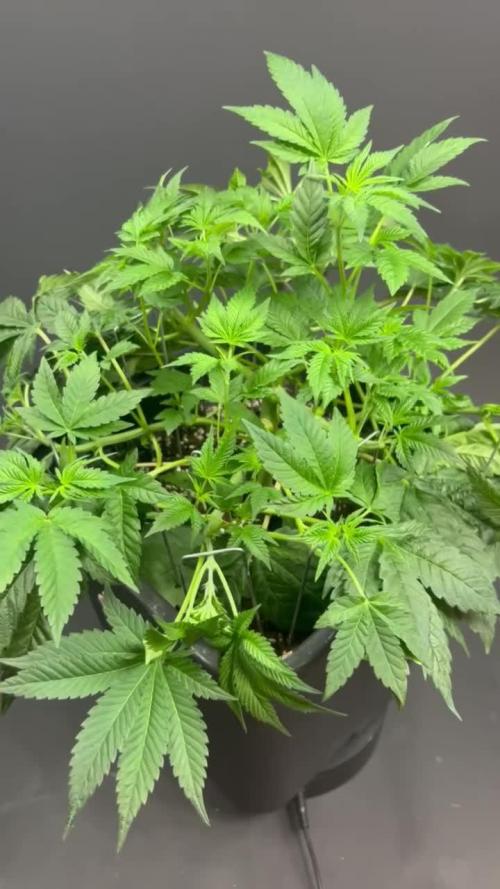
_____📅 Week 6 | 📅 Day 36 - 42 | 03.05 - 09.06 ______
09.06.25 | Day 42 🌞💧
🔸Grape Guava: Looks like an accident, haha - Also grows very well but quite compact, it may need a little less light so that the spacing between the nodes is not so dense. In any case, one of her main shoots broke off, which is not too bad, so I topped the other side for the symentry. Looks like broccoli hehe. But it has a nice rich green color. I think next week it will start flowering.
🔸It was a bit colder this week, but that didn't bother me or the plants.
🔸This week I watered them 2 x with 2000 ml
_________________________________________________________________________________________
current conditions:
🌡️🔆= 22-23°
🌡️🌜= 18-19°
💨 Hum. = 65%
🔦 PPFD = 500 umol 18/6
🔦⌚DLI = ~ 32
_________________________________________________________________________________________
Equipment to use:
💡 Light: 2 x Sanlight Evo 4- 120 on 50%
⛺ 120 x120 x 180
🍯 Pots: 18 liter pot
🌱 Soil: Bio-Bizz light mix
💊 Nutrients: Advanced Nutrients
💧 Water: Tap Water 0,5 EC


Likes
9
Share


@SuperSmoker
Follow
check out my youTube and show some love!!
www.youtube.com/superiorsmoker

Likes
7
Share


@Baboon_Grows
Follow
Weekly SST with kelp foliar, rest in 5l with 1.2l of super8 tea & sprinkle of potash through drip
No problem what so ever this grow,
Noticed after applying UV more frequently and for longer period it brings out purple in my plant , proof is after removing tie of a branch it was nice and green under while rest of the stem purple . Also purple on the tips of the leaves.
Probably running low on nitrogen so ordered blood , bone & fish meal , got 44-0-0 Prilled urea but that’s not organic so to say and only for emergency use
Likes
165
Share


@Tropicannibis_Todd
Follow
💩Holy Crap Growmies We Are Back💩
So what do you say we have some fun 👈 We got some EXOTIC SEEDS 👉 👻👻👻MONSTERMASH👻👻👻 😛
Well my friends we are just at the 7 day mark and it's the 2 headed monstermash clash who's gonna win 🏆 the left of the right👈
Lights being readjusted and chart updated .........👍rain water to be used entire growth👈
👉I used NutriNPK for nutrients for my grows and welcome anyone to give them a try .👈
👉 www.nutrinpk.com 👈
NutriNPK Cal MAG 14-0-14
NutriNPK Grow 28-14-14
NutriNPK Bloom 8-20-30
NutriNPK Bloom Booster 0-52-34
I GOT MULTIPLE DIARIES ON THE GO 😱 please check them out 😎
👉THANKS FOR TAKING THE TIME TO GO OVER MY DIARIES 👈

Likes
3
Share


Likes
8
Share


@DoDrugs420
Follow
Grow Sponsored by MARSHYDRO
HIGH EFFICIENCY WHITE LED LIGHT: Newest SMD LED technology provide highest PAR/LUMEN output(743umol@18"), designed to replace a single-ended 250watt HPS; MARS HYDRO TS 1000W Plants Growing lamp makes you get 30% higher yield compare OLD blurple led lights, Max 2.0g yield per wattage (power draw)
LOW ENERGY CONSUMPTION GROW LIGHTING : Consuming only 150W with 342 LEDS! It saves up to 50% energy than other led grow lights. Perfect for 2.5x2.5ft,Max coverage 3x3ft. Over 90% light energy can be absorbed by plants; higher intensity and more even coverage in a MARS HYDRO grow tent, reflective area, or by crossing over using multiple TS1000
SUNLIKE FULL SPECTRUM LED INDOOR GROWING: 660-665nm Red IR/3200-4200Knm/5200-6800Knm, infinite close to natural light, best for all plants all stages growing, rapid plant response from seed to flower and increase yield & crop quality
HIGH REFLECTIVE & NOISE FREE-Fanless LED GROW SYSTEM design will make your growing life easy and quiet, quickly heat dispersing material aluminum reducing light lost to aisles and walls, increase the light intensity up to 20%, allowing your plants receive more energy and without burning your plants for maximum headroom
Get your own at https://www.amazon.de/dp/B07ZVFBR34


Likes
4
Share

@DogDoctorOfficial
Follow
🍑 Passion Fruitz by Zamnesia – Week 9 | The Girl Who Refuses to Hurry
Welcome back to another chapter of the 8×8 Adventure! 🌱💚
At this point, I think we can officially stop pretending that Passion Fruitz is going to hurry up.
She's not.
😂🍑
We're now at week 9 from seed, and this girl has been showing signs of flowering for roughly three weeks.
Three weeks.
And somehow, when I look at her, I get the feeling she's still thinking about whether she really wants to commit to the idea.
She's giving us the same message she's been giving us for weeks:
“I'm getting there. Relax.”
And honestly?
I've learned to listen.
Because while Passion Fruitz may be incredibly slow compared with the rest of the tent, she's certainly not doing nothing.
She's building.
She's growing.
She's staying beautiful.
And she's giving us another fascinating example of just how differently genetics can behave when they're given the same environment.
🐌 The Slowest Girl in the Room
If you've been following this phenotype from the beginning, you already know her reputation.
Passion Fruitz is slow.
Not a little slow.
Not slightly behind.
We're talking about a plant that seems to have completely rejected the concept of rushing. 😂
The other plants around her have moved further into flowering, while Passion Fruitz continues to take her time.
We're now several weeks into seeing those first signs of flower development, and the transition is still remarkably gradual.
But here's the important part:
She doesn't look unhappy.
She doesn't look weak.
She doesn't look like she's struggling.
She's simply on her own schedule.
And that distinction matters.
Because this is exactly what makes a phenotype hunt so interesting.
🌱 Slow Doesn't Mean She's Standing Still
Although her flowering transition has been painfully slow, the plant itself has continued developing beautifully.
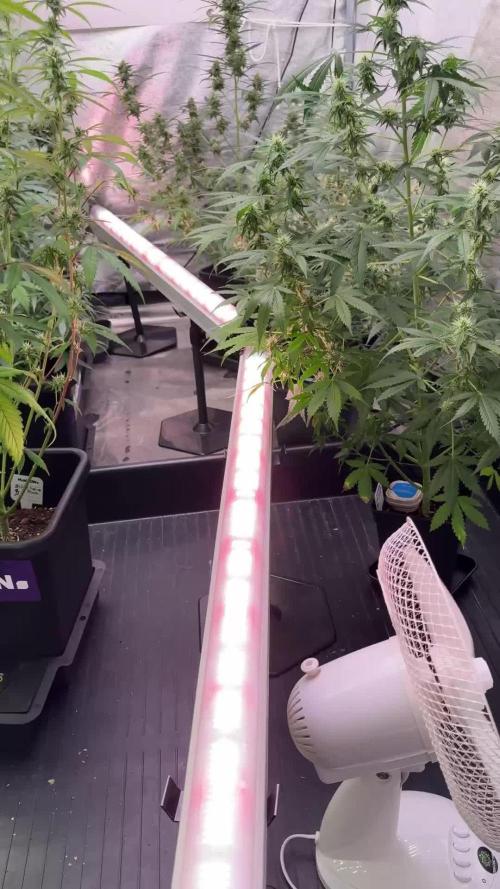
She's around 72 cm, with a compact, powerful structure and some absolutely beautiful foliage.
And those leaves...
Wow.
They're big.
They're beautifully formed.
They're carrying that lush green colour that makes this girl so enjoyable to photograph.
When I look at her, I don't see a plant that has stopped growing.
I see a plant that has spent a lot of time investing in her structure.
Strong branches.
A dense framework.
Large fan leaves.
Healthy new growth.
She's been building the machine.
She's just taking her time deciding when to turn that machine completely toward flowers.
🍑 Three Weeks of "Almost There"
This is probably the funniest part of her story right now.
We've watched her start showing signs of flowering.
Then we watched her continue showing signs of flowering.
And now we're watching her...
continue showing signs of flowering.
😂😂😂
At this point I'm starting to wonder whether Passion Fruitz has invented her own flowering stage.
Maybe this is Passion Fruitz Extended Pre-Flower.
But jokes aside, this is actually a fascinating observation.
Under the same overall environmental strategy as the rest of the room, she's expressing a very different developmental rhythm.
And that's precisely the kind of thing I wanted this project to reveal.
The plants don't read the diary.
They don't look at the calendar.
They don't care what week everyone else is in.
They follow their genetics.
And this girl apparently has a very long internal calendar.
🍃 The Green I Love
One thing I absolutely don't have any complaints about is her foliage.
She continues to look beautiful.
The colour is strong.
The leaves are large.
The structure is healthy.
And the new growth continues looking vibrant.
This is another reason I'm not interested in trying to force her into somebody else's timeline.
If the plant is healthy and continuing to develop, then there is value in simply observing.
I don't need to make her flower faster just because the plants beside her are further ahead.
The entire point is to see what she wants to do.
And Passion Fruitz is making that lesson very easy.
🌿 A Structure Worth Looking At
The more I photograph this girl, the more I appreciate her architecture.
She's not a giant plant.
She's not trying to reach the ceiling.
But she's compact, sturdy and beautifully built.
The large fan leaves give her an almost tropical appearance, while the branching structure underneath shows just how much development has happened before the flowering phase really got moving.
There is something quite satisfying about seeing a plant like this.
She's essentially saying:
“I may be late, but when I arrive, I'll have something to show you.”
And now I'm genuinely curious whether that's exactly what she's planning.
📸 Back to the Studio
This week I decided Passion Fruitz deserved another trip to the studio.
And I'm glad I did.
Sometimes when you're looking at plants inside the tent, surrounded by lights, equipment and twenty-plus other plants, it's easy to overlook the individual beauty of one phenotype.
Put her on her own...
and suddenly you notice everything.
The size of those leaves.
The colour.
The spacing.
The branching.
The little details in the new growth.
The personality of the plant itself.
That's one of the reasons I enjoy photography so much during this project.
The camera forces me to slow down.
And with Passion Fruitz...
apparently we're already very good at slowing down. 😂📸🍑
💡 Same Room. Very Different Story.
The 8×8 Adventure continues to prove one thing over and over again:
Genetics matter.
We're giving these plants the same general environment.
The same lighting philosophy.
The same irrigation system.
The same shared reservoir.
The same overall cultivation strategy.
Yet Passion Fruitz has chosen a completely different timeline.
Some phenotypes race into flowering.
Some stretch aggressively.
Some build flowers almost immediately.
And Passion Fruitz?
She takes her time.
That's not necessarily a disadvantage.
It's simply her story.
And we're here to document it rather than rewrite it.
💧 Feeding & Consistency
The room continues following the same flowering nutrition strategy:
🌱 Plagron Terra Bloom – 2.2 ml/L
🌱 Power Buds – 1 ml/L
🌱 Green Sensation – 1 ml/L
🌱 Sugar Royal – 1 ml/L
⚗️ Lemon Kick / pH Plus as required
The solution remains around EC 2.0 mS/cm, with pH around 6.0.
The important thing with a phenotype like Passion Fruitz is resisting the temptation to chase her timeline with unnecessary changes.
She's slow.
We've established that. 😂
But she's healthy.
She's growing.
She's developing.
So consistency remains the approach.
Give her the same foundation.
Watch what she does with it.
And let the genetics speak.
🌡️ Environment
The room remains stable:
🌡️ Day temperature: 29°C
🌙 Night temperature: 25°C
💧 Relative humidity: 60%
⚗️ pH: 6.0
⚡ EC/TDS: approximately 2.0 mS/cm
💦 Solution temperature: 25°C
🌱 Substrate temperature: 26°C
💨 CO₂: 636 ppm
💧 Watering: approximately 1.3 L/plant/24h
? Pot size: 15 L
💡 Light schedule: 12/12
Nothing dramatic has changed.
And that consistency gives us an even better opportunity to observe just how differently this phenotype behaves.
💡 Lighting the Slow Girl
The lighting strategy continues to be particularly interesting with Passion Fruitz.
The overhead lighting provides the main source, while the additional lighting deeper in the canopy helps us observe what happens beyond the top layer.
Her structure gives us plenty of foliage to work with, and as flowering continues to develop, I'm curious to see how those sites respond throughout the plant.
Again, there is no rush.
We're simply watching.
And documenting.
And waiting.
Patiently.
Very patiently.
😂🍑
🔍 What I'm Watching Now
At this point, my biggest question is incredibly simple:
How long is Passion Fruitz actually going to take?
We're entering week 9 from seed.
We've been watching flowering signs for around three weeks.
And she's still moving at her own wonderfully frustrating pace.
But here's the thing...
I'm no longer annoyed by it.
I'm fascinated.
Because eventually, she will have to reveal where this story is going.
Will she suddenly accelerate?
Will the flower sites begin developing more rapidly?
Will she remain the slowest girl in the room all the way through?
I honestly don't know.
And that's exactly why I'm enjoying her.
🍑 Beauty Doesn't Have a Schedule
Sometimes we get so focused on timelines that we forget to look at the plant itself.
Passion Fruitz may be behind the others in flowering development.
But look at her.
She's beautiful.
Beautiful colour.
Beautiful leaves.
Beautiful structure.
Healthy growth.
And a phenotype that has already given us a completely different story from almost everything else in the room.
She's not late.
She's just writing a different calendar.
And I'm perfectly happy to keep turning the pages.
🔮 Looking Ahead
So what happens next?
Honestly...
we wait.
😂
I want to see whether this slow transition finally begins accelerating.
I want to see the flowering sites become more defined.
I want to see whether her impressive structure translates into equally impressive flower development once she finally decides to commit.
And most importantly, I want to continue documenting her exactly as she is.
No forcing.
No unnecessary intervention.
No trying to make Passion Fruitz become another phenotype.
She's Passion Fruitz.
And apparently, Passion Fruitz takes her sweet time.
💚 The Girl Who Makes Us Wait
There are plants in this project that make you excited because they're explosive.
There are plants that impress you because they're enormous.
There are plants that surprise you with their colours or aromas.
And then there's this girl.
She makes you wait.
And wait.
And wait.
😂🍑
But every time I look at her, I find another detail worth appreciating.
The leaves.
The structure.
The colour.
The development.
The potential.
And that little question sitting in the back of my mind:
“What happens when this girl finally decides it's time?”
That's what I'm waiting for.
🙏 Thank You
Another week.
Another chapter.
And another reminder that plants don't care about our schedules.
Passion Fruitz continues to be the slowest girl in the room, and at this point, I think she's earned the title permanently. 😂🍑
But slow doesn't mean uninteresting.
Quite the opposite.
She's giving us one of the most unique stories in the entire 8×8 Adventure.
A huge thank you to:
💚 GrowDiaries — for providing the platform where we can document these journeys, learn from one another and share the results.
🍑 Zamnesia — for the Passion Fruitz genetics that gave us this wonderfully patient phenotype.
🌱 Plagron — for the nutrition supporting the garden throughout the cycle.
💡 Future of Grow LED — for providing the lighting powering the room.
🌡️ TrolMaster — for helping maintain a stable environment.
✨ LumiFlora — for the additional lighting helping us explore development deeper into the canopy.
And of course, thank you to everyone following the 8×8 Adventure.
Whether you're here every week, dropping a comment, asking questions, sharing your own experience, or simply watching quietly...
thank you.
This project wouldn't be the same without you.
Passion Fruitz...
Week 9 from seed.
Still slow.
Still beautiful.
Still green.
Still building.
Still taking her time.
And still making us wonder:
“Girl... when are you actually going to flower?” 😂🍑
But that's okay.
We're not going anywhere.
We'll wait.
Because maybe the slowest girl in the room has simply been saving her story for later.
And when she finally decides to tell it...
I want to be there with the camera ready. 📸🍑💚
Growers Love, my friends, and happy growing! 🌱💚
