


Likes
Comments
Share


@TGriner420
Follow
For germination I took the seeds and did the paper towel method and then once they developed tap roots I placed them into Root Plugs. Then I placed them directly into the AC Infinity Seed Starter for best results until they reach Seedling phase.

Likes
10
Share


@CervantiS
Follow
Feb.2
Diy Growbox: 60*60*160 cm
Light: 150w led
Light Cycle: 18/6
Soil: CocoPerlite in diy Hydrobucket
Extractor: 120mm PC vent Running 24/7
Dear Growdiary,
She is loving the new light, very nice progression, I keep all new growth away, so i only have 8 strong branches.
Its a small space, and its sharing it with my brothers Cheese.

Likes
52
Share


@Salokin
Follow
The plant again doubled in size. Not sure if it’s the light, but the plant is growing super bushy. I have already started removing some of the inner shoots, to focus the energy into building some length. The roots are developing phenomenally and she seems to be overall quite happy. Once she is a bit taller, I will probably top her to make sure that I can fill the SCR.O.G. Properly. Light intensity is currently set to somewhere around 80% veg only.

Likes
16
Share


@nerdz
Follow
57 to 63 Thursday
The last week. I am dropping the feed down low, might even just flush them entirely for the next week which I don't normally do but I want them to start dying naturally
These things are going to be very nice. Very tight and frosty buds in here!



Likes
17
Share


@Budophile
Follow
Day1: Tent is getting a bit crowded so I had to flip the switch and let the stretching begin! Raised the lamps about 10cm to get some more spacing between the nodes and removed a lot of the leaf mass to promote the lower branches grow. Sunset Sherbet #1 had its newest growth tips turning a little yellow and I'm not sure yet is it overdose/deficiency/heat issue or just a little pH mishap from overwatering.. gave her a little less nutrients to see how it responds. Gonna wait a little more time between next watering to let the soil dry up a little better (saw a fungus gnat flying in the tent and I don't want those f*ckers to overpopulate.)
Day3: Some training, all seems fine
Day4: Raised the lamps a bit again, not sure if the other Sunset Sherbet and now OG Kush too is suffering from mild nutrient burn or light stress
Day6: My hydrohomie fucked up the Gelato#45 cuts I gave him so I took Peyote Critical as my next mother victim. Took 12 good sized shoots from below which I would've lollipopped anyways.. Hope she wont mind since I wasn't planning on defoliating/lollipopping this soon. Planning on training at around day 10 and 20 give or take and then I'll let them grow stress-free. Stretching ain't so crazy at least yet and the canopy is staying pretty much at the same height. Next defoliation/lollipopping I think I will remove all the bindings to avoid snapping the stems. All girls are now showing at least few pistils. Tried using the blooming leds on Viparspectra for two days and the temps are staying pretty much at 28C at most but switched back to just blues since not sure if there's a bit of light stress on SS/OGK. Will switch to full power when the stretching ends.


Likes
3
Share


@spacetimeman
Follow
At the and of the week all lST supporting thenfs were removed: canopy is formed and all the stems are hardened.
The progress is very slow, but I like how the plant looks, it seems to be healthy and has more flowering points than I've seen on any autos I grew before.
I also adjusted the fertilizers ratios to get more optimal for flowering stage and added pH-down to improve the solution assimilation.
Likes
35
Share


@Chedderbob112
Follow
Well guys not uploaded a proper update since swazzenger teqnique well hav been doin my best not to over water hav been using bio bizz all mix and bio grow bloom top max n bio heaven with canna pk I follow the feeding schedule but sometimes I add a little more and between feeds I give just plain water n let the roots sook up the goodness seems to be doing the trick anyway well think tomorrow is start of week six tomorrow so hav two I hav not done as much defoliation on n two that I hav in next few weeks the girls will be ready av got itchy feet actually excited yez know the feeling well hope everyone likes ma progress on the juicy chronic from paradise seeds and hopefully as the next few weeks progress these ladies will fatten up a bit but am happy any tips more than welcome @ chedderbob112 these girls look like there Goni be beasties 😎
Likes
20
Share


@French__flair
Follow
Since I am in DWC and the fertilizers are organic, I take care to add them slowly..
Como estoy en DWC y los fertilizantes son orgánicos, me ocupo de añadirlos lentamente...
Por el momento no controlo la atmósfera, sólo tengo un extractor ajustado a 400m3/h para los 2 lumatek al 75%.
Planeo controlar la atmósfera a partir de la inyección de CO2 en la semana 2 o 3 para ver más.
Mientras tanto tengo algunos picos de temperatura por encima de los 28 pero son realmente específicos.
Estoy tratando de mantener la humedad lo suficientemente alta para tener un buen VPD.
For the moment I don't control the atmosphere, I just have an extractor set at 400m3/h for the 2 lumatek at 75%.
I plan to control the atmosphere from the CO2 injection in week 2 or 3 to be seen again.
In the meantime I have a few temperature peaks over 28 but they are really specific.
I am trying to keep the humidity high enough to have a good VPD.
Subí un poco la ec este fin de semana 4 de 0.9 a 1
I turned up the ec a bit this weekend 4 from 0.9 to 1

Likes
7
Share


@Stickygreens420
Follow
3/20/2023 - Day 22 Flower: So far the plants look like they handled the big defoliation just fine. Nice and healthy and they are all preying. Seeing the first signs of some tricomes.
3/22/2023 - Day 24 Flower: watered 4 gallons of water at at a 6.6 ph mixed with Jay Plantspeaker Quillaja as a wetting agent, Rootwise Enzyme Elixer, and Bio-Phos, BuildASoil Big 6, BuildABloom, Coconut Powder, Pure Protein Dry, Fermented Comfrey and Fermented Peach. Not much to report. Plan to keep the plants on 12/12 for one more week, then drop to 11 hours on and 13 hours off for the final weeks of flower.
3/26/2023: watered 4 gallons mixed with ThermX-70, BuildABloom, Rootwise Bio-Catalyst, coconut powder, and Yah-Whey Thrive. Went lighter on the nutrients today. Figured I've gone heavy enough for a while, so a lighter feeding couldn't hurt. Overall, the frost is coming on and the flowers are starting to add some weight. Other than the leaf curl issue from a couple weeks ago, everything else continues to go smoothly.

Likes
6
Share

@MrsHinduGod
Follow
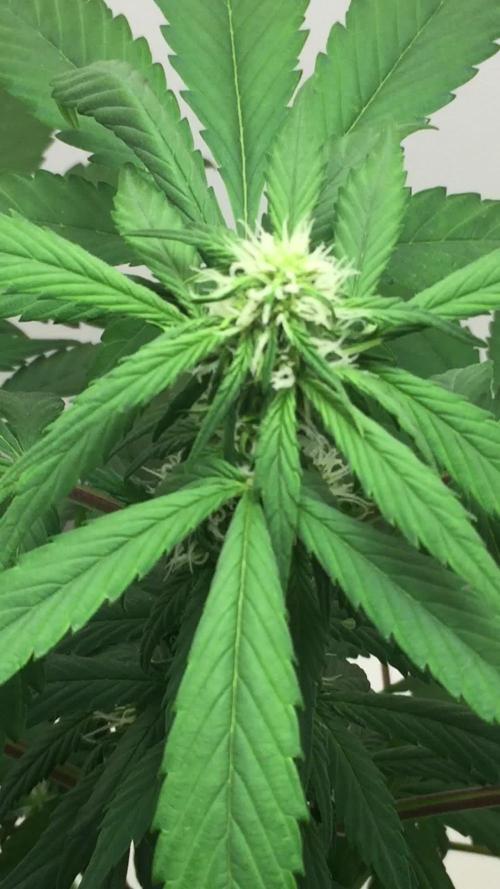
wow look at dat!!!! dat plant grew some in dis week!!! now it is 18 inches tall dat is amazing after i cut off all da leaves!!! da plant was not very happy wit dat!!! i will not do dat much next time!!! i did learn from doing dat da husband was very very right!!! he has such vast knowledge i am so very very blessed!!! it is such an honor to serve dis great man!!!! da plant is being top watered 3 days a week!!!! it is also butt chugging da water everyday!!!!

Likes
21
Share


@Cali_Grown_420
Follow
Start of week 3, the three survivors are doing great! I did happen to find some algae growing on top of one of the rockwool cubes. (This was my fault for not fully covering the tops of them with hydroton to block out light.) As an attempted fix, I cut some square pieces of black cloth that I laid of the top of the cubes to block out the light completely. Hoping removing their light source, the algae will die off and discourage any further growth. If it gets any worse I’ll try using a hydrogen peroxide solution.
Day 17, the three ladies are looking nice. Starting to see some nice healthy roots populate inside the buckets. I went ahead and upped their nutrients today. We will see how they are doing in the morning.
-FloraFlex - 1.5g/gal of each V1 and V2.
-Advanced Nutrients - 1/2 strength MGB and hobbyist additives.
**Algae update: seems like using the black cloth to block out all the light has killed off that algae growth and I don’t see anymore so it’s working!**
Day 18, I thought one of my plants had root rot. Which was weird for it to happen that fast in less than 24 hours since changing the res. Come to find out it’s just nutrient stain from the Advanced Nutrients, so thank god. #1 and #2 which are growing with FloraFlex got FIMmed today. I’ve topped plants before but never FIM. Not sure if I did it right, but that’s the fun in all this, is experimenting to see what works.
Day 20, #1 and #2 are responding well after being FIMmed couple days ago. I decided to FIM #3 as well. I also decided to leave the 4th one out of this diary from here on out since she’s behind. We will stick with the original three that survived from the start.
So far I’m really loving their bushy appearance and thick leaves. Their roots are coming out super nice as well! Pretty soon these babies are going to just take off!
Likes
20
Share


@Ieiogrow94
Follow
Eccoci qui...
Che splendore questa genetica, NON SEBRA MARIJUANA!!!
- Strain 1:
Ha una conformazione più simile alle normali piante ma ha le prendi sole e tutte le foglie della pianta con le mini foglie che si sovrappongono e sta iniziando a formare le cime come GIOIELLI davvero mi piace molto, tralasciando il fatto che è PIENA di RESINA!!!!!
- Strain 2:
Lei ha una conformazione molto strana purtroppo avendo avanti a lei nel box la Alladdin Kush ha allargato il ramo a destra allungando e modificando la forma che aveva, lei è molto imboscabile ovunque inquanto NON sembra marijuana. Nella fioritura è più indietro rispetto Strain 1 ma non importa la resa essendo così particolare vince in partenza!!!!
Questa settimana inizieremo con i nutrienti che finora NON sono stati utilizzati...
Grazie a @Khalifa_Genetics per la collab e a tutti per il supporto🔥🌲❤️

Likes
4
Share

@Elemental
Follow
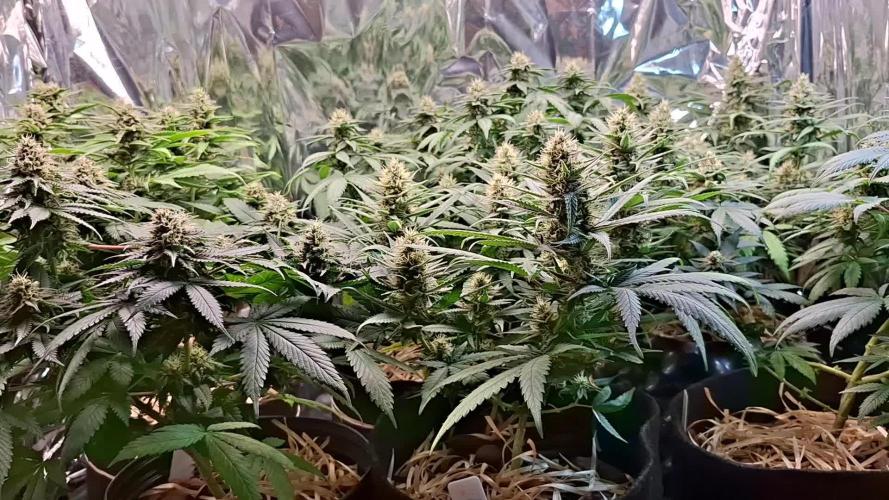
Segunda dose de chá de banana dia 10 de novembro.
O caldo estava denso.
Os buds estão engordando lindamente.

Likes
24
Share


@TheGreenLeopard
Follow
Really lovely flower. Look snd smell lovely. Gréât structure amd looks
Like she’s gonna be a real banger. She’s at full feed now for this week and the next. Will see how no strips it is by then. Highly recommend to grow. Pretty and big.


Likes
17
Share


@GWSD82
Follow
Well, it's been another busy week in the garden, and things are getting interesting. The coolest thing about a mixed run is seeing all the differences between the strains, all growing at different speeds, having different structures, different shapes..... It's gonna look awesome when the tents are in full flower. And with them all at slightly different stages, it's kept me with things to do every day.
Some highlights from the week:
MBAP #1 - Fimmed, LST'd and defoliated on day 16
MBAP #2 - Fimmed, LST'd and defoliated on day 17
Walter White - I normally fim my autos, but given that this plant had the 3-way node mutation, I decided to top and see if we can get some nice 3-way main cola action going. Topped on day 18.
SOH #1 & #2 - Haven't even started training these yet due to size, and they are already throwing pistils!! Both first started to show signs of sex around day 16. #1 had clearly defined pistils by day 18, and #2 had them the next day. I think these may be some fast finishers, never seen them go into pre-flower this early. Will raise a grow question to see if anyone else has any experience of this.
BGS - Fimmed, LST'd and defoliated on day 20
All the plants have started some form of training except the PP and 2 x SOH. The SOH have already begun sign of going into pre-flower. Given their small stature I'm inclined to simply stick to LST and avoid high stress techniques, so I don't think I'll be fimming or topping these ones. All plants are still on the same feeding schedule for now, but I think I'm going to have to start independent schedules this week, as they are clearly developing at different rates and will have different nutrient requirements. But for now, the current feeding looks like this:
Nutrients
~~~~~~
CalMag: 0.95ml / gallon (0.25ml / liter)
MegaCrop: 3g / gallon (0.79g / liter)
Total EC: 1050
PH: 5.7
Tasks for the week ahead - get the MBAP and SOH onto autopots. This will cut my manual watering by more than half, saving time, sanity and my marriage :)
Happy days. Catch you all in a week....

Likes
7
Share

@Matteliquo
Follow
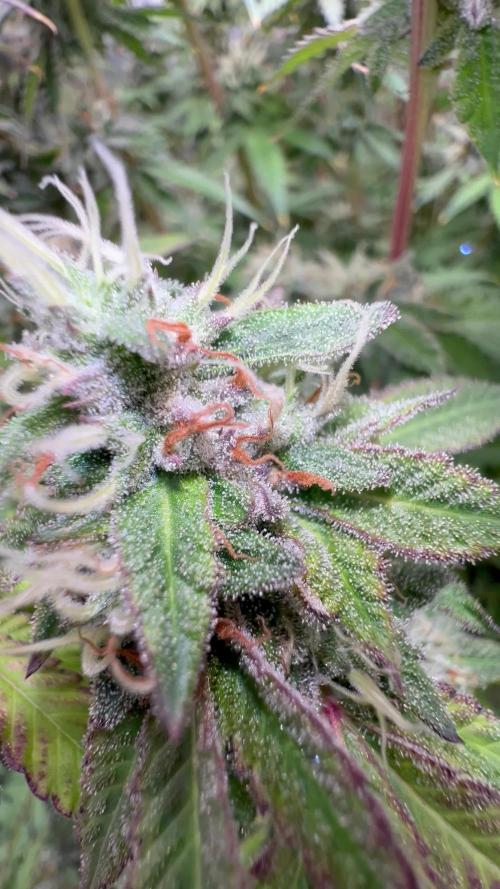
The flowers continue to grow, there is a good amount of resin and a minty smell. The first amber trichomes are starting to appear.🕺

Likes
5
Share


Likes
15
Share


@MG2009
Follow
08/20/2020
Soil temp a little warm,it is hot and humid going to water her good,and mulch the topsoil.
Flowering has started!