


Likes
Comments
Share


@BushDoctor740
Follow
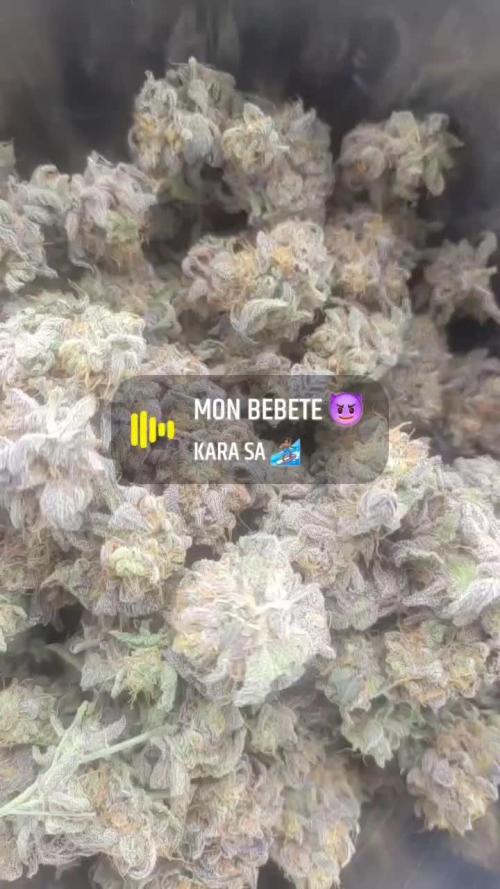
Strawberry 🥧 I feel like her milky trichomes were starting to turn a little amber on some of the more mature buds so I chopped her down.Indica dominant strain so I wanted to let her go as long as possible.Smells great I’ll update a smoke report after she dries and cures.I think I’m going to use the majority of this one for some Rick Simpson oil and see how she turns out :)



Likes
7
Share

@Lapaluma420ohe
Follow
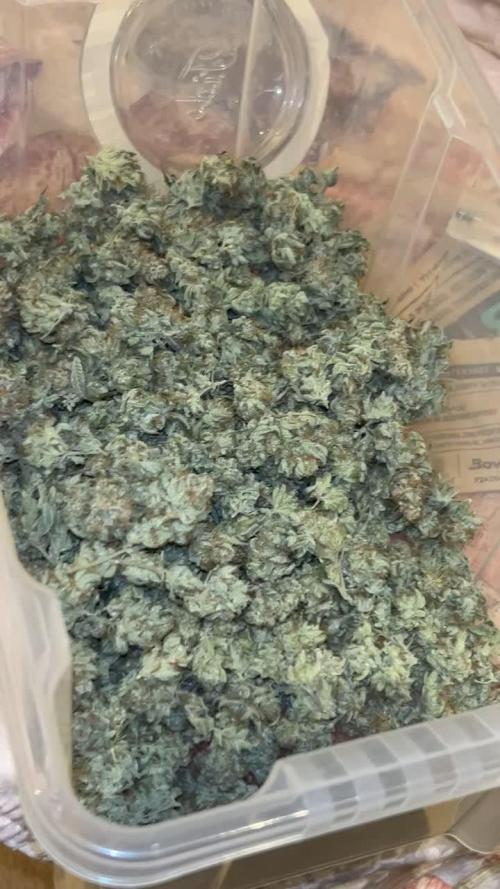
Die 4 Pflanzen haben insgesamt 160g abgeworfen. Es gab 3 unterschiedliche phenotypen und bis auf eine Pflanze haben alle schöne dichte Blüten. Geschmacklich sind sie alle sehr süß und fruchtig. Angenehmer Rauch und von der Wirkung her nicht zu stark und nicht zu schwach.

Likes
24
Share


@Spazmagi
Follow
11/3 - Today is technically the first day of Week 5 and also the first day I could see a visible drop in her water level since her last check-in (~12 hours apart). As a result, her ppms shot up to around 800. I diluted the solution with straight tap (7.5pH, 170ppm) since her pH was registering around 5.3. This brought her up to 5.6pH and 670ppm (1.0ec + tap, 500ppm of nutrients). I would have liked to adjust her pH more, but the water level ended up at the bottom of the basket. I'll adjust further as necessary. The other day while attempting to LST her top branches, they ended up snapping off, so I just topped her down one node and broadened her other LST to make her as squat as possible. Once I am able to find a suitable individual ScrOG screen, I will put it on her.
11/4 - I wasn't even planning on doing an update today, but I want to note a few changes. The first of which is a visible difference between her foliage density in a span of 36 hours. Her root bundle is over a foot long and getting more wound up every day. I removed her LST ties in order to take advantage of the ScrOG screen apparatus (see notes below). After lights came back on, she measured 645ppm and had another notable drop in water level. Currently, I am preparing another nutrient solution that closely matches what she is feeding on now. I will be upgrading her to a 5 gallon bucket. I will be aiming for 1ec of nutrients/additives (500ppm + Tap on my meter, Hanna Primo .5 conversion). Tap measured 180ppm, so target ppm would be 680.
Later that same day... So I finished upgrading her to a 5 gallon bucket before I actually got done writing the update. Added one photo showing new 5 gallon setup.
Solo ScrOG test mk1 - In an attempt to do a ScrOG, but maintain control over each bucket, while still having relatively easy access to each reservoir, I decided to throw together this little contraption. I removed the lowest complete segment of a tomato cage, leaving a short "tail" beyond the lower ring to act as a peg to insert into corresponding holes in the lid. The lower ring is 10" in diameter and the upper is approximately 12" in diameter. Each ring is 11" apart. I would prefer to have a shorter segment, but I haven't worked out exactly how to do this yet. I would prefer to set the screen height at around 6" above the bucket instead of 11". This will have to suffice for the time being while I let my latent conscious work out a solution or one is provided by the community. Above each cage will sit a coated wire fence with grids measuring ~2"x3", as shown in the above picture.
11/5 - Uploaded short video showing Solo ScrOG Apparatus in place. Screen height currently set to 6".
Thanks for stopping by my garden, and, as always, Happy Growing!

Likes
27
Share


@Veteransgrow710
Follow
Their on point im feeding every 2 days now. Power pots are so awesome i recommended for sure.ill top a 3rd time here soon .hope i get a yield i want

Likes
9
Share


@Lifesgarden420
Follow
These genetics are amazing especially with the best nutrients it really equals some spectacular results

Likes
6
Share

@sanibelisl
Follow
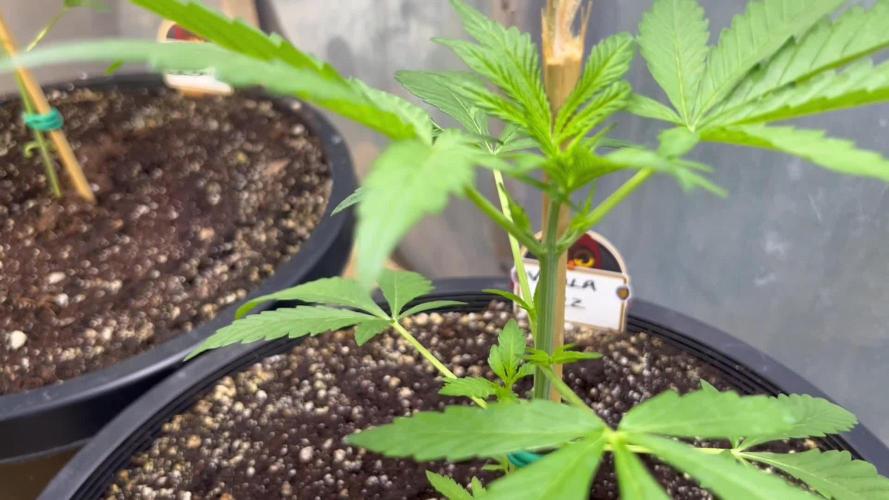
Girls had a great week at summer camp! Smiles are found everywhere regarding their new homes. Plenty of room to grow and wiggle their toes in the amended formula 707, which is doing what was expected retaining moisture nicely, bringing the watering to a minimum.
All three girls received merit badges for hiking(survived transplanting), water sports(2 liters), light tolerance(supplemental lighting), physical fitness(color and strength)and kite flying(added a fan). They are all looking forward to this weeks activities.
Girls seem to like what they’re getting at the chow hall, green and growing daily, strong and upright. Plenty of good stuff in the soil.
A fan was added and the benefits are three fold, dry out the top layer of soil, pest control, makes them stronger.
I will update as needed.
***update, the girls are looking good this morning, well rested, well nourished, vibrant. Their roots must be really liking the 707 as evident by the rapid growth. Measured them this morning with the H. W. At8 in. the V. F. at 8.5 and the 91 Grapes at 10 in. And at least an inch wider as well. No water will be needed today.
Note. The greenhouse may be better suited for growing mushrooms than cannabis. Pine trees and shade. No direct sunlight until after 2pm. Dappled sun all morning long, so installed a T-5 4 foot ArgroLed 6550(k) daylight led fixture above the girls. That was a bright idea!
***update, New Video includes new homemade lighting.
*** update, new videos.
Before 7/14 After 7/15 videos of the girls being sprayed with a folier dose of silica. I had forgot to add the silica on Sunday when I had watered them and they needed it! I would not be able to water them again until at least Friday so delivered it via a foliage spray. Worked wonders , will apply again in a week. Let me know what you think.
***update, OMG going to ignore a few people here who seem to interested in my financial status, whom i care to promote and what i do, so let's put this to rest... i'm a hobbyist cannabis grower who enjoys cultivating autoflowers... i'm not paid nor sponsored by anyone , i simply like and trust the genetics from Night Owl Seeds and in my opinion so should anyone else who desires quality autoflower genetics, please feel free to use the breeder of your choice as i don't want any issues because i prefer one over another(happy mOuse).
***update, Three Girls!!! pics will follow. ** ok pics are here. I labeled most of them so should be self explanatory. Can’t seem to get any sunny afternoons. It’s a little disappointing as it is the only time the greenhouse gets direct sunlight. Watered last Sunday, today is Wednesday and they are good no water needed, 707 on the job! Such a difference from the coco grow where I was I nutrient mixing slave.lol

Likes
85
Share


@OrganicNature420
Follow
• In House Genetics
• FlapJacks (Mac1 x Slurricane x Pancakes)
• THC dominant
• Terp %45
Nutrients • GreenBuzzNutrients
(DISCOUNT CODE • GD42025) %25 off
I use the whole product range and this stuff is a game changer. I've not had one bad grow with this company and it hasn't let me down once. Terps and taste are through the roof. No need for run off in coco only during flush week (i use a 0ppm distilled water) Hands down the best nutrients on the market
GREEN BUZZ OUR NOW GIVING YOU GUYS A WHOPPING %25 OFF USING THE NEW CODE ABOVE 💚🌱
LIGHT/TENT • Mars Hydro FC-E6500 5x5 tent
Not impressed with how much is on it and Buds are smallish compared to my other photo grows. Looks more like an auto. Great levels of frost but disappointed with both Plants. Expecting more from its great linage. To be continued....
Bubble hash review : most probably used 2oz of trim and all the sugar leaves. Looks an easy oz and if so that's a banging return. Will update when dry 👍🏻


Likes
2
Share


@Grandillustrator
Follow
Having to constantly move the ties as each branch keeps pulling in closer together , keeping on top of defoliation starting to get a weak smell when opening the tent overall plants healthy

Likes
12
Share


@DogDoctorOfficial
Follow
# 💙 Project Blue Tent – Week 12
## ? Blue Waffle F1 – Pheno A
### 🌸 More Photons, More Flowers, and a Beautifully Balanced Ecosystem
Hello everyone, and welcome back to another chapter of Project Blue Tent! 💙🌱
And honestly, my friends...
LOOK AT HER! 😂🌸
We're now moving further into flowering, and I'm genuinely happy with what I'm seeing inside this little ecosystem.
Four plants. Two different cultivars. One tent. One shared environment.
Our beloved Blue Waffle F1 girls are sharing the space with their Pickle Lemon Haze F1 sisters, and every plant is giving us something interesting to observe.
But today, we're putting the spotlight on Blue Waffle F1 – Pheno A.
Because even though she's sharing the same tent, the same reservoir, and the same environmental conditions as the other girls, she deserves her own report and her own moment to shine.
And this week, we made a couple of small but meaningful adjustments.
We lowered the temperatures and humidity slightly, increased the power of our overhead LEDs, and kept the entire nutrition recipe exactly where it was.
No unnecessary changes. No complicated interventions.
Just a little refinement of the environment and a lot of appreciation for what these beautiful cultivars are showing us.
Let's get into it! 💙🌿
### 🌸 WEEK 12 – A SMALL CHANGE THAT MAKES THIS WEEK INTERESTING
Not every week needs to bring a major transformation.
Sometimes, the most interesting updates are the ones where we make a few adjustments and observe how the plants respond.
That's exactly where we are now.
The major structural work has already been completed. The canopy has been organized, the second SCROG is in place, and the under-canopy lighting experiment is underway.
Now we're concentrating on maintaining a comfortable environment while the flowers continue developing.
This week, we made two principal adjustments:
- We reduced the temperature and relative humidity slightly.
- We increased the power of the overhead LEDs to the highest level we intend to use in this 1 × 1 metre tent.
We're not running everything at 100%, and we're not necessarily trying to squeeze every possible watt out of the equipment.
Instead, we're giving the girls a little more light than before while keeping an eye on how the whole ecosystem responds.
And so far?
They're looking beautiful! 😂💙
### 💡 MORE PHOTONS – BUT WE'RE KEEPING OUR HEADS COOL
Let's talk about the lighting, because this is one of the most interesting changes this week.
We've increased the LED power to the maximum level we currently intend to use in this particular tent.
Not necessarily the maximum the equipment can deliver, but the maximum we've decided to use for this setup.
There's a difference!
I honestly don't think we need to push the lights harder just for the sake of doing it. The tent is relatively compact, and we already have a beautiful, productive-looking canopy.
But we also know that light is one of the important factors influencing plant development and flower production.
So we're giving the girls a little more photon availability and observing how they respond.
The goal isn't simply to turn up the lights and hope for the best.
It's to find a sensible balance between light intensity, temperature, humidity, and the plants' overall condition.
More light can be beneficial when the plants can use it effectively, but more isn't automatically better. The response depends on the intensity reaching the canopy, the environment, and how comfortably the plants are handling the conditions.
That's why we're not jumping straight to 100%.
We're increasing the available light while keeping the ecosystem balanced.
And now we watch.
Because the plants always get the final word. 🌿💡
### 🌸 THE WHITE PISTILS ARE CHANGING, AND THE FLOWERS ARE FORMING
This is where things are becoming particularly beautiful.
The white pistils are developing and changing as the flowers continue to form.
The flowering sites are becoming more defined, and the overall structure is starting to show us more clearly where this plant is heading.
When I look at Blue Waffle F1 Pheno A, I see a plant that's moving through another stage of her flowering journey.
We're no longer looking only at the framework we created during vegetation.
We're watching the flowers develop within that framework.
The branches, the canopy organization, the training, and the support system are all part of the picture, but the flowers are increasingly taking centre stage.
And the close-up photographs make it even more enjoyable to follow.
Every week gives us another opportunity to compare what we're seeing now with what we saw before.
The pistils. The flower structure. The developing resin. The way the plant is progressing.
It's a beautiful process to document.
And she's giving us plenty of reasons to keep the camera ready! 📸💙
### ❄️ THE FROST IS STILL ONE OF MY FAVOURITE THINGS TO OBSERVE
I have to mention the frost again, because you know me...
😂❄️
I love getting close to the flowers and seeing all those little details that are easy to miss when you're simply looking at the whole plant.
The developing flowers and sugar leaves give us so much to appreciate through the camera.
And that's one of the things I love about keeping a detailed diary.
You can see the plant from a distance and appreciate the structure.
Then you get closer, take a photograph, and discover an entirely different level of detail.
We're documenting the plant as she develops, not just taking pretty pictures.
Although, let's be honest...
the pretty pictures certainly help! 😂💙
### 🌡️ A LITTLE LESS HEAT AND HUMIDITY
Alongside the increase in LED power, we've also reduced the temperature and relative humidity slightly.
These adjustments go together as part of the overall environmental management.
When we change the lighting, we're also paying attention to the conditions around the canopy. More light can mean a different thermal load, so we want to make sure the room continues operating comfortably.
We're not changing every setting at once or rebuilding the entire environment.
We're refining the conditions while keeping the rest of the setup consistent.
And that's an important distinction.
We already have a system that we're happy with. We don't need to reinvent it every week.
We simply need to keep observing, make sensible adjustments when appropriate, and avoid changing things without a reason.
The ecosystem is working beautifully, and the goal is to keep it that way. 🌿💙
### 🌱 SAME NUTRITION, SAME RESERVOIR, SAME PHILOSOPHY
Now, here's something that hasn't changed this week.
The nutrition.
We're keeping the same recipe in the reservoir because everything is progressing well, and there's no reason to introduce unnecessary changes just because we've adjusted the lighting and environmental conditions.
Our current recipe remains:
- PLAGRON Hydro A — 2.2 ml/L
- PLAGRON Hydro B — 2.2 ml/L
- PLAGRON Power Buds — 1 ml/L
- PLAGRON pH Plus — 0.03 ml/L
- PLAGRON pH Minus — 0.03 ml/L
The pH Plus and pH Minus quantities are the recorded recipe values; the actual amount required for adjustment can vary with the source water and the solution.
We're not changing the nutrient recipe this week.
The plants are developing, the irrigation system is working beautifully, and we're happy with the overall progress.
Keeping the nutrition consistent also means we're not introducing another variable while observing the effect of the lighting and environmental adjustments.
That's part of what makes this project interesting.
We make a change where we believe it makes sense, maintain the other elements, and watch what happens.
Simple, consistent, and documented. 💙
### 💧 IRRIGATION AND DRAINAGE – THE QUIET HEROES
One of the best things about this ecosystem is that the irrigation and drainage systems are doing their jobs without demanding constant attention.
The girls are sharing the same reservoir, and the automatic irrigation system continues supporting the plants throughout the day.
When these systems are working properly, it's easy to forget how important they are.
But consistency matters.
We want a setup that supports the plants while allowing us to concentrate on observing their development.
And that's exactly what we're aiming for here.
The equipment doesn't need to be the star of every update.
Sometimes, the best compliment you can give a system is that everything is running as expected.
No unnecessary drama.
Just another part of the ecosystem working together. 💧🌿
### 🕸️ THE STRUCTURE IS ESTABLISHED – NOW WE WATCH
Remember how much work went into getting these girls to this point?
The training.
The topping.
The SCROG.
The defoliation.
The management of the stretch.
The adjustments to the available space.
The additional support.
The airflow improvements.
There was a time when the main question was how we were going to manage the canopy.
Now, the structure is established, and we're watching the plants develop within it.
The second SCROG remains an important part of that support system, while the canopy organization helps us observe the flowering sites more clearly.
We're not looking to make unnecessary structural changes this week.
The plant has a framework, the support is in place, and the focus is on monitoring her progress.
Sometimes, the best way to appreciate the work we've done is to stop interfering with it and see what the plant does next.
And that's precisely what we're doing with Blue Waffle F1 Pheno A.
### 💡 TWO LUMIFLORA FIXTURES – LIGHT FROM BELOW
Our under-canopy lighting experiment also remains part of the bigger picture.
We're using two LumiFlora 150W full-spectrum fixtures underneath the canopy, arranged in an X-cross configuration.
The main LEDs provide the primary overhead lighting, while the LumiFlora fixtures give us another way to explore supplemental lighting in the lower portions of the plants.
It's an interesting addition to this setup, particularly because the plants have developed substantial vertical structure.
But, as always, we're approaching this as an experiment.
We aren't assuming that adding lights underneath will automatically produce a particular result.
We're interested in observing how the lower flowering sites develop and how the complete lighting arrangement performs as the plants progress.
The overhead power adjustment and the under-canopy lighting are both parts of the lighting environment, but they serve different roles.
Now we continue monitoring the plants and documenting what we see.
That's what this project is about: experimenting, observing, and learning as we go. 💡🌸
### FOUR PLANTS, TWO CULTIVARS, ONE BEAUTIFUL ECOSYSTEM
This is one of the things that makes Project Blue Tent so enjoyable for me.
We have four plants sharing one tent, representing two different cultivars: Blue Waffle F1 and Pickle Lemon Haze F1.
They're growing in the same room, sharing the reservoir, and experiencing the same general environmental conditions.
And yet every plant deserves to be documented individually.
I know I've mentioned how uniform these plants can look, but I still find it fascinating.
Sometimes, looking across the canopy, the plants appear remarkably similar in their overall development.
At the same time, we need to leave room for individual differences to show themselves as flowering progresses.
That's why I'm keeping separate phenotype reports.
A shared environment gives us a useful basis for comparison, but it doesn't mean every plant will necessarily respond identically.
Each one has its own development to document.
And today, that's Blue Waffle F1 Pheno A's moment.
She's looking fantastic, and I'm genuinely happy with the way this ecosystem is progressing.
### 🌿 WHY THIS WEEK MATTERS – AND WHY IT DOESN'T NEED TO BE DRAMATIC
I think this is an important point to make.
This week matters because we've adjusted two environmental variables: temperature and relative humidity. We've also increased the overhead LED power to the highest level planned for this tent.
Those are meaningful changes to observe.
But this doesn't mean we need to make the week sound more dramatic than it is.
We haven't changed the nutrition.
We haven't introduced a completely new training technique.
We haven't rebuilt the room.
We're refining an already established setup.
And sometimes, that's exactly what a good grow update should document.
Not every week needs a breakthrough.
Not every adjustment needs to produce an immediate, obvious difference.
Some changes need time before we can properly evaluate them.
So we're recording what we've changed, appreciating what we're seeing, and giving the plants time to respond.
That's how we learn.
And that's why I enjoy documenting the entire journey rather than only showing the big moments.
The quiet weeks matter too. 💙
### 🌸 CURRENT GROW CONDITIONS
- Cultivar: Blue Waffle F1
- Phenotype: Pheno A
- Flowering: Week 12
- Height:Approximately 145 cm
- Light schedule: 12/12
- Day temperature: Reduced slightly; current value to be confirmed
- Night temperature:Reduced slightly; current value to be confirmed
- Relative humidity: Reduced slightly; current value to be confirmed
- pH: 6.01
- EC: 2.24 mS/cm, last recorded value
- Solution temperature: 25°C, last recorded value
- Substrate temperature: 24°C, last recorded value
- CO₂: Approximately 666 ppm, last recorded value
- Pot size: 8 L
- Watering volume: Approximately 1.6 L per plant per 24 hours
- Main lighting: LED power increased to the maximum planned level for this tent
- Under-canopy lighting: 2 × LumiFlora 150W full-spectrum fixtures
- Nutrient program: PLAGRON Hydro
- Nutrient recipe: Unchanged this week
Note: The previous recorded readings are retained where no new measurement was provided. They should not be interpreted as newly measured values for this week.*
### 🔭 WHAT I'M WATCHING NEXT
Now I'm particularly interested in seeing how the girls respond to the updated environment.
How will Blue Waffle F1 Pheno A progress with the increased overhead light intensity?
How will the slightly reduced temperature and humidity affect the overall balance of the room?
How will the flowers continue developing?
How will the lower flowering sites progress under the supplemental LumiFlora lighting?
And will the similarities between our Blue Waffle F1 and Pickle Lemon Haze F1 plants continue as they move further through flowering?
We don't need to answer all those questions today.
We need to keep the environment consistent, observe the plants, and record what happens.
That's the beauty of a project like this.
We're not simply trying to reach the finish line.
We're learning along the way.
### 💙 FINAL THOUGHTS – KEEP EVERYTHING SHINING
Blue Waffle F1 Pheno A is looking beautiful, and I'm genuinely happy with the direction this ecosystem is taking.
The flowers are forming.
The white pistils are developing and changing.
The structure is established.
The nutrition remains consistent.
The irrigation and drainage are working beautifully.
We've slightly reduced the temperature and humidity, increased the overhead LED power, and kept the rest of the system stable.
And that's the story of this week.
A few deliberate adjustments.
No unnecessary changes.
And a beautiful plant continuing her flowering journey.
I don't believe we need to push every setting to its absolute maximum to prove that we're doing something.
We need to find a balance that makes sense for the space, the lighting, and the plants themselves.
That's why we're not running the LEDs at 100%.
We're giving the girls more light while keeping the whole environment in mind.
And now we let the plants show us how they respond.
I'm really, really happy with this room.
Four plants. Two cultivars. One ecosystem.
And so much still to discover.
Blue Waffle F1 Pheno A deserves her own spotlight, and this week she's getting exactly that.
Keep the environment balanced.
Keep observing.
Keep learning.
And remember that sometimes the best decision is the one that allows you to appreciate what you've already built.
💙🌸🌿
### 🙏 A HUGE THANK YOU
A huge thank you to Zamnesia for making Project Blue Tent possible and giving us the opportunity to explore these beautiful Blue Waffle F1 and Pickle Lemon Haze F1 cultivars.
Thank you to PLAGRON for the Hydro nutrient line supporting the girls throughout this journey.
A massive thank you to Zamnesia for the Phytonaut LED lighting, curved scissors, and clip fans that have become important parts of this ecosystem.
Thank you to Mars Hydro for the automatic irrigation and drainage system that continues helping us maintain consistency throughout the tent.
And a special thank you to LumiFlora for the 150W full-spectrum under-canopy fixtures that we're using to explore supplemental lighting beneath the canopy.
And of course, thank you to GrowDiaries for giving us the platform to document the journey, the experiments, the lessons, and the beautiful moments along the way.
Most importantly, thank you to everyone following Project Blue Tent! 💙
We're continuing to learn, observe, and enjoy the process, one week at a time.
Until next week...
More flowers.
More observations.
More learning.
And hopefully, even more reasons to stand in front of the tent, look at these beautiful girls, and smile.
😂💙🌸
Growers Love, happy growing, and take care everyone!🌱💙


Likes
19
Share


@Duendeverde28
Follow
Han respondido bastante bien a la poda en pocos días se realizará el transplante a su macetas final y se le realizó una poda más. Estoy probando en este cultivo unas podas diferentes para ver el resultado en tiempo y desarrollo de la planta


Likes
2
Share


@GroloCup
Follow
Week 2 underway and she's developing accordingly. Everything is in the soil so we continue to just let her sip from the reservoir thru the wicks. I'm still misting the top of the soil to make sure she's getting enough to drink.

Likes
18
Share

@Roberts
Follow
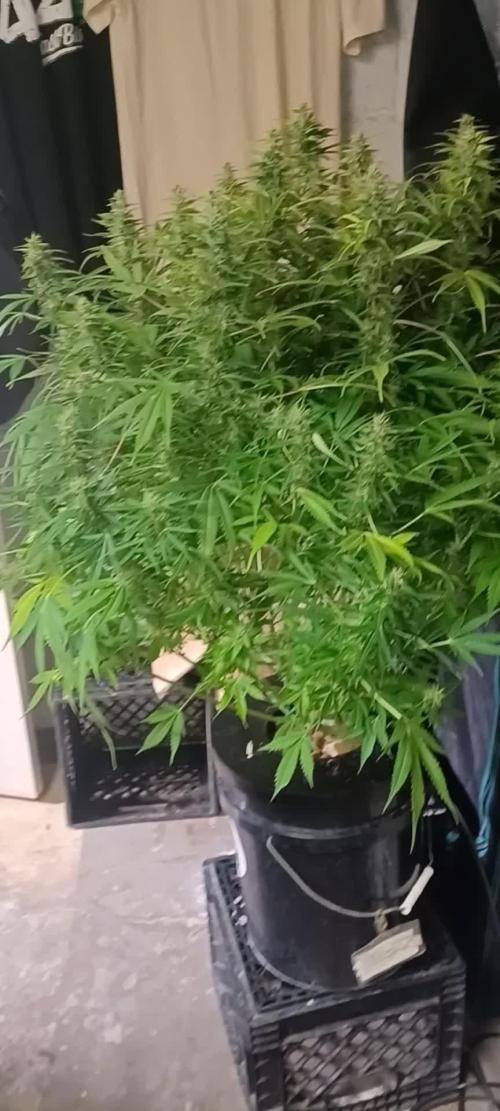
Blue Dream Auto is doing good. She has about 2 weeks left. Everything is looking good. Thank you Spliff Seeds, Medic Grow, and Athena nutrition. 🤜🏻🤛🏻🌱🌱🌱
Thank you grow diaries community for the 👇likes👇, follows, comments, and subscriptions on my YouTube channel👇.
❄️🌱🍻 Happy Growing 🌱🌱🌱
https://youtube.com/channel/UCAhN7yRzWLpcaRHhMIQ7X4g.
Likes
8
Share


@Kappa420
Follow
Every plant grows differently... i think one is getting ready (No1)? I am not sure maybe couple weeks more?
