


Likes
Comments
Share


@lozaa111
Follow
I left my brother to mist the seedlings whilst i was in amsterdam for 4 days, got back expecting growth but found the plants have stretched and looked leggy and not much growth apart from stretch…(should have took photos before repot)
I planted the seedlings in clear plastic cups with holes punched into the bottom, the medium was very moist and wasn’t seeming to dry out soo i decided i would repot in red cups as i heard clear cups are bad for roots…(feed the girls very lighly was due to bad drainage more then over watering)…
I used fresh coco and pulled away as much moist coco as possible without disturbing roots, i added great white to the medium and root balls of the seedlings and repotted burying the stretched stem as much as possible…
I didn't water the coco prior or after the repot as i didn’t want to stress the plant further if the roots have been getting drowned by excess water in the coco due to poor drainage, i sprayed mist above all seedlings when all was transplanted very very lightly with a micro dose of rhizotonic by canna…
1 blueberry muffin seedling looks like its going to die the other 2 are okay. I have attached photos after transplant should have photographed before transplant but didn’t 😅
When should i water next seedlings are hard work i usually runs clones that come of a defent size and root structure…🤷♂️
My ppm is 150 tds from the tap
Ec is 0.4 out the tap
Im dechlorising my water with tap safe for 24 hours before use.
I have been recommended to ph to 5.8 is this correct ?
My temps are around 23-28 degrees
And humidity around 55% - 80%
Love for reading this far, i will be posting a update every week, Any help or advise would be greatly appreciated 👊❤️

Blueberry Muffin · Humboldt Seed Company
California Octane · Humboldt Seed Company

Slurricane #7 S1 · In House Genetics
Velvet Pie F2 Regular · In House Genetics

Blue OG · G13 Labs
Apple Crumble · G13 Labs

Cannacotta · Tastebudz Genetics

Peanut Butter Cookies · Pure Instinto

Nori Cake · Green House Seed Co.
Likes
152
Share


@BioBuds
Follow
The end of the fourth week. Only 2,5 to 3 weeks to go, since this is the FAST version of Gelato 33 by Advanced seeds.
Last week temps were better, so that was a lot better to manage. The smell is a different story. We are trying to combat it as we speak with a double filter which my friend still had from a previous grow.
The ladies are performing, however, because this is a monstercrop with many budsites, none of them will be very big. We anticipate a lot of cutting come harvest time.
The stickieness and smell (cookies, dough, herbs, spices, gingerbread, vanilla) promise a lot to make up for that hopefully!!
The middle plant that seemed to go fastest, now looks like to have the hardest time flowering. Her more advanced stage of flowering as a bigger clone, made it harder for her to return to veg, which she never really did.
This seems to make her want to rush to the finish, as she is already browning the pistils. Also these buds seem more flakey, popcorny. As if the many flowers and grapelike bundled growth was too much for her.
I put the light a little closer, to help her fatten up in the time she is given. I never expected the two 'runts' to outperform the mighty middle clone, but hey seem to fatten up and age much more nicely.
So for now, prelimenary tip: make sure all your plants are completely revegged before flowering and consider that faster flowering species might have some ruderalis ancestry that might siderail all your lighting intentions and remains in flower what ever the growers lighting schedule.
So with at least two more weeks for the two outer plants, and well see how many for the middle one, we are going to make them as comfortable as possible the final push of this flowering.
Thank you for following and see you next week!!

Likes
23
Share


@NSCanna
Follow
Grow is coming along well, though the Black Devil is still lagging behind IMO. I think the strain maybe isn't too impressed with being Main-Lined? Either way she's hungry so I gave her some bokashi, clover leaf trim and worm castings. Next week is main dry amendment feeding so the girls will get everything they need. Couple more weeks and the Northern light should make it's way around the entire pot, then if it's tall enough, I'm putting them into flower.
Some weird shit on the microscope today; videos above.


Likes
12
Share

@Suemchen
Follow
Outside right now untill there is room in the tent
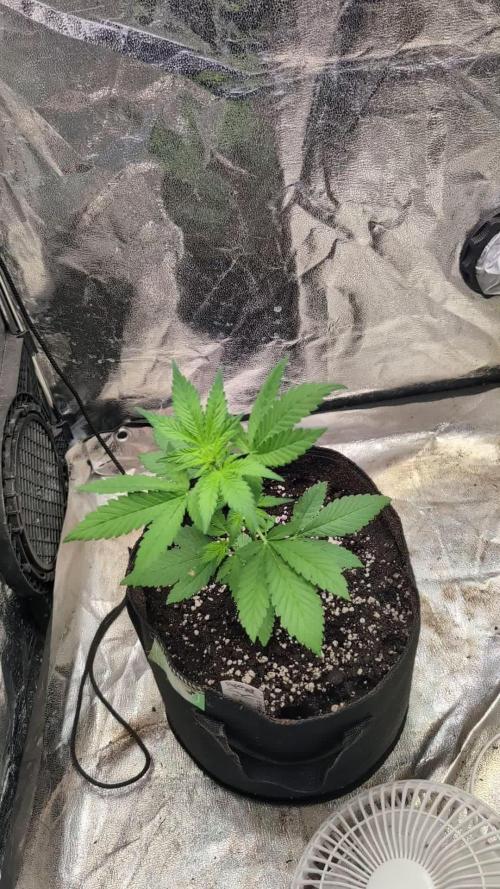
Day 15: Looks good 👍🏻 watered with rain water 👌🏻 keeping the soil moist 🌧️
Day 18: looking good and transplanted her into a bigger pot with Plagron All Mix and Dolomit Lime. 🌊Watered with rain water and 1 ml/l Hesi Boost, 1 ml/l Cal Mag, and 1 ml/l Green Sensation. EC at 1.0 and a pH of 6.4 .
Day 21: looking good and watered again. Watered with rain water and 1ml/l Powerzyme, 1 ml/l Hesi Boost, 1 ml/l Cal Mag, 1 ml/l Bloom Complex and 1 ml/l Green Sensation. EC at 1.0 and a pH of 6.4.

Likes
8
Share


@weed_gastro
Follow
Week 3!
- day 21: Decided to top them
Also this is my first time topping, please feel free to let me know if I do something wrong.
-update on day 22: transplanted the one that was in the smallest pot, quite nice root system!
-upd. day 26: I gave them 12 hours of darkness, thereby flowering phase is ON! :P

Likes
34
Share
@Arcadium
Follow
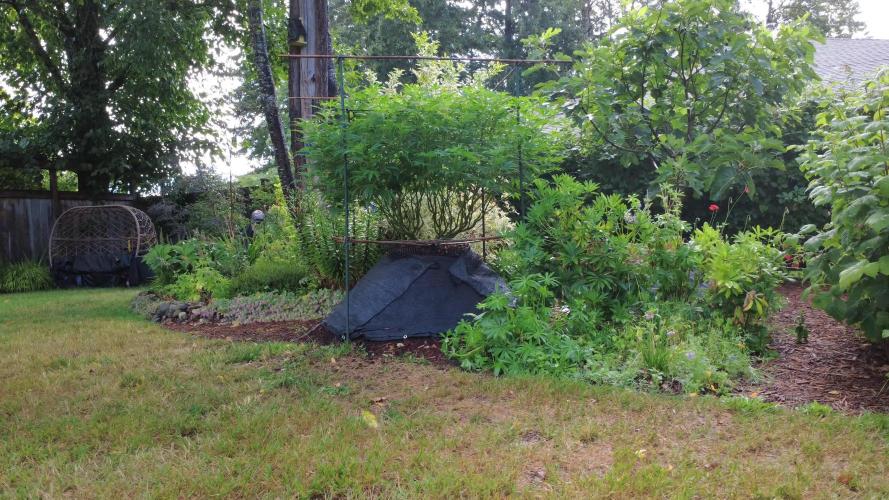
Crazy thunderstorm this week, just dumped 15mm in under 10min (over 40mm in under 24hrs), flooded everything in town, luckily no issues at home! I didn't witness how she handled it as I was out fishing (not the smartest idea, but hey lots of salmon) , but she still looks great, no issues at all. That's a big benefit of growing in a mound like this, no chance of drowned roots, but it is hard to keep the overall outside of the mound moist.
Still moving bud clips up every few weeks to even out the cannopy, light defoliating of the bottom and inside, monster maxx and silica, compost tea Brewing as we speak (every 3 weeks). Pistils are everywhere, but I wouldnt say flowering yet.
10g airpot is maybe finally done stretch and should officially flower soon, will probably trelis net shortly.
Added some scat matt to the underside of the plant to stop the Robin's from peckin away at all the tasty millipedes from the compost top dress layer, I can see how aggregated they got but it worked haha.
Overall incredibly smooth grow so far, no issues at all, looks incredible. Still plucking out any growth tips buried in the cannopy, had to cut out a couple more branches that lagged behind but you really can't even tell, so I wasn't worried. Those bud clips have really tripped the number of leading nodes, in the cannopy, so easy and simply highly recommended.

Likes
2
Share


@dsullivan157
Follow
Soaked some then put them directly into rapid rooters and some into my own custom medium I’m putting them on a heat mat with a T5 light to get them big enough to put in my mini greenhouse


Likes
6
Share


@SkunkyDog420
Follow
Hallo zusammen 🤙.
Sie wächst sehr schön und macht keine Probleme.
Rabattcode für den BIOTABS-Webshop https://biotabs.nl/en/shop/ GDBT420, damit erhalten Sie 15 Prozent

Likes
16
Share


@Mo_Powers
Follow
the weather in my part of germany is really bad for this summer at the moment. it's raining too much. i've put them in a dry place to prevent mould from forming. maybe they're not getting as much fertiliser. they'll get one more week and then they'll be harvested.


Likes
9
Share


@Kushizlez
Follow
Harvest:
Everything dried up to 347 grams + 96 grams of super high quality trim. Overall I am not too pleased with the smoke of the product. Although the bud size, bag appeal, smell and taste are pretty much all there, the shitty burn is a deal breaker for me and the majority of this weed is quite frankly useless. Another downside is while smoking I’ve found 4 seeds in an ounce from almost every strain. Light leaks? At least I learned a ton, including how to get super good burn for my next crop. I’m hoping that curing for a month or so will improve the burn but I wouldn’t really count on it. I have seen weed dried for 4 days with no cure and no flush smoke clean and not go out once. I have been told that the key to white ashes/clean burn is proper mineral content in the soil and there is tons of scientific studies on cigar ash going back 100 years. Plants grown in a medium with high levels of decomposing organic matter, phosphorus, magnesium, chlorine and heavy metal ratio tend to produce black/grey ash. Whereas plants grown in a medium with a higher ratio of trace minerals like calcium carbonate and potassium in the form of wood ash, rock dusts, oyster shell flour and lower levels of decomposing organic matter will produce a dense, uniform white ash that rarely goes out. But this is still all theory until I test it to confirm for myself a few times. My last few outdoor harvests did not improve with curing at all so I’m hoping this will be the missing link. Plain peat moss and coco clearly lack essential minerals that help burn. If said theory is correct I should find a synthetic nutrient line with more trace minerals. Makes me wonder if growing if rockwool/basalt rock could improve burn in a hydro setup.
I think I did a fairly decent job for my first grow. I went wrong in a million different places but I still stuck it out and got some decent herb. Things went wrong early when I got black spot mold, nitrogen/magnesium deficiencies and powdery mildew. I corrected most of it but things didn’t get really bad until mid veg when I intentionally skipped a few feedings and defoliated quite heavily stunting the plants. I also didn’t even top or start LST until the 6-9th node which was really stupid and hurt my yield. My temperatures were all over the place from the learning curve. I was severely overwatering without realizing it. 100% peat moss is a shitty medium. I also fed way too late in flower (not what caused shitty burn). I also used synthetic nutrients in soil.
Zkittlez bonsai
Yield: 1.9g
Smell: 7/10 - sweet, candy, berry, gassy, piney hints
Bag appeal: 7/10 - slightly leafy/stemy
Crystal coverage: 7.5/10 - very impressed
Ash: 6/10 - flaky, mostly white/grey
Fire holding: 4/10 - stays lit for 10-30 seconds
Smoke: 6/10 - taste is decent, needs curing
High: 6/10 - indica dom
Comment: looks nice, smells nice, tastes nice, burns like shit.
43.5/70 = 62% 👎🗑️
Black Garlic #1
Yield: 53.6
Smell: 8/10 - gassy, piney, earthy, skunky
Bag appeal: 7/10 - slightly leafy/stemy
Crystal coverage: 7.5/10 - very impressed
Ash: 8/10 - thick, uniform white ash
Fire holding: 7.510 - stays lit for 45+ sec
Smoke: 7.5/10 - taste is good until the end
High: 7/10 - sativa dom
Comment: looks nice, smells nice, tastes nice, burns great but quite leafy.
52.5/70 = 75% 👍🔥
Black Garlic #2
Yield: 42.3
Smell: 7/10 - woody, earthy, tea
Bag appeal: 6.5/10 - slightly leafy/stemy
Crystal coverage: 7/10 - impressed
Ash: 6/10 - flaky, mostly white/grey
Fire holding: 4/10 - stays lit for 10-30 seconds
Smoke: 6/10 - taste is decent, needs curing
High: 8/10 - sativa dom
Comment: looks nice, smells nice, tastes nice, burns like shit.
44.5/70 = 63% 👎🗑️
Zkittlez
Yield: 39.4
Smell: 7/10 - sweet, candy, berry, gassy, piney hints
Bag appeal: 6.5/10 - slightly leafy/stemy
Crystal coverage: 7.5/10 - very impressed
Ash: 8/10 - thick, uniform white ashes
Fire holding: 8/10 - stays lit for seconds
Smoke: 7.5/10 - taste is decent, needs curing
High: 7/10 - indica dom
Comment: looks nice, smells nice, tastes nice, burns great but smalls didn’t fill out.
51.5/70 = 73% 👍🔥
Blackberry Breath #1
Yield: 57.5
Smell: 9/10 - sweet, grape, berry, gassy, earthy, hashy
Bag appeal: 8.5/10 - dense, sparkly buds
Crystal coverage: 9/10 - super impressed
Ash: 5/10 - flaky, mostly grey/blackish
Fire holding: 4/10 - stays lit for 10-30 seconds
Smoke: 5/10 - tastes like chalky shit
High: 6/10 - indica dom
Comment: looks amazing, smells amazing, tastes like shit, burns like shit.
46.5/70 = 66% 👎🗑️
Blackberry Breath #2
Yield: 76.1g
Smell: 6/10 - musky, tea, berry, herbal
Bag appeal: 8/10 - slightly leafy/stemy
Crystal coverage: 7.5/10 - very impressed
Ash: 5/10 - flaky, mostly grey/black
Fire holding: 4/10 - stays lit for 10-30 seconds
Smoke: 5/10 - taste is shit
High: 6/10 - indica dom
Comment: looks nice, smells shitty, tastes shitty, burns like shit.
41.5/70 = 59% 👎🗑️
Slurricane #4
Yield: 34.5g
Smell: 8.5/10 - gassy, deep piney, fuel, earthy,
Bag appeal: 8.510 - slightly leafy/stemy
Crystal coverage: 7.510 - impressed
Ash: 6/10 - flaky, mostly white/grey
Fire holding: 4/10 - stays lit for 10-30 seconds
Smoke: 6/10 - taste is decent
High: 6/10 - indica dom
Comment: looks amazing, smells amazing, tastes nice, burns like shit.
46.5/70 = 66% 👎🗑️
Badazz OG Cheese
Yield: 43.5g
Smell: 6.5/10 - musty, woody, cheesy, piney hints
Bag appeal: 6/10 - slightly leafy/stemy
Crystal coverage: 6/10 - very impressed
Ash: 5/10 - flaky, mostly white/grey
Fire holding: 4/10 - stays lit for 10-30 seconds
Smoke: 6/10 - taste is decent
High: 6/10 - sativa dom
Comment: looks like shit, smells decent, tastes decent, burns like shit.
39.5/70 = 56% 👎🗑️

Likes
120
Share


@Kitties_and_Colas
Follow
~_~_~_~_~_~_~_~_~_~_~_~_~_~_~_~_~_~_~_~_~_~_~_~_~_~_~_~_~_~_~_~_~_~_~_~_~_~_~_~_~_~_~_~_~_~_~_~_~_~_~_~_~_~_~_~_~_~_~_~_~_~_~_~_~_~_~_~_~_~_~_~_~_~_~_~_~_~_~_~_~_~_~_
02/13/22
😻These ladies are sooo close! ❤️🌱.. the Peyote Gorilla looks especially sticky (has to be the GG#4) , as far as eye appeal, its definitely my favorite strain in the tent (shhhhh.. don't tell the others 😹).. we're still rocking a lot if clear trichs but the cloudiness is coming on fast, we're about 30%/70% atm..we gave them all their last heavy feeding 2 days ago, we dropped the lights again (app reading approx. 40k LUX at plant tops)...we're only doing water only from here on out, the whole tent should be entirely faded in 2weeks or less and some nice white ash in our future (and some killer tincture for yours truly lol🤘🐱).. thanks for reading if you made it this far and happy harvests everyone!!!! ❤️💡🌱😽💨
~_~_~_~_~_~_~_~_~_~_~_~_~_~_~_~_~_~_~_~_~_~_~_~_~_~_~_~_~_~_~_~_~_~_~_~_~_~_~_~_~_~_~_~_~_~_~_~_~_~_~_~_~_~_~_~_~_~_~_~_~_~_~_~_~_~_~_~_~_~_~_~_~_~_~_~_~_~_~_~_~_~_~_
Likes
15
Share


@Noob_quest
Follow
So all good this week,
All are still looking healthy & happy apart from the weirdo SP2. There’s amber trichomes so it’s coming down on the weekend. Such weird thing so small & weird but matured really quickly. Gonna dry & then attempt to smoke it - damn straight. Who knows might be chronic right.
Also just starting to see some yellowing on bottom leaves of SP3. Was planning a top dress this week anyway but may have left it a few days late.
Still this is the longest I’ve kept them looking this healthy and I’ll know for next time so I’m still happy.
The big drama this week was a giant fucken Hornet got in the tent while I had it open watering the girls. It was MASSIVE like bigger than my thumb. I wasn’t brave enough to deal with head on but gave it smack with 3 ft bamboo cane and ran out the room and shut the door behind me. I think it’s flew out the window and is gone. But that was 2 days ago and I’m still shitting myself everytime I open the tent in case it’s in there waiting to get me.
Running out of the better we’d from last grow so starting to count days to harvest lol. All good though.
Thanks for reading have a great week 😊
Likes
8
Share


@Kirsten
Follow
16.2.25:
I decided to check out the lower canopies of all plants to see if I need to get rid of any foliage.
I did get rid of a few small branches and leaves.
However, whilst I was doing this, I saw more garden pegs from my LST remaining.
There were about 6 or more in Pink Mist alone. Additionally, on Watermelon, there were some left in, too.
I'm so annoyed to see that because the plants are really stretching, and I could've potentially disrupted this by leaving the pegs in for all this time without realising it.
🤞 that I haven't compromised things too much. We'll see.
I watered today with 2ltrs of dechlorinated water PH'd to 6.3 containing the following nutrients;
♡ .8g Green Leaf Nutrients PK booster
♡ .5g Ecothrive Biosys
I ordered quite a few things for the garden. I got Greenleaf Nutrients Sea K(elp) and Mega Crop Parts A+B. To go with their PK Booster I got last month. I'm excited to try it all together. Next run, maybe just using these. We'll see how it goes.
18.2.25:
The plants are going crazy for water! Everything is getting used right up so fast!
Today, I decided to add some more Black Strap Molasses to add some carbs and other micronutrients. I'll add the jar with the label in the photos section above.
I watered a very small amount to each plant.
What I put in:
♡ Black strap molasses 150g
♡ 2g Sea K(elp) Greenleaf nutrients.
I dissolved everything in 4ltrs of dechlorinated water PH'd to 6.4.
19.2.25:
I received the majority of the garden purchases that I made. I'm still waiting for the Ecothrive Life Cycle. I wanted to top dress, but it's been delayed unfortunately.
I am using my Greenleaf nutrients products which I bought on Amazon. I got the Mega Crop 2 part system Part A and Part B. I have the Sea K(elp), and the bud explosion PK booster.
I really wanted to get some of their sweet candy asking read many positive reviews. Unfortunately, for me, this is unavailable to buy currently. So that's a little disappointing.
I needed to do a good watering so when my nutes were delivered today, I got excited 🤗
I watered 2ltrs of dechlorinated water per plant, PH'd to 6.4, containing the following nutrients:
♡ 1g Mega Crop Part A
♡ 1g Mega Crop Part B
♡ .5g Sea K(elp).
The plants drank this up within a few hours.
I'm going to try and hold off on watering in hopes that my Ecothrive Life Cycle will arrive so I can top dress and water it in then.
20.2.25:
My Ecothrive Life Cycle arrived yesterday, and the plants are ready for their top dress and a good watering in.
I have some Biobizz Light Mix, Canna Coco,and perlite. I'm going to use this as a base to mix my amendments in.
I'm going to fill my 5 gallon bucket with about 4.5 gallons of my top dress mix. I will distribute this across 6, 4-5 gallon pots. Then I will water in well with Greenleaf nutrients Mega Crop Parts A+B and Sea K(elp).
I've made a crude attempt to video mixing my top dress. Don't listen to the audio. lol, my YouTube didn't stop playing whilst I recorded this 😂
So anyway, I added the following amendments to the above base mix of 4.5 gallons;
♡ 3 TBSP Ecothrive Life Cycle
♡ 3 TBSP Vitalink Bat Guano
♡ 3 TBSP Ecothrive Charge
♡ 1 TBSP RHS Mycorrhizal Fungi granules
♡ 6 TBSP Ground Cinnamon.

Likes
236
Share

@yan420
Follow
This two were part of another diary and got moved out due to space reasons at VW8 and moved back indoors at VW20
https://growdiaries.com/diaries/218151-auto-god-s-glue-grow-journal-by-yan402
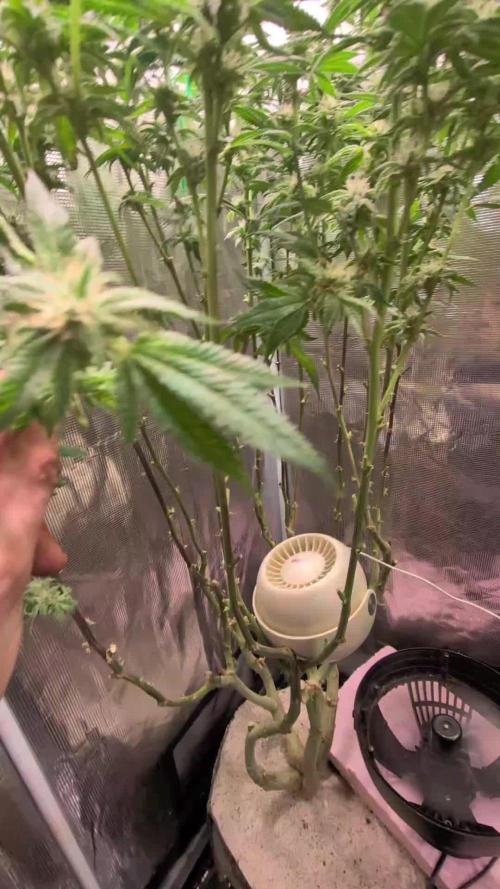
13.09.25 VW21 Both are looking good and are developing tighter nodes than when they were outside, I'm going to have to keep cutting them back every once and a while I also applied nematodes against thrips and fungus gnats.
20.09.25 VW22 some spots and some yellow leafs, I think it's a root problem, probably root bound, but both seem healthy and are getting thicker so maybe just top up with Coco coir and give a slight different nutrient schedule less Tri Part Bloom could do the trick MAYBE lol.
27.09.25 VW23 Topped up the pots with extra coco coir and trimmed the side roots a bit, both plants were root bound 📹
03.10.25 VW23 did a HST/LST session 📹
12.10.25 VW25 Done a major HST session to try and keep them in line with the Sunset Sherbet GF I have going in the same tent, rest in the video 📹
17.10.25 VW25 ffj/fpj/fish 30 → 60 ml
19.10.25 VW26 it just became a one plant diary, keeping #5, #6 gets it's own diary for testing nutrients.
20.10.25 VW26(?) Feed tweak: added 3 g Calcium Nitrate/ 30 L (≈ 15 ppm N + 10 ppm Ca)
24.10.25 VW26 did a defoliation and trimming session 📹
25.10.25 VW26 I'll be repoting tomorrow, 26.10.25 VW27 rest in the video📹
27.10.25 VW27 Epsom Salt 0 → 2.5, Calcium Nitrate 3 → 9 g
01.11.25 VW28 CalMag 60 → 30ml, TriPartBloom 20 → 30ml, Magnesium 2.5 → 3.5g
04.11.25 VW28 no more yellowing between the veins and no new spots, the changes to the schedule worked, rest in the video 📸
09.11.25 VW29 Did what I'm hoping is a last cleanup 🎥
12.11.25 VW13 Did another cleanup in the tent 🎥, also switched to the FERMAKOR PK Micro schedule, (10.11.25) added Phosphoric acid as a pH down in preparation for flowering
14.11.25 FW1 FERMAKOR PK Micros 40 → 50 ml
22.11.25 FW2 Calcium Nitrate 40 g → 35 g
05.12.25 FW3 about 2 weeks ago Calcium Nitrate 35 g → 25 g, FERMAKOR PK Micros 50 ml → 60 ml
08.12.25 FW4 powdery mildew, rest in video 📸
🌱💦🌱💦🌱💦🌱💦🌱💦🌱
Day to day tasks & actions 🌿
🌱💦🌱💦🌱💦🌱💦🌱💦🌱
06.12.25 FW3 – Fed 5l of #1 → 2l runoff
(*RUNOFF reused for indoor house plants)
💧💦💧💦💧💦💧💦
🌱 Nutrients in 30 L #1 Veg – FERMAKOR
💧💦💧💦💧💦💧💦
Calcium Nitrate (Calcinit / Nitcal): 45 → 40 g → 35 g → 25 g
= 1.50 g/L → 1.33 g/L → 1.17 g/L → 0.83 g/L
= 207 ppm N / 253 ppm Ca → 184 / 225 → 161 / 197 → 115 / 141
PK Concentrate (FERMAKOR Base): 30 → 40 ml → 50 ml → 60 ml
= 1.00 → 1.33 ml/L → 1.67 ml/L → 2.00 ml/L
→ balanced 1:1 P:K + light micros (from extract)
Home-made FFJ/FPJ (Fish + Veg): 30 ml
= 1.00 ml/L
Epsom Salt (MgSO₄·7H₂O): 8 g
= 0.27 g/L → ~26 ppm Mg + ~35 ppm S
Fetrilon Combi 1 (Micros): 0.5 g
= 0.017 g/L
→ Fe 0.7 ppm · Mn 0.7 ppm · Zn 0.3 ppm · Cu 0.3 ppm · B 0.1 ppm · Mo 0.02 ppm
Phosphoric Acid (pH down) + Citric Acid (chelation): as needed
→ First set pH with phosphoric acid, then add a little citric only if you want extra chelation
Target pH: 5.8 – 6.0 (drop test yellow-green)
📦 TOTAL:
Liquids: 60 → 70 → 80 → 90 ml per 30 L
= 2.00 → 2.33 → 2.67 → 3.00 ml/L
Solids (CaNO₃ + Epsom + Fetrilon):
53.5 → 48.5 → 43.5 → 33.5 g per 30 L
= 1.78 → 1.62 → 1.45 → 1.12 g/L
💧💦💧💦💧💦💧💦
⚙️✂️⚙️✂️⚙️✂️⚙️✂️⚙️
✂️ Tools & equipment ✂️
⚙️✂️⚙️✂️⚙️✂️⚙️✂️⚙️
✂️ 2× MarsHydro SP3000
⚙️ MarsHydro 150mm ACF Ventilator
✂️ Trotec dehumidifier (big unit)
⚙️ Mini no-name dehumidifier
✂️ Kebab skewers (LST – stainless)
⚙️ Wire + roast skewers (LST assist)
✂️ Scissors (HST)
⚙️ Vacuum (for spills & cleanup)
✂️⚙️✂️⚙️✂️⚙️⚙️✂️⚙️✂️⚙️✂️⚙️
🍒🍭🍬🌈🍒🍭🍬🌈🍒🍭🍬🌈🍒
🦄Fantasy Feast ( Seeds)🦄
🌈🍒🍭🍬🌈🍒🍭🍬🌈🍒🍭🍬🌈🍒
Species: Hybrid (Regular)
Genetics: The mother is Unicorn Whip by Dirty Bird Genetics. The father is Charcuterie by Cannarado Genetics.
Effect: Unknown Mixed effect body and head high
Flavor: Some phenos are Skunky gassy fruity, some are fruity sour citrus with a chemical touch and a touch of skunk
Flowering: Estimated 8–10 weeks
Resistance: Strong — Testing phase done
YouTube Link: https://youtube.com/-m8h?si=A7x4Zlr2kj-_ga31
Likes
27
Share


@RDWCGrowing
Follow
3/18/2023
Week 5- Day 1 of Veg (Day 45 overall)
First day of Week 5 Water change day.
36 Gallons in
Mammoth Silica = .5Mil/Gal = 18Mil
CalMag = .5Mil/Gal =18Mil
Root Drip = 1Mil/Gal =36Mil
FLoraMicro = 4.8Mil/Gal = 173Mil
FLoraGro = 4.0Mil/Gal = 144Mil
FLoraBLoom = 3.8Mil/Gal = 137Mil
ORCA = .5Mil/Gal =18Mil
PH = 5.85
PPM = 576
I adjusted the lights to final position for grow the lights are now 45" from the top of the plants.
PPFD= 450
Tent Temp = 78.3
Water Temp = 73.2
3/19/2023
Week 5- Day 2 of Veg (Day 46 overall)
Not much to report.. Did some defoliation and some topping. The humidifier was not cutting it by itself to keep the humidity around 60 so I added a bigger humidifier today on a second InkBird Controller. Lets see if it can help control the environment a little better and keep me from having to refill 3 times a day.
3/20/2023
Week 5- Day 3 of Veg (Day 47 overall)
Just let them be today. We all took the day off and just grew!!
3/21/2023
Week 5- Day 4 of Veg (Day 48 overall)
Nothing much to report they continue to do good.. I topped a little I fim'ed a little and I defoliated a little.
Everything seems to be on point still...
3/22/2023
Week 5- Day 5 of Veg (Day 49 overall)
Did a little bit of daily maintenance by adding 6mil of PH Up to bring my PH from 5.80 to 5.89, I refilled my humidifier. I topped a little, I FIMed one and I defoliated a little bit.
3/23/2022
Week 5- Day 6 of Veg (Day 50 overall)
Regular maintenance conducted. The PH was down to 5.80 so I added 8mil of PH UP bringing the PH to 5.91. I topped where it was needed, I also defoliated some to allow light to hit lower nodes as well as allow a good air flow.
3/24/2023
Week 5- Day 7 of Veg (Day 51 overall)
Last Day of the week time for measurements:
#3 = 1 foot
#2 = 11 and 1/2 Inches
Tomorrow I will try to just add a SILICA top off to my Res.. I hope it doesn't call any gumming and me to drain and restart my Res.. this will be my first time topping off SILICA.

Likes
4
Share


@Barcelona_Farmers710
Follow
Muy buenos resultados para el poco cuidado por falta de tiempo! Una maravilla.
Likes
6
Share


@AbbyCat
Follow
The weight listed is wet, so I expect to lose about 20% as it dries and cures, leaving a final yield of around 8–9 ounces. This is a fantastic strain with an uplifting, energetic high—perfect for thinking, dreaming, and relaxing without knocking you out. I had a lot of fun growing this strain even with all the challenges in the beginning


