


Likes
Comments
Share


@budlicious
Follow
This week has been good, pistils started showing up on the 27th. Just watering with ph'd dechlorinated tap water. I bought lst wire but I'm not too sure if I did lst the best way but there are about 6 side branches with tops and 5 more on the way. Im probably going to be switching my 50% veg 20% bloom, to a 50/50 consuming 190 true watts from the wall next week.

Likes
27
Share


@MaltaHerbman
Follow
Its time for more pk i am using Hesi phosphorus plus.
Plants look like love it.
Thank for watching lot of ❤️ from 🇲🇹

Likes
10
Share


@mr_smooke
Follow
One more week is behind us, buds are getting bigger, day by day. smelling incredible and is frosty A.F. on pics is 24 days in flowering, She has biggest buds in growroom 😅😊

Likes
9
Share


@Wicked_Stix
Follow
Day 35 is here. We are a week into flower and most the plants are just starting to hit that flowering stretch. I have been bending them down a little every couple days, but I need to focus on cleaning up some of the bottom branches so we can keep good air flow through the plants. Will work on that through this next week. I haven't done a water change, just been topping off the reservoir with fresh nutrients as they drink it up. Feeding half and half maxigro and maxibloom. Will cut out the maxigro in a couple weeks when I notice their stretch slowing down. I had a plant overflow this week because the drain line is getting full of roots. I noticed a couple roots have made their way into the reservoir already. I set a pump timer to 1 minute on and 20 minutes off so they can drain properly. I would like to make it through the grow without having to mess with the drains, but we will see what happens. I will make some modifications if needed. Other than that everything is running smooth and I hope we have some little pistils to show by next week. Thanks for stopping by ✌️
Likes
22
Share

@Kirsten
Follow
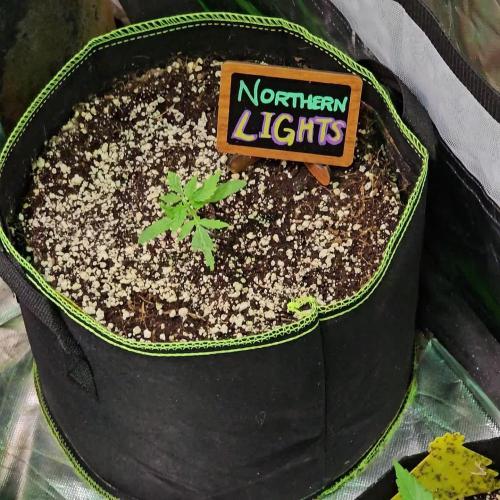
Northern lights is looking a little bit sorry for itself. Unfortunately, she was leaning really heavily towards the ground. So I decided that I was going to use some metal garden pegs to prop her up with. She seems to be doing well in that respect now.
The leaves are looking a little bit crazy. I'm not sure what's going on with that, but hopefully, she'll start growing, and she'll grow out of it. I guess we'll have to wait. And see what happens.
I have added an additional 100Watt UVA/UVB lamp, as the uppermost canopy of Acapulco Gold is blocking pretty much everything in the tent.
Hopefully, this will aid the shorter plants in surviving until I can harvest it. There will be so much more space and lighting. Can't wait! 😅
Here is what I did this week.
25.9.25:
I watered with 1.5L of dechlorinated water PH'd to 6.5 with;
💜 Sea K
PH: 6.5
PPM: 565
The fungus gnats have really increased since I did a watering of the whole tent.
I have some more sticky traps set out, and I will not water for several days.
Once it has dried the top soil, I will add some more Diatomaceous Earth to the top 5cm.
Thanks for checking in this week, and see you in the comments 👌💚🙌🧡😁

Processing
Likes
7
Share


@Chronnoisseur
Follow
Growing strong,very bushy lt gives off a nice skunky smell already. I didnt think she was gonna do really well and than all of a sudden boom your thick and bushy
Likes
22
Share


@Prilyfe13
Follow
June 16, 2024 Day 57
This week nothing changes with the nutrient schedule. I cleaned out the reservoirs and gave fresh nutes. I also made sure to double check the height of all the plants and we have a final height for each of them.
Sour Diesel A is looking pretty good. Her final height is 23". Her bud production is looking pretty good as well. Trichomes are coming through quite nicely.
Sour Diesel B is looking really good with her frosty fat nugs. Her final height is 21". I haven't touched her so I don't know how sticky she is nothing. But I see good things coming to this lady. Huge buds and lots of frost.
Sour Diesel C is frosty, covered in nugs and has a final height of 30.5" tall. She looks fantastic and I wonder what her final yield will be. Her bud production is coming along nicely with buds starting to swell.
Sour Diesel D is shaping out to be my lowest yielder. She has very little bud on her and what she does have is a bit slow to develop. I have a feeling this will be my extraction plant. Edibles and concentrate.
The lighting is looking great at 45 mol/m²/d. Nothing to change. The plants are very happy.
The environment is almost back to normal. The humidity is below 60% for the most part. Yesterday it was all the way down to 52%. Today just under 60% for the morning anyway. The Central Air should be kicking on in an hour or two.
Grow System Environment:
Temp: 74.6°
RH: 55.3%
VPD: 1.27 kPa
June 17, 2024
Nothing going on today. No watering, no training, no pics. Just a smooth day in the tent.
Sour Diesel A looks good. Lots more frost. Buds are swelling. Everything looks great.
Sour Diesel B had a couple leaves popped off, ones that were overlapping Sour Diesel C. Her buds are huge and I'm already starting to see orange pistils. She smells awesome too. Definitely Sour Diesel smell. Sour and gas. And a bit of sweetness as well. Very nice aroma.
Sour Diesel C is looking fantastic. Her buds are also swelling and her trichome production is amazing. So frosty and smelly. As long as the buds continue to swell at this rate, this lady will be a pretty good yielder.
Sour Diesel D is small as ever. Her buds are swelling quite nicely. They are bigger than A and C for now, but not as frosty. I'm honestly not sure if I did something wrong or if this is how she grew naturally. I didn't screw up the nutrients, nor did I add any stress except for the small defoliation. But that was right when she stopped stretching. I guess I'll find out at the end of the run. I also pulled a couple outer leaves off to keep them from overlapping other plants.
Lighting is of course the same as yesterday, and won't be changing until the last 2 weeks of flower. I might drop the intensity down a bit for the last leg of the run. I'm going to research this though. As these are autoflowers they're fine with constant light, but at the end are they looking for less light? I think so. Naturally in the world, the end of a growing season is when it starts to drop on temp and light. So it would make sense to drop the light intensity the last week to help induce maturity and more trichomes. That's what it's supposed to do. I'm not sure if that's the case with autos. Will research and report back.
The environment was great yesterday. Today it's a bit humid in my room but it's also kinda humid outside and 83°. It's supposed to climb up to 88° today, so I'm hoping the central AC will kick on early. The room temp is well controlled around 70°. Once the AC kicks on the humidity should drop down to around 52%. Not ideal, but actually within range. If I can somehow get it below 50% I'll be happy. 52% is merely satisfactory but not perfect.
Grow System Environment:
Temp: 75.7°
RH: 56.1%
VPD: 1.30 kPa
June 18, 2024
It's Picture Day! Did some stuff today. No watering or anything like that.
Sour Diesel A is doing quite well. Her buds are swelling more and more. She's even frostier. I cannot wait to see how frosty she gets by the end. I also checked her roots. I figured out why the container is light. The roots are taking in all the water they can directly before it gets to the container. I'll have to top feed in a day or 2 if she gets lighter. However, she hasn't lost anymore weight in days, but I really need her to moisten the soil in the container.
Sour Diesel B is now producing orange pistils. And kinda rapidly. I knew she would be done first, maybe a couple weeks left for her. I think next week, if she is as far along as I think she will be, I'll switch out Big Bud for Overdrive for the rest of the grow. But we shall see.
Sour Diesel C is looking really good. Her buds are swelling more and she's even more frosty. As we all know, this one is about a week behind the others, so I expect more swelling and some fat buds.
Sour Diesel D needed some leaves trimmed today. They were super overcrowded in one particular spot. So I took 3 of those and then a couple outer leaves that grew out since my last defoliation. Her main cola is getting fat. Just not fat enough. I have a feeling I'm getting no more than 2 oz. I'm guessing just over an oz. We shall see. She's definitely not big enough and doesn't have enough bud to produce a good yield. Oh well. The rest are pretty promising, so I'm not too worried.
I added to the lighting today. I have supplemental lighting from AC Infinity. So I installed them today just below the top of the canopy. It should help with the lowers and get more fat buds throughout all 4 plants. I'll keep it at level 7 for today and see how things look tomorrow. The only concern I have is too much light from the main light due to the extra light from the supplemental bars. However, it should do quite well.
So we are in a humid heat wave for the rest of the week. The Central Air should be kicking on anytime and will definitely drop the humidity down to about 50%. The temp should stay around 75° to 76°. Currently the humidity is really high at 66%. I'll be keeping the tent door open every hour or so until the A/C turns on. The temp is kind of high as well at 79°. I think I need to try to get the bedroom temp down to 76°. Wish me luck. It's already 82° and climbing.
Afternoon update: Damn it's hot.
Grow System Environment:
Temp: 76.7°
RH: 55.8%
VPD: 1.34 kPa
June 19, 2024
Not much going on today. I may need to water, but that's a maybe. Other than that, just the one pic.
Sour Diesel A looks great. Surprisingly, she is nearly empty where the other 3 have more water in them. Her bottom is also more moist than normal. She's in the way back and I didn't bother taking the plants out today. I'll take her out tomorrow and inspect her for any issues.
Although, I'm pretty sure I'll be refilling her reservoir this evening and might as well refill the rest.
Sour Diesel B is getting more orange pistils. I will have to research when I should be adding Overdrive now that I don't think she has more than 3 weeks left. 2 of flower and 1 of flush. Maybe just a week more in flower. I'm not sure. Researching. She's also getting the natural foxtails I read about. Apparently Sour Diesel, in general, foxtails. We shall see how it comes out. There should be no foxtails based on the environment unless the humidity can cause it. I'll have to research that as well.
Sour Diesel C actually took the least amount of water for this watering. She's still about half full where the rest are near empty to about a quarter full. I find it interesting that she isn't drinking like a fish. She's in the second half of flower and should be super thirsty. I'll check the moisture content of the soil tomorrow when I refill the reservoir.
Sour Diesel D is getting a nice fat main cola. She is the second most empty with less than a quarter gallon left. It's funny. I'm starting to think it's not the plants, but the dehumidifier on that side. I think it's evaporating the water faster than the plants can drink it. I might have to either move it or take it out all together. We shall see.
The lights seems to be doing quite well. I don't see any stress from the supplemental light bars. If I start seeing it, I'll drop the power down to 50%, but I doubt it. They are attached to the poles vertically. I would have much rather had them horizontal, but I took my support bars out. I can't reinstall them or I won't be able to take the plants out. So that's out the window. So vertical it is. I may however install the inside bars if I can and then mount the front one to the tent door with a magnet bar. I might try that tomorrow when the plants are out of the tent.
The environment is killing me. When the Central Air is off, the humidity spikes like 12%. Now the humidity is ridiculously high yet again at 67%. I really hate not having a wall or window AC. That would solve all of my problems. So I'm screwed until the AC kicks on.
Grow System Environment:
Temp: 76.1°
RH: 59.2%
VPD: 1.22 kPa
June 20, 2024
It's picture day! We have some happy ladies and there isn't anything to really do today.
Sour Diesel A is getting fatter buds. They are kind of small, but it's still only week 4 of flower. She's still a little light. I might top feed a quarter gallon. Maybe with Recharge in it. I'll have to decide what to do. She's definitely not struggling, but she does have upward clawing edges. I'll have to research what that means.
She is still the frostiest of the bunch.
Sour Diesel B is getting even fatter. Frost is starting to come through pretty quickly now. I can't wait for this one to finish up.
Sour Diesel C took quite well to the small bit of top watering I did yesterday. Her buds are still small, but that is to be expected with this one. I can tell they will swell up pretty good and there will be a nice bunch of colas.
Sour Diesel D looks great. Her leaves are a lush green still, her buds are getting fat and stacking like mad. The buds are so close together, the plant looks like it has a tiny football on its top. I wonder what she will look like all trimmed up. Probably very small.
The lighting seems to be fine now. The praying has lessened, so I know the lighting was an issue. Now that it's fixed, it should be business as usual.
The environment is absolutely wrong now. The humidity is in the 70s today. And the temp is in the 80s. Just have to wait for the house AC to kick on.
Grow System Environment:
Temp: 75.7°
RH: 58.2%
VPD: 1.23 kPa
June 21, 2024
Nothing going on today. No watering, no light changes and I didn't even pull them out. I can see everything that I need to see.
Sour Diesel A is getting orange pistils now and seems to be swelling more. Her buds are a little small, but I expect them to swell up over the next 2 to 3 weeks.
Sour Diesel B should be done in a couple weeks. She has orange pistils everywhere. I was thinking she would go the same time as everyone else, but it looks like she will be done a week before the rest.
Sour Diesel C is looking great as ever. She is a week behind and has all white pistils. Her buds are also a bit small, but I expect them to fill out over the next 4 weeks. Maybe 3.
Sour Diesel D needed a few leaves cut from the main cola. The foliage is just way too thick there. I'm afraid the buds won't swell because there's no space at all. Even cutting the leaves off did next to nothing.
The lighting didn't change at all. That's it. No changes.
The environment is doing the same thing as the last 3 days. High humidity in the morning and lower humidity in the afternoon. Today the temp is a bit wonky sitting kinda high at 78°. Too high for happy trichomes. I'm working on dropping the temp back down to 75°. 74° would be ideal, but this strain also likes it really warm.
Grow System Environment:
Temp: 75.4°
RH: 59.1%
VPD: 1.20 kPa
June 22, 2024
Last day of week 4 and we got some pictures! And a video.
Sour Diesel A is doing quite well. She has some pretty nice stacks going on. But the most trichomes production. I also popped a few leaves off. They were getting crushed. Only a few though.
Sour Diesel B may be ready for Overdrive. I'll check tomorrow, but I don't think she'll be growing much more. Her pistils are about 50% orange, but still stark white on the bottoms. So I might wait a week before starting Overdrive. Big Bud is supposed to go to week 6, but this is a 45 day flowering cycle. A total of 6.5 weeks. Based on that info, I think next week will be a good start for Overdrive and then leave it for week 6 and then flush for week 7. And then harvest. I also took 2 leaves off. They were also being crushed.
Sour Diesel C is coming along nicely. She has super long stacks covered in frosty bud. Not a single orange pistil. I'd say she has another 3 weeks before flush. Yet another plant that I took some leaves from. Just a few though. Sticking out and overlapping other plants.
Sour Diesel D has this hot mess of a main cola. It's ridiculously large, but it's just a whole bunch of super tight nodes. I'm not sure what it's going to do, but trimming it will be a super pain in the bottom parts. No leaf removal today, but I did take 3 yesterday.
As for lighting, I think I should have left the support bars in the tent. I'm not really liking the vertical supplemental lighting. I'd much rather them be horizontal along each wall. I feel like that would be the best way for adding the lower light. I may add the bard tomorrow, but just the back and sides. I still need to be able to pull the plants out for watering and to check for any issues. Not that I think there will be any issues, but you never know.
The environment is the same as yesterday and the day before. High humidity in the morning and lower humidity in the afternoon. The temp is bouncing around a bit. Up to 80° this morning and now down to 78°. Too high. I need to try to drop the heat down more.
Grow System Environment:
Temp: 75.7°
RH: 59.3%
VPD: 1.21 kPa


Likes
8
Share


@NO_DRAMA
Follow
If we look closer we can see bored leaves , i think we have little stress, but this plant is Perfect !!! Bravo S.S 💪

Likes
39
Share


@eldruidamx
Follow
Day 57. Watering with clean water.
The light schedule has been changed (12x12). Replaced lamp.
Day 58. Watering with fertilizers.
Day 59. Watering with clean water.
Day 60. Watering with fertilizers.
Day 61. Watering with clean water.
Day 62. Watering with fertilizers.
Day 63. Watering with clean water.

Likes
20
Share


@adam_pawloski87
Follow
We are in Flush !! Was giving them GH Flora series + rapid start + cal mag
Likes
21
Share


@MG2009
Follow
01/27/2021
Flowering going well
Flowering #2,#3,#6 #6 is a week ahead of#2,#3 will put others in on week 4 for a staggered harvesting
01/30/2022
watered with fungal tea and some aloe mixed in for amino acids and other goodness. Well see how she progresses in 4 days
Also working on some banana peel tea to give a boost of potassium if I do next week it should be available for week 6-7.
Ps.
Fuzzy Mellon (bag seed male)
I will pollinate one lucky branch on #6 as she is my favorite. But number 3(tall and lanky one) will get pollination of one branch as well.
I can't wait to see how they recombine with fuzzy melon smell mixed with burnt rubber and model glue and pine.
#2 no pollination (smaller one) #5 (bonsai) and #8 are males. So 3 female out of 8 seeds. Going to make some feminized seeds next time,so I'll have plenty of female's for a staggard harvest.
Likes
52
Share


@MadeInGermany
Follow
Flowering day 44
since time change
to 12 / 12 h
Hey guys :-)
The buds are becoming incredibly beautiful and smelling better and better ☺️.
Today there was again the full load of food and will be slowly driven down as soon as it comes to an end :-)
Was watered 3 times a week with 1.2 l each (nutrients see table above)
Otherwise everything was cleaned.
Have fun and stay healthy 💚💚💚
👇🏼👇🏼👇🏼👇🏼👇🏼👇🏼👇🏼👇🏼👇🏼👇🏼👇🏼👇🏼
You can buy this Nutrients at :
https://greenbuzzliquids.com/en/shop/
With the discount code: Made_in_Germany you get a discount of 15% on all products from an order value of 100 euros.
👇🏼👇🏼👇🏼👇🏼👇🏼👇🏼👇🏼👇🏼👇🏼👇🏼👇🏼👇🏼
You can buy this strain at :
https://www.ripperseeds.com/en/feminized/kmintz-feminized-cannabis-seeds
Water 💧 💧💧
Osmosis water mixed with normal water (24 hours stale that the chlorine evaporates) to 0.2 EC. Add Cal / Mag to 0.4 Ec Ph with Organic Ph - to 5.8 - 6.5
MadeInGermany


Likes
18
Share

@DogDoctorOfficial
Follow
🌸 BlueBerry — Week 8 Flower | Shining Toward the Finish Line
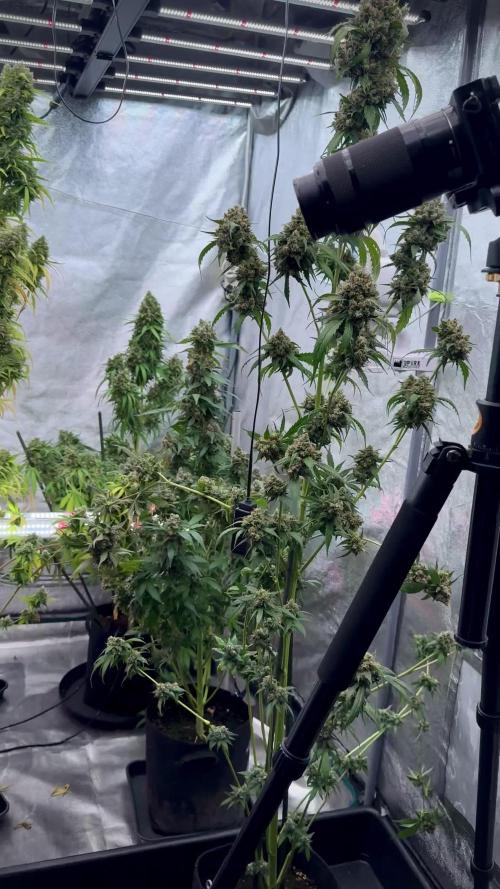
Here we are, my dear readers — Week 8 of flower. The room feels magical. Our BlueBerry girls, both phenos, are in their full glory — dense, fragrant, and sparkling with resin. From seed to now, it’s been a journey of patience, learning, and pure joy. The final stretch has begun, and you can feel it in the air — harvest is not far away, maybe one or two weeks more.
✨ The Girls
Both BlueBerry #1 and BlueBerry #2 are magnificent. Thick colas stacking from top to bottom, glistening with frost under the lights. The pistils are slowly turning color, and the aroma is deep, sweet, and nostalgic — that unmistakable BlueBerry essence that makes this classic a legend.
The trichomes are swelling beautifully, and bud density is impressive. The girls are holding up thanks to the yo-yos — these branches are heavy, bending under the weight of their own success.
⚙️ The Gear
This week, let’s give a shout-out to the gear making this symphony possible:
💡 Lighting Setup
We are running a mix of powerhouses — the ThinkGrow Model One and the ICL 300 inner canopy lights.
Together, they create a perfect, even spread — deep canopy penetration from the ICLs and full-spectrum brilliance from the top lights. The inner canopy lighting has really proven its worth, driving light deep into the plant’s heart and boosting bud formation all the way down.
🌬️ Airflow & Extraction
Two 6-inch extractors keep the air moving — one AeroFan, the other Spider Farmer, both with carbon filters for clean, fresh air.
The Spider Farmer extractor runs through its own GGS controller, while the AeroFan is perfectly synced with the TrolMaster Tent-X system, ensuring ideal airflow at all times.
🎥 Monitoring & Control
Our guardian eye — the TrolMaster camera — keeps a close watch, allowing remote monitoring of the girls in real time. The entire ecosystem (lights, fans, sensors, and camera) is fully integrated, giving us control and data precision from anywhere.
🌿 Environment & Feeding
Temperatures stay warm — around 29°C — while humidity fluctuates around 55–60%. It’s hot, yes, but the airflow and light balance keep things steady enough for the girls to thrive.
We’re continuing with our nutrient mix featuring Aptus Holland and Plagron products. The recipe is fine-tuned now — the balance between power and gentleness, giving the plants the final push to perfect those trichomes and terpene profiles.
💧 What’s Next
As we near the finish line, we’re watching closely:
• Trichome maturity is the main focus now — we’re waiting for that milky-to-amber dance.
• Flushing is coming soon, preparing the soil and the plants for a clean, flavorful harvest.
• Aroma intensifies daily — the room feels alive, sweet, fruity, and full of promise.
💙 Gratitude & Reflection
From germination with The Cannakan method, through every transplant, every tweak, every experiment — it’s been a story of care and curiosity.
Huge thanks to Zamnesia for these legendary genetics, to Aptus Holland and Plagron for their nutrient support, and to TrolMaster, ThinkGrow, Future of Grow, Spider Farmer, and AeroFan for helping make this environment as close to perfect as we can dream.
And of course — thank you to everyone reading, supporting, learning, and growing with us. The haters, the lovers, the curious souls — all of you are part of this. 🌍💚
🌸 What to Expect (and Not)
Expect swelling buds, deeper aromas, and trichomes that’ll make your camera cry tears of joy.
Don’t expect miracles overnight — the last weeks are about patience, precision, and presence. This is where you let nature finish her masterpiece.
📲 Don’t forget to Subscribe and follow me on Instagram and YouTube @DogDoctorOfficial for exclusive content, real-time updates, and behind-the-scenes magic. You won’t want to miss it.
• GrowDiaries Journal: https://growdiaries.com/grower/dogdoctorofficial
• Instagram: https://www.instagram.com/dogdoctorofficial/
• YouTube: https://www.youtube.com/@dogdoctorofficial
⸻
Explore the Gear that Powers My Grow
If you’re curious about the tech I’m using, check out these links:
• Genetics, gear, nutrients, and more – Zamnesia: https://www.zamnesia.com/
• Environmental control & automation – TrolMaster: https://www.trolmaster.eu/
• Advanced LED lighting – Future of Grow: https://www.futureofgrow.com/
• Root and growth nutrition – Aptus Holland: https://aptus-holland.com/
• Nutrient systems & boosters – Plagron: https://plagron.com/en/
• Soil & substrate excellence – PRO-MIX BX: https://www.pthorticulture.com/en-us/products/pro-mix-bx-mycorrhizae
• Curing and storage – Grove Bags: https://grovebags.com/
⸻
We’ve got much more coming as we move through the grow cycles. Trust me, you won’t want to miss the next steps, let’s push the boundaries of indoor horticulture together!
As always, this is shared for educational purposes, aiming to spread understanding and appreciation for this plant. Let’s celebrate it responsibly and continue to learn and grow together.
With true love comes happiness. Always believe in yourself, and always do things expecting nothing and with an open heart. Be a giver, and the universe will give back in ways you could never imagine.
💚 Growers love to all 💚


Likes
19
Share


@Coopmc
Follow
This Pheno from seeds from Supper Lemon Haze high CBD crossed with my FruitWalker!!
Decided to call this pheno SubLIMEinaL since she taste like key lime is supper chill, relaxing., and a bit psychedelic!!
Likes
46
Share


@DogDoctorOfficial
Follow
Germination Report: Runtz vs. Runtz 🌿✨
Hey there, green thumbs and cannabis enthusiasts! 🌱🌟 I'm thrilled to share the exciting details of our Runtz vs. Runtz germination journey. Buckle up, because this ride is packed with fun, knowledge, and a touch of green magic! 🍃💫
The Germination Journey 🌱🚀
Our Runtz seeds were given the royal treatment from the get-go! We kicked things off with the Cannakan method, ensuring our precious seeds had the best start. Here's a step-by-step breakdown:
Hydration Stage 💧:
Seeds were soaked in water, embracing their first taste of life. This process lasted about 30 hours, allowing the seeds to absorb enough moisture to kickstart germination. Watching those little seeds swell up is always a magical moment! 🌟
Transition to Soil 🌿:
After their water bath, the seeds were gently transferred to soil. This crucial step ensures they have the nutrients and environment they need to grow strong and healthy. Each seed was placed in a cozy, nutrient-rich bed, ready to sprout and thrive.
Understanding Runtz Genetics 🌸🔥
Runtz is a legendary strain, celebrated for its powerful genetics and exceptional traits. Let's dive into what makes Runtz so special:
Parentage 🌿:
Runtz is the love child of two powerhouse strains: Gelato and Zkittlez. This dynamic duo contributes to Runtz's unique flavor profile and potent effects.
Flavor and Aroma 🍭:
Expect a delightful explosion of sweet, fruity flavors with a hint of candy-like goodness. The aroma is equally enchanting, filling your space with a tropical, sugary scent that's hard to resist.
Effects 🌈:
Runtz is known for its balanced high, offering both euphoria and relaxation. Perfect for those seeking a joyful, uplifting experience that melts into a soothing body calm.
What to Expect 🌿✨
As our Runtz plants grow, here are a few things to watch for:
Vigorous Growth 🚀:
Thanks to its robust genetics, Runtz is a strong grower. Expect rapid development, especially in the early stages. Keep an eye on those green shoots as they stretch toward the light!
Resin Production 💎:
Runtz is a resin powerhouse, producing dense, trichome-covered buds. This not only enhances its potency but also contributes to its striking appearance.
Balanced Structure 🌱:
Look for a balanced structure with a mix of sturdy branches and lush foliage. This makes Runtz ideal for various growing techniques, whether you're a novice or a seasoned grower.
The Joy of Growing Runtz 🌿❤️
The journey of growing Runtz is as enjoyable as the end product. Each day brings new growth, surprises, and the satisfaction of nurturing such a phenomenal strain. Whether you're growing for personal use or to share with friends, Runtz is sure to impress with its vibrant traits and rewarding yield.
Stay tuned as we continue this exciting adventure! We'll keep you updated on the progress, sharing all the green goodness and joyful moments along the way. Happy growing, everyone! 🌿🌟💚
Germination method 🌱 @thecannakan
Genetics Runtz F1 @zam.nesia Runtz auto @kannabiaglobal
Nutrition
@aptusholland 🌿
@aptus_world 🌎
@aptus_es 🌍
@aptusbrasil 🌱
@aptus_thailand 🌿
@aptus_portugal 🌳
@aptususa_official 🍀
@aptusplanttechnz 🌺
@aptusplanttechaus 🍃
Ambient controls🎮
@trolmaster.eu @trolmaster.eu.support @trolmaster.support @trolmaster.agro
Soil @promix_growers_eur @promix_cannabis
LED - @lumatekeu
Watering- @autopot_usa @autopot_global
Love and attention- @dogdoctorofficial
#aptus #aptusplanttech #aptusgang #aptusfamily #aptustrueplantscience #inbalancewithnature #trolmaster #trolmastereurope #trolmastersecrets #Autopots #RuntzBattle #KannabiaVsZamnesia #GreenJoy
As always thank you all for stopping by, for the love and for it all , this journey of mine wold just not be the same without you guys, the love and support is very much appreciated and i fell honored and so joyful with you all in my life 🙏
With true love comes happiness 💚🙏 Always believe in your self and always do things expecting nothing and with an open heart , be a giver and the universe will give back to you in ways you could not even imagine so 💚
More info and complete updates from all my adventures can be found ⬆️link in the profile description ⬆️
Friendly reminder all you see here is pure research and for educational purposes only
💚Growers Love To you All 💚
