





Likes
11
Share


Likes
4
Share


@Orchard
Follow
&&&&&__ WEEK 4 VEG / FINAL TRANSPLANT COMPLETE___&&&&&
***!!!!FOGGER WORKS AWESOME!!!!***
Introduced and created the ultra sonic fogger humidifier. This thing rocks it works so damn well. Being in Arizona we have ZERO humidity plus if you have AC to cool it just takes the humidity out anyways. This thing only effects the tent and its hooked up to a constant supply line and float so zero hassle. No... if your wondering it doesnt soak anything inside the tent it leaves ZERO water marks moisture or residue absolutely no spotting on anything including the lights. ---->👌I HIGHLY RECCOMEND THIS SETUP FOR ANYONE IN A LOW HUMIDITY SITUATION. 👌<----INSPIRATION AND CREDIT : 👽 This on https://allgrowers.grobo.io/t/everything-flora-flex/4636/1192. The original poster is a freaking sweet genius AUSSIE that change my desert dwelling life. Here is the original how to and with a few tweaks what I use. https://youtu.be/vmiO6Z_HLCE
+++ 03.08.2021 +++
<---NOTES--->
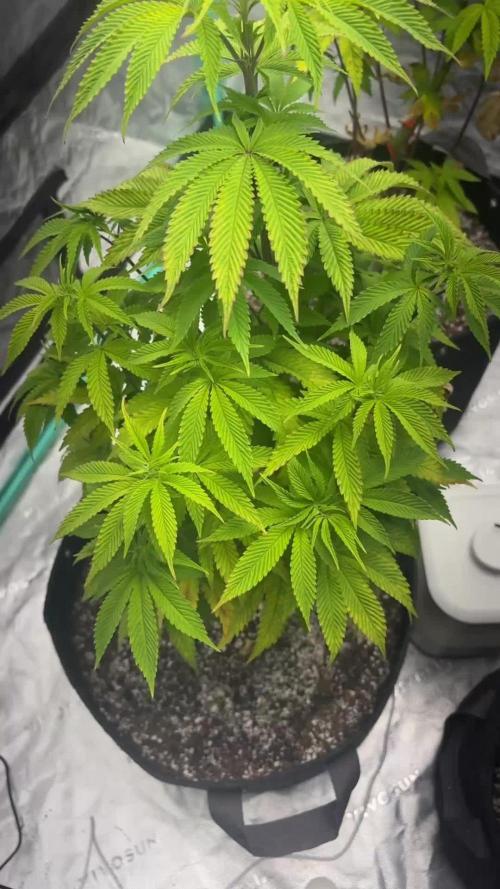
Notes: Week 4 Start Final Transplant from SOLO cups to 2 Gal 8" FloraFlex Pots with 8" Caps. Medium is COCO hybrid mix (Coco60%,Perlite25%,Hydroton15%) using FloraFlex V1 & V2 @ 3g / Gal each. Week 4 Nutes. !!!SWITCHED TO ALL LIGHTS!!! TOOK LIGHTS BACK TO 30" --- !!!VENTALATION ON TO LOW!!!--- Topped off with full week 4 nutes. !!!!!!!(TOPPED ALL PLANTS)!!!!!!!!
(((((((((((((((((((((((( CONDITIONS )))))))))))))))))))))))
*Nutes: CaliMagic GHE 2ml / Gal, FloraFlex V1 1 tsp/gal, FloraFlex V2 1tsp/ gal, pH Down
*Ph: 5.9
*Ec: 2.1
*Light: Mieemclux 1500W LED Veg+Bloom@ 30" 18/6; Mieemclux1500W LED Veg+Bloom@ 30" 18/6; Parfactworks RA1000W LED@ 26" 18/6
*Rh: 65%
*Temp: 78F
<-------- END -------->
+++ 03.10.2021 +++
<---NOTES--->
Notes:
(((((((((((((((((((((((( CONDITIONS )))))))))))))))))))))))
*Nutes: CaliMagic GHE 2ml / Gal, FloraFlex V1 1 tsp/gal, FloraFlex V2 1tsp/ gal, pH Down
*Ph: 5.9
*Ec: 2.1
*Light: Mieemclux 1500W LED Veg+Bloom@ 30" 18/6; Mieemclux1500W LED Veg+Bloom@ 30" 18/6; Parfactworks RA1000W LED@ 26" 18/6
*Rh: 65%
*Temp: 78F
<-------- END -------->
+++ 03.13.2021 +++
<---NOTES--->
Notes: All plants enjoying new humidity and fog. Checkup add pics.
(((((((((((((((((((((((( CONDITIONS )))))))))))))))))))))))
*Nutes: CaliMagic GHE 2ml / Gal, FloraFlex V1 1 tsp/gal, FloraFlex V2 1tsp/ gal, pH Down
*Ph: 5.9
*Ec: 2.1
*Light: Mieemclux 1500W LED Veg+Bloom@ 30" 18/6; Mieemclux1500W LED Veg+Bloom@ 30" 18/6; Parfactworks RA1000W LED@ 26" 18/6
*Rh: 65%
*Temp: 78F
<-------- END -------->


Likes
28
Share


@KannaGrowing
Follow
Estamos en la tercera semana de crecimiento vegetativo.
Nuestras plantas ya tienen unos 15 centímetros aproximadamente, y han superado la fase crítica.
Recordamos que hasta ahora solo estamos regando con agua, aún no hemos incorporado los fertilizantes.
Seguimos manteniendo la humedad relativa bastante alta, y la temperatura entre 22 y 24ºC.
Pero aumentamos la potencia al 50% de ambas luminarias.

Likes
60
Share


@Roberts
Follow
Alaskan purple is growing great under the Medic Grow Mini Sun-2. she is in heavy bulking now. She is eating, and drinking a lot. 🤞🏻she keeps it up. Looking for a good finish in the contest. Thank you Medic Grow, and Seedsman. 🤜🏻🤛🏻💪🏻❄️🌱
Thank you grow diaries community for the 👇likes👇, follows, comments, and subscriptions on my YouTube channel👇. ❄️🌱🍻
Happy Growing 🌱🌱🌱
https://youtube.com/channel/UCAhN7yRzWLpcaRHhMIQ7X4g


Processing
Likes
54
Share


@RastaGrow
Follow
Ужэ 17 день активнова цветения , 2 недели без изменения всё идёт нормально жду середины 3 недели чтоб провести лёгкую дефоляцию . С удовольствием жду вашы коментарии , советы , вапросы и дажэ критику ;)

Likes
17
Share


@Ton_Trichomen
Follow
ruce Banner#3
See of green project
By #originalSensibleSeeds
Day 21 08:00
Now it looks like a starting S.O.G
I think i give them 1-2 more days 18/6 than i switch over to flowering
Checked all leafs and soil yesterday and all was more than good ph and salts just perfect
See you tomorrow again
Day 22 08:15
Good morning
I kicked them into flowering this morning
all so i gave Plagron Terra Bloom 60% of there normal dosis also pure zym and power roots also Plagron full dosis ...
My baby are 30cm now i count with a 150-200% stretch but i think i handle that baby ...
I dominate my Amnesia grow to, so Hulk who are you .... show me ..... 😉
Day 23 13.20
After i send them into flower feed them with nutes all is good no sighns of stress to much nutes or some else, air temp and humidity are controled so thats fine to 😉
Se ya back tomorrow
Day 25 07.10
So they do realy grow like i want them to grow thats cool
Now on 12/12 since 3 days the strech is really smooth till now and it seems its true what i heard about Bruce not to much till no leafs on the bottem of the plant know i wait till the flowering will start think mid of next week
Day 26 07.30
I see here and there starting of flowering little white hairs are comming feed them today with the full dosis of nutes but still under the limit of plagron less is more
Bruce looks really healthy at all so far
Day 27 07.30
I cleand up my room🙃 no no worrys some plants were a bit smaler some a bit higher so i switched the long ones in the back the smaler ones in the front now it looks a bit weird but that will be fixxed up in 2 days ..
But all in all are very fine and healthy
See ya tomorrow again
Temp: 27.5 lights on
19.5 °C when lights out
Humidity: 60%
Ph : 5.92
Ppm: 850
Water: 25l 23°C
CO²: No Mercy Tabs
Plagron: Terra bloom 100ml
Plagron: Pure Zym 25 ml
Plagron: Power Roots 25 ml
Light distance: 50cm
3x MarsHydro eco 120 total 675w
Air Van: 809m³ Prima Klima
AKF : 800m³ prima klima
3 l water cooling airco Diamant...
3.3l humidifier
1.8l Airdryer
Humidity control: Inkbird IHC-200
Temp control cooler - heater: Inkbird ITC-308
1.5x1.5m² Custom Grow Room
All seeds comes out #originalsensibleseeds
so they have 100% of 100%
Bruce Banner the 3. hits the ground and i really hope he gets angry as fuck and shows me the green big guy sleeping inside him ...
S.O.G.
☠️☠️☠️🌶️🌶️☠️☠️☠️
Thx to Linda Seeds, BTB Grow Supplies & Zamnesia for supporting this grow.
Zamnesia unconsciously because they sent me my seeds 2 times but I'm very grateful for that

Likes
28
Share


@TheGreenQueen420
Follow
Two of the smaller plants I will not be creating 12 colas. The remaining ones I have trained the same. Removing the second and third nodes off each arm. And topping the end of each arm. Creating 6 on each side.
They are very slow to recover. But will be vegging longer this time. And this time not using nutes every water which I think has been my problem in the past even though biobizz state they can be given every watering.

Processing
Likes
13
Share


@GeOMaTTiC
Follow
Figured I would start a part two, since GD doesn't go further than 32 weeks. I only have about 6-8 weeks left, so this won't be a long one, but it will be detailed.

Likes
25
Share


@frostypaws
Follow
This is the start of week 6 of flower!
She will be getting the last bit of nutrients given to her this week.
This way she's got a little bit of food for the next two or three weeks. Then she can ripen up the last week or two with nothing.
I'll be top dressing her with some Kashi, flower finisher, worm castings, bloom booster...


Likes
5
Share


@leapingsoil
Follow
Welcome to the pink feno hunt.
I have a good feeling about this pack of 3 from fast buds. Very exciting. This is an attempt to recreate that one strawberry smoke...
We will be growing these in bottles first so i can have a humidity cap on them (my tent is busy). After about 2 weeks we will have more room. The bottles have air circulation holes and a drain on the bottom.
Plan is to top these in their temporary homes and then transplant them in larger 20 L pots so they can be trained.
No nutrients for the first week. I will just be spraying their pots with PH water when they need it for humidity.
Look for weekly updates.

Likes
15
Share


@Venabr96
Follow
Estamos aqui começando mais uma semana, algumas folhas apareceram manchadinhas e com uns buraquinhos.
Pode ter sido por causa da queda da lampada ensima delas...
Folhas muitos grandes e desenvolvimento muito bom
A piquena esta crescendo bem,muito forte e linda com belas folhas. Ira crescer para cima reta sem nenhuma tecnica.

Likes
19
Share


@Chubbs
Follow
420Fastbuds
FBT2306 Week 8
Weekly update for these two mesmerizing beauty's. They both are stacked up perfect and the colors coming off the flowers are a thing of beauty. I'll do a mild defoliation this week taking the bigger fan leafs off to allow light to the lower flower sites. All in all Happy Growing
Likes
10
Share


@Sadhus
Follow
Léger ajout de nutriments plagron stimulateur racine et croissance, sa commence a grandir tranquillement, les 5 sont pareil , vaillante ! J'attend de voir des racines bien développé avant de remporter en 3,5 litres !
Quelques petit souci d'humidificateur d'air qui se vide beaucoup trop rapidement, mais j'arrive a tourné au alentour de 24 degré celsius pour 60 -70% RH
Bientôt la taille apical ( topping)


Likes
9
Share


@SoulGrownBotanicals
Follow
Another good week. She started to flower. I missed a watering or 2 but she came right back. She's happy so I'm happy.
