The Grow Awards 2026 🏆
Likes
Comments
Share
@Roberts
Follow
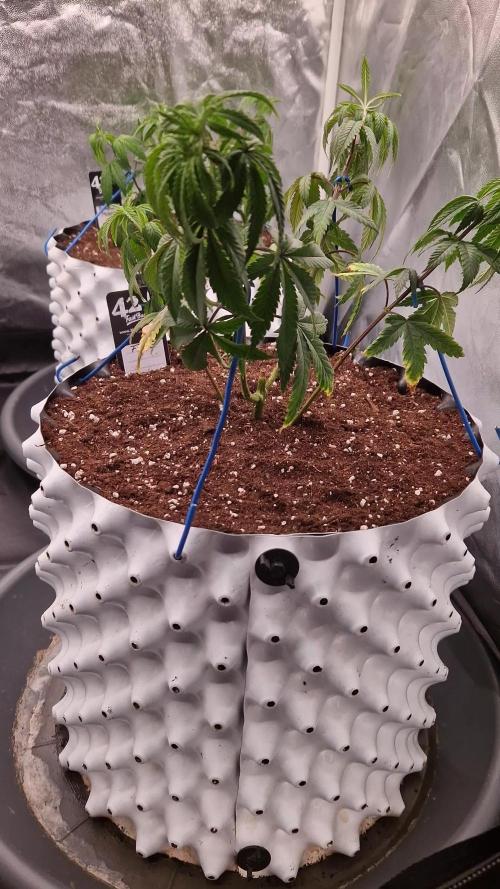
Deepforest Super auto is growing great. She has been thriving and making a lot of progress. I delayed her solution change she has been doing so well. I will likely have to in about a week. I did her first lst and selective defoliation on her today. She is looking good. I did turn tge light down from 40 percent to about 30. She seemed to be growing stocky. I want her to reach a little more. I know there is still lots of growth to come. Everything is going great. Thank you Spider Farmer, Athena, and Doctor's Choice. 🤜🏻🤛🏻🌱🌱🌱 Thank you grow diaries community for the 👇likes👇, follows, comments, and subscriptions on my YouTube channel👇. ❄️🌱🍻 Happy Growing 🌱🌱🌱 https://youtube.com/channel/UCAhN7yRzWLpcaRHhMIQ7X4g.
Likes
3
Share
Temps have been on the cooler side lately, with a few days close to 80° .
Likes
97
Share
She really growing excellent.. Buds forming nicely slight smell . pretty soon some frost should show up 😃..thanks todd for giving a seed so i can try the genetics👍🏆.. Thank you to all my GrowMies where would be without each other.. Thank you
Likes
59
Share
Gente!amici contadini eccoci arrivati all'ottava settimana di fioritura 💪 tutto procede come deve. La lotta biologica che sto facendogli con le mie care amiche coccinelle 🐞 funziona Super bene...fossero state tutte larve di coccinelle 🐞 era ancora meglio.si perché la voracità che ha la larva di coccis è incomparabile....poi le larve non volano aggirro. Stanno sulle foglie e mangiano tutto. Uova ragni rossi ecc....
Likes
52
Share
@MeaCulpa
Follow
Hey everyone. I made one video with flash and one without as last week. So far everything seems to be good. The buds look very impressive. I never expected it.
Likes
11
Share
Likes
3
Share
@Dabking
Follow
Harvested 7.49 Oz of dry flower after drying for 8 days. This plant is fairly difficult to grow and not resilient in my opinion. I would advise looking at their other strains like apple strudel if you want something easy to grow. Check out my videos on Youtube/Rumble/IG - DabKing7200
Likes
15
Share
Have been trimming some cover leaves off the top of the canopy to allow some light to hit the lower buds, actually seems to be having some positive impact! The girls are looking lovely, after the herms were gone from last week I decided I was going to say fuck it and use the beastie bloomz on my remaining 2 plants. They seem to be loving it! No signs of nute burn or anything at all after 2 feedings, at half strength (1/8 tsp/G). Buds are forming nicely. Definitely 2 distinctly different phenos for sure, one is going to be fat and fuely, the other seems like its leaning more towards a sativa look, almost has a pink hue to it when I look at them. 🤤 Smell is also starting to come on fairly strong at this point as well as trichome formation. Other than the hermie issue I'm kinda diggin these things so far!
Processing
Likes
4
Share
Estamos a meio da 2° semana a crescer bem ja cm boa ramificação mas a dar indicios de falta de magnezio, mais uma semana começa o lst Afinal vai começou mais cedo q o esperado.. a crescer muito rápido, mais uns dias estamos no inicio da 3°semana
Likes
25
Share
As you can see on the pictures, all seems to be ok except that the potting soil is maybe a bit too charged with nutrients: radish leaves are big and thin, the small NL plant is also a bit disturbed by this. This should get better with time. Tomorrow (Jan 08) I'll water the area around the NL5 with corn seed sprout tea. Goal being that with these growth hormones (SST) it'll be able to cope better with the super charged soil. The next step will be deciding which training technique to journey with: hst-mainlining (reg or quad) vs a more popular lst... @sensiseeds let me know if either is totally proscribed from your knowledge on how your genetics behave 😜. Patience wise, I can handle a slow growth, I want this to be fun and exciting. FYI, lights still at ~20% and 60 cm (2ft) from plant
Likes
49
Share
6/23 Due To The Two 8 Day weeks this week will only consist of five days to get me back on track. SEE LAST WEEK FOR DETAILS. I DID ANOTHER EIGHT DAY WEEK. I'LL DO THIS WEEK AS SIX DAYS. THAT WAY IM BACK ON SCHEDULE. WATERED 6/22. WENT BACK AT NIGHTCAND WATERED ANOTHER GALLON WITH 1/3 TSP Armor Si. I mixed the solution with kelp you kelp me but I dumped it out. I've mixed silica with other nutes before but I had read something earlier about bioavailability issues and I didn't want to risk it. My plants are the healthiest I've ever grown. I'm considering transplanting the large 10th planet that I'm light depping. I also need to develop my ipm and my nute schedule. Still gonna have to keep an eye onvthe water situation. Luckily I have a buddy in my corner that's co tinualkt Bern a great help. WENT BACK OVER AROUND NOON. BEAUTIFUL OUTSIDE AND THE PLANTS WERE LOVING THIS SUN. I DEFOLIATED SOME BURNED LEAVES AND MIXED A SOLUTION IF KELP ME KELP YOU THAT I PLAN TO FEED TO THE GARDEN TODAY. IM HAPPY WITH HOW THINGS ARE GOING. WE HAVE SOME RAIN AND THINDERSTORMS COMING. I NEED TO GET MY IPM UP AND RUNNING AND THE NUTES ONLINE. I ALSO NEED TO DECIDE IF IM GOING TO TRANSPLANT THE LIGHT DEP 10th PLANET. Went back over to put the girls to bed at six and if was still 90 degrees. The water from yesterday had dissipated. The tops were dust dry. I mixed two gallons of kelp you kelp me and fed it to the garden. Afterwards I pointed qbd found a couple plants that were more open to the wind were a little lighter. I know tomorrow will be very hot. Maybe quarter inch of rain. However after that it will rain (showers) off and on for days. I wanted to make sure the girls had what the needed to make it through tjis heat wave until they get that rain. I had another gallon mixed up and I'm thinking I should've given it to them. Oh well. I'd rather underwater than overwater any day. I did notice a burnt top on the plant furthest from the tarp that the sun JUST BARELY TOUCHES when the rest are in shade. I'll just raise the tarp a little. These are tiny problems. Can't upload video until tomorrow. 6/24 Good thing u gave the plants that water. I know it wasn't much but we didn't get any rain. Suppised to get a qtr in today and another qtr in tomorrow. Then rain a couple more days. It's working our really good for my watering schedule lol. Yesterday the girls got there first dose of a bottled nute. They got two gallons of kelp me kelp you (1/3 tsp per gallon) and another gallon of just phed water. I was going to do another gallon but held off due to the threat of syring rain. Didn't get it bur it looks like the plants loved the kelp. It had reached 90 yesterday. They look better today. It's 70 at 9 today. I LST the 10th planet in the 3 gallon. It's getting huge. I should start a separate diary for those three light dep plants. Its cool as hell watching this. One of the purple punches is flowering pretty good. I probably should start another diary for them. I'll be starting to feed my plants soon. Wondering if I should pinch plants again. TUCKED THE LITTLE GIRLS IN AT SIX AND SHOT A VIDEO AND TOOK SOME PUCTURES. PLANTS LOOKED PHENOMINAL! GOT HOME AND AROUND SEVEN IT JUST STARTED RORREBTIAL DOWNPOURS! THE TYPE OF RAIN THAT BREAKS STEMS. I SHOULDVE PUT MY OTHET TARP UP BUT I DIDNT. I WISH I HAD. IM A LITTLE NERVOUS. I KNOW THESE GIRLS ARE STRONG THOUGH! TOMORROW. ILL ROLL THE RARP UP AND SECURE THE BOTTOM FOR FAST ACCESS. IM ALSO GOING TO KOOK INTO FINDING A TOP FOR MY CAGE I CAN USE IN INCLIMENT WEATHER. 6/25 That little qtr in of rain we were supposed to get turned into torrential downpours and high winds. Luckily no REAL damage. If you watch the video you'll see what I mean. I'm going to havecto be cognizant moving forward. Noticed a few chunks from leaves butvplants are still healthy. I'm surprised how well these girls withstood this storm. They are certainly resilient. The 2 purple punch 1 10th planet that I'm light depping are flowering nicely now. They missed all the commotion from the storm as they were inside. It's smelling good. I'm happy. 6/26 It's what a friend would say is "maineing") out. That mistcthe plants love. I'm surprised the plants are doing as good as they have been considering the wind. Will be adding nutes soon. Need to add extra supports too. Light dep 6/27 Brief periods or torrential downpours. Light depped 3 gallon 0lants are under an overhanfcwhete the hatsxrain can't hurt them but they still get sun. They are really starting to flower now! I'm going to begin feeding with a base nute and a flower nute I think. I'm thinking about giving the light dep some open sesame or something similar. I need to set up a nute program soon but the plants ALL look so healthy! And it's been raining! I've only watered like once or twice since they've been in the big pots. I've seen zero pests aside from a chunk missing from a grasshopper. Usually by now I'd have battled half a dozen things and be battling another half dozen. However I was posing from clones. These are seeds and boy don't I see the difference!
Likes
15
Share
@Dunk_Junk
Follow
Good week this week. She over doubled her height!! 😎 Now 31cm tall.
Likes
24
Share
@Mathew
Follow
I feel like she's doing great, loving this batch of living soil. Still a bit confused on how watering at a ph of 5.3 is being buffered by the soil up to a runoff ph of 8. Not going to worry about it, she looks great and smells great and it's day 29-30 since flipped. The soil has her now.
Likes
23
Share
This week has been great ,today is day 78 and the girls are just doin their thang , 1 looks ready for flush already and the rest look about another longer then flush for them aswell,, can’t wait to see how these girls finish out over the next couple of weeks 😍!! Y’all keep them eyes peeled an stay tuned for next week! Peace love an positive vibes to y’all Cheers.💨💨💨
Likes
16
Share
@valiotoro
Follow
A wonderful genetic thank you Fast Buds ❤️‍🔥🤩 The trim was super easy the buds are FAT & FROSTY full of resin 🤤 I’m very happy with the harvest 142g !! For the light i’ve used the Mars Hydro SP-6500💡
Likes
46
Share
@Capo420
Follow
This past week has been a blast! After getting these ladies nutrition straightened out, they are thriving!💚🌱💚 I gave defoliated wayyy more than what I see other growers traditionally doing. After the "3rd and final haircut" I defoliated two more times 😅 Thank you the GD community for the support and resources along the way 🙏 My only concern now is the tent actually becoming too crowded.😆. Other then that I am thinking it should be smooth sailing these next 6 weeks or so. 🏴‍☠️😎🏴‍☠️ Happy Growing! 💚💪🌱😎🌱💪💚
Likes
Comments
Share
@RCUgrows
Follow
I love this plant. It's such a beautiful structure. Buds are fattening up really well. Seeds are also starting to be produced. Looks like the rest of the plant has become pollinated. Couldn't be happier.
Likes
22
Share
@TechDCo
Follow
10/08/2024 Lights On! Week 8 12/08/2024 Lights On! Looking good; phattening up! Mid-day: Dimmed to 420watts The buds are right under the canopy are showing signs of slight fishtailing. Reasons for dimming light! As they start to mature dimming of the light for 2-3days is needed. They are getting bigger! Will have to raise scrog net soon for support 🙏🙌👍 14/08/2024 Lights On! Increased light to 490watts! Mid-day! Video 60fps FHD Light needs turning down Dimmed backs to 420watts!
Likes
52
Share
Once again she passes my expectations, late to the show with trichome production. I'm surprised there is purple on the bud, maybe Purpinator does work. I thought I could see hints under the grow lights and thought my eyes were deceiving me, I was just being hopeful. But nah 2 of the 3(under the UV) have developed a beautiful tone of purple. I was never going to bother with a deep freeze but maybe the whole bud will change given conditions, that would be something, fingers crossed. 🤔 was a little skeptical that reducing temps humidity would change density, but it does, buds are solid something I've not been able to achieve before. Rule of thumb is never to surpass 60% RH in the flowering phase and try to progressively reduce it down to 40% in the last 2–3 weeks before harvest. The plant will react as it seeks to protect its flowers, responding by producing denser buds and a higher concentration of resin. Cannabis plants are sensitive to sudden temperature changes, especially in the flowering stage. Extreme heat or cold can impact bud density and overall yields. In nature as a defense mechanism from cold, the plant sensing sudden dips in temperature will attempt to remove the pockets of air within the bud, it achieves this by compacting itself in doing so to better protect itself from cold snaps which are normally indicators in nature that worse weather is on the way. Terpene levels are the highest just before the sun comes out. Ideally, you want as many terpenes present in your plants as possible when you harvest. Cannabis plants soak up the sun during the day and produce resin and other goodies at night. The plant is at its emptiest from "harvest undesirables" so to speak right before the lights on. Boiling cannabis roots during harvesting slows down the drying process. When you boil cannabis roots, it shocks the plant, closing the stomata on the leaves. This prevents massive moisture loss through the leaves, leaving only the floral clusters actively losing moisture at a reduced pace. I've always run a strict 60/60 and it took almost twice as long to dry to a snap than previous grows where I didn't boil for what it's worth. Chlorophyll is good for the plant but not for you. When you harvest the buds, even after you flush them, if you flush them, they’re still filled with chlorophyll. Freshly cut buds are greener than dried buds because they still contain loads of chlorophyll. However, when rushed through the drying process, the buds dry but retain some chlorophyll, and when you smoke it, you will taste it. Chlorophyll-filled buds are smokable, but they aren’t clean. Slow drying gives the buds enough time and favorable conditions to lose the chlorophyll and sugars, giving you a smoother smoke. How the plant disposes of the chlorophyll and sugars by a process of chemically breaking them down and attaching the decomposed matter once small enough to water molecules which then evaporate back into the ether. Time must be given to the process to break down the chlorophyll and sugars. Think of it like optimizing the environment for decay. All the nutrients it could ever need are in abundance, it eats nutrients based on its demand for growth, which is dictated primarily by available light. Plant growth and geographic distribution (where the plant can grow) are greatly affected by the environment. If any environmental factor is less than ideal, it limits a plant's growth and/or distribution. For example, only plants adapted to limited amounts of water can live in deserts. Either directly or indirectly, most plant problems are caused by environmental stress. In some cases, poor environmental conditions (e.g., too little water) damage a plant directly. In other cases, environmental stress weakens a plant and makes it more susceptible to disease or insect attack. Environmental factors that affect plant growth include light, temperature, water, humidity, and nutrition. It's important to understand how these factors affect plant growth and development. With a basic understanding of these factors, you may be able to manipulate plants to meet your needs, whether for increased leaf, flower, or fruit production. By recognizing the roles of these factors, you'll also be better able to diagnose plant problems caused by environmental stress. Water and humidity *Most growing plants contain about 90 percent water. Water plays many roles in plants. It is:* A primary component in photosynthesis and respiration Responsible for turgor pressure in cells (Like the air in an inflated balloon, water is responsible for the fullness and firmness of plant tissue. Turgor is needed to maintain cell shape and ensure cell growth.) A solvent for minerals and carbohydrates moving through the plant Responsible for cooling leaves as it evaporates from leaf tissue during transpiration A regulator of stomatal opening and closing, thus controlling transpiration and, to some degree, photosynthesis The source of pressure to move roots through the soil The medium in which most biochemical reactions take place Relative humidity is the ratio of water vapor in the air to the amount of water the air could hold at the current temperature and pressure. Warm air can hold more water vapor than cold air. Relative humidity (RH) is expressed by the following equation: RH = water in air ÷ water air could hold (at constant temperature and pressure) The relative humidity is given as a percent. For example, if a pound of air at 75°F could hold 4 grams of water vapor, and there are only 3 grams of water in the air, then the relative humidity (RH) is: 3 ÷ 4 = 0.75 = 75% Water vapor moves from an area of high relative humidity to one of low relative humidity. The greater the difference in humidity, the faster water moves. This factor is important because the rate of water movement directly affects a plant's transpiration rate. The relative humidity in the air spaces between leaf cells approaches 100 percent. When a stoma opens, water vapor inside the leaf rushes out into the surrounding air (Figure 2), and a bubble of high humidity forms around the stoma. By saturating this small area of air, the bubble reduces the difference in relative humidity between the air spaces within the leaf and the air adjacent to the leaf. As a result, transpiration slows down. If the wind blows the humidity bubble away, however, transpiration increases. Thus, transpiration usually is at its peak on hot, dry, windy days. On the other hand, transpiration generally is quite slow when temperatures are cool, humidity is high, and there is no wind. Hot, dry conditions generally occur during the summer, which partially explains why plants wilt quickly in the summer. If a constant supply of water is not available to be absorbed by the roots and moved to the leaves, turgor pressure is lost and leaves go limp. Plant Nutrition Plant nutrition often is confused with fertilization. Plant nutrition refers to a plant's need for and use of basic chemical elements. Fertilization is the term used when these materials are added to the environment around a plant. A lot must happen before a chemical element in a fertilizer can be used by a plant. Plants need 17 elements for normal growth. Three of them--carbon, hydrogen, and oxygen--are found in air and water. The rest are found in the soil. Six soil elements are called macronutrients because they are used in relatively large amounts by plants. They are nitrogen, potassium, magnesium, calcium, phosphorus, and sulfur. Eight other soil elements are used in much smaller amounts and are called micronutrients or trace elements. They are iron, zinc, molybdenum, manganese, boron, copper, cobalt, and chlorine. They make up less than 1% of total but are none the less vital. Most of the nutrients a plant needs are dissolved in water and then absorbed by its roots. In fact, 98 percent are absorbed from the soil-water solution, and only about 2 percent are actually extracted from soil particles. Fertilizers Fertilizers are materials containing plant nutrients that are added to the environment around a plant. Generally, they are added to the water or soil, but some can be sprayed on leaves. This method is called foliar fertilization. It should be done carefully with a dilute solution because a high fertilizer concentration can injure leaf cells. The nutrient, however, does need to pass through the thin layer of wax (cutin) on the leaf surface. It is to be noted applying a immobile nutrient via foliar application it will remain immobile within the leaf it was absorbed through. Fertilizers are not plant food! Plants produce their own food from water, carbon dioxide, and solar energy through photosynthesis. This food (sugars and carbohydrates) is combined with plant nutrients to produce proteins, enzymes, vitamins, and other elements essential to growth. Nutrient absorption Anything that reduces or stops sugar production in leaves can lower nutrient absorption. Thus, if a plant is under stress because of low light or extreme temperatures, nutrient deficiency may develop. A plant's developmental stage or rate of growth also may affect the amount of nutrients absorbed. Many plants have a rest (dormant) period during part of the year. During this time, few nutrients are absorbed. Plants also may absorb different nutrients as flower buds begin to develop than they do during periods of rapid vegetative growth. 432 Hz is said to be mathematically consistent with the patterns of the universe. Studies reveal that 432 Hz tuning vibrates with the universe’s golden mean PHI and unifies the properties of light, time, space, matter, gravity and magnetism with biology, the DNA code and consciousness. When our atoms and DNA start to resonate in harmony with the spiraling pattern of nature, our sense of connection to nature is said to be magnified. Another interesting factor to consider is that the A=432 Hz tuning correlates with the color spectrum while the A=440 Hz is off. Audiophiles have also stated that A = 432 Hz music seems to be non-local and can fill an entire room, whereas A=440 Hz can be perceived as directional or linear in sound propagation. Once you adopt the idea that sound (or vibration in general) can have an equalizing and harmonizing effect (as well as a disturbing effect), the science of harmony can be applied to bring greater harmony into ones life or a tune to specific energies. There is a form of absolute and of relative harmony. Absolute harmony can for example be determined by the tuning of an instrument. The ancients tuned their instruments at an A of 432 Hz instead of 440 Hz - and for a good reason. There are plenty of music examples on the internet that you can listen to in order to establish the difference for yourself. Attuning the instrument to 432 Hz results in a more relaxing sound, while 440 Hz slightly tenses up to body. This is because 440 Hz is out of tune with both macro and micro cosmos. On the contrary, 432 Hz is in tune. To give an example of how this is manifested micro cosmically: our breath (0,3 Hz) and our pulse (1,2 Hz) relate to the frequency of the lower octave of an A of 432 Hz (108 Hz) as 1:360 and 1:90. It is interesting to note that 432 Hz was the standard pitch of many old instruments, and that it was only recently (19th and 20th century) the standard pitch was increased. This was done in order to be able to play for bigger audiences. Bigger audiences (more bodies) absorb more of the lower frequencies, so the higher pitch was more likely to “cut through”. One of the oldest instruments of the world is the bell ensemble of Yi Zeng (dated 423 BC), tuned to a standard F4 of 345 Hz which gives an A= 432 Hz. The frequency of 345 Hz is that of the platonic year! Similarly many old organs are tuned in an A=432 as well; for example: St. Peter’s Capella Gregoriana, St. Peter’s Capella Giulia, S. Maria Maggiore in Rome. Maria Renold’s book “Intervals Scales Tones and the Concert Pitch C=128 Hz” claims conclusive evidence that 440 Hz and raising concert pitch above scientific “C” Prime=128 Hz (Concert A=432 Hz) disassociates the connection of consciousness to the body and creates anti-social conditions in humanity. The difference between concert pitch A=440 Hz and Concert A=432 Hz is only 8 cycles per second, but it is a perceptible difference of awareness in the human consciousness experience of the dream we share called existence.
Likes
15
Share
@maelxich
Follow
Final defoliation took place and they’re bushy but lights getting through to the lowers and that’s what counts. I ran out of build a flower, so I just gave them each 1/2 cup of Dr Earth Flower girl topdress. I’ll probably use it til finish if need be. The smell is starting to come in and they are a GASSY bunch already. Purple ghost candy has a diesely fruit flavor coming in already. Very excited for the next coming weeks