The Grow Awards 2026 🏆
Likes
Comments
Share
@Kirsten
Follow
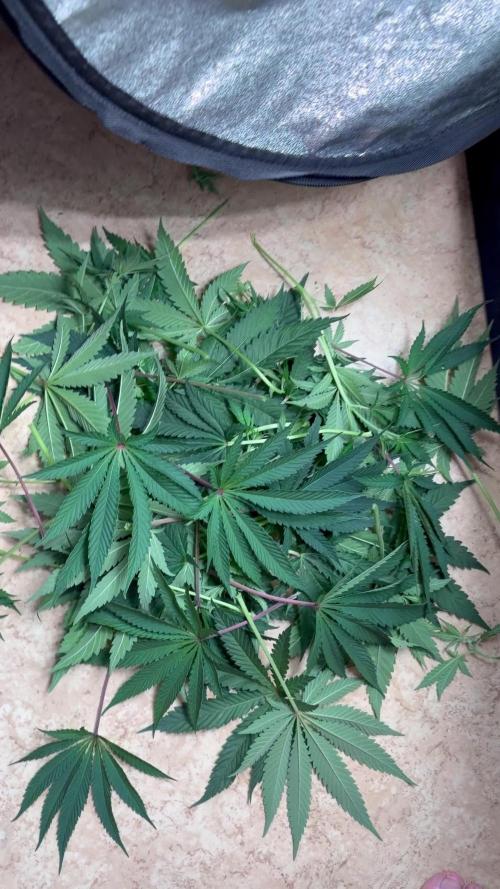
16.2.25: I decided to check out the lower canopies of all plants to see if I need to get rid of any foliage. I did get rid of a few small branches and leaves. However, whilst I was doing this, I saw more garden pegs from my LST remaining. There were about 6 or more in Pink Mist alone. Additionally, on Watermelon, there were some left in, too. I'm so annoyed to see that because the plants are really stretching, and I could've potentially disrupted this by leaving the pegs in for all this time without realising it. 🤞 that I haven't compromised things too much. We'll see. I watered today with 2ltrs of dechlorinated water PH'd to 6.3 containing the following nutrients; ♡ .8g Green Leaf Nutrients PK booster ♡ .5g Ecothrive Biosys I ordered quite a few things for the garden. I got Greenleaf Nutrients Sea K(elp) and Mega Crop Parts A+B. To go with their PK Booster I got last month. I'm excited to try it all together. Next run, maybe just using these. We'll see how it goes. 18.2.25: The plants are going crazy for water! Everything is getting used right up so fast! Today, I decided to add some more Black Strap Molasses to add some carbs and other micronutrients. I'll add the jar with the label in the photos section above. I watered a very small amount to each plant. What I put in: ♡ Black strap molasses 150g ♡ 2g Sea K(elp) Greenleaf nutrients. I dissolved everything in 4ltrs of dechlorinated water PH'd to 6.4. 19.2.25: I received the majority of the garden purchases that I made. I'm still waiting for the Ecothrive Life Cycle. I wanted to top dress, but it's been delayed unfortunately. I am using my Greenleaf nutrients products which I bought on Amazon. I got the Mega Crop 2 part system Part A and Part B. I have the Sea K(elp), and the bud explosion PK booster. I really wanted to get some of their sweet candy asking read many positive reviews. Unfortunately, for me, this is unavailable to buy currently. So that's a little disappointing. I needed to do a good watering so when my nutes were delivered today, I got excited 🤗 I watered 2ltrs of dechlorinated water per plant, PH'd to 6.4, containing the following nutrients: ♡ 1g Mega Crop Part A ♡ 1g Mega Crop Part B ♡ .5g Sea K(elp). The plants drank this up within a few hours. I'm going to try and hold off on watering in hopes that my Ecothrive Life Cycle will arrive so I can top dress and water it in then. 20.2.25: My Ecothrive Life Cycle arrived yesterday, and the plants are ready for their top dress and a good watering in. I have some Biobizz Light Mix, Canna Coco,and perlite. I'm going to use this as a base to mix my amendments in. I'm going to fill my 5 gallon bucket with about 4.5 gallons of my top dress mix. I will distribute this across 6, 4-5 gallon pots. Then I will water in well with Greenleaf nutrients Mega Crop Parts A+B and Sea K(elp). I've made a crude attempt to video mixing my top dress. Don't listen to the audio. lol, my YouTube didn't stop playing whilst I recorded this 😂 So anyway, I added the following amendments to the above base mix of 4.5 gallons; ♡ 3 TBSP Ecothrive Life Cycle ♡ 3 TBSP Vitalink Bat Guano ♡ 3 TBSP Ecothrive Charge ♡ 1 TBSP RHS Mycorrhizal Fungi granules ♡ 6 TBSP Ground Cinnamon.
Likes
8
Share
@IQuSX
Follow
Hi, topman!! 10 days have passed since the last report, and during this time the plants have grown and We have bent them down to prepare for SCROG. Defoliation was also carried out 7 days ago, which we will do again before the transfer on 12/12. Added delta 9 from CBG - the best thing to add at the vegetative stage!!
Processing
Likes
13
Share
@GrowGuy97
Follow
Flower day 31 - Having a little trouble with the temperature getting higher than I would like because my dehumidifier puts off some heat while it’s running so it’s been a constant struggle to keep the environment in this tent stable! Definitely will not have so many plants next run lol, but all in all the ladies are growing great & I can’t wait to see how they turn out! Thanks for following friends & happy growing!✌️🏼🌱 Flower day 33 - Fed half the plants today with PH at 6.4 to try and keep the humidity down some I’ll water the other half tomorrow!
Processing
Likes
7
Share
@420keef
Follow
So i had to take all my plants inside because i found bud rot on 2 of them & the weather wasn’t going to get any better, had to transform my bedroom into a grow room😂 & i have 2 more plants which i am going to finish next to a window.. The smaller plant to the right is a Northern light by zamnesiaseeds that has a seperate diary if you are interested! I really hope the bud rot doesn’t spread anymore & if anyone has any tips or tricks for that they are always welcome!
Likes
13
Share
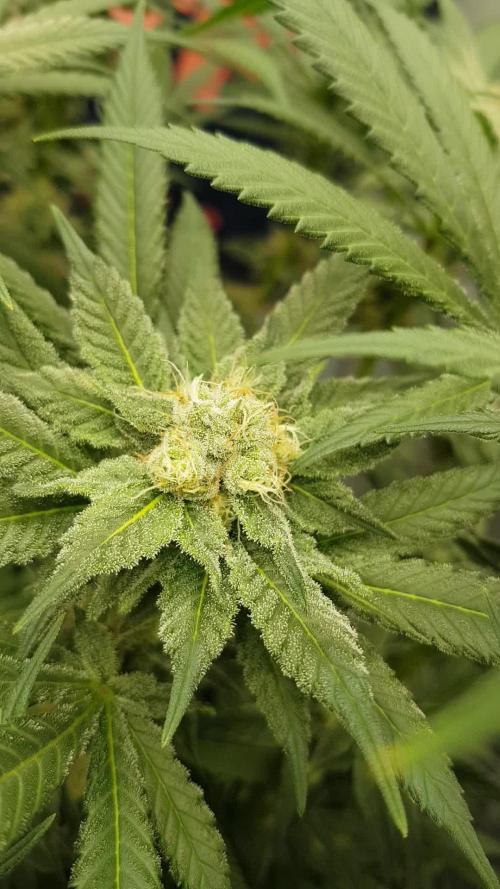
21.8 7th week of flowering done and I started flushing today. Not much to report still swelling nicely and frosting up to the end 👌 This has been really nice grow overall. I think I'm gonna come back for this strain for sure in the future. I'll check trichomes next week at the 8th week mark and decide then if I'll harvest or keep couple more days. Barney's timeline for flowering was 49 to 56 days. So let'see. I added that video of whole tent there is also Strawberry Glue and Orange Sherbert Now thinking back there was couple times me overwatering so always something to improve next time.. beauty of growing also 😍 Happy growing! Peace out 🙏 26.8 edit Topped girl got harvested and is now trimmed and hanging to dry. Man she's frosty and two that still stands are even more 😍 Wonderful strain! Top notch job respect Barney's Farm for providing these seeds for me and awesome genetics! 🙏
Likes
Comments
Share
@Kardo
Follow
Es sind sehr viele Triebe zu sehen sie fängt an sich schön zu entwickeln zeigt ihre Fäden und sieht sehr grün aus ich bin sehr gespannt wie die buds aussehen kannst garnicht abwarten
Likes
5
Share
Okay so this week things have started to really take off in every way. Buds glistening and fattening up more by the day. Extreme resin production on the cereal milk, sugar and fan leaves on the cereal milks are COATED in trichomes. The wedding cakes also have a fair resin production and covered in trichomes and are seriously starting to fatten up! The smell is very pungent and come out of nowhere compared to last week. The wedding cake has a sweet, earthy Almost vanilla like smell and the cereal milk has a very pungent cookies sweet smell with hints of fruityness. So far so good cant wait to see how these turn out. Been told they are 8-9 week flowering strains from other people who have grown the same Cuttings so not long left!
Likes
23
Share
@Ferenc
Follow
Day 51, 4th of November 2020: The 3rd day since the lamp switched to be 12/12... I raised up the nutrition intake as it can be seen above only the BioBizz family 2ml/l and removed some LST because the plant remains in shape or just set a bit but nothing significant.... She looks nice and strech is on the way..... 😅 Nothing really to report there is crazy 2-3 weeks from now ;) Kalini Asia let's go we can do it baby 😅
Likes
18
Share
10/29: flowing on autopilot At this point. I did not have to do anything with them this week. They have recovered from that terrible stress from a massive defoliation. The smell is not very strong, but of you get close to the buds, they smell pretty bad honestly. Lol. Its a weird smell. Bot sure how to describe it. Kinda like a bitter chemical. Hopefully that is not the end result of the terps. I am very disappointed now that i did not get one of the really purple phenos. The clones are doing great and have been potted in 1 gallon pots. Not sure i end up keeping any of them now that i know i do t have the plant that i wanted and i al not convinced that i will even like any of these yet.
Likes
66
Share
I've dropped to weekly updates on Bertha as a stunted plant she doesn't hold much interest for me, she is only alive because I am not desperate for the space. Here she is on day 49 end of week 7. I will take multiple photos and a video once a week until she is chopped.
Likes
7
Share
It’s frosty time these bruccies are putting out trichomes like nobodies business!! This update is coming in at around halfway through week 9 as I’ve been very busy recently and haven’t been able to give the girls quite as much attention but boy oh boy are they doing well. Stopped pruning and trimming of any sort, just letting them run their course now. Switched big bud for overdrive, I read online that overdrive is more beneficial for calyx production so hoping they continue to bulk up a bit before I harvest. Was under the impression that autos would be finished by week 11, leaving for a trip around that time so I will be forced to harvest the girls then, regardless of how mature they are. Ideally they would go for another 4 weeks but it is what it is, my first grow and it’s been an enormous learning experience. Just bought some 3 bears OG from the Mephisto restock, super hyped on these. Also hoping to grab a few of their new illuminautos as well when they drop tomorrow. Gotta set my alarm for that!! Really hyped on this upcoming run, learned so much from these bruccies that I’m ready to put into the Mephistos.
Likes
62
Share
@Hou_Stone
Follow
This week i flush the roots with tap water ( PPM : 310 , PH : 7.5) after i add water with 0.7 grow powder and 0.1g of Booster PK+ to reach 720PPM and adjust PH to 5.8 ---------------------------------------------------- -Daytime temperature: 27°C -Night temperature: 23°C -Humidity: 45-65% -Lamp: Mars Hydro FC3000. intensity 80% at 40cm from the top leaves -Room: Mars Hydro 100x100x180cm -Extractor: Mars hydro 402 CFM Max. power 2/10 -Substrate : 70% coco, 25% perlite, 5% vermiculite. My instagram : https://www.instagram.com/p/CuMhQ_BsjRP/?utm_source=ig_web_copy_link&igshid=MzRlODBiNWFlZA==
Likes
18
Share
The photoperiodic Blue Dream gave us this magnificent main cola which is the most exciting visual part but guys, you should smell what this beauty has. A real marvel I am very happy with her. Also here excellent resin and resistance to the first heat. ** Remember that we have two plants per strain one left to grow straight and one worked with the techniques. Description // This plant was simply left to grow straight, free and beautiful and the result was really excellent. The scent is its hidden strength, great fragrance in the room and soon in the jars. It did not give us particular problems and was very fast to flower. Trichomes and maturation // We did a thorough microscopic analysis 10x (and 10x x 1.6) and noticed a good percentage of milky/lumpy trichomes; The percentage of amber trichomes was also excellent and still a bit transparent, but that's fine for us as we're not crazy about THC oxidation and hyper indica effects around here. Fertilizers and soil // We used the Plagron organic fertilizer range, all the recommended additives and Pro Mix soil, both unfertilized and organic. Calculate the dosage according to your needs on the website ------ https://plagron.com/ The nutrients are available in convenient packs on the Zamnesia website --------- https://www.zamnesia.io/en/11457-plagron-easy-pack-natural.html Try this strain, it's more than promising ---- // https://www.zamnesia.io/en/3271-zamnesia-seeds-blue-dream-feminized.html Zamnesia Short Description // Exceptionally tasty and potent, Blue Dream by Zamnesia Seeds is a distinctive and sophisticated hybrid. A blend of Haze and Blueberry strains, it manages to bring out the best of both worlds. Its short flowering time of just 9 weeks far surpasses that of other Haze strains! From the moment you take your first toke of Blue Dream your taste buds will be intoxicated by a delicious blend of berry, citrus and sweet flavours. As for the experience, Blue Dream induces an incredible uplifting and euphoric high. But be careful, if you consume large quantities you will quickly be swept away to dreamland. This overwhelming potency not only makes Blue Dream particularly attractive to recreational users, but also to medical marijuana users. Those suffering from anxiety, stress, insomnia, depression, pain and lack of appetite will find this plant particularly effective in reducing symptoms. The whole world of growing and more is at Zamnesia, just take a look at the site and you'll find "the best that nature has to offer" in various shapes and colors. The new strains are fantastic and the old ones are no exception... -- // www.zamnesia.com
Likes
72
Share
_____Week 6 | Day 42-49 ______ Day 42 - 48 🌞 ------ Not much happened this week. I had little time for pictures and documentation. This week I just made sure that the new branches always get a lot of light and are not covered by other leafs. The plants have not grown much, because I constantly stress them and push them down. All new shoots that grow to size were topped, in the middle area of the plant, to keep everything nice and even Day 48 🌞 ------- each Plant 2 Liter...gluck, gluck, gluck.... ____________________________________________________________________________________________ Light - 18/6 h - 400 Watt 60% Dim. PPFD - 600 - 650 µmol Temp. - 24° Hum. - 70 % RLH
Likes
25
Share
ANTHOCYANIN production is primarily controlled by the Cryptochrome (CR1) Photoreceptor ( !! UV and Blue Spectrums are primary drivers in the production of the pigment that replaces chlorophyll, isn't that awesome! 1. Diverse photoreceptors in plants Many civilizations, including the sun god of ancient Egypt, thought that the blessings of sunlight were the source of life. In fact, the survival of all life, including humans, is supported by the photosynthesis of plants that capture solar energy. Plants that perform photosynthesis have no means of transportation except for some algae. Therefore, it is necessary to monitor various changes in the external environment and respond appropriately to the place to survive. Among various environmental information, light is especially important information for plants that perform photosynthesis. In the process of evolution, plants acquired phytochrome, which mainly receives light in the red light region, and multiple blue light receptors, including his hytropin and phototropin, in order to sense the light environment. .. In addition to these, an ultraviolet light receptor named UVR8 was recently discovered. The latest image of the molecular structure and function of these various plant photoreceptors (Fig. 1), focusing on phytochrome and phototropin. Figure 1 Ultraviolet-visible absorption spectra of phytochrome, cryptochrome, phototropin, and UVR8. The dashed line represents each bioactive absorption spectrum. 2. Phytochrome; red-far red photoreversible molecular switch What is phytochrome? Phytochrome is a photochromic photoreceptor, and has two absorption types, a red light absorption type Pr (absorption maximum wavelength of about 665 nm) and a far-red light absorption type Pfr (730 nm). Reversible light conversion between the two by red light and far-red light, respectively(Fig. 1A, solid line and broken line). In general, Pfr is the active form that causes a physiological response. With some exceptions, phytochrome can be said to function as a photoreversible molecular switch. The background of the discovery is as follows. There are some types of plants that require light for germination (light seed germination). From that study, it was found that germination was induced by red light, the effect was inhibited by subsequent far-red light irradiation, and this could be repeated, and the existence of photoreceptors that reversibly photoconvert was predicted. In 1959, its existence was confirmed by the absorption spectrum measurement of the yellow sprout tissue, and it was named phytochrome. Why does the plant have a sensor to distinguish between such red light and far-red light? There is no big difference between the red and far-red light regions in the open-field spectrum of sunlight, but the proportion of red light is greatly reduced due to the absorption of chloroplasts in the shade of plants. Similar changes in light quality occur in the evening sunlight. Plants perceive this difference in light quality as the ratio of Pr and Pfr, recognize the light environment, and respond to it. Subsequent studies have revealed that it is responsible for various photomorphogenic reactions such as photoperiodic flowering induction, shade repellent, and deyellowing (greening). Furthermore, with the introduction of the model plant Arabidopsis thaliana (At) and the development of molecular biological analysis methods, research has progressed dramatically, and his five types of phytochromes (phyA-E) are present in Arabidopsis thaliana. all right. With the progress of the genome project, Fi’s tochrome-like photoreceptors were found in cyanobacteria, a photosynthetic prokaryotes other than plants. Furthermore, in non-photosynthetic bacteria, a homologue molecule called bacteriophytochrome photoreceptor (BphP) was found in Pseudomonas aeruginosa (Pa) and radiation-resistant bacteria (Deinococcus radiodurans, Dr). Domain structure of phytochrome molecule Phytochrome molecule can be roughly divided into N-terminal side and C-terminal side region. PAS (Per / Arndt / Sim: blue), GAF (cGMP phosphodiesterase / adenylyl cyclase / FhlA: green), PHY (phyto-chrome: purple) 3 in the N-terminal region of plant phytochrome (Fig. 2A) There are two domains and an N-terminal extension region (NTE: dark blue), and phytochromobilin (PΦB), which is one of the ring-opening tetrapyrroles, is thioether-bonded to the system stored in GAF as a chromophore. ing. PAS is a domain involved in the interaction between signal transduction-related proteins, and PHY is a phytochrome-specific domain. There are two PASs and her histidine kinase-related (HKR) domain (red) in the C-terminal region, but the histidine essential for kinase activity is not conserved. 3. Phototropin; photosynthetic efficiency optimized blue light receptor What is phototropin? Charles Darwin, who is famous for his theory of evolution, wrote in his book “The power of move-ment in plants” published in 1882 that plants bend toward blue light. Approximately 100 years later, the protein nph1 (nonphoto-tropic hypocotyl 1) encoded by one of the causative genes of Arabidopsis mutants causing phototropic abnormalities was identified as a blue photoreceptor. Later, another isotype npl1 was found and renamed phototropin 1 (phot1) and 2 (phot2), respectively. In addition to phototropism, phototropin is damaged by chloroplast photolocalization (chloroplasts move through the epidermal cells of the leaves and gather on the cell surface under appropriate light intensity for photosynthesis. As a photoreceptor for reactions such as escaping to the side of cells under dangerous strong light) and stomata (reactions that open stomata to optimize the uptake of carbon dioxide, which is the rate-determining process of photosynthetic reactions). It became clear that it worked. In this way, phototropin can be said to be a blue light receptor responsible for optimizing photosynthetic efficiency. Domain structure and LOV photoreaction of phototropin molecule Phototropin molecule has two photoreceptive domains (LOV1 and LOV2) called LOV (Light-Oxygen-Voltage sensing) on the N-terminal side, and serine / on the C-terminal side. It is a protein kinase that forms threonine kinase (STK) (Fig. 4Aa) and whose activity is regulated by light. LOV is one molecule as a chromophore, he binds FMN (flavin mononucleotide) non-covalently. The LOV forms an α/βfold, and the FMN is located on a β-sheet consisting of five antiparallel β-strands (Fig. 4B). The FMN in the ground state LOV shows the absorption spectrum of a typical oxidized flavin protein with a triplet oscillation structure and an absorption maximum wavelength of 450 nm, and is called D450 (Fig. 1C and Fig. 4E). After being excited to the singlet excited state by blue light, the FMN shifts to the triplet excited state (L660t *) due to intersystem crossing, and then the C4 (Fig. 4C) of the isoaroxazine ring of the FMN is conserved in the vicinity. It forms a transient accretionary prism with the tain (red part in Fig. 4B Eα) (S390I). When this cysteine is replaced with alanine (C / A substitution), the addition reaction does not occur. The effect of adduct formation propagates to the protein moiety, causing kinase activation (S390II). After that, the formed cysteine-flavin adduct spontaneously dissociates and returns to the original D450 (Fig. 4E, dark regression reaction). Phototropin kinase activity control mechanism by LOV2 Why does phototropin have two LOVs? Atphot1 was found as a protein that is rapidly autophosphorylated when irradiated with blue light. The effect of the above C / A substitution on this self-phosphorylation reaction and phototropism was investigated, and LOV2 is the main photomolecular switch in both self-phosphorylation and phototropism. It turns out that it functions as. After that, from experiments using artificial substrates, STK has a constitutive activity, LOV2 functions as an inhibitory domain of this activity, and the inhibition is eliminated by photoreaction, while LOV1 is kinase light. It was shown to modify the photosensitivity of the activation reaction. In addition to this, LOV1 was found to act as a dimerization site from the crystal structure and his SAXS. What kind of molecular mechanism does LOV2 use to photoregulate kinase activity? The following two modules play important roles in this intramolecular signal transduction. Figure 4 (A) Domain structure of LOV photoreceptors. a: Phototropin b: Neochrome c: FKF1 family protein d: Aureochrome (B) Crystal structure of auto barley phot1 LOV2. (C) Structure of FMN isoaroxazine ring. (D) Schematic diagram of the functional domain and module of Arabidopsis thaliana phot1. L, A’α, and Jα represent linker, A’α helix, and Jα helix, respectively. (E) LOV photoreaction. (F) Molecular structure model (mesh) of the LOV2-STK sample (black line) containing A’α of phot2 obtained based on SAXS under dark (top) and under bright (bottom). The yellow, red, and green space-filled models represent the crystal structures of LOV2-Jα, protein kinase A N-lobe, and C-robe, respectively, and black represents FMN. See the text for details. 1) Jα. LOV2 C of oat phot1-to α immediately after the terminus Rix (Jα) is present (Fig. 4D), which interacts with the β-sheet (Fig. 4B) that forms the FMN-bound scaffold of LOV2 in the dark, but unfolds and dissociates from the β-sheet with photoreaction. It was shown by NMR that it does. According to the crystal structure of LOV2-Jα, this Jα is located on the back surface of the β sheet and mainly has a hydrophobic interaction. The formation of S390II causes twisting of the isoaroxazine ring and protonation of N5 (Fig. 4C). As a result, the glutamine side chain present on his Iβ strand (Fig. 4B) in the β-sheet rotates to form a hydrogen bond with this protonated N5. Jα interacts with this his Iβ strand, and these changes are thought to cause the unfold-ing of Jα and dissociation from the β-sheet described above. Experiments such as amino acid substitution of Iβ strands revealed that kinases exhibit constitutive activity when this interaction is eliminated, and that Jα plays an important role in photoactivation of kinases. 2) A’α / Aβ gap. Recently, several results have been reported showing the involvement of amino acids near the A’α helix (Fig. 4D) located upstream of the N-terminal of LOV2 in kinase photoactivation. Therefore, he investigated the role of this A’α and its neighboring amino acids in kinase photoactivation, photoreaction, and Jα structural change for Atphot1. The LOV2-STK polypeptide (Fig. 4D, underlined in black) was used as a photocontrollable kinase for kinase activity analysis. As a result, it was found that the photoactivation of the kinase was abolished when amino acid substitution was introduced into the A’α / Aβ gap between A’α and Aβ of the LOV2 core. Interestingly, he had no effect on the structural changes in Jα examined on the peptide map due to the photoreaction of LOV2 or trypsin degradation. Therefore, the A’α / Aβ gap is considered to play an important role in intramolecular signal transduction after Jα. Structural changes detected by SAXS Structural changes of Jα have been detected by various biophysical methods other than NMR, but structural information on samples including up to STK is reported only by his results to his SAXS. Not. The SAXS measurement of the Atphot2 LOV2-STK polypeptide showed that the radius of inertia increased from 32.4 Å to 34.8 Å, and the molecular model (Fig. 4F) obtained by the ab initio modeling software GASBOR is that of LOV2 and STK. It was shown that the N lobes and C lobes lined up in tandem, and the relative position of LOV2 with respect to STK shifted by about 13 Å under light irradiation. The difference in the molecular model between the two is considered to reflect the structural changes that occur in the Jα and A’α / Aβ gaps mentioned above. Two phototropins with different photosensitivity In the phototropic reaction of Arabidopsis Arabidopsis, Arabidopsis responds to a very wide range of light intensities from 10–4 to 102 μmol photon / sec / m2. At that time, phot1 functions as an optical sensor in a wide range from low light to strong light, while phot2 reacts with light stronger than 1 μmol photon / sec / m2. What is the origin of these differences? As is well known, animal photoreceptors have a high photosensitivity due to the abundance of rhodopsin and the presence of biochemical amplification mechanisms. The exact abundance of phot1 and phot2 in vivo is unknown, but interesting results have been obtained in terms of amplification. The light intensity dependence of the photoactivation of the LOV2-STK polypeptide used in the above kinase analysis was investigated. It was found that phot1 was about 10 times more photosensitive than phot2. On the other hand, when the photochemical reactions of both were examined, it was found that the rate of the dark return reaction of phot1 was about 10 times slower than that of phot2. This result indicates that the longer the lifetime of S390II, which is in the kinase-activated state, the higher the photosensitivity of kinase activation. This correlation was further confirmed by extending the lifespan of her S390II with amino acid substitutions. This alone cannot explain the widespread differences in photosensitivity between phot1 and phot2, but it may explain some of them. Furthermore, it is necessary to investigate in detail protein modifications such as phosphorylation and the effects of phot interacting factors on photosensitivity. Other LOV photoreceptors Among fern plants and green algae, phytochrome ɾphotosensory module (PSM) on the N-terminal side and chimera photoreceptor with full-length phototropin on the C-terminal side, neochrome (Fig. There are types with 4Ab). It has been reported that some neochromes play a role in chloroplast photolocalization as a red light receiver. It is considered that fern plants have such a chimera photoreceptor in order to survive in a habitat such as undergrowth in a jungle where only red light reaches. In addition to this, plants have only one LOV domain, and three proteins involved in the degradation of photomorphogenesis-related proteins, FKF1 (Flavin-binding, Kelch repeat, F-box 1, ZTL (ZEITLUPE)), LKP2 ( There are LOV Kelch Protein2) (Fig. 4Ac) and aureochrome (Fig. 4Ad), which has a bZip domain on the N-terminal side of LOV and functions as a gene transcription factor. 4. Cryptochrome and UVR8 Cryptochrome is one of the blue photoreceptors and forms a superfamily with the DNA photoreceptor photolyase. It has FAD (flavin adenine dinucle-otide) as a chromophore and tetrahydrofolic acid, which is a condensing pigment. The ground state of FAD is considered to be the oxidized type, and the radical type (broken line in Fig. 1B) generated by blue light irradiation is considered to be the signaling state. The radical type also absorbs in the green to orange light region, and may widen the wavelength region of the plant morphogenesis reaction spectrum. Cryptochrome uses blue light to control physiological functions similar to phytochrome. It was identified as a photoreceptor from one of the causative genes of UVR8 Arabidopsis thaliana, and the chromophore is absorbed in the UVB region by a Trp triad consisting of three tryptophans (Fig. 1D). It is involved in the biosynthesis of flavonoids and anthocyanins that function as UV scavengers in plants. Conclusion It is thought that plants have acquired various photoreceptors necessary for their survival during a long evolutionary process. The photoreceptors that cover the existing far-red light to UVB mentioned here are considered to be some of them. More and more diverse photoreceptor genes are conserved in cyanobacteria and marine plankton. By examining these, it is thought that the understanding of plant photoreceptors will be further deepened.
Likes
13
Share
Sep 6: the bud type seems a bit disappointing. Likely just this particular phenotype but she is not really forming normal looking buds. Whatever, the smell is very nice and there will be enough mass and potency for extracts. Sep 7: added a final round of malted barley and Power Bloom. Sep 12: don’t take flash pics of your plants unless you follow up with a far red light to put them into dark mode. Otherwise you run a higher risk of hermies.
Likes
10
Share
@valiotoro
Follow
Photoperiod buds 🤩 The smell is absolutely divine very fruity,sweet & tropical🍋🍊🍉🍌 Solid like a diamond 💎 Bay harbor butcher’s trim to show the density
Likes
5
Share
@Kickdrum
Follow
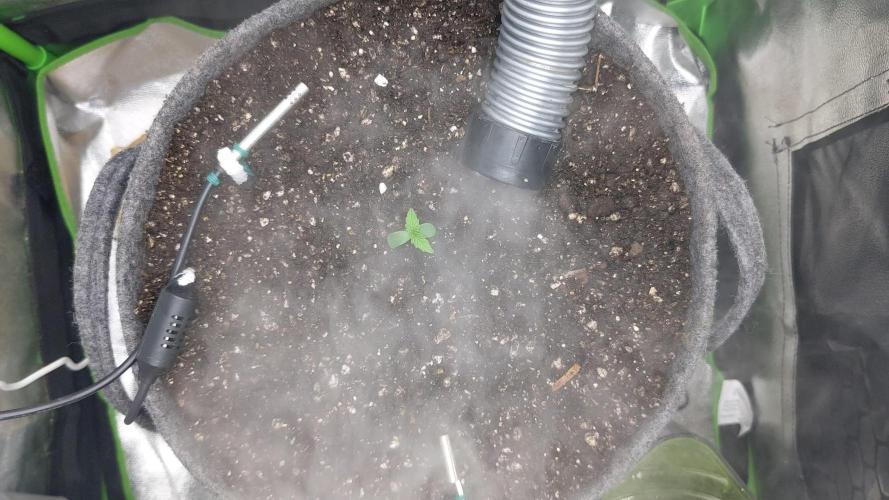
The Mars Hydro FC-E1500, the Inkbird dehumidifier, and the auto-draining pot stands have all arrived this week. I will set up the pest control, nutrients, and the Exhale CO2 bag when I return from Italy. I will be leaving for 9 days next week, and I must admit, it makes me quite nervous to leave the house for a trip. However, I have tested the automation system, and it should take care of the light cycle and feeding/watering remotely. It is surprising to see that the "normal" leaves are already twice the size of the round cotyledons (or "seed leaves") after just 4 days. This indicates that my autoflowering plants have already entered the vegetative growth stage. It's a positive sign that the autoflowering genetics are taking effect and the plants are progressing rapidly, even at this early stage. The DLI (Daily Light Integral) of 18.6, which I have set, is ideal for supporting this quick transition. Providing sufficient light intensity and duration during the vegetative stage is crucial for autoflowering strains as it fuels their accelerated growth and development. I have been watching the size and appearance of the leaves to track the plants' progress. Maintaining the optimal environmental conditions I have been going for including an 18/6 photoperiod, a temperature range of 24-28°C, and a relative humidity (RH) of 55-70%, which should theoretcially enable my autoflowers to continue thriving in the vegetative stage. The fact that my plants have reached this milestone within the first 3 days is a promising indication of a fast and productive growth cycle.