


Likes
Comments
Share


@TerpTurtle
Follow
Week 8 flower
Average VPD of 1.14
Pheno 3-4 are smaller plants grown with AC infinity watering bases and Build A Soil in 10 gallon pots


Likes
5
Share

@Organic_G
Follow
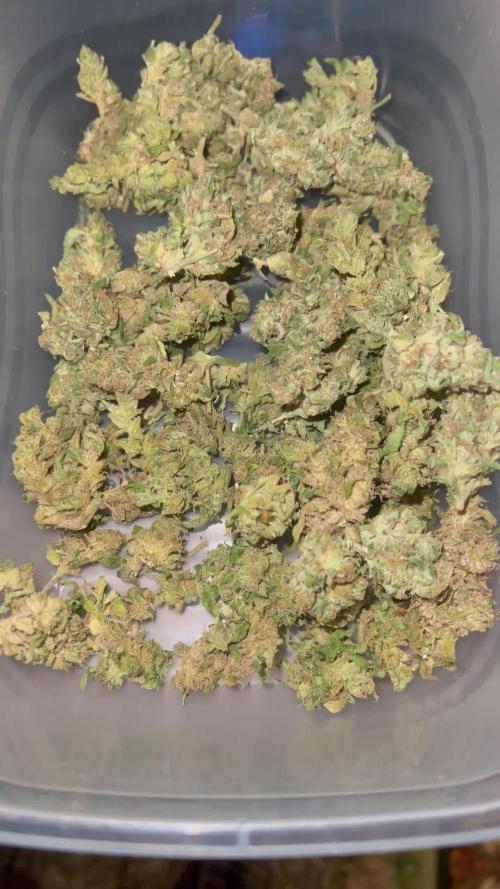
War eh nur ein Experiment, wie sich die Pflanzen bei 4 h direktem Sonnenlicht verhalten auf dem Balkon.
Ertrag ist dem entsprechend gering & die Dichte der Blüte fehlt, sehr sehr Fluffig aber der Geruch/Geschmack erinnert an 2014er Vibes.
Also Smoke Qualität ist super und die Wirkung sehr klar & clean. Werde die Sorte sicherlich nochmal im Zelt ausgrown.

Likes
1
Share
@Samsationalseeds
Follow
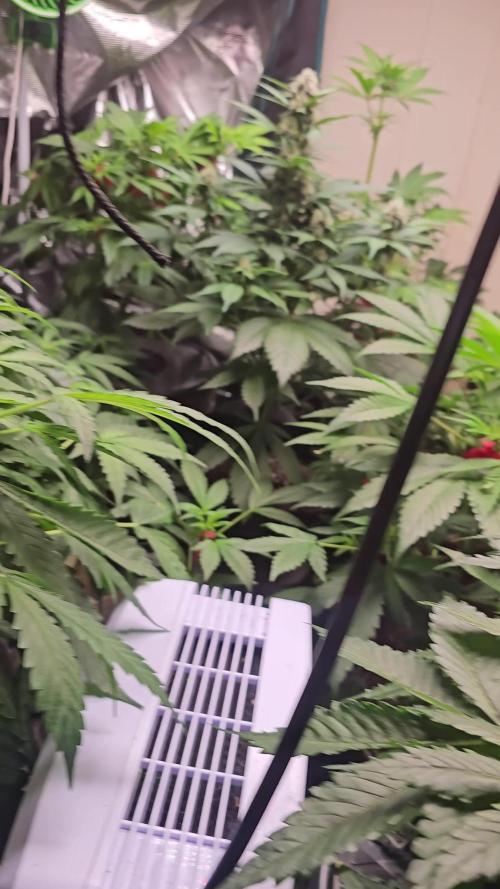
Day fifty, they're all looking pretty good.I'm doing a ph check every couple days
Processing
Likes
7
Share


@Alejangrow
Follow
Had my brother defoliate these girls for me.😎 ✂️
Just watching for those hairs to show up.♀️

Likes
23
Share


@Gram_Solo
Follow
Week 10
Ohhhh yehhhh! 👽👍
These runtz are firing with bud sites now!
They are all in the flower tent this week with the Spiderfarmer sf4000 and dehumidifier locked in at 50%
Few more weeks and these will be stacked. Got a lemony smell on a couple of them and can see some frost coming through too ❄️❄️❄️
Really need to invest in some new pots because the waste nutrient water coming through is too much
dry pockets all over I think, used about 20litres on 5plants


Likes
126
Share


@WhiteWidow
Follow
** video in 2 parts
Sweet and sour showing interesting gold color on her leaves and some curled tips so i flushed her with canna flush and will dry her for a few days.. i dont know whats the provlem except the cold nights for the last few days. Would like to hear opinions..
Grapefruit from dinafem is amazing smell - very fruity and sweet..
Sweet and sour and spliffs strawberry share almost the same smell but sweet and sour is more hubba bubba chewing gum, intensive sweetnes...
Remo chemo still no distincitve smell, just sweet.. amazing trichome production.
Ayahuasca isnt purple and smells like a bag of nuts and petroleum. Very odd i am afraid i wont like.her...


Likes
16
Share


@ChewiesGrow420
Follow
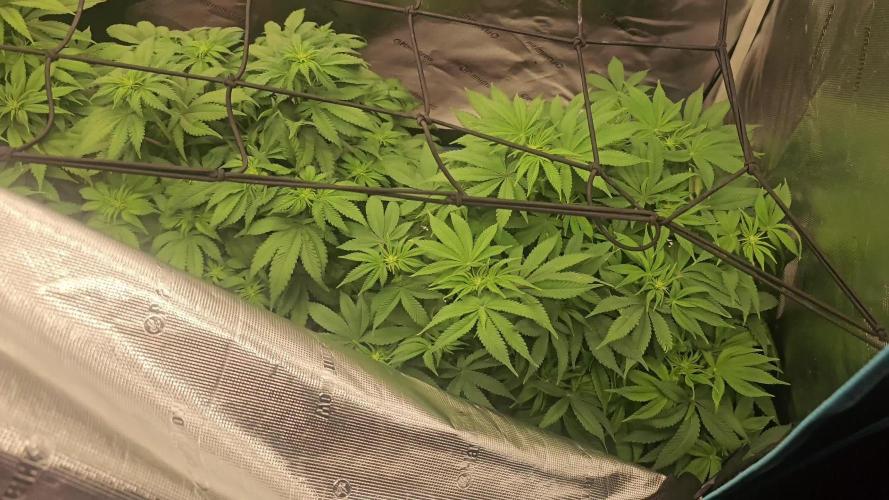
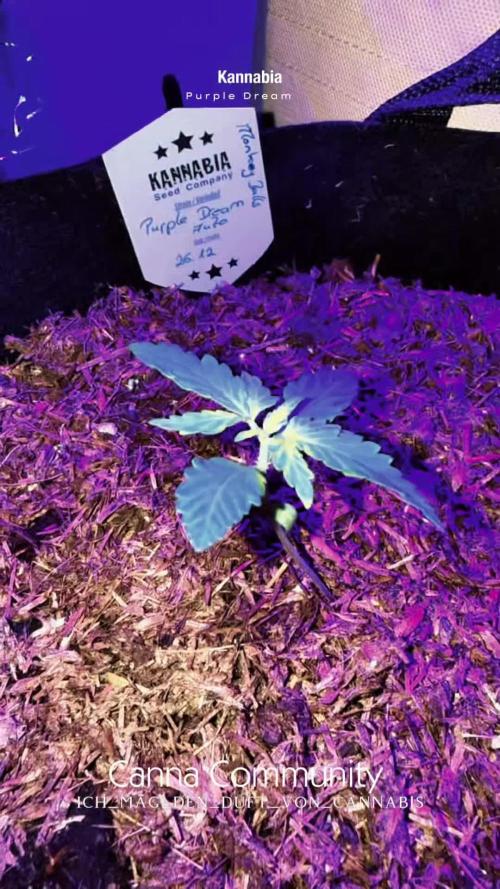
Today on day 17 from date of birth Iam preparing a worm casting tea. In a cheese cloth bag ,Made up of 2 cups of worm castings 2 tablespoons of unsulfured molasses,2 tablespoons of mineralized phosphate (bat shit) ,2 tablespoons of soluble seaweed extract . 2 tablespoons of alfalfa meal 2 tablespoons of all purpose 4-4-4 all Gia green products other than. I also sprinkled in some great white premium mycorrhizae inton2 gallons of water. Tea will brew for 24 hours before applying.





Likes
79
Share


@JUNGLE_B4RNS
Follow
Week 13, flowering week 3
Omg, omg, omg 😱 Lemon Cream Kush has some Jack magic beans in it 😅 Putting them on the side, I was expecting a big stretch but not like that, it is reaching a x3 in size in 3 weeks.
All 3 phenotypes are similar.
The MEGA POWER PLANT is definitely the perfect strain to grow. Compact structure, not too tall not too small, and making nice buds. The 4 phenotypes are totally identical, this strain seams to be absolutely stable and suitable for a SoG from seeds.
Next week I will swap the BIO 8-2-2 for the Alga-Max. I should avoid a Die back around week 5 of flowering, except maybe on one mega power plant. One of the girls started to turn light green from the bottom, giving it a last feed of Veg nootz shall slow it down turning yellow in 2 weeks.
Let’s see how it goes next week, stay tuned folks 😊
(I’m looking for a job in the Cannabis industry as Master Grower, Mineralogist, Quality Control)
Likes
19
Share


@BigBuds95
Follow
Day 67, new grower mistake: been flushing for roughly 3 weeks+, backed of the nutrients when the light burn started weeks ago because of fear of stunting the plant, noticed the fall colors starting 2 weeks and figured I would be close enough to harvest but unfortunately I was wrong. This LSD just wants to keep growing; still throwing out new white hairs with almost 60/40 orange to white hair ratio, and mostly cloudy trichomes but not too many Amber. In a perfect world I'd let it go another 1-2 weeks, but going into the 4th week of flushing, the dead leaves are getting too close to the main colas for my liking, I decided to do a partial harvest of the main top colas, and lower my lights a few inches to hopefully beef up the smaller buds that have been further from the light and are further behind then the main colas . I now know the importance of checking trichomes before starting flush and understanding the need for nutrients all the way through flower.
Likes
14
Share


@MUSRIME_supreme
Follow
Всех тепло приветствую.
Начинаем свой репортаж, погнали!
17 добрых автоцветов от компании Errors Seeds.
Южный Урал, теплица.
Обо всем подробнее в следующих постах!🤟
Начинаем как всегда, с семян)
Они отправились в ватные диски на прорастание, далее переедут в торф-таблетки под лампу APOLLO 6.
Переезд в теплицу будет осуществляется в нашей готовности, в готовности самой собственно теплицы и САМОЕ важное, когда будет готова рассада🌱
Likes
Comments
Share

@Vet_J
Follow
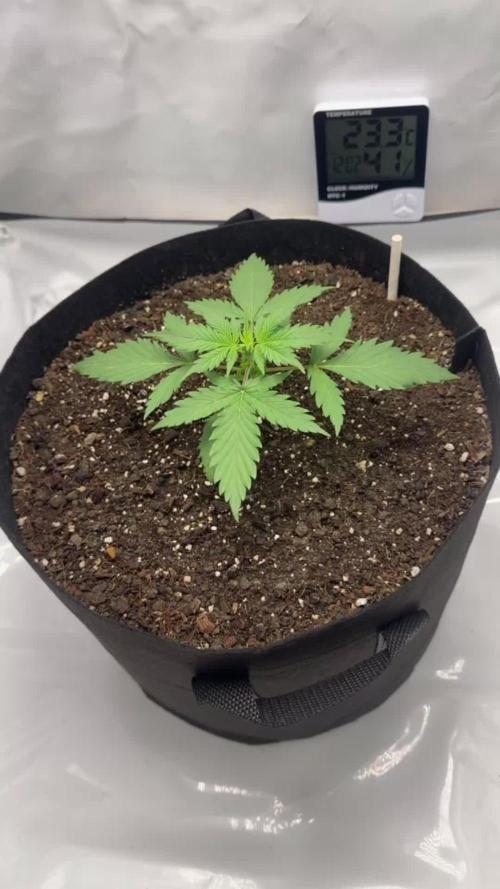
It's growing at a good pace and looks healthy
I should have started the LST technique earlier because now the initial branch has become quite stiff and no longer has the appropriate elasticity
It's okay, I'll wait a little longer for the branches to grow and then I'll stretch them with wire.
I grew the previous grow using a similar technique and still got pretty good results.
I have no complaints.
Likes
5
Share


@GhostmanGrows
Follow
Because of the hight and cold we have some and very different Pheno's its not gonna be my best run.. but we have still got some time..

Likes
152
Share


@ThrashedTV_BakedByGlaze
Follow
VIDEO ADDED: DEC 29 2020!
--
PHOTOS ADDED: DEC 27 2020! MORE COMING
VIDEO?!
--
Smell is starting to come down from the fresh cut, definitely has a great look to the bud as the cure goes on, have two 8 gram boveda packs in there after a few days with one that was WAY too big for it 😂
Brought down my Chocolate Mint OG in my other diary right now as well, way more weight to that last plant... probably more than both these Chem Bombs combined, great genetics over @Humboldt_seed_organization 😎
--
PHOTOS ADDED: DEC 23 2020! MORE COMING!
--
DEC 19 2020 - Harvest Day
Chem-Bomb Auto .. DONE.
Step-Brothers ... CHOPPED.
Buds.. TRIMMED.
Giving them my first bud wash tomorrow! Already juiced the lemon, have the spring water, and off-brand baking soda because COVID has every place sold out of Arm&Hammer 😂
Dale: 50 Grams Wet Buds/Stem
15 Grams Trim/Larf = Total 65 Grams Wet
Brennan: 55 Grams Wet Buds/Stem
12 Grams Trim/Larf = 67 Grams Wet
Total Wet: 132 Grams (Buds/Stems/Trim)
Looks like I'm getting in and around the "1 Ounce per Auto Plant" range with my basic soil/hand feed system. The CMOG from my other diary looks like it will be my first 1OZ plant when it dries.
With my past experience of wet buds drying out to about half of bud weight, I'm hoping that they both come in JUST under an Oz a piece.
Going to update with more pictures, going to take a couple days to dry and get a good weight and hopefully get somewhere close to the 64 grams of the ONLY sized Boveda packs I have right now 😇
--
UPDATE - Dec 20 2020 - Cure Day
😵😭 i once again got my hopes up by pulling the classic male "over-exaggerating" and all the wet weight came from the main stems. After 3 days or so of drying both plants together came in just under an ounce. The smell is great and I have no doubt it's quality bud but I need to up my density game somehow for sure. New nutrients or better set up, still very low-end with all my equipment as I've just slowly been finding affordable pieces to add as I go. Maybe more light? Feel free to hit me up below with ideas short of switching to a Hydro set up 😹 I can hardly afford my bags of soil so I definitely couldnt keep up with the financial costs of a Hydro set up yet 😓
Have had a few bowls of the dried/uncured bud and it's very nice, clean, and crazy good for being uncured at this point. Just the classic flower taste from the chlorophyll but the pineapple/tropical taste is coming through nice already.
Final Stats:
26g Dried Bud
26g Trim
--
Thanks for checking in! Will be updating soon and posting more pictures! Throw down a like and/or follow so I can return the favour 🙌
--
IG: @GlazedGrow (DM and let me know you're from Grow Diaries so i can follow back!)
Likes
14
Share


@GodZilla_Owner
Follow
Week 8 Update – Height Issues and Frosty Buds 🌿❄️
No major complaints this week—everything is under control, except for the height of AN#3… but Supercropping to the rescue! 😅
BioBizz#1 – BT30
She’s now using less water, managing 3L every 3 days. Bud development is steady, but compared to AN#4, she’s noticeably less frosty.
AN#4 – BT30
This is officially my best and strongest plant so far—super frosty, even on the large fan leaves! 😍 She’s also down to 3.5L every 3 days and thriving.
AN#3 – BT26
Not performing as well as the others, mainly due to the light distance. At times, there’s only 4cm clearance from the lamp! She’s definitely not loving it, but I’ve managed to keep things under control with Supercropping.
I have to admit, the stretch on this strain caught me off guard, and I’m not entirely happy about it. 😅
Likes
4
Share


@Trinidad
Follow
23.04.2025 Day 51. God Dang these ladies are beginning to pack a punch. In the past week the chemdawg has strected. No smell yet on chemdawg. As for the others, the flower are terping up. The struggling one has begun showing some nice purple flowers and smells like bubblegum. Another one smells sour like a green or unriped mango and the next one just smells sweet like candy. Flowers are swelling and begun to put on weight. During the past week I topped up reservoirs with nutrient solution but today i changed out reservoir with fresh nutrient solution. No training was done This week.