


Likes
Comments
Share


@420DeepGrow
Follow
¡Estoy muy contento con los resultados de la cosecha de mi Hulkberry! Esta cepa de Royal Queen Seeds ha sido increíblemente resistente y productiva. Utilicé XpertNutrients durante todo el ciclo de cultivo y los resultados fueron notables. Desde la fase de vegetación hasta la floración, las plantas respondieron perfectamente a los nutrientes, mostrando un crecimiento robusto y saludable.
Los cogollos están densos, resinosos y con un aroma increíblemente afrutado, con toques de pino y tierra. La calidad de la cosecha ha superado mis expectativas, tanto en cantidad como en calidad. A lo largo del cultivo, XpertNutrients proporcionó una nutrición equilibrada, lo que permitió a la Hulkberry desarrollar su máximo potencial sin signos de deficiencias o excesos de nutrientes.
En resumen, si buscas una cepa fácil de manejar y con grandes rendimientos, la Hulkberry de Royal Queen Seeds es una excelente opción, y combinada con XpertNutrients, los resultados serán realmente impresionantes. ¡Totalmente recomenda.

Processing
Likes
3
Share


@XxBILLZAxX
Follow
Noticing some buds. Growing a Tad in size. Thinking of getting a new light as this is useless. Hardly impacts half the plant.
Likes
207
Share


@DogDoctorOfficial
Follow
And with enormous honor and pleasure that i start collaborating with Zamnezia and Viparspectra
For this run i will have the pleasure of growing some Runtz genetics from Zamnezia seeds that they wore kind enough to send me for test and review 🙏🙏🙏💚💚💚🙏🙏🙏 and for the testing and reviewing i was blessed with the VIPARSPECTRA model P2000💚💚💚🙏🙏🙏 they wore amazing and send me this LED light for me to do some testing and some reviews. Special thanks to Zamnezia and to Viparspectra for this opportunity, lets make magic together 💚💚💚🙏🙏🙏
For now all is normal, seeds in glass of water and from there in to root riot, now lets see how the tiny babies come outside 🙏💚🌱
And not even 24h later we have them popping out from the root riot 😅 and we are off to what it look to be a great start 🙏🙏🙏
And a couple days latter and this beauty’s are ready to move and have their first contact with organic soil 😅🌱💚💚💚
All i grow is medicine for myself, for me and for my best friend with is me 😆 nothing to sell, so don’t even ask 😅💚💚💚
All info and full product details can be find in can find @
https://viparspectra.eu/collections/grow-lights DISCOUNT CODE - DOGDOCTOR
https://www.zamnesia.com DISCOUNT CODE - GROWITGD
More info and updates @
https://growdiaries.com/grower/dogdoctor
https://instagram.com/dogdoctorofficial
https://youtube.com/channel/UCR7ta4DKLFMg2xxTMr2cpIg
💚💚💚Growers love to you all 💚💚💚

Likes
16
Share


@eldruida_lamota
Follow
Venga familia, actualizamos la quinta semana de floración de estas Royal Gorilla de RoyalQueenSeeds.
Tienen un color verde bien bonito se ve que están bien sanas y los cogollos van formándose bien por lo general, ya se está produciendo la resina y se están poniendo potentes.
Hasta aquí todo bien el único suplicio que sufro son altas temperaturas por estar en pleno verano. Acabaré este proyecto y daremos parón unas semanas. Que avance algo más el verano.
Máximas de 28 y mínimas de 25 ahora viene el calor y ando jodido en humedad ronda el 50%.
Agrobeta:
https://www.agrobeta.com/agrobetatiendaonline/36-abonos-canamo
Mars hydro:
Code discount: EL420
https://www.mars-hydro.com/
Hasta aquí es todo , espero que lo disfrutéis, buenos humos 💨💨


Processing
Likes
9
Share


@HollowSource
Follow
Not much to be said for this lady. Her calmag issue seems to be still present and I'm suspecting lockout. She's on pHd water and calmag for now. Her aroma is amazing. So minty but cheesy at the same time. Amazing. She is fattening up good regardless of any issues. Not long to go for this girl!


Likes
7
Share


@Big_Rade_SCLA
Follow
No changes on my end. Watering about 2 gallons every other day for each plant...about 1 gallon a day for each. Most of it gets sucked up by the substrate and some grass+clover that's also starting to grow. It's early in the year an neither P1 or P2 have sexed. I also have a side project that I show on the videos, but am not keeping a diary for that one. Will be adding worm castings and some more soil topper next week. Possibly will add some kelp meal if I remember. Weather has been cooperating nicely. At one point in the past two weeks it was raining every other day. It's cleared up in the last few days.
Likes
25
Share


@pifflestikkz
Follow
Day 22
25/07/24 Thursday
Still no Feed/water since Tuesday.
Been a humid and overcast two days so not as much evaporation as normal.
All plants happy and healthy 💚
Video updates
Day 23
26/07/24 Friday
De-chlorinated watering pH 6 with 5ml calmag to 5L water.
Watered each with 250ml and had small run off.
I will continue to feed/water with small run offs to help prevent salt build ups.
Video update.
Day 26
29/07/24 Monday
Nice feed today, using de-chlorinated tap water pH 6.
They each had 300ml with small run off.
All looks incredibly happy and healthy!
The Auto Kabul that was mutated and twisted has pulled herself through and is just a bit shorter than the others.
Day 28
31/07/24 Wednesday
End of week😁
De-chlorinated water pH 6 today with Plagron pk13-14 5ml to 5L
Plagron power buds 5ml to 5L
Used 300ml of the 5L solution.
I will be using these on water days from now on as they are advised to be used every irrigation.
We'll see how they perform 💪💚


Likes
68
Share


@Ferenc
Follow
Day 36, 22nd of October 2020:
Hi there! All cool she is going crazy....
After the 2 videos the first pictures before topping. I have topped her 6x.... 6 branches and the rest pictures shows her after... pretty nice little lady thirsty and growing rapidly. I tried to do more LST also to spread the branches.
Everything ontomues the same way fertilization and all the things.
Happy Growing.
Likes
4
Share


@HoneyBlunt42
Follow
The plant is thriving in its fourth week of the 12/12 light cycle. Watering with CalMag and pH Down. I also gave it one extra feeding of 5 liters with Simplex PK Boost (1 ml/L).
The hydroponic plant is about twice as wide—it has completely filled the 40x40 cm grow box. The fan leaves are nearly the size of a palm, and the foliage is dense. The day before yesterday, it shed four lower fan leaves on its own. It seems 40W of light is becoming insufficient. I’ve added Hesi Boost and Hesi PK to the nutrient solution, following the chart dosages.
Every day, I top up with 1 liter of water containing CalMag and pH Down. I’m thinking about setting up an automated watering pump to run once a day. I’ve noticed the pH dropping to 5.5 daily; adding 1 ml/L of SillicX and a liter of filtered water brings it back to the 6.0–6.2 range. By the next day, however, it tends to drop to 5.5 or lower. It might be time to completely replace the nutrient solution.

Likes
13
Share


@DieselKush
Follow
Oct.29 - We transplanted the girls into soil since they are moving into vegetation phase
Nov.4 - Watered each plant 250mL, 0.25mL of each nutrient for each girl

Likes
13
Share


@Farmerskr
Follow
Este es el avance finalizando la 3ra semana, tienen 21 días, ahora les haré una defoliación y una poda de bajos, van maravillosas las Gorilla Banana de BSF Seeds. Planeo pasarlas a floración el día 31 para cerrar con 30 días de vegetación.
Saludos
@farmer.skr 🤙

Likes
70
Share


@ICEGrow
Follow
Die woche war recht spannend.
Nachdem ich meine Bestellung erhalten habe, kamen sehr viele technische Sachen hinzu, wie ein GSE Klimacontroller zur Regulierung der Temperatur und der Luftfeuchte, sowie ein Homebox Equipment Board und eine CO2 Baggy.
Ausserdem kamen noch einige neue BioBizz Produkte hinzu die jetzt nach Schema verwendet werden um das maximale Potenzial der Mädels heraus zu bekommen.
Ich bin sehr stolz auf mein Equipment was meinen Zelt eine Vollendung bringt.
Jetzt heißt es sich gut um die Mädels zu kümmern damit starkr und kräftig werden um die fetten Knollen zu halten. 🤪
Likes
6
Share


@oregonian
Follow
Yellowsticky traps capture hundreds of thrips. She is just beginning to become a girrrrl.

Likes
23
Share


@Mazgoth
Follow
The color is awesome,this plant is really tall even for this tent,the grow is really fast too
Likes
2
Share

@GoodTimesOrganics
Follow
Welcome Back!💚
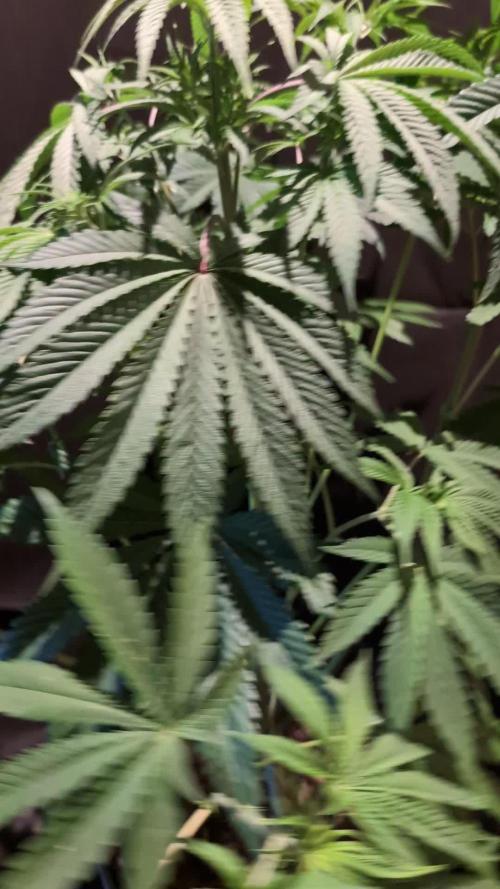
Die Pflanze hat nochmal ordentlich an Masse zugelegt und heute am 17.10.25 wurde sie in die Blüte übergeleitet.
Die Triebe sind schon homogen und Buschig, so dass sie nun bereit ist die Früchte zu tragen.
Die Umgebungsgegebenheiten sind bis jetzt optimal:
—————
🌞 Temp: 23°C bis 24°C
🌚 Temp: 18°C bis 19°C
💧RH: 68%
🌬️ VPD: 0,77 kPa👍
—————
Grüne Grüße 🥦

Likes
6
Share


@masterofsmeagol
Follow
5/4 I stupidly watered everything this morning. They were pretty much perfect weight for transplant......then I watered them. Oh well. If that's the worst mistake I make I'll be ecstatic. Went back over and found my 1 gal and 2 of those wierd slanty airports that tapers and holds like a gallon and a half and washed them. I mixed up 12 gallons of soil in a garbage bag and mixed it thoroughly with my gloved hands. It's mixed good. Looking at my plants in sadness thinking, "today could've been the day" and noticed a Special Kush of average size I didn't water that weighed in the 220's. I was happy. I filled the pit arpund a cup before removing it leaving the perfect hole. Mykos and water were poured in. Plant came out of the cup REALLY easy. Suprisingly easy. This wasn't totally dry. I was amazed it came out so easy so I kinda rolled it around looking at the roots. I started lowering it in the hole and I felt something break away but it webt DIRECTLY into the hole made for it. I tucked some soil around it but it was pretty tight from packing it around the empty cup. Didn't take a picture but the plant is fine. That was an average size plant too. So I may have to give some of the strains I popped later a little longer before I transplant. After everything's been transplanted I'll need to change lighting again. I think I'll open the window and use the hps and the l.e.d on the days and nights cThat's these girls won't be hardening off. I so wanna go plant those others but my intuition tells me to wait until morning and it's been serving me well. A couple can stay in cups longer. Not much longer but still.
5/5 Transplanted everything but two this morning into 1 gals with 1/2 happy frog half ocean forest. Mykos and water used during transplant. Found put the l.e.d was on for 24hrs for a while. I made sure the timer switch was ON but it was a different cord plugged in. Oh well. All transplants went perfect. I'm picking up an adapter for the outlet so I can plug the power strip into the timer and only use one timer. I had to hang the 150watt hps back up with the 1,000 watt equivelant 105 true watts. I hope this lighting setup works. Chemdog #4 and One MK Ultra will be transplanted later today or later in the morning. I also opened the shade to the south facing window. Shits getting real.
EDÌT: I FINISHED TRANSPLANTING THE LAST TWO PLANTS AND PICKED UP THE ADAPTER SO I COULD HANG THE HPS NEXT TO THE L.E.D. THEY WERE FIBE WHILE I WAS GONE. EASIEST TRANSPLANTS EVER. THEY ALL LOOKED PERKY AND HAPPY SIX OR SEVEN HOURS POST TRANSPLANT. I OPENED THE CURTAIN TO (SOUTH FACING WINDOW) BUT I MADE SURE THE PLANTS WEREN'T IN THE DIRECT LIGHT. EVEN THOUGH IT WOULD PROBABLY BE FINE. LAST TIME I HAD SEEDLING IN DIRECT LIGHT. I'LL PLAY IT BY EAR BUT IM HAPPY.
EDIT 2. Went back over to meditate by the stream and do my qigong. It's 75 and BEAUTIFUL today. The girls will be going out for a few hours on days like this. Anyway when I went in I was surprised to see everything looking nice and happy with praying leaves. Nothing is in direct sunlight but damn that window let's in a lot of light.
5/6 Girls LOVED the transplant! They seem to be all happy. No stress. Easiest transplant I've done. Leaves are praying upwards so I think the lights are approx tje right distance. They'll be going outside soon to harden off. It's been in the 70s but it's rainy now. I'll play it by ear according to weather. I'll continue to monitor lighting and I may lower the hps.
5/7 The soil was super dry when I went over this morning. Everything looked awesome though. I used about a half gallon watering. I don't want to water to run off. I want to keep the nutes IN the soil. It's also easier to fix an undet watered plant than an over watered one. It came out to about a half gaterade bottle on the biggest and half that on the smallest. I'll gradually increase water after I monitor the response. The water sat on the soil for quit a while so they definitely needed it. Looking good so far.
5/8 Soil lookeddry this morning. I think I'm going to up the water. Last time I dod seeds I gave like a pink. Some plants still had a little dampness where I watered that I could see. Others looked dry but happy. I gave the REAL dry bigger ones a small circle around the rootball. Just in case. I'm thinking of lowering the hps slightly so it's at least level with tje L.E.D. That window being open gives tons of light. If u moved them slightly left they'd get DIRECT sun most of the time. I'll be bringing them outside soon to start hardening them off.
EDIT: WENT TO CHECK THE GIRLS AT 5 TO MAKE SURE THEY WERENT DRIED OUT. THESE GIRLS ARENT JUST GETTING BIGGER BY THE DAY THEYRE LOOKING BIGGER FROM MORNING TO NIGHT! ITS BEEN RAINING LIKE CRAZY BUT WE WILL HAVE GREAT WEATHER NEXT WEEK AND I'LL BE BRINGING THEM OUTSIDE. I'M SUPER HAPPY WITH GROWTH SO FAR. ILL PROBABLY HST (TOP/FIM) AT THE NEXT NODE. I WANT THEM TO SETTLE IN NICELY BEFORE STRESSING THEM.
5/9 I may have stupidly uploaded doubles of pictures from today. Soil LOOKED real dry. I gave the plants their first real watering. I still went light. Almost a gallon with all plants. I know many say I should be watering to runoff but I want to keep the nutes in the soul as long as I can I don't want to overwater. I always start out careful. Once they show they xan tolerate it I'll increase water next time. This weekend it will be raining but after that we are getting some real good weather and I'll he taking the girls out to begin hardening off. I also need to take a look and top/FIM the plants now that they are settled. Also need to wash grow bags and sanitize outside.
5/10 It's pouring out. Horrible night and morning but this is about cannabis. After the watering ALL the plants shot up in size! Substantially. Leaves are over the sides of containers. I think I'm somewhere close with the watering schedule. I may bring the hps light down a little. I also NEED to start HST. I need to FIM and/or top these girls. Unfortunately I've been dealing with medical problems of my wife so I haven't got to it. If I get some sleep I may do something this morning or in the afternoon.


Likes
18
Share


@Pokan187
Follow
Slowly cruising and getting closer to the end, they all reacted very well to the feeding and look rejuvenated.
Had some aphids on the GDP but I caught them early and sprayed them with some homemade soapy water with essential oils mixture,so it shouldn't be a problem moving forward plus I spotted some natural allies (ladybugs)
The Runtz has the biggest buds and looks like it will finish first
The G13 has the best and strongest smell

Processing
Likes
19
Share


