


Likes
Comments
Share


@TechDCo
Follow
23/04/2025
Lights On! Sprayed walls 6%HP/L sprayed Domes 0.05% HP/L
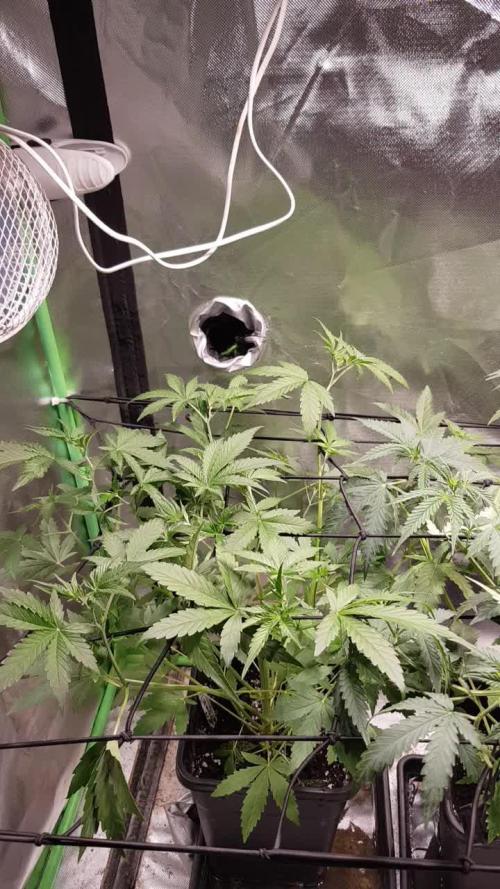
Pulled backwards MS with tape to try and shape her.
23/04/2025
Lights Off!
25/03/2025
Lights On!
Placed seedlings in the 5L starting cans.
Lights Off!
Check the VT me like the old me!
26/03/2025
Midday!
27/03/2025
Lights On!
28/03/2025
Lights Off!
30/03/2025
Lights On! Defolled!
Switch to flower in 4days. I need to setup the sativa tent in loft!
Midday! Increased light: 460watts they perked up and are praying!
- "If the truth perished, it'll still stand true that the truth perished"
Likes
13
Share


@Canadian
Follow
This plant has been very enjoyable to grow and the smell of it is incredibly Pleasant I will update when the plants are drying and ready for curing it will take approximately between 7 and 14 days because I wait until the main stem snaps with a crunchy sound.
Day 5 of drying and they are still far away from ready but they're starting to show a nice Colours now . the smell it's becoming very powerful even without curing I know many Growers cut them down when the smaller branch are snapping off easy but I wait until the main stem I bend and a crunch very dry sound come out of it because I don't like to deal with mold and I have a very busy life can be opening curing jars every
few hours everyday that's why a good Boveda packs and a good drying are my best friends.
These are the weights for the two plants that one that was bigger #1 is 51.12 grams the second plant #2 was 36.17 grams . They smell very nice like a kiwi skunk smell to it . The high are strong and last about hour and a half to two hours. For a regular smoker I will classified as day stuff on the Stoney side. With a high THC probably what is advertised on their website . This is very good for somebody who wants to have a quick grow of very good stuff or somebody who lacks space but doesn't want to sacrifice quality. The fact that I couldn't get a large yield out of it was a bomber for me I really like plants that are capable of producing a large yield.
Taste 10 out of 10
Aroma 10 out of 10
High 8 out of 10 . day. strong THC.
Yield 6 out of 10.
Easy to grow strain.
Possible to crop in 65 days from seed at 20h lights on.32 Centigrades and 45%humidity.
Thank you for reading I will continue to update have a happy grow.


Likes
18
Share


@thenotillwizard
Follow
Harvested at day 76, after 72h of darkness.
Very good yield!
3.3 pounds of dry buds + 1 pound of trim
The 2 keepers yielded 366 and 342g of premium quality smoke.
Very uplifting and energizing high :) Love it!
Likes
14
Share


@Fullmeltalchemist
Follow
D71/F19 - 11.25 - Got them all defoliated. Everything is looking open, lots of light for the flowers, lots of room to grow and good airflow. I've got a couple co2 bags hanging in there too now.
D75/F24 - 11.29 - Responded well to defoliation. Getting chunky! <3

Likes
2
Share


@sunshinegroww
Follow
Final week has arrived very nice and dense flowers smeels very nice and strong off to the druer

Processing
Likes
19
Share


@HempnainteZ
Follow
Transplanted Into Micro PC Grow Room On 1/21/19 At 10 am. Experienced Mild Stress As The Leafs Indicated Slight Wilting. 2 Hours After Settling Into Her New Spot. Observed Stress Relief. As The Leaf's Indicated By Stretching Upward For More Light Intake. Will Be Adding Growstones Tomorrow. After A Full Days Rest. All In All Not A Bad Transition Overall! As She Seems To Like Her New Spot. Air Temp Maintaining At A Comfortable 70 Degrees F. With Water At 60 And A Ph At 6.3!
Day 9 Second Nodes And Fan Leafs. Roots Are Exploding! Got Here Hooked like A Crack Head On Emerald Goddess Green Crack. Splash'd Her With R.O. Water! Progress Is Stable And Looking Good!
Tomorrow Jan 29 begins week 3 and top'n along with low stress training. Will be customizing a metal net file basket into a scog system for the begining of week 4 as I will be training her for vigorous sideway grow to maximize yield. I am just hoping I have the time as i think it will be flowering sometime in the late 4th to middle of the 5th week! Will update with week 3 photos soon!

Likes
17
Share


@ChunkeyMunkey420
Follow
Started flushing after having murder with jeweler's loops, phone microscope that I couldn't get to work. But next week theyll be down


Likes
10
Share


@Herbz_Unkraut
Follow
nice strain with a rich terpene profile! sweet, gelato like, hard hitting smoke!
sadly my phenos had no banana taste but still very nice

Processing
Likes
27
Share


@Hawkbo
Follow
This week they are all just putting on some weight still a few weeks left to go. Pics were taken on Monday video on Tuesday. The aromas are pretty strong in the tent in general.
Shes a struggler but it's too late to turn back now just gunna let it finish.

Likes
4
Share


@Kiqogrowing
Follow
repottet the plants in to their final 11L Fabric Pot with bio bizz All Mix. I put them more on the side of the pots, so that i can bend them over with LST and get an even canopy


Likes
11
Share


@GRow_M8s
Follow
Only new for this week is that topmax dose increased to 4ml/L.
There was a light defol made on HC#2. Some leaves from main stem that had kept few buds hidden were removed.

Likes
12
Share


@Sieben
Follow
Sorry guys some trouble only a vid today.
Best at this week , i had to re attach the Sanlight directly to the tent cause only cause plants got too high.
I do not suggest this fun to anyone 😂🙈.

Likes
46
Share


@Roberts
Follow
Going for another run at drunken bitch slap. Last attempt HPLVD destroyed everything. So all new equipment from new buckets to new light. Which is the HortibloomLED Solux 350. I have it on at 50 percent. Virus is gone as far as I can tell after resetting everything. Plus extra sterilization I have been doing. So she germinated, and sprout well. Everything is looking pretty good at the moment. Thank you Aeque Genetics, and Hortibloom. 🤜🏻🤛🏻🌱🌱🌱
Thank you grow diaries community for the 👇likes👇, follows, comments, and subscriptions on my YouTube channel👇. ❄️🌱🍻
Happy Growing 🌱🌱🌱
https://youtube.com/channel/UCAhN7yRzWLpcaRHhMIQ7X4g

Likes
2
Share


@PrinceOfHerbs
Follow
The plant grows extremely quickly and is constantly tied down with plant clips to create the largest possible scrog area.
The Ac infinity cloudforge t3 humidifier was installed.

Likes
41
Share


@deFharo
Follow
Bienvenidos cultivadores a la décima semana de floración de esta gran cepa con dominancia sativa. La planta está alcanzando su gloria... grandes y densas colas dominan toda la escena; intensos y complejos aromas endulzados dominan todo el ambiente!! 👨🌾💦💡🌾
Todavía hay crecimiento en los brotes florales, los pistilos blancos lo delatan, esta semana la planta ha seguido centrada en la formación de flores, absorbiendo lenta pero constantemente los nutrientes de las hojas, antes de que estas caigan al suelo agotadas, ahora, para la planta, lo importante son sus flores, por está razón prescinde de sus hojas más antiguas.
Aunque ha cumplido el tiempo de floración (9 semanas), información del banco de semillas, la planta mantiene mucha energía y capacidad de fotosíntesis, para al menos continuar floreando, un par de semanas más antes del corte!! 🤓🤙🤷♂️
ACTIVIDAD SEMANAL 💦💡👨🌾
Esta semana ha disminuido el consumo de agua de riego, 2396ml, un 24% menos que la semana anterior, debido a bajada de temperaturas y aumento de la humedad relativa, pero además, observo mayor consumo de agua conforme la mezclas tienen menor concentración de nutrientes, creo que los próximos riegos voy a hacerlos exclusivamente con agua, melaza y Microorganismos de Montaña Activados para capturar los nutrientes del sustrato retenidos por varios componentes del sustrato (Vermiculita, Zeolita y Biochar) y facilitar el trabajo de las raíces, creo que la planta por ahora no va a necesitar más.
- Día 121. Riego con agua de montaña, melaza, Microorganismos de Montaña Activados (MMA Basic) al 5% y Ormus al 0,5%.
Potencio de este modo la inoculación de Microorganismos al sustrato, para que mineralicen la materia orgánica convirtiéndola en humus y además quelaten los minerales del sustrato a la mayor velocidad posible, para ponerlos a disposición de la planta cuando esta lo solicite. Según datos, un centímetro cúbico de sustrato puede llegar a contener hasta 200 millones de microorganismos.
- Día 124. Mezcla de riego nutritivo especializado para floración con agua de montaña con Hidrolizado potásico (Humato) de leonardita (Húmicos, fúlvicos, K) al 1%, Biol de Guanos con Microorganismos Eficientes -EM- (MMA, BAL, Ca, Mg, Cu, P... micronutrientes) al 3% y melaza.
Nada más por hoy...
SALUDOS A TODOS!! 😄
================================= 🙄☮️👇🙏👌🤛👍👉👉👉❤️💜❤️👈👈👈🤜👌🙏👇☮️🤩🖐️🏻 =================================

Likes
2
Share


@ryanthegrower
Follow
week 9 is officially done, site calls for 8-9 weeks of flowering time, sadly the one on the right got revegged and has 2-3 more weeks to go. the one on the left however is full of trichomes,almost quartz like, mostly cloudy with a bit of amber, i’m thinking about chopping her this weekend, smell is like if you combined mothballs and sherbet (sounds weird but smells just like it) this grow as been one of my easiest grows so far, all the problems i’ve had with it has mostly been user error (i.e dog stepping on timer and day temps reaching 87)
Likes
71
Share

@Roberts
Follow
Quebec Blast is growing good, she is starting to develop flowers, and stretching. She is the shorter one in the room. I am figuring a stocky frosty plant at end. 🤞 I get there with no major issues. A solution change of a gallon every 4 to 5 days has been my current schedule. Future grows I wanna try to keep roots higher up through pruning to allow more solution for better stability, and longer between changes. She is in a New Level Hydro bucket, under a Spider Farmer SE5000 light at 80 percent. Thank you Spider Farmer, New Level Hydro, and Quebec Seeds. 🤜🤛❄️🌱
Thank you grow diaries community for the 👇likes👇, follows, comments, and subscriptions on my YouTube channel👇. ❄️🌱🍻 Happy Growing 🌱🌱🌱
https://youtube.com/channel/UCAhN7yRzWLpcaRHhMIQ7X4g
SE5000
https://amzn.to/3qFpAML
Spider Farmer Official Website Links:
US&Worldwide: https://www.spider-farmer.com
UK: https://spiderfarmer.co.uk
CA: https://spiderfarmer.ca
EU: https://spiderfarmer.eu
AU: https://spiderfarmer.com.au
Coupon Code: saveurcash
Www.newlevelhydro.com
Www.hygrozyme.com

Likes
10
Share


@Wilstang
Follow
The grow was super easy, steady growth and sturdy strength, no deficiencies..fed 3/4 strength General Hydroponics nutrient line. Ended up topping her three times, giving her a total of 10 tops. Overall medium height with an amazing manifold and unbreakable stem. Harvested on day 65, an absolutely great strong structure being able to hold it's weight of 101 Grams⚖️️. An easy grow with an amazing taste, smell, and smoke. Recommended completely for all growers 💯


