Likes
Comments
Share
I let the soil dry, then gave 72 hours of darkness, after which I harvested.
Likes
13
Share
@MADMANk
Follow
Hopefully il find a nice keeper to continue the lineage! Going to select, and "self" with another genetic, then back cross 💚✌️💖
Likes
13
Share
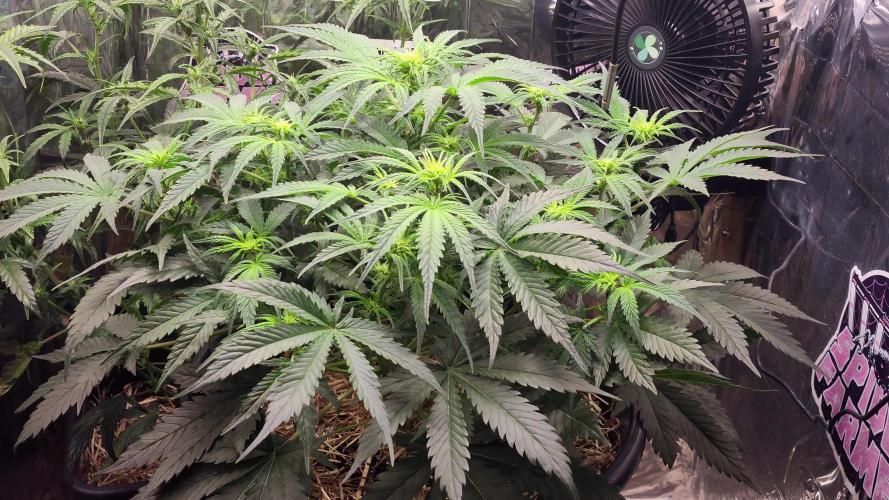
Switching them into flower after 8 weeks of veg. Going to get some nutrients this week as well. I decided to downsize and keep the biggest strongest plants and adopting out the rest.
Likes
3
Share
Tito's Living Soil Blueprint: Why You Can’t Treat Organics Like a Synthetic Hydro System. When transitioning from synthetic hydroponics to true organic cultivation, many growers bring their old habits with them. It is a common pitfall: pulling out pH pens, measuring runoff, and liquid-feeding heavy doses of organic nutrients as if the medium were sterile coco or rockwool. But living soil operates on an entirely different set of rules. To achieve the true potential of an organic garden, we must stop treating the soil as a mere holding tank for liquid chemicals and start viewing it as a self-sustaining biological engine. This will be a breakdown of why treating organic soil like a synthetic system fails, and how to shift ones methodology to unlock the true power of the soil food web. Pouring massive amounts of raw elements into a living system all at once is the biological equivalent of force-feeding a newborn a massive takeout meal and expecting them to digest it instantly. In an optimal system, soil should never be breaking down more than roughly 5% of its total composition as organic matter at any given time. The math is simple: more intense chemical and biological reactions equal more physical heat. If the root zone temperature creeps even remotely over 72°F, oxygen hypoxia sets in, drastically reducing plant growth. Organic rhizospheres and biological nutrient delivery require significantly more oxygen to maintain efficient parameters for growth—a reality that is drastically different from a pure synthetic approach where a complex rhizosphere is virtually non-existent. The fundamental blueprint of organic growing relies on Cation Exchange Capacity (CEC). The goal is to build a medium with so much CEC that it can store massive amounts of excess nutrients safely. This provides the necessary buffering capacity to handle large biological reactions, a process typically managed in the time period between grows. Once the soil is fully loaded and stabilized, the rhizosphere maintains its own pH balance, allowing the plant to dynamically feed itself directly from its massive, built-in storage of CEC. Treating Living Soil Like Coco creates a runoff-runaway trap. Applying a massive overdose of raw organic materials releases too many nutrients at once, leading to completely uncontrolled pH skewing. Running a synthetic-style management setup while simultaneously dumping organic inputs into the container does not make it an "organic" grow. Trying to judge a metric like pH after letting it run completely out of control with multiple simultaneous amendments is an uphill battle. Each input possesses unique chemical properties that drastically alter atomic decay chains and, consequently, pH. Without an adequate structural buffer, the medium experiences unpredictable swings. Put simply, the sheer volume of inputs rapidly outpaces the soil's built-in buffering capacity. Constantly reading the pH and Electrical Conductivity (EC) of input and output water in an organic soil is not true organic cultivation; it is just a synthetic indoor environment layout utilizing organic ingredients. This presents a distinct misunderstanding of how these two opposing approaches need to be separated. One cannot simply measure EC and pH to heavy runoff in a soil designed to store cations and expect to keep accurate tabs. Even when using 100% organic certified ingredients, liquid feeds, and compost teas, the underlying methodology matters most. Measuring runoff pH and EC treats an organic soil system like a synthetic coco or rockwool grow. In a high-CEC organic soil, a runoff reading is highly inaccurate. A soaring runoff reading of 8.0 is often just the water physically washing past raw amendments on its way out of the pot. It does not mean the actual root interface is locked out; it simply indicates that the soil ran out of immediate storage capacity for those heavy inputs. Synthetic growing relies entirely on direct nutrient delivery. Chemical salts are poured over the root system, the plant absorbs what it needs through basic osmotic pressure, and the excess is flushed away. True organic growing, however, relies on biological cycling. An organic soil should never be watered to heavy runoff, because doing so actively washes away the beneficial microbes, soluble humic acids, and organic buffers that the soil life works so hard to create to protect the root zone. Applying inputs as an immediate, massive overload of raw elements causes chaotic chemical spikes. Dumping heavy amendments directly into a big pot mid-grow triggers unpredictable reactions. In a true living soil system, amendments are added in tiny, balanced amounts long before the plant ever meets the dirt. This deliberate timeline allows the soil’s Cation Exchange Capacity to naturally "park" and buffer those nutrients. When inputs outpace the soil's ability to buffer them, the system breaks down, and the runoff pH screams. When faced with a fluctuating pH meter, a common reactive impulse is to throw agricultural sulfur at the problem. This is a classic example of trying to react mechanically to a digital number rather than letting the soil chemistry work. Elemental sulfur does not lower pH on contact. Soil microbes must first digest it and convert it into sulfuric acid. Because this biological process takes weeks or even months, adding it mid-problem yields no immediate change. This leads to the temptation to add even more. Weeks down the line, the cumulative sulfur will finally convert, causing the pH to crash violently and fry the root system. As a general rule, avoid using sulfur as a corrective knee-jerk reaction. If it is used at all, it should be applied strictly 2 to 3 weeks prior to flower as a precise, one-off addition to assist with Isopentenyl pyrophosphate synthesis. If a soil matrix is truly experiencing a severe alkaline lockout at a pH of 8.0, the new leaves at the very top of the plant will tell you directly by turning bright yellow while the veins stay dark green—the classic signature of alkaline drift and iron chlorosis. The solution is simple: put the pH meter away. Stop watering to heavy runoff. Only apply enough water to evenly moisten the soil matrix, and let natural inputs do their job to feed the microbes and naturally buffer the root zone. Electrical Conductivity (EC) dictates plant water and nutrient availability by altering the soil solution's osmotic potential. This potential controls whether a plant can efficiently pull water into its roots or if it will actually lose water to the surrounding soil. If a grower cannot control the rate of what is going in (the rate of nutrient release) and cannot control the rate of what is going out (the plant's dynamic growth), the immediate medium's EC deviates. When EC deviates, osmotic potential goes with it, disrupting bulk flow and the entire vascular transport system of the plant. Synthetic nutrient delivery relies on precise input measurements and an incredibly tight management of the wet-dry cycle to prevent the constant, violent spiking of EC caused by excess moisture loss. Reducing EC to a mere measurement of "food in and food out" oversimplifies its true function. It acts as a balance of electrical conductance that must be maintained to regulate the flow of water. Failing to acknowledge this is a severe disservice to the beauty and potential of a true rhizophagy cycle in all its respiratory glory. True organic cultivation does not actually begin until biological cycling is actively linked to hydrogen exudation from the roots. The vast majority of modern cultivation advice leaves growers completely in the dark regarding these biological mechanics. This is a product of market capitalism rather than basic chemistry. There are significantly lower profit margins for hydroponic companies when a grower uses ten times fewer mass consumables and relies on little more than water from seed to harvest. By shifting focus away from "feeding the straw" and moving it toward nurturing the near-infinite soil food web, the plant regains absolute autonomy over its own rhizophagy cycle. It begins regulating its own nutrient intake dynamically, without a single digital EC pen in sight. This allows the grower to focus entirely on optimizing the macro-environment rather than micromanaging the root zone. The cultivation medium can be reused indefinitely so long as you can prevent a buildup of carbon and nitrogen in the soil; cover that in a later week. To achieve a truly organic system that unlocks this rhizophagy cycle, the cultivation approach must shift entirely from feeding the plant directly to feeding the soil microbiome. Because the modern gardening community is heavily guided by synthetic methodologies, the subtle nuances and variations of this biological process are rarely highlighted. The hydroponic industry is fundamentally built on a recurring revenue model of bottled minerals, flush agents, and sterile mediums. Conversely, a self-sustaining living soil system requires minimal external inputs after its initial build. This shifts the grower's role from a rigid chemical manager to a biological custodian. Because managing biology requires observing subtle environmental factors—like consistent soil moisture, oxygenation, and temperature—rather than reading a digital screen, commercial entities scaled for automated, synthetic delivery often dismiss it as unpredictable. When the soil food web is fully unlocked, the plant takes the driver's seat, operating with a level of systemic efficiency that synthetic nutrient lines simply cannot replicate. In the commercial cultivation landscape, corporate structures are legally bound to protect shareholder interests and recurring profit margins, which often prioritize the sale of bottled consumables over the promotion of self-sustaining agricultural practices. Under modern industrial cultivation models, biology is too often treated as secondary to business. By stepping away from the meters, understanding Cation Exchange Capacity, and feeding the microbiome instead of the roots, you break free from the chemical cycle—allowing nature to do what it has perfected over millions of years. "When I was a child, I spoke as a child, I understood as a child, I thought as a child; but when I became a man, I put away childish things"
Likes
15
Share
This grow was the best ive had thus far...through out this whole grow leaves never discovered one bit!! This was the strongest, most resilient plant I've ever grown. The buds look amazing!!! Trichomes on Trichomes on Trichomes!!!! They are super fat as well. I look to get at least 3-4 ounces of this girl!!! Thank you @420fastbuds
Likes
8
Share
@Slobasian
Follow
I chopped every plant In half just going slow trying to fill every inch turned light on to 450 watts
Likes
2
Share
Day 21 have done much but water when dry ive just started to implement fish sh!t to my regiment and silica The schedule is plain ph water next water fish sh!t then plain ph water then silica Trying to keep it simple i water about ever 3days so far and everything it going well as far as my eyes can see
Likes
Comments
Share
Day one of flower for the London Pound Cake and Purple Shah. I moved the Blueberry Muffin into another veg tent for a week or two. They’re early finishers so when I move them back everything should harvest around a similar timeline. Fed them all with an Organic Alf Alfa seed sprout fermentation. The triacantanol in the Alf Alfa makes these things go crazy if you don’t overdo it. Add some coconut water and aloe and youve got yourself organic plant steroids. The growth rate will cause you to have an increased need for ca mg and nutrients which in organics may not be readily available. Top dress or feed ahead of the curve.
Likes
36
Share
@OGTrauma
Follow
Hi Potheads, VEGGING WEEK THREE: 17 days of vegging, only 14 remaining if everything goes smooth as butter , the menace was controlled by the use of aceite springhill + glycerine soap. Plants had a bit on a rough patch because more aggresive plague control means stress , yes, it has its throwbacks but at least plagues were 90% controlled ,with small quantities of flea survivors. Instructions (to evade toxic reaction !) states that next application should be 2 weeks from last spray. thats also fits that's intended to not spray products during flowering stage. Overall , they can still be considered healthy according to their different growing speed and ages. For plant placement inside the tent , u can use week 1, pic 1 for reference. G13 Hashplant : They were the ones that received more pest control doses , so they can have some burns and more darker color but still growing at great steps while they almost finished required LST and the pots are almost at 100%. Santa Bilbo: These one are growing wild and also more tend to be taller than the others on the grow. They are all growing steady, even the one that shares a pot and that was criteria for the next homies. Eleven Roses: The 4 most healthy topped plants were chosen , transplanted and trained . Because i want to put to have the most colonized soil in JUNE, i put 2 plants per pot, making a total of 12 plants, 4 of each variety.
Likes
7
Share
@Mett420
Follow
Dopo due settimane senza postare nulla siamo all’ultima settimana di prodotti prima del risciacquo. Tutte e 4 le piante sembrano avere un ottima struttura, una buona ramificazione degli apicali e teste compatte e profumate (a super incollose, senza guanti non si possono toccare. Partiremo a breve con il risciacquo con il ghiaccio per incentivare i pigmenti viola a formarsi ed espandersi su tutta la pianta. Ci aggiorniamo a inizio risciacquo!
Likes
85
Share
Buds are looking good and building good. I am amazedthinking Ihave another five weeks of flower. Looking forward to this. Backed off the nutrients a bit. I think I will taper off even more and let the plant use up what is left. Did a bit of defoilation, plants look better. The buds are stinky, as much care I took, my arms still endedup smelling like buds. I kept smelling the buds on my arms for hours. Gotta love it. Freed up some room in the flower room and rearranged the plants. Adjusted the height so the canopy is even. Now all the ASD are now under the lights. Happy days. Thanks for looking.
Likes
2
Share
Que pasa familia, vamos con la septima semana de floración de estas Orange Sherbet Fast Flowering, de FastBuds. Agradezco a Agrobeta todos los kits obtenidos de ellos 🙏. Vamos al lío, El ph se controla en 6.2 , la temperatura la tenemos entre 22/24 grados y la humedad ronda el 50%, añadimos ya varios productos de la gama de Agrobeta. Las próximas semanas veremos cómo avanzan. Agrobeta: https://www.agrobeta.com/agrobetatiendaonline/36-abonos-canamo Hasta aquí todo, Buenos humos 💨💨💨
Likes
6
Share
Well she starting to pack on buds and aroma now verry gassy and sweet smell ,love her structure and very easy to grow with very little maintenance,she wants a big feed coming tonight,
Likes
10
Share
in house all the wayyyyyy check out the sugerdaddy shack just getting started got Jelly Breath S1 In House Genetics Platinum Gorilla In House Genetics black berry auto FastBuds and the finishing of the one you see in video purple lemonade auto FastBuds
Likes
29
Share
@Smokwiri
Follow
Welkome to week 3 of my Runtz gum diary by Original sensible seeds. I just transplantated the young one to its main container a couple of days ago and it looks happy. Amazon: http://url-9.cn/0y9i Amazon US: https://amzn.to/3e0P2bk Amazon CA: https://amzn.to/3bTnEJC Amazon discount Code: it10smokwiri XS1000 10% XSsmokwiri XS1500 8% it20smokwiri XS2000 5% it40smokwiri XS4000 5% ViparSpectra 8% DISCOUNT CODE on the viparspectra websites (.com/.eu) RUFFSELEKTAH
Likes
8
Share
@RBG
Follow
Week 7 Flower-day 2 16/10/2025 Nutrient change Floramax veg 1: 1L Floramax flowering enhancer: 400ml Floramax organabud:400ml Floramax rezin: 100ml ( around 1/4 dose) Floramax cal mag: 100ml Gp3 pro cal: 100ml ( unfortunately ran out and won't have any until next week ) Gp3 massive bloom: 100ml Cyco platinum series silica: 200ml Sleeps with the fishez: 400ml ( half dose system shock testing to see of this minimises/prevents problems per nutrients change like i was having ) Ph 5.9-6 - EC 2.2-2.3 ( Floramax wants e.c of 2.4, so I'm doing .1-.2 under for now to see how she responds No lst changes or defoil today, just let her heal and recover. I thought I should add, with the way I lst, I like to get as much defoilation out the way before flipping to flower that way all she does in flower is just get fat and lovely. Seemed to work well coming from only doing Autoflowers so just using that knowledge and implementing to my photo grows and tweaking it
Likes
23
Share
MATARO BLUE by KANNABIA Week #13 Overall Week #12 Veg This week she's doing good no issues to report great genetics being outside she had dealt with the heat and elements. Stay Growing!! Kannabia.com MATARO BLUE
Likes
67
Share
@AsNoriu
Follow
Day 50. All grow got busted heavily, for few last waterings AT LEAST pH was way off. When I caught it instead of my presumed 6.3 it was 5.7 . So damaged leaves and delayed smaller harvest. Very sad , especially when I am forced to leave ASAP. Guess I'll delay my holiday for few weeks more ;)))) Outdoors girls beaten by frost, so no hope from them too. Worst time to put them out ... Live and learn ... Mars SP150 is back ! I need more Watts and she helped to veg 5 girls for my friend already. I took light back a bit , anyway his girls are in greenhouse already ;))) Happy Growing !!!
Likes
13
Share
@Kayotic
Follow
Starting to get frosty and sticky. Snell is more intense, like berries and gas. Very thirsty and hungry. Watering every day, feeding every other.