The Grow Awards 2026 🏆
Likes
Comments
Share
*Grow Diaries* ,you guys are doing a great job this is an awesome sight. Keep up the good work. I love looking at all these different grows and Diaries From great growers. Booco Of different strains with so many Individual techniques.Such beautiful pictures makes it hard to leave the computer. No doubt an Experience every grower should know. Informative & Educational truly a learning experience . I have been growing for a while but never tried to measure document and record a grow Start to finish with pictures. I know this will be helpful for future grows I appreciate the opportunity To participate. THANKS Happy growing! Farmer Joe
Likes
7
Share
@Krissci
Follow
Ending 1st week of flowering Mainlining for 1st time 8x Nodes, topped 3x Tied down to create even canopy Flavour & yield is my biggest aim Day 3 - Tie down training and defoliation. Both strong growers.. WC2 is the biggest so far
Likes
38
Share
Utopia Haze is a rare heavily sativa dominant hybrid (90% sativa/10% indica) strain created through back crossing Brazilian Sativa strains. This tasty little bud took home 1st Place for Best Sativa in the 2008 High Times’ Cannabis Cup and for good reason – with its potent 18-22% average THC level and long lasting cerebral effects, Utopia Haze is one powerhouse smoke. The Utopia Haze high comes on soon after you finish your first toke, hitting you with a strong cerebral lift that infuses you with a sense of hazy relaxation. Type: Feminised/Photoperiod Cultivation: Indoor/Outdoor Flowering Time (days): 70-75 Indoor Yield (g): Up to 650 Feminised Outdoor Harvest Month: October Feminised Outdoor Harvest Month Week: 3rd-4th week Aroma: Citrus, Woody, Pungent, Mint Effect: Cerebral Lift, Hazy Relaxation, Sleepy Welcome Everyone to the Final Entry of my Utopia Haze Grow ! There is so much to discuss ! I have been extremely busy as of late trying to get this Harvest together, but i am happy to have it here for you now ! I Seriously under estimated the amount of time, help from others, and my own necessary skills to pull this off.. and i still kind of screwed it up lol ! But its worth noting i have never actually done this before and trying to document it during....was extremely hard. It is next to impossible to work an iPhone with rubber gloves on ! First I want to discuss everything step by step so before you jump straight into the comments on how the end product is so small in "quantity" Rest assured i am happy with its"quality"...and thats all that matters to me because Life is a journey not a destination! and i have learned so much from this grow that I couldn't be any happy even if i messed some things up :) But at the very least I hope you read through this entry in its entirety with an open mind and focus more on the process, rather than just the outcome! I ran out of Ice & i was only able to wash three times..(normally I've heard you should go sometimes 5-6 washes) Preparation is Key & things will be much better next round :) Photos 1-22 These are pretty self explanatory but for those of you just tuning in now.. this is what happens to a very happy plant when you don't have the necessary tools to monitor key components of growing cannabis.. Ph, as well as EC levels play a very key role in the outcome of your grow lol that being said I was just able to save this plant by purchasing both tools but that doesn't mean the plant didn't suffer because of the prior events.. This was a Huge reason behind me choosing to turn this harvest into what i would consider "Solventless Hash Rosin" from "Ice water extracted Bubble hash". Pictures 23 The idea here is the process of using "fresh Frozen Cannabis" this has been discussed many a time online on such sites as instagram and here on grow diaries as well.. I personally have Never tried the process so i decided to try it out and make a judgement for myself.. Video 24 The Cannabis has now been in the freezer for 72 hours making it very well frozen.. as you can tell i struggled getting it all into the 25u Screen Wash Bag. One thing of note i would do differently is i will de-stem my next batch as i also believe this played a part in the amount of plant matter that escaped through the sieves. Photo/Video's 25-28 The idea here is "ice water Seiving" & especially with the bags that I am using here that are only have screen material on the bottom portion of the bag it is very important to have spaces in-between the screens to allow the water to pass directly through the screens into the bottom bucket with the least amount of resistance.. because the hash is so extremely temperature dependant if it gets warm on the side of the bag.. it will stick there and not make it to the bottom to become use able product.. 29 You do not need to use as much Ice as i used here lol... the idea is to keep everything very cold..i certainly achieved that but at the sacrifice of using so much that i ended up grinding product and producing "contaminants" but in the end they are just plant matter that i would be smoking when i rolled up my joint either way so.. I'm not super disappointed.. But it should be noted that what you want to achieve here is a Layering effect where you have the wash bag between two small layers of ice while the "water current" washes the Trichomes away allowing them to be separated by the screens setup below :) Before Starting the machine you should allow some time (i.e.;10-12minutes pre soak to allow the product to become saturated) before the first cycle. By video 32 I have just ran out of ice lol.. Video 33-34 Here I have a tip for you.. to separate the screens that you sieve through.. cut 5 gallon buckets to stretch them across nice and tight.. it'll make scooping your Bubble that much easier ! i learned this from the many "Frenchy" videos I have watched :) Picture 35 Here in lays the problem for most people.. drying your hash without loosing vast amounts of "Terpenes" whilst also stay ever vigilant against mold ! Thanks to all those videos I've watched on youtube.. id like to think this was one of my most successful parts of this process.. Things to Note; Terpenes start to seriously evaporate at temperatures 68F or 20C you need to stay as cold as possible whilst bringing the Relative Humidity in the space down into the 40-30% to stay away from that nasty mold ! I used my cold storage room in the basement.. with a dehumidifier running to keep the space at 45% RH & staying at a constant 15c. All while spreading the hash as thin as possible across parchment paper, on top of the white screens with a fan moving air across both sides of the paper. Pictures 36-38 These are some macros i took in the middle of my drying session I fell in love with the colour. Yes i know the black spots are plant material but they will get caught when i bag the hash & squish the oil out. Thing to Note; at this stage it is important to ensure you 'micro plane" the hash down as fine as you can whilst staying weary of the temperature... any "chunks" will hold pockets of moisture.. that lead to potential problems..ie; mold ... Picture/Video 39-41 Successfully planed bubble hash ready to be bagged and Squished ! Picture 42 Ive decided to follow Pedro.. from Pedros Grow Room and double bag to be on the safe side so i don't have any blow outs. So thats One 25u bag inside one 160u bag ! :) Pictures 43 This is almost 3 grams of the bubble hash from above, already melting in the bag.. this is where i ran into trouble again lol things started getting to warm in the house and i was only able to get one of the three squish's i did on video :( things started getting sticky. Picture 44 This is basically just a photo of the equipment I'm using; 3x5 LowTemp Cage in the frame I built myself, with a 20Ton bottle jack. Something to note here is this is an older Lowtemp model with only a single heating zone which is which i have it closed here heating Both sides of the press :) As well as the importance of having adequate pressure on your plates.. my rig is very overkill for the size of hash bags..lol Video 45 Here is the lovely press video.. its didn't quite work the way i wanted either lol my directional folding wasn't quite tight enough for a big "drip" :) &the Press was set to 65°c Photo's 46-50 are pretty self explanatory :) I had a blow out.. but still managed to pull an 80% return from the hash once squished...& yes it tasted amazing :) Was it worth it in the end... that could be debated.. for some..i understand..its not your thing, but for those of us that are interested in making our own concentrates.. free from Solvents... I wouldn't make it any other way :) If even ONE of you reading this diary finds it helpful to reference for ANYTHING.....even if its "what not to do" ill consider it a success ! Thanks again for tagging along on this garden adventure.. its been one heck of a journey ! Much Love from B.C. Canada, Until Next time, Cariboo
Processing
Likes
23
Share
@GrowGuy97
Follow
Wish the buds would have got a little bigger but feel like that’s particularly my fault for a short Veg but overall I am blow away by the outcome for all the seeds to just be random bag seeds! 2 of the plants are drying now 3rd one will be cut tomorrow & the other 2 got probably 2 more weeks! Will do a taste & smoke report and also give a weight as soon as they dry & cure a little bit but honestly couldn’t be happier with my first grow! Thanks for all the support & help along the way & happy growing friends!🤙🏼✌️🏼🌱 Update on 1st plant - dry weight 42g, still smelled pretty Earthy when I put it in the jar but the smell is definitely coming out now, extremely sticky & frosty buds❄️: 1:🏼🙏🏼 Update - plant 2 Dry weight was 40 grams! Extremely happy with the out come this is honestly some of the best bud I have ever smoked! Amazing to me this came from a random bag seed, it has a very citrusy flavor, smells & smokes amazing! Honestly a 10/10 in my book, wish I could knew what strain this was so I could grow it again!😫❄️✌️🏼🌱 Update - plant 3 Dry weight 34g, smells & look phenomenal, the buds are much smaller & had the smallest yield so far but this is by far the best smelling so far! Will have a smoke update on this one soon, stay tuned friends & happy growing!✌️🏼🌱 Update - plant 5 dry weight was 52g it dried a little faster than plant 4 which I will probably jar tomorrow! Will update again with a smoke report soon, this plant brought my total so far up to 168 off 4 plants👍🏼 Thanks for following friends & happy growing! Also the butter I made from the trim was 🔥🔥
Likes
19
Share
Here we gooooo! We are headed i to weel seven going strong! This plant here is definitely taking her time to flower, starting to produce thriclomes! Im not too sure if I stunned her in week 5. How ever this is a Sativa dominant hybrid. I've learned that sativas have a bit longer of a flowering time! Im thinking we have 3 to 4 more weeks of flower to go! Still keeping my main focus on keeping the plant healthy and fed! With a great flowering environment, vpd, humidity. I did have a few colder days last week so I was a bit worried about the fluxation in heat, but shes doing well! Much love and happy growing! Im excited for the weeks to come! ✨️✨️✨️✨️ Lets Go GUAVA SLUSHY
Likes
19
Share
@Lazuli
Follow
She finally puts on some decent weight, i keep feeding strong for another week
Likes
54
Share
~ FastBuds Strawberry Gorilla Autoflower Harvest Report ~ The Setup: • AC Infinity 4x4 tent •AC Infinity Cloudline T6 Exhaust Fan w/ Controller 67 •HLG 650R w/UVA Bar *** For some reason GD does NOT have a listing for the USA version of the 650R so I selected the closest match to it. •AirCube Active Oxygen Ebb/Flow 6 pot System •TrolMaster Hydro-X Controller for light •AutoPilot APC8200 co2 controller fed by a 50# tank •16" Hurricane oscillating fan and 8" floor fan •Tent cooling via filtered outside air delivered by AC Infinity Cloudline T6 fan •BlueLab instruments: PH Pen and Truncheon Nutrient Meter ________________________________________________________________________________________________________________________________________________________________________________________________________________________________________________________________________________________________________________________ Here we go fam!...after 13 exciting weeks this run of three FastBuds Strawberry Gorilla Autoflowers has come to an end and, despite some hiccups along the way, all three of this phenomenal cultivar delivered the goods! This was my first attempt at 'hydroponic' growing and honestly I made some mistakes along the way. In hindsight, I ran too many feed cycles in a 24hr period which did not allow the medium and fabric pots dry out enough which led to a Fungus Gnat infestation which wasn't caught until late into flower. I also think I had the nutrient level set too high which may have kept the upper portion of the medium too wet. Other than those issues the only other hindrances were related to the actual ebb/flow system itself and beyond my immediate control such as plant spacing, solution temperature etc. I will say that when using this AirCube system I found out the hard way that you really need to have all of your plants starting at the same time, and preferably of the same strain unless you're using a trellis net to control the canopy height. Lastly, I will say that the GrowAce AirCube system was very well built, used quality materials, is expandable, and was very easy to setup and get running. Now to the plants... All three Strawberry Gorilla's were germinated together and sprouted within 24hrs of one another. I did very minimal training on them consisting of leaf tucking and gentle bending of branches, then some LST using horticulture wire starting in Week 1 of flower, which all three responded well to. All three pheno's began to flower right around Day 24 from seed and continued for another 10 weeks. I kept the tent temperatures during veg and early flower between 76-80℉ with the light on, and 70-72℉ with the light off and the RH at 60-70%. Once in flower, I gradually lowered the 'light on' temperature to 72-75℉ and 65℉ during the dark period. I also lowered the RH down to 35-40% during late flower. The entire run they were fed Plagron nutrients exclusively, using their Cocos 'A' and Cocos 'B' along with Green Sensation. Power Roots and Royal Rush. I had nothing but great results from this lineup from Plagron and highly recommend their entire product line! I ended up with three distinct phenotypes, two of which leaning more to the fruity/strawberry side. The third pheno was Glue all the way, with a pungent, chem-like aroma that will make your eyes water! The #1 and #2 phenotypes took on some beautiful coloration through late flower, expressing shades of purple, pinks and lavender. Both of them also had a very fruity/sweet aroma that grew extremely strong during late flower. The #3 phenotype struggled a little bit during the run and was affected the most by the Fungus Gnats (which I'm sure affected her yield) but incredibly ended up not only being the most aromatic of the bunch, but also the frostiest! The #3's flowers were a lime green with hints of pink and lavender on some, all were covered in large headed trichomes! Once the Strawberry Gorilla's reached Week 8 of flower I began regular checks of their trichomes and once they had reached a ratio of 90% milky/10% amber I placed all three plants in darkness for 72hrs in the 4x4, keeping the temperature at 64℉ and a RH of 35%. After three days in the dark I chopped and hung the plants whole in the 4x4 suspended by a wire I ran across the tent. I kept gentle air circulation going in the tent and maintained a temperature of 55-60℉ and monitored the RH, keeping it at 50% for the first 24hrs, then 60% for the remainder of the hanging time. The first plant was ready to trim in 9 days, with the other two 10 & 11 days respectively. All three were trimmed and their flowers placed in Mason jars with a hygrometer inside to begin the curing process. The beautiful 'sugar trim' was sifted on my 24"x24" four screen setup which I did outside on my porch on a calm day that was only 38-40℉. I got a tremendous return of 42g of some beautiful 90u sift that I can't wait to press into rosin! All in all, having cultivated this strain previously I can say that the results could have been a whole lot better, but... taking into consideration my level of expertise with hydroponic growing and the stresses that the Strawberry Gorilla's had to contend with, I'd say that it was a win and a testimony to how resilient and strong this strain from FastBuds is... It's no wonder that Strawberry Gorilla Auto is a trophy winner!🏆
Likes
Comments
Share
little fella came along well, given the odds were stacked against it.
Likes
12
Share
Checkout my Instagram @smallbudz to see the Small budget grow setup for indoor use, low watt, low heat, low noise, step by step. 08/11/2019 - Showing early flower development? 09/11/2019 - Gave her 0.500 ml plain water PH 6.5, she's starting to need more water and also due to 30c temps. She's also showing light green around the leafs maybe slight magnesium deficiency. 10/11/2019 - Yellow leafs showing up really fast so I 'flushed' the medium with 1l of 6.4 PH plain water, watered until some run off start to showing, change the watering plan again, now I only water when the pot feels light and dry at the bottom. 13/11/2019 - Pot was really light and dry at the bottom so I gave her 1.5l of water with 0,75ml of Grow, 1,5ml of Bloom and 0.75ml of Max BioBizz PH 6.5 until some runoff started to appear I think was too much again : also added a work-supplement led strip light. 14/11/2019 - Leaves looking pale raise the light to 45cm instead of the recommended by manufacture 25-40cm.
Likes
113
Share
Hey My 420 Friends. Very cruisey week this week,kicking back watching our Purple Princesses popping out more purples and bulking heavier day by day.Changed watering schedule to flush with ph adjusted water and dropping the nutrients.I also measured light and have lowered the Mars TSW2000 to get a higher Par reading but they are still at around 35-40 Cm from the light.Some girls branches needed abit of stretching to let lower light in and get more light and air distribution.I have also staked some for heavy bud support.Have got some close up photos of chromes….The girls are teasing me with there Trichromes,and heck I’m sure there not ready to go but there flirting with beautiful trichromes and just delicious smell of sweet Terps,PURPLE LEMONADE Flowers.This strain is my new favourite.Goodbye Purple Grand Daddy,We have a NEW Purple Power House around.😎🌱🤜🏼🤛🏼😊🍁💨🚬 https://growdiaries.com/grower/420highlifecouple https://youtube.com/channel/UCKvjJ_S8nRI2wTc4cx_O1KQ https://myfastbuds.com/?a_aid=616a33e294e50 With every order you will get a free seed Join the community on GROWDIARIES It’s a awesome place to meet cool people, document your grow and learn a lot from fellow growers, happy growing 😊🌱
Likes
6
Share
#1 pheno has the same problems as last time. Super purpling stems. I think this one needs a little higher ph. Considering i use r/o water that comes out to 6 and i dont ph. Im thinking that might be the issue for this girl. #2 is starting to ganster lean on some branches. Getting heavier even though they are popcorn buds all the way around the plants. Smells are beautiful. But the Wedding Cake x BBC takes over the room. Its a wonderful mix of smells.
Likes
7
Share
Plant is looking good 😊, fully recovered from defoliation, I set the lights closer, switched them to 12h of light per day, and did some spraying to control pests with neem oil and organic Marseille soap, everything good so far . Can't wait to see the flowers forming. I used a net to open up the branches, and get more colas, it worked but I think stressed out the plant a bit and the fact that I did it in the flowering period didn't helped, so next time I'll do it way before, but I recently bought the net so.. anyway I kept the net on for three days, and now I decided to remove it cause was getting me lot of troubles accessing the setup in general, watering, basically made impossible any movement inside the tent. Still did is thing and now I have not the best even canopy but many more top colas for sure. Please give me any advice, I've noticed it is drying out lot faster, humidity is still at 58% but I believe the roots are much more developed. I will leave home for 2 or 3 weeks, my sister will have the duty to just water, can't ask her more, hope for the best. So updates will be very rare but she'll take pictures for me and for us :D .
Likes
55
Share
What's in the soil? What's not in the soil would be an easier question to answer. 16-18 DLI @ the minute. +++ as she grows. Probably not recommended, but to get to where it needs to be, I need to start now. Vegetative @1400ppm 0.8–1.2 kPa 80–86°F (26.7–30°C) 65–75%, LST Day 10, Fim'd Day 11 CEC (Cation Exchange Capacity): This is a measure of a soil's ability to hold and exchange positively charged nutrients, like calcium, magnesium, and potassium. Soils with high CEC (more clay and organic matter) have more negative charges that attract and hold these essential nutrients, preventing them from leaching away. Biochar is highly efficient at increasing cation exchange capacity (CEC) compared to many other amendments. Biochar's high CEC potential stems from its negatively charged functional groups, and studies show it can increase CEC by over 90%. Amendments like compost also increase CEC but are often more prone to rapid biodegradation, which can make biochar's effect more long-lasting. biochar acts as a long-lasting Cation Exchange Capacity (CEC) enhancer because its porous, carbon-rich structure provides sites for nutrients to bind to, effectively improving nutrient retention in soil without relying on the short-term benefits of fresh organic matter like compost or manure. Biochar's stability means these benefits last much longer than those from traditional organic amendments, making it a sustainable way to improve soil fertility, water retention, and structure over time. Needs to be charged first, similar to Coco, or it will immobilize cations, but at a much higher ratio. a high cation exchange capacity (CEC) results in a high buffer protection, meaning the soil can better resist changes in pH and nutrient availability. This is because a high CEC soil has more negatively charged sites to hold onto essential positively charged nutrients, like calcium and magnesium, and to buffer against acid ions, such as hydrogen. EC (Electrical Conductivity): This measures the amount of soluble salts in the soil. High EC levels indicate a high concentration of dissolved salts and can be a sign of potential salinity issues that can harm plants. The stored cations associated with a medium's cation exchange capacity (CEC) do not directly contribute to a real-time electrical conductivity (EC) reading. A real-time EC measurement reflects only the concentration of free, dissolved salt ions in the water solution within the medium. 98% of a plants nutrients comes directly from the water solution. 2% come directly from soil particles. CEC is a mediums storage capacity for cations. These stored cations do not contribute to a mediums EC directly. Electrical Conductivity (EC) does not measure salt ions adsorbed (stored) onto a Cation Exchange Capacity (CEC) site, as EC measures the conductivity of ions in solution within a soil or water sample, not those held on soil particles. A medium releases stored cations to water by ion exchange, where a new, more desirable ion from the water solution temporarily displaces the stored cation from the medium's surface, a process also seen in plants absorbing nutrients via mass flow. For example, in water softeners, sodium ions are released from resin beads to bond with the medium's surface, displacing calcium and magnesium ions which then enter the water. This same principle applies when plants take up nutrients from the soil solution: the cations are released from the soil particles into the water in response to a concentration equilibrium, and then moved to the root surface via mass flow. An example of ion exchange within the context of Cation Exchange Capacity (CEC) is a soil particle with a negative charge attracting and holding positively charged nutrient ions, like potassium (K+) or calcium (Ca2+), and then exchanging them for other positive ions present in the soil solution. For instance, a negatively charged clay particle in soil can hold a K+ ion and later release it to a plant's roots when a different cation, such as calcium (Ca2+), is abundant and replaces the potassium. This process of holding and swapping positively charged ions is fundamental to soil fertility, as it provides plants with essential nutrients. Negative charges on soil particles: Soil particles, particularly clay and organic matter, have negatively charged surfaces due to their chemical structure. Attraction of cations: These negative charges attract and hold positively charged ions, or cations, such as: Potassium (K+) Calcium (Ca2+) Magnesium (Mg2+) Sodium (Na+) Ammonium (NH4+) Plant roots excrete hydrogen ions (H+) through the action of proton pumps embedded in the root cell membranes, which use ATP (energy) to actively transport H+ ions from inside the root cell into the surrounding soil. This process lowers the pH of the soil, which helps to make certain mineral nutrients, such as iron, more available for uptake by the plant. Mechanism of H+ Excretion Proton Pumps: Root cells contain specialized proteins called proton pumps (H+-ATPases) in their cell membranes. Active Transport: These proton pumps use energy from ATP to actively move H+ ions from the cytoplasm of the root cell into the soil, against their concentration gradient. Role in pH Regulation: This active excretion of H+ is a major way plants regulate their internal cytoplasmic pH. Nutrient Availability: The resulting decrease in soil pH makes certain essential mineral nutrients, like iron, more soluble and available for the root cells to absorb. Ion Exchange: The H+ ions also displace positively charged mineral cations from the soil particles, making them available for uptake. Iron Uptake: In response to iron deficiency stress, plants enhance H+ excretion and reductant release to lower the pH and convert Fe3+ to the more available form Fe2+. The altered pH can influence the activity and composition of beneficial microbes in the soil. The H+ gradient created by the proton pumps can also be used for other vital cell functions, such as ATP synthesis and the transport of other solutes. The hydrogen ions (H+) excreted during photosynthesis come from the splitting of water molecules. This splitting, called photolysis, occurs in Photosystem II to replace the electrons used in the light-dependent reactions. The released hydrogen ions are then pumped into the thylakoid lumen, creating a proton gradient that drives ATP synthesis. Plants release hydrogen ions (H+) from their roots into the soil, a process that occurs in conjunction with nutrient uptake and photosynthesis. These H+ ions compete with mineral cations for the negatively charged sites on soil particles, a phenomenon known as cation exchange. By displacing beneficial mineral cations, the excreted H+ ions make these nutrients available for the plant to absorb, which can also lower the soil pH and indirectly affect its Cation Exchange Capacity (CEC) by altering the pool of exchangeable cations in the soil solution. Plants use proton (H+) exudation, driven by the H+-ATPase enzyme, to release H+ ions into the soil, creating a more acidic rhizosphere, which enhances nutrient availability and influences nutrient cycling processes. This acidification mobilizes insoluble nutrients like iron (Fe) by breaking them down, while also facilitating the activity of beneficial microbes involved in the nutrient cycle. Therefore, H+ exudation is a critical plant strategy for nutrient acquisition and management, allowing plants to improve their access to essential elements from the soil. A lack of water splitting during photosynthesis can affect iron uptake because the resulting energy imbalance disrupts the plant's ability to produce ATP and NADPH, which are crucial for overall photosynthetic energy conversion and can trigger a deficiency in iron homeostasis pathways. While photosynthesis uses hydrogen ions produced from water splitting for the Calvin cycle, not to create a hydrogen gas deficiency, the overall process is sensitive to nutrient availability, and iron is essential for chloroplast function. In photosynthesis, water is split to provide electrons to replace those lost in Photosystem II, which is triggered by light absorption. These electrons then travel along a transport chain to generate ATP (energy currency) and NADPH (reducing power). Carbon Fixation: The generated ATP and NADPH are then used to convert carbon dioxide into carbohydrates in the Calvin cycle. Impaired water splitting (via water in or out) breaks the chain reaction of photosynthesis. This leads to an imbalance in ATP and NADPH levels, which disrupts the Calvin cycle and overall energy production in the plant. Plants require a sufficient supply of essential mineral elements like iron for photosynthesis. Iron is vital for chlorophyll formation and plays a crucial role in electron transport within the chloroplasts. The complex relationship between nutrient status and photosynthesis is evident when iron deficiency can be reverted by depleting other micronutrients like manganese. This highlights how nutrient homeostasis influences photosynthetic function. A lack of adequate energy and reducing power from photosynthesis, which is directly linked to water splitting, can trigger complex adaptive responses in the plant's iron uptake and distribution systems. Plants possess receptors called transceptors that can directly detect specific nutrient concentrations in the soil or within the plant's tissues. These receptors trigger signaling pathways, sometimes involving calcium influx or changes in protein complex activity, that then influence nutrient uptake by the roots. Plants use this information to make long-term adjustments, such as Increasing root biomass to explore more soil for nutrients. Modifying metabolic pathways to make better use of available resources. Adjusting the rate of nutrient transport into the roots. That's why I keep a high EC. Abundance resonates Abundance.
Likes
11
Share
7/20: All three are doing great. I'm hoping to extend Plant 1's vegetation week so that the others catch up to her for the flip, which is eventually coming. I added RapidStart this week. I've heard great things, we shall see. More root, more fruit. Trimmed 2 lower fan leaves that were not getting any light. 7/21: Our time is drawing near for the flip! Are those........ STIPULES? 7/22: LSTing hard. Much good. Nutes niiiice. She's just letting me bend her all sorts of ways for that light. 7/23: LST for you and me, to grow some weed so happily... la la la 7/24: They are just perky tonight! 7/25: Last day of week 4. I started some bloom nutes this morning to prep, and tomorrow I lollipop 'em! I also got a new microscope for the trichomes later on, can't wait to see what's photos and videos I get.
Likes
18
Share
@Wakesk8
Follow
Runtz is almost done ✔️ I will cut her between Sunday and Monday Balance going good let’s see the final result… Colas are pretty nice !
Likes
3
Share
@Organic_G
Follow
Interessant zu beobachten wie die Lila Pigemtierung innerhalb einiger Tage die Pflanze färbt, das UVB macht auf jedenfall seine Arbeit, sehr schön und verdichtet nochmal ordentlich die unter liegenden Blüten… 2/4 wurden geerntet, denken in 7 Tagen kommt die nächste Ernte
Likes
6
Share
@Weedzoks
Follow
La floraison a été lancé le 24 Août/Jour 88 Jour 85: Arrosage engrais complets Flo 1: Arrosage eau seulement Flo 7: Pulvérisation de 3ml de Vita Race
Likes
5
Share
@cannamite
Follow
Im using Divine Grow short flowering, really god stuff
Likes
31
Share
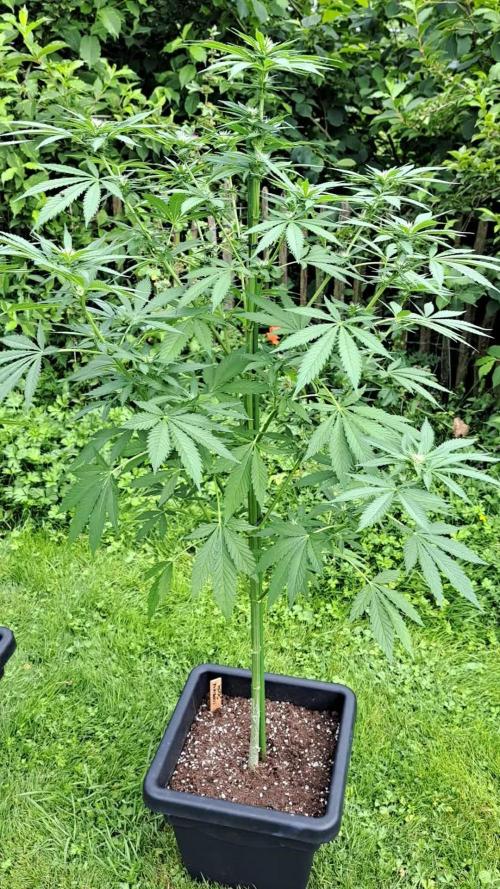
2024-09-07 This was a very effective Week, it started with Rain an Wind then it turned over to very hot and sunny exactly what we need here. The Outdoor tangie still looks super fresh and green, only minor signs of getting ready the colas are very glitery and you see alot of potential already super frostyhere. the revegetating Plant looks fine too. she produces some flowers.too.