


Likes
Comments
Share
@Trinidad
Follow
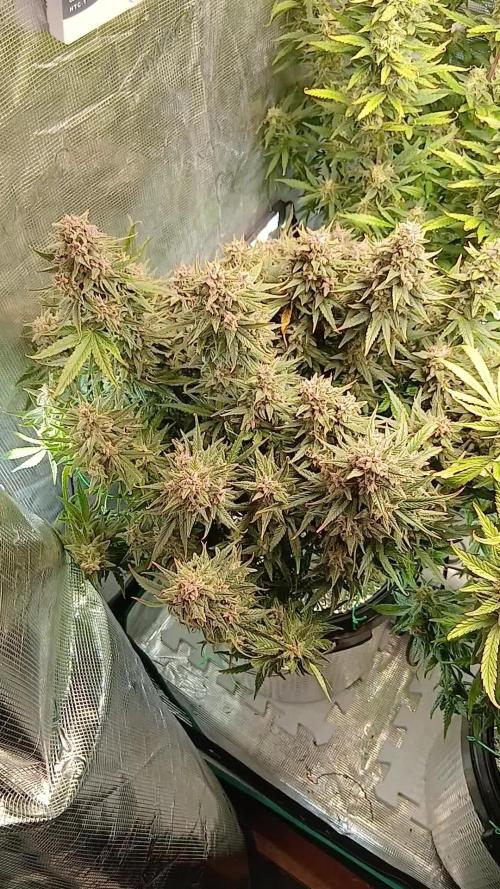
15th.05.2025 Day 70. Left these girls for a couple of days, came back to see them explode. All milky trichomes. Still some white pistil hairs. Strong 💪 smell. Tropicana cookies 🍪 strong cirtus smell. Banana 🍌 purple punch has sweet and fruity smell, so lovely. Lemon 🍋 cherry🍒 has bubble gum smell with hint of citrus. They have definitely put on some weight in past week. We will see how far we can take them until we start seeing amber trichomes.
17th.05.2025 day 72
Today I harvested the tropicana cookies. I still could have waited a bit longer, however i am dying for a smoke. Hung whole plant in small grow tent, maybe 1ft x 1ft. I am trying to slow down drying as much as possible because on last run (wurlz f1) I dry too quickly without keeping an eye on temperature and humidity. Buds were crispy. In dry tent now the buds are touching the wall. I don't know if this will affect the dry. We will find out. Placed dehumidifier in tent as humidity keeps going up as plant drys. Set at 60%. I can't get temperature down to 60f or 15.5c as recommended. My temperature is around 20c or 68f. As for the others i will try to push them as much as possible. We'll see how things progress.
18th.05.2025 Day 73
Today was chop day for banana 🍌 purple punch 👊🏼. She is frosty as f**k. On this plant fimming was applied. She came out short as I wanted. It's difficult to see with jewelers loop but I see some amber. I need to get better scope.
Also today I gave chemdawg a reservoir change out with final part solution. Also because there is more room in grow tent I spread some of the branches and trimmed off some of the lower popcorn buds. Topped up lemon cherry with nutrient solution. Soon lemon 🍋 cherry 🍒 will be chopped🔪
For the dry tent I removed dehumidifier as it was creating heat on the buds directly about. I am using an inline fan now . Once the humidity gets too high it comes on and sucks dry air in. This also removes stagnant or stale air, which is better for buds and will help prevent mold.
21th.05.2025 Day 76
Today lemon 🍋 cheery was harvested. Looking at trichomes they seem milky woth little amber, however the pistil hairs on her were all brown and she was starting to lose her bubble smell. I placed her in dry tent with tropicana cookies and banana purple punch. I had to install carbon filter because these girls were stanking up the house.

Likes
2
Share


@TowersD
Follow
In the beggining of week 4 of flower the phenos are showing differences.
Nanaz x BBC are way toller that the Headbands.
Also, Nanaz x BBC #2 has no pistils but it is a female plant. I have that happened before when I grew the Banana Butter Cups S1

Likes
27
Share


@Mosquito_Haarlem
Follow
Ze is heerlijk gegroeid en de fruittoppen zien er verrukkelijk uit. Dik en compact 👌
Mama Mia wat een mooie plant.
De hoofdtop is te zwaar geworden dus die wordt nu ondersteund door een stang.
Dit was de laatste week dat ze nutriënten heeft gekregen, vanaf deze week krijgt ze alleen nog maar water met flawless finish.
Wil je ook een strain van Zamnesia kweken?
Bestel dan zaden met korting op Zamnesia. com
De korting is 20% en de code is: ZAMMIGROW2024

Likes
22
Share


@420DeepGrow
Follow
Gracias al equipo de Kannabia Marshydro XpertNutrients y Trolmaster sin ellos esto no sería posible.
💐🍁 Amnesi K - Lemon:
La Amnesi-K Lemon es una semilla formada a partir de un trío de reyes, la Amnesia, la Lemon Skunk y la Jack Herer. Este matrimonio de tres dio lugar a una gran sativa que, con tonos dulces, terrosos y muy cítricos
🌻🚀 Consigue aqui tus semillas:
https://www.kannabia.com/es/semillas-marihuana-feminizadas/amnesi-k-lemon
💡TS-3000 + TS-1000: se usaran dos de las lámparas de la serie TS de Marshydro, para cubrir todas las necesidades de las plantas durante el ciclo de cultivo, uso las dos lámparas en floracion para llegar a toda la carpa de 1.50 x 1.50 x 1.80.
https://marshydro.eu/products/mars-hydro-ts-3000-led-grow-light/
🏠 : Marshydro 1.50 x 1.50 x 1.80, carpa 100% estanca con ventanas laterales para llegar a todos los lugares durante el grow
https://marshydro.eu/products/diy-150x150x200cm-grow-tent-kit
🌬️💨 Marshydro 6inch + filtro carbon para evitar olores indeseables.
https://marshydro.eu/products/ifresh-smart-6inch-filter-kits/
💻 Trolmaster Tent-X TCS-1 como controlador de luz, optimiza tu cultivo con la última tecnología del mercado, desde donde puedes controlar todos los parametros.
https://www.trolmaster.com/Products/Details/TCS-1
🍣🍦🌴 Xpert Nutrients es una empresa especializada en la producción y comercialización de fertilizantes líquidos y tierras, que garantizan excelentes cosechas y un crecimiento activo para sus plantas durante todas las fases de cultivo.
Consigue aqui tus Nutrientes:
https://xpertnutrients.com/es/productos/
📆 Semana 9:
El engorde de los cogollos está prácticamente terminado y solo falta que maduren un poco antes de ser cosechada.
Gran trabajo por parte de mis colaboradores, estoy bastante contento con este grow, el próximo tendré más atención en la etapa de crecimiento, la cual es muy importante si quiero obtener una cosecha de calidad.
A partir de ahora agua hasta el fin.

Likes
49
Share


@masterofsmeagol
Follow
6/23 Due To The Two 8 Day weeks this week will only consist of five days to get me back on track. SEE LAST WEEK FOR DETAILS. I DID ANOTHER EIGHT DAY WEEK. I'LL DO THIS WEEK AS SIX DAYS. THAT WAY IM BACK ON SCHEDULE. WATERED 6/22. WENT BACK AT NIGHTCAND WATERED ANOTHER GALLON WITH 1/3 TSP Armor Si. I mixed the solution with kelp you kelp me but I dumped it out. I've mixed silica with other nutes before but I had read something earlier about bioavailability issues and I didn't want to risk it. My plants are the healthiest I've ever grown. I'm considering transplanting the large 10th planet that I'm light depping. I also need to develop my ipm and my nute schedule. Still gonna have to keep an eye onvthe water situation. Luckily I have a buddy in my corner that's co tinualkt Bern a great help.
WENT BACK OVER AROUND NOON. BEAUTIFUL OUTSIDE AND THE PLANTS WERE LOVING THIS SUN. I DEFOLIATED SOME BURNED LEAVES AND MIXED A SOLUTION IF KELP ME KELP YOU THAT I PLAN TO FEED TO THE GARDEN TODAY. IM HAPPY WITH HOW THINGS ARE GOING. WE HAVE SOME RAIN AND THINDERSTORMS COMING. I NEED TO GET MY IPM UP AND RUNNING AND THE NUTES ONLINE. I ALSO NEED TO DECIDE IF IM GOING TO TRANSPLANT THE LIGHT DEP 10th PLANET. Went back over to put the girls to bed at six and if was still 90 degrees. The water from yesterday had dissipated. The tops were dust dry. I mixed two gallons of kelp you kelp me and fed it to the garden. Afterwards I pointed qbd found a couple plants that were more open to the wind were a little lighter. I know tomorrow will be very hot. Maybe quarter inch of rain. However after that it will rain (showers) off and on for days. I wanted to make sure the girls had what the needed to make it through tjis heat wave until they get that rain. I had another gallon mixed up and I'm thinking I should've given it to them. Oh well. I'd rather underwater than overwater any day. I did notice a burnt top on the plant furthest from the tarp that the sun JUST BARELY TOUCHES when the rest are in shade. I'll just raise the tarp a little. These are tiny problems. Can't upload video until tomorrow.
6/24 Good thing u gave the plants that water. I know it wasn't much but we didn't get any rain. Suppised to get a qtr in today and another qtr in tomorrow. Then rain a couple more days. It's working our really good for my watering schedule lol. Yesterday the girls got there first dose of a bottled nute. They got two gallons of kelp me kelp you (1/3 tsp per gallon) and another gallon of just phed water. I was going to do another gallon but held off due to the threat of syring rain. Didn't get it bur it looks like the plants loved the kelp. It had reached 90 yesterday. They look better today. It's 70 at 9 today. I LST the 10th planet in the 3 gallon. It's getting huge. I should start a separate diary for those three light dep plants. Its cool as hell watching this. One of the purple punches is flowering pretty good. I probably should start another diary for them. I'll be starting to feed my plants soon. Wondering if I should pinch plants again. TUCKED THE LITTLE GIRLS IN AT SIX AND SHOT A VIDEO AND TOOK SOME PUCTURES. PLANTS LOOKED PHENOMINAL! GOT HOME AND AROUND SEVEN IT JUST STARTED RORREBTIAL DOWNPOURS! THE TYPE OF RAIN THAT BREAKS STEMS. I SHOULDVE PUT MY OTHET TARP UP BUT I DIDNT. I WISH I HAD. IM A LITTLE NERVOUS. I KNOW THESE GIRLS ARE STRONG THOUGH! TOMORROW. ILL ROLL THE RARP UP AND SECURE THE BOTTOM FOR FAST ACCESS. IM ALSO GOING TO KOOK INTO FINDING A TOP FOR MY CAGE I CAN USE IN INCLIMENT WEATHER.
6/25 That little qtr in of rain we were supposed to get turned into torrential downpours and high winds. Luckily no REAL damage. If you watch the video you'll see what I mean. I'm going to havecto be cognizant moving forward. Noticed a few chunks from leaves butvplants are still healthy. I'm surprised how well these girls withstood this storm. They are certainly resilient. The 2 purple punch 1 10th planet that I'm light depping are flowering nicely now. They missed all the commotion from the storm as they were inside. It's smelling good. I'm happy.
6/26 It's what a friend would say is "maineing") out. That mistcthe plants love. I'm surprised the plants are doing as good as they have been considering the wind. Will be adding nutes soon. Need to add extra supports too. Light dep
6/27 Brief periods or torrential downpours. Light depped 3 gallon 0lants are under an overhanfcwhete the hatsxrain can't hurt them but they still get sun. They are really starting to flower now! I'm going to begin feeding with a base nute and a flower nute I think. I'm thinking about giving the light dep some open sesame or something similar. I need to set up a nute program soon but the plants ALL look so healthy! And it's been raining! I've only watered like once or twice since they've been in the big pots. I've seen zero pests aside from a chunk missing from a grasshopper. Usually by now I'd have battled half a dozen things and be battling another half dozen. However I was posing from clones. These are seeds and boy don't I see the difference!


Likes
6
Share


@Mundito
Follow
Didn't post much I'm week 6 as not too much difference..
Was feeding by recommended dose as per nutrient bottle..
Switched to measuring by ppm mid week and has really made a difference.
Now starting week 7 and looking lovely with fattening buds and ripening trichomes..
Gonna maybe push her for week to 10 days n the flush..
The yield is looking quite promising..

Likes
13
Share


Likes
10
Share


@RandomStreetMerchant
Follow
Mimosa X Orange Punch is a beast! She’s doing so well and she is growing vigorously.
The trellis net will support the branches when they start stacking the nugs on.
Had to give these girls some more nutes as the lower growth is showing signs that the top is taking what they need. Only sparsely so not worrying me much but good to note.
Well these girls are cruising can’t wait to see you all next week, till then peace ✌️ 08/21/23
Processing
Likes
4
Share


@Green_Thumb
Follow
My o my, what can I say... These ladies are gorgeous! Along with adding in the 2000W along side my 600W, I cut out the grow solution in my nutes contrary to the instructions and my ladies are booming! We'll see how the rest of the week continues! I started a majority bloom with some added glucose for my feed to help with bud weight but they are really packing on. Hopefully next week will be my last week of feeding as trichrome production increases and I can start my 2 week flush!
Likes
3
Share

@Pompeyblue
Follow
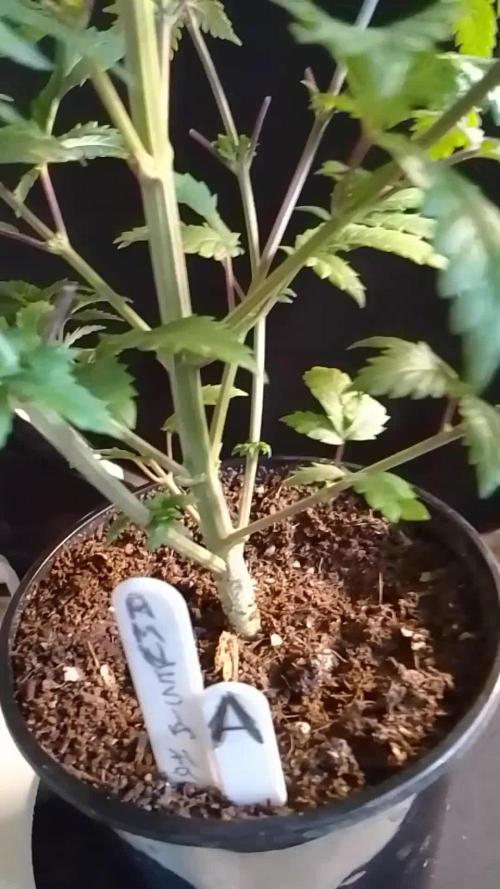
They are going amazingly not had any work need as they have done it for me just done some defoliation to them so I could open them up to show of their amazing structure
A is growing like a Christmas tree
B has split herself at 3rd node and again at the 5th and theirs a new nodes popping up in the middle and it looks like she going to split again
C went sideways ways when she started and give herself 3 main head's and now pushing new nodes everywhere from the bottom
Processing
Likes
6
Share


@SniperFourTwenty
Follow
Oh well, not my (our) week 🙄
During the week the Ladys start to look a overwatered and I had no idea how this could happen ... Well, first I tried to rise temperature slightly and had the fans run more often to dry them out a bit quicker, did not work. Than I took them out of the System ... All together worked, at least it looked so ... for 1 day ... Yesterday I found the real reason. The Humidity Controller was broken ... During the night they had around 90% humidity and during the day only 25-30%, way to high and way to low. Replaced the Controller today, hope next week will start smoother 🙂
Beside of this they made huuugggeeee progress, some nearly tribbeld in size and are around 5-6 Nodes now, will top them all next week when they recovered a bit 🙂
Also added some Alfaboost to help them a bit.
In the Videos the Vanilla Ice are in the right 🙂
Thanks for your time, I hope you enjoyed this entry 🙂
See you next week 💚

Likes
2
Share


@bbs42
Follow
Starting to get some real buds now. Color in leaves changed within 3days. Had me super nervous I screwed up the plant. Thought I was dealing with a ph issue because of how early the leaves changed colors. Green spots on leaves are from me not turing down the light fast enough.


Likes
46
Share


@GanjaReaper
Follow
Day 67:
Increase in flower size phrase has been finished now they about to go into the mature phrase.
I will eighter flower them for 1 or 2 weeks depending on how it goes.
Might only give them water with enzymen,regulator and humic for now on, that Is basicly flushing ( ec 0.7 ).
or Ill just slightly feed them( ec 1.4-1.6) for a few times before I start flushing them( ec 0.7).
Again I took the pictures before doing work on them ( watering and defoliation), so they look a little sad.
I did notice that many of them got burned tips, indicating that they get more nutrients then needed.
It does make sence since In this week and weeks to come, they need less nutrients and having a harder time taking it.
Yet they do drink everything in 1.5-2 days, so they still do like to get nutes.
Thats all for this week.

Likes
10
Share

@CheeRz
Follow
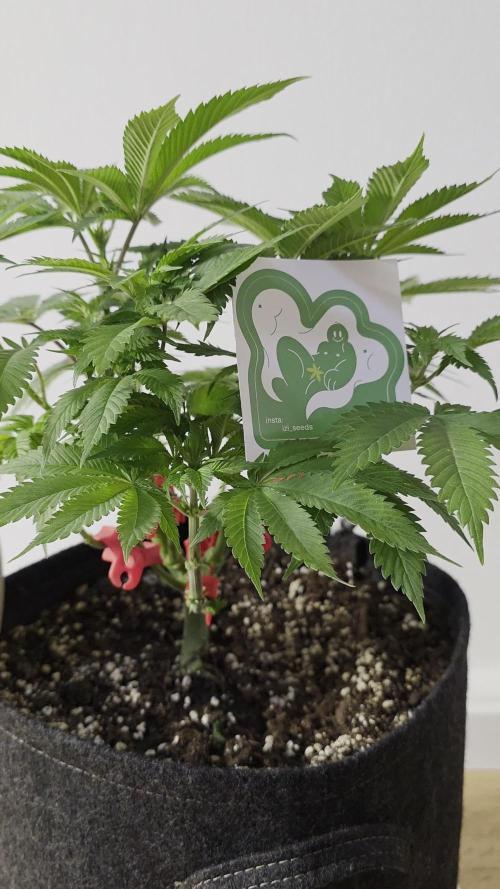
Blue is now around 30 cm tall. I don't think she'll catch up with the others, but we'll do our best. However, since she's been getting fish mix, you can see that she's growing better. Perhaps I should have started giving her protein earlier. Keep it IZI 💚

Likes
23
Share
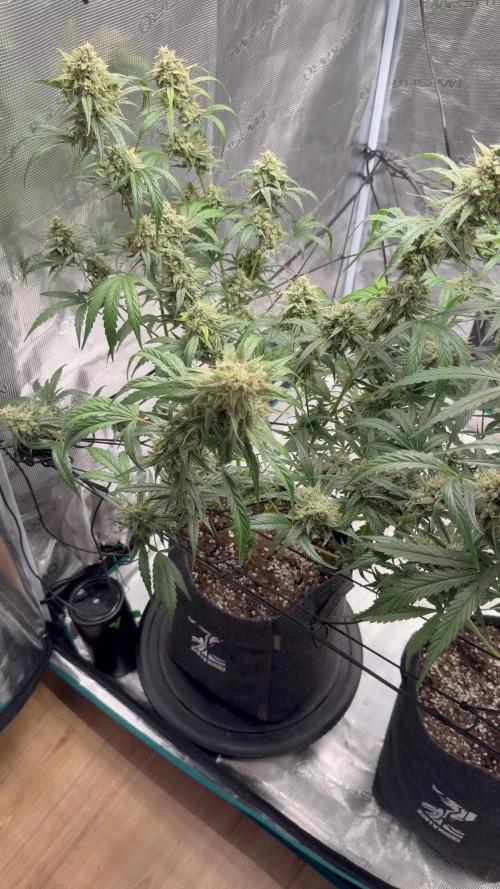

@cangrowz
Follow
frosted guava ❄️
🌱 Woche 10 von 10 ERNTE 🌱
So, jetzt sind tatsächlich alle drei Pflanzen geerntet und damit ist dieser Grow offiziell abgeschlossen. Mit dem Gesamtergebnis bin ich mehr als zufrieden! 🙌🌱
Gerade bei der dritten und letzten Pflanze konnte man während der Ernte noch einmal richtig schön sehen, was die Frosted Guava zu bieten hat. Die Buds waren unglaublich frostig und haben durch die kleinen Sonnenstrahlen, die während der Ernte durchs Fenster ins Zelt gefallen sind, richtig schön geglitzert. ❄️✨
Was mich bei diesem Grow besonders überzeugt hat, war die Widerstandsfähigkeit der Sorte. Trotz der teilweise wirklich hohen Temperaturen im Zelt hat die Frosted Guava keinerlei größere Probleme oder sichtbare Mängel gezeigt und sich bis zum Schluss sehr stabil entwickelt. Auch die Buds können sich definitiv sehen lassen schön groß, kompakt und mit einem wirklich starken Farbenspiel über alle drei Pflanzen hinweg. 💚💜
Beim Ausleeren der Töpfe konnte man außerdem ein sehr schönes und gut entwickeltes Wurzelwerk erkennen, was für mich noch einmal bestätigt hat, wie gut sich die Pflanzen über den gesamten Grow entwickelt haben.
Abschließend kann ich für mich ganz klar sagen: 10/10! 🔥 Die Frosted Guava hat wirklich einiges hergemacht und mich sowohl beim Wachstum als auch bei der Entwicklung und natürlich beim Endergebnis überzeugt.
Ein großes Dankeschön geht an Green House Seeds für die gesponserten Seeds und die Möglichkeit, diese Sorte zu testen. 🌱 Natürlich auch vielen Dank an alle, die diesen Grow begleitet, gelikt und kommentiert haben. Es macht einfach Spaß, die Entwicklung gemeinsam mit euch zu teilen! 🙏💚
Damit ist dieser Grow abgeschlossen und wir sehen uns beim nächsten Projekt wieder. 👀🌱
Bis zum nächsten Grow!
Happy Growing Growmies 🌱?💚

Likes
459
Share


@Ju_Bps
Follow
Hello my friends 👨🌾👩🌾,
Week was great! I got my new lamp, SP3000 from Mars Hydro 💡💡.
The girls are beautifull 😍, we have lot of hedgehogs 🦔, already frosty ❄️❄️
A nice smeel when I open the tent 😋😋.
The canope is nice 🌲🌲, we have a nice rectangular green screen, as expected.
I didn't remove leaves, I know in few weeks some of them will be died, so I'll let the nature do is job.
So I just kick off the big leaves.
💦 1 Watering this week 1.5l/plant .
Water + Cannazym + Sugar Royal
PH@6
I continue to spray with water each day, but probably the last week I did it, I don't like put water on the buds...
I'll start the flowering nutes next week, I didn't give this week, so I'll start the schedule week 2 Flo.
Lamp @100%
After 1 week, I love this lamp, very nice for 120x60, all the canope is covered by the lamp.
Thanks community for follow, likes, comments, always a pleasure 👩🌾👨🌾❤️🌲
See you next week 👊👊
Mars Hydro - TS 1000
https://www.mars-hydro.com/ts-1000-led-grow-light
Mars Hydro - FC3000
https://www.mars-hydro.com/fc-3000-samsung-lm301b-led-grow-light
Mars Hydro - SP3000
https://www.mars-hydro.com/sp-3000-samsung-lm301b-greenhouse-led-grow-light
The High Chameleon - Vannila T
https://www.thehighchameleon.com/shop/vanilla-t-5

Likes
10
Share


@DeepRootsGrowTrees
Follow
MIMOSA ZKITTLEZ FF /
GANJA FARMER
WEEK #5 OVERALL
WEEK #4 VEG
This lady is a fast grower is how I must stay this week she's a plant that will take the training you provide to her I'm using the budtraining clips to help train her as well I've as topped her. Great genetics with this lady!! Stay Growing!!
Thank you for stopping by and taking a look it's much appreciated!!
Thank you GANJA FARMER!!!
MIMOSA ZKITTLEZ FF GANJA FARMER
.

Likes
10
Share


@Furfacefarmer
Follow
Time to flower so she is now the flower tent whit some pretty big sisters.


