




Likes
Comments
Share

@Dr_Zauberer
Follow
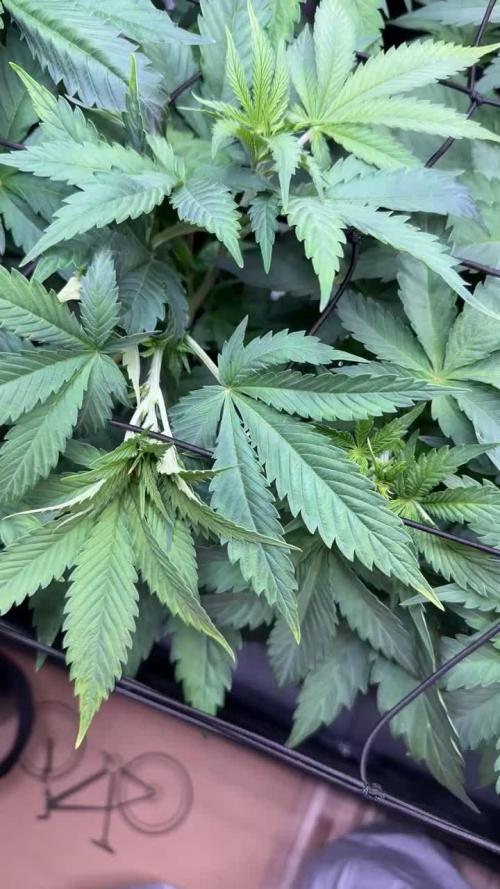
Day 29-35
I installed the net cuz they got big very fast at this point and also tall so thats the perfect time to use a net. It makes LST very easy. Also i dont really know what to write here always, so if u guys have any questions to the genetics or whatever just let me know i am lost in those comments here hahaha

Likes
25
Share


@cheetah844
Follow
Growing nicely, I'm hopeful she will be colorful later on in her life. She will be going outside, I have wind blowing to strengthen the stems up to prepare for mother nature.

Likes
5
Share


@CannaIGrow
Follow
This plant seems to have grown much denser and better than my first plant. I just got the ac infinity ventilation setup with controller 69 for my 2x2, still trying to learn, hopefully grow #3 goes even better. Stay tuned
Likes
15
Share


Likes
2
Share


@SebastianFastBuds
Follow
I started her directly in the soil of my Grow on the Go. I really didn't pay that much attention and once I cut the Lemon Cherry Cookies I just had the pot outdoors on Campground. Of course hiding a plant on Camp Grounds is not ideal conditions and the intension was to grow a plant outdoors while travelling.

Likes
9
Share


@greenthumb86
Follow
4 of the 12 seeds from fast buds didn't pop so i am soaking some from 00 seeds hopefully all goes well with them

Likes
36
Share


@TheGreenLeopard
Follow
Lovely lovely. Easy to get Around . Long stems with sizable gaps but enough bud on the site to keep you very happy. I had 8 plants to get through today so sorry for the lack of cut bud - will post the dry stuff later in smoke report. The pics are the night before harvest


Likes
11
Share


@Radagast_
Follow
19.07.
Wedding Cake 1# Day 85#
This plant is progressing very well, it has only grown 10 cm since the last update, but it has grown a lot in width, I forgot to measure the width, but I think it is currently as wide as it is tall, which I really like.
This phenotype is not difficult to grow, but it is not too easy either, I would not recommend it to beginners because it can cause problems sometimes.
Yesterday was the end of her twelfth week.
I think I mentioned in the seventh or eighth week that this plant will be a monster, it was already seen then and it definitely will be, I look forward to the further cultivation and progress of this plant.
Wedding Cake 2# Day 79#
As far as this phenotype is concerned, everything is against the first one.
As for the size of the plant, I think it has to do with genetics, it probably drew on some small ancestor, but it doesn't necessarily mean, maybe it's also down to what I'm going to mention now.
Basically, this plant is constantly hungry and thirsty from the moment it is transplanted, it always lacks something and is never completely happy.
For weeks I've been trying to correct that and please her, but she can't be as healthy and happy as she should be... this week she looks the best so far, but it's still not that... because of this phenotype (I don't know if it's common) I definitely wouldn't recommend this strain to beginners because I also struggle with this phenotype, the first phenotype is much easier to grow, although it's not for beginners either.
Stay High and Keep Growing!!!
Likes
2
Share


@Terpslurpgoat
Follow
A breez to grow 450 grams off 5 plants first ever grow red buds throughout the whole grow
Likes
11
Share


@Professor_Daank
Follow
The main issue with Gorilla Glue #4 is that the strain grows so fast, you need to prune your plants regularly.
I had a light-stress issue in week 9, it stunted the growth of this one plant and it is taking approximately 1 more week to reach harvest stage.
Great grow. will do again!

Likes
229
Share


@Crashoverite
Follow
Week 8
Hi everyone 😀
I am so delighted with this little grow. Finally upper growth slowed down and buds are getting structure and weight. Have adjusted nutrients and increased watering to approx. 2 liters every 2 days. The aroma inside this cabinet it's very strong. It's smells a little bit fruity. 2 kg active carbon filters doing the job perfectly and nothing is coming out.
Will update progress of this week every couple days.
12/09 Day 51
Buds on 2 most developed girls are getting frosty and gaining weight. Due to extreme fast flowering time on this strain decided to start applying final nutrient - Green Sensation from Plagron. Today only 0.5ml per liter but will increase to 1ml on next watering.
14/09 Day 53
Girls got so bushy again and decided to apply selective defoliation and tied some branches to netting. Not easy task if you have only frontal access and can't remove pots out 😅
17/09 day 56
Its the end of week 8
Everything is going well, buds and leaves are covered with lovely frost now. Thankfully have no major issues accept the humidity which can't be dropped below 50%.
Stay tuned for upcoming updates.
Peace and love ✌️


Likes
4
Share


@Guerrilla_grower777
Follow
19/09/2025 19:15
Very good climate this week,finally buds are bumping and showing some frostyness
Almost at the 12/12 light cycle now,days will be soon shorter and croptober Is near
Pic #1 and #2 Coco Milk and Coco fresh before defoliation and Lollipopping
Pic #3 video #2 and#3 Coco Milk 62 days from seed
Heavy defoliation on this one pretty impressive,there Is a lot of leaves,but i wanted to do from the start because this time i didn't top like i use to
Buds have already a good flavour not so strong but sure It will be
Pic #4 video #4 Coco fresh 50 days from seed
Defoliated less because It was dark,next time i will cut the rest but not as much as the Coco Milk
Flowers now forming but they are very small,i think this could be the last plant to harvest
Video #1 Apricot auto 58 days from seed
Buds now stacking this could be one of the fastest autoflower but also the one with the lower yield since the very first one
Smell Is just like rotten fruit,awesome
At the end there Is what i left of the gorilla z,those buds seems to flower Forever
Video #5 21/09/2025 gorilla z joint
While the gorilla z and the frostbanger are still hanging in the dark at 20°C 48%rh,the bud i took more than a week ago Is fully crisp and ready to be tested
Nice smoke not so flavourful but clean,ash looks pretty clean too,i hope with a proper cure It will be Better
High is not so strong on the body initially,only after some minutes tou can fell the body slowly relax
Next week it will be probably rainy as hell,maybe i will be back at the end of September

Likes
9
Share


@FowerTwennyNoob
Follow
Changed reservoir water for new week. Upped the nutes a little. Everything seems to be on schedule growth wise from what I've seen so far, I hope.
Day 11- Changed to 20/4 light cycle
Likes
11
Share


@Thigh
Follow
Werde sie denke jetzt so lassen wie sie ist. Bin Mega zufrieden für mein erstes Outdoor Projekt. Die Farbe lila ist einfach Mega und der Geruch steigert einfach nur die Freude auf die Verkostung. 😄
Likes
10
Share


@WEEDOOR
Follow
Hello everyone! The last two weeks I have been very busy so I did not have time to upload the previous week.
The previous week I noticed a mold starting to form in the flowers of the wedding cake (the taller plant) because the humidity was too high in the growing space. I acted quickly and added a dehumidifier, an extra fan and a home co2 system . On top of that, I cut out any part I found that was infected with the mold.
Last week I started washing the gorilla skittles (the low plant) hoping to harvest it next week.

Likes
38
Share


@Ukfarmer420
Follow
Hi guys
So end of week 4 and entering week 5 now.
Few issues this week with the feeding of the plants.
Dark phoenix are hungry well half of the plants are anyway 🤔🤷♂️ so I upped the feed to 1200ppm the dark phoenix didnt mind it as it needed it but my blue cheese suffered and has significant burnt tips on every leaf 😅 I will disconnect this from the auto feeder and flush and add half nutes by hand in a few days.
Othere than that the plants buds are growing and getting frosty.
Thanks for looking and happy growing guys👌💪💚
Day 37 flower
I changed the marshydro tsl2000 to a 400watt hps to finish the job on the scrog along with the bloomplus bp2500 250watt led light.
So cheese got burnt quite bad I totally disconnected it from auto pot system and feeding ph 6.5 water only for a week. Dark phoenix is really frosty now still loads of pistils standing on end and filling out now and smells amazing. The next 2 weeks I will keep feeding bloom and top max then I will start the flush on them.
Happy growing guys.

Processing
Likes
8
Share


Likes
13
Share


@H2Smith
Follow
📅 03.05-21 (Harvest day 1)
📜 cutting all plants, roots looks great. New climat set. I will update the harvest step every day until the end.
⛆58 - 62%
🌡️ 18 - 22°c
📅 06.05-21 (Harvest day 3)
📜 ------- Nothing to say.
⛆ 56,7% - 62%
🌡️ 18°c - 22°c
📅 07.05-21 (Harvest day 4)
📜 Preparing the curing automated system
⛆ 57,6% - 63.3%
🌡️ 17.6°c - 22.8°c
📅 11.05-21 (Harvest curing day 1)
📜 ---- Curing in progress.
⛆ 57,6% - 63.3%
🌡️ 17.6°c - 22.8°c
📅 21.05-21 (Harvest curing day 1)
📜 Making hash with dry ice: 365 Gr harvested
_____________________________________________________
📅 Day - 📜 Note - ⛆ Humidity - 🌡️ temperature
Equipment:
Idrolab 12 bucks
Chiller teco Hy500
weather controler with Co2 : PRO-LEAF BECC-B2
Bavagreen 720w
Bavagreen 720w
Bavagreen 240w
Bavagreen 240w
Nutrients and PH controller: PRO-LEAF PHEC-B2
Nutrients: Green House feeding - powder feeding hybrids | Powder feeding boost
Extractor: primaklima PK250-A1 PK250-L1 x2
System and roots care: Idrolab Total care

Likes
32
Share


@PEAKYPLANTERS
Follow
Respect for all of you, brother farmers! masters and beginners! thank you again for gathering on the pages of my diaries! we carry out our work with dedication and live on ambition! Come on guys!🙌👽🙌
WE WANTED TO CELEBRATE WITH YOU
OUR 3 YEARS OF AGRICULTURE ON THE PLATFORM.
GREETINGS TO THE FRIENDS OF @GROWDIARIES WHO MADE THIS POSSIBLE!