Processing
Likes
Comments
Share
These beans have been taking a beating and she still is pulling threw and starting her stretch now as she is heading into the second week of flowering .. I like the smell of this one right now and the structure is good very open just needs buds to start forming up. These were part of the grower of the month contest a while back very good quality genetics ...cheers
Likes
14
Share
28th week for critical the critical was very resistant, very strong but had like 50 seeds maybe for stress or defected seed
Processing
Likes
21
Share
@rhodes68
Follow
8/17 Week 5 Flipping Lights set to 11-13 for the first few days then 12-12 Nuets will transition accordingly Reducing feeds to once a day during the switch Intro Cocotek Bloom a/b at 5ml/gal each Reduce Grow to 10ml/g each Next feed half and half 8/19 Switching to 12-12 from 11-13 think its done its work changes are afoot 8/20 Colas forming quickly may have to flip the week to Flower, lets hope so 😉 They getting a dose of Kangaroots 5ml/g and Fish Shit 2ml/g at intervals during transition purely as plants seem to need. Pics tonight 8/21 Not there entirely yet but wont be long at all Vertical growth has picked up strongly, 2" in 3 days, though I really wont call it stretch yet Continued light defoliation keeping center clear Nuets as is for now Took two cuttings from her for cloning before she is into hard flower. Bring the total to six, so far so good
Likes
9
Share
Commencing Week 8: day 50 on January 19th Update is late my sincerest apologies. I will make it up by giving a very thorough smoke report when all is done. Otherwise all is going very well 😁😁👏👏 On day 50 I took the head off of bloody skunk. I checked trichome colors under USB microscope. At least 90% fully milky-white with maybe 5 or 6% Amber and the remainder clear. 😁 On day 55 I gave all of the plants a fan leaf trim including the remaining bottom half of bloody skunk. as I sit here and think about it I believe this will help with ensuring the entire plant ripens and matures at the same time - versus the tops being ready before the bottoms. I still plan on letting the bottoms of all these plants go way beyond the recommended time to see if I can initiate the process of rodelization. Either way I am glad to report that Bloody skunks pollenization looks like it is resulting in some seeds. (See photo). In hindsight my only concern is that because the plant finished a bit earlier than I expected the seeds may not make it to full maturity but I believe it should be okay we'll just have to wait and find out. That being said besides the bloody skunk being done just a few days early everything else seems to be right on time as described in plant profiles on company websites.👍 That's all for now thank you for your patience and attention and support and as usual feel free to leave any suggestions comments or questions and I'll do my best to get back sooner rather than later 😁
Likes
24
Share
@NuttyYeti
Follow
She seems ready! Smells so good like pineapple and diesel but also fruit punch. I'm excited to try it! 💚🌱✌️
Likes
116
Share
💩Holy Crap Growmies , we are outdoors and in the Ground and there Doing Great💩 👉It's been another full week 63 days from seed and she's doing great , very nice Growth, considering shes been up against the wind and rain 👈 So due to horrific weather as of late , I've had to deal with some slight bud rot 👈 removed it , and hopfully we are good to go 👊 I GOT MULTIPLE DIARIES ON THE GO 😱 please check them out 😎 👉THANKS FOR TAKING THE TIME TO GO OVER MY DIARIES 👈 👉NutriNPK NUTRIENTS USED FOR FEEDING 👈rain water to be used entire growth👈 👉www.nutrinpk.com right now get 10% off using SPRING2022 as the coupon code👈
Likes
31
Share
Info: Unfortunately, I had to find out that my account is used for fake pages in social media. I am only active here on growdiaries. I am not on facebook instagram twitter etc All accounts except this one are fake. Have fun with the update. Hey everyone :-) The growth this week is very nice :-) This week I will give her some time with training to recover and then I will continue next week 👍. Otherwise, as always, the tent was cleaned and the humidifier refilled. Have fun and stay healthy 🙏🏻👍 You can buy this Strain at : www.Zamnesia.com Type: Runtz ☝️🏼 Genetics: Zkittlez x Gelato 👍 Vega lamp: 2 x Todogrow Led Quantum Board 100 W 💡 Bloom Lamp : 2 x Todogrow Led Cxb 3590 COB 3500 K 205 W 💡💡☝️🏼 Soil : Bio Bizz Coco ☝️🏼 Nutrients : Green House Seeds Company Powder Feeding Bio ☝️🏼🌱 Water: Osmosis water mixed with normal water (24 hours stale that the chlorine evaporates) to 0.2 EC. Add Cal / Mag to 0.4 Ec Ph with Organic Ph - to 5.8
Processing
Likes
19
Share
@Skuba
Follow
Beginning of week 3 of flower for this girl and wow. She’s looks amazing😍😍. Last feed was about 600 Ppms. Purple looks stunning on this plant.
Likes
4
Share
Anche queste albicocche crescono molto bene.....sempre complimenti a fast buds e a me🤣😂💪.sono robuste e anche lei con tanti punti dove fiorire....
Likes
36
Share
Info: Unfortunately, I had to find out that my account is used for fake pages in social media. I am only active here on growdiaries. I am not on facebook instagram twitter etc All accounts except this one are fake. Have fun with the update. Flowering day 8 since time change to 12/12 h. Hey everyone ☺️. As the flowering begins you can already see a clear stretch of the lady :-). Yesterday 2 g GHSC Bio Bloom per l coco were added. In 2-3 weeks I will add another 1 g per liter 👍. The tent was cleaned and everything was refilled. Have fun with the update. Stay healthy 🙏🏻 You can buy this Strain at https://www.barneysfarm.com/blue-cheese-34 Type: Blue Cheese ☝️🏼 Genetics: Blueberry X Original Cheese 👍 Vega lamp: 2 x Todogrow Led Quantum Board 100 W 💡 Bloom Lamp : 2 x Todogrow Led Cxb 3590 COB 3500 K 205W 💡💡☝️🏼 Soil : Bio Bizz Coco ☝️🏼 Fertilizer: Green House Powder Feeding ☝️🏼🌱 Water: Osmosis water mixed with normal water (24 hours stale that the chlorine evaporates) to 0.2 EC. Add Cal / Mag to 0.4 Ec Ph with Organic Ph - to 5.5 - 5.8
Likes
3
Share
Everything has been great, Happy healthy and growing fantastic.
Likes
226
Share
~_~_~_~_~_~_~_~_~_~_~_~_~_~_~_~_~_~_~_~_~_~_~_~_~_~_~_~_~_~_~_~_~_~_~_~_~_~_~_~_~_~_~_~_~_~_~_~_~_~_~_~_~_~_~_~_~_~_~_~_~_~_~_~_~_~_~_~_~_~_~_~_~_~_~_~_~_~_~_~_~_~_~_ 08/13/21: 😺Week 5 is here!!🐱 they're growing fast and the yellowing seems to have corrected on its own (keeping the feeding routine consistent) .. we removed some growth from the mainline and topped at the ends (we decided to try topping at 3rd node for a wider plant, we'll see what happens lol), our goal is for 4-6 mains per side. All the BigBud plants need to be re-potted this week into their final homes..we're running a little low on promix so 50% will be reused..thanks for reading, drop a like if you made it this far lol..we'll update midweek ❤️🐱💡🌱 ~_~_~_~_~_~_~_~_~_~_~_~_~_~_~_~_~_~_~_~_~_~_~_~_~_~_~_~_~_~_~_~_~_~_~_~_~_~_~_~_~_~_~_~_~_~_~_~_~_~_~_~_~_~_~_~_~_~_~_~_~_~_~_~_~_~_~_~_~_~_~_~_~_~_~_~_~_~_~_~_~_~_~_ 8/14/21 😽Everyone was up-potted to 5- 6 gallon containers toady..I also cleaned out a tent and moved a light, creating a space just for the ILGM Big Bud 😺👌 ~_~_~_~_~_~_~_~_~_~_~_~_~_~_~_~_~_~_~_~_~_~_~_~_~_~_~_~_~_~_~_~_~_~_~_~_~_~_~_~_~_~_~_~_~_~_~_~_~_~_~_~_~_~_~_~_~_~_~_~_~_~_~_~_~_~_~_~_~_~_~_~_~_~_~_~_~_~_~_~_~_~_~_ 8/16/21: 😺I think my transplant solution was a little too spicy for them, we're starting to get glossy and claw (pics) but no dead tips yet..definitely water only for a little while... ~_~_~_~_~_~_~_~_~_~_~_~_~_~_~_~_~_~_~_~_~_~_~_~_~_~_~_~_~_~_~_~_~_~_~_~_~_~_~_~_~_~_~_~_~_~_~_~_~_~_~_~_~_~_~_~_~_~_~_~_~_~_~_~_~_~_~_~_~_~_~_~_~_~_~_~_~_~_~_~_~_~_~_ 8/18/21 😻Crazy fast new growth after last topping despite looking over fed.. this seems to be a very forgiving strain.. A+ so far 👊🐱 ~_~_~_~_~_~_~_~_~_~_~_~_~_~_~_~_~_~_~_~_~_~_~_~_~_~_~_~_~_~_~_~_~_~_~_~_~_~_~_~_~_~_~_~_~_~_~_~_~_~_~_~_~_~_~_~_~_~_~_~_~_~_~_~_~_~_~_~_~_~_~_~_~_~_~_~_~_~_~_~_~_~_~_
Likes
58
Share
@Krisis
Follow
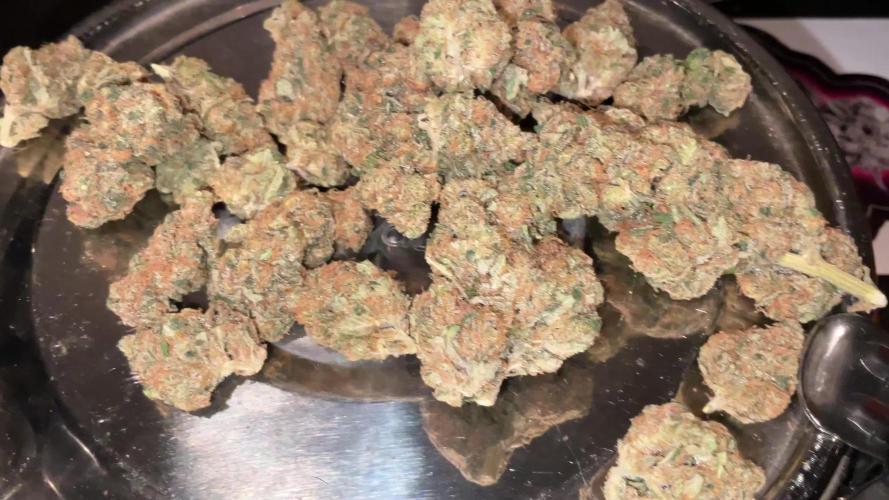
She was taken down 09/02/24 She dried for 9 days at what was hoped to had been around 60/60 but the temperature was between 72 up to 80 at one point, with the average being around 76. This was not ideal, and made drying faster than I had hoped. Nonetheless, seems as though she turned out fine. I was worried about the smell not being ideal etc. Alls good. Phew. I’ve trimmed her up and she’s in jars now to cure. Humidity is sitting at 59. Trimming her was pretty easy.. and I hate to trim. She was much more bud than leaf thankfully. Buds are good sized, dense, sticky, and frosty. As for now, not getting any smells of bananas lol. I guess maybe the cure could change that. Guess we’ll see. Will finish smoke report after some curing/smoking
Likes
8
Share
@Aleks555
Follow
Test FBA 2503 – 42Fast Buds 68 days from seed — and we’ve reached the final stage: harvest time! Although the plant didn’t grow very big, it truly impressed us — the buds are dense, large (as big as a fist!), and absolutely drenched in sticky resin. The pinkish hue of the buds gives this beauty an extra touch of elegance — she looks stunning! But the most striking thing is the smell. It’s incredibly strong, sharp, and long-lasting. Our girl has a seriously intense chemical scent — it fills the entire grow tent instantly and lingers for hours. Not for the faint of heart! From the beginning, we focused on giving her everything she needed: a well-balanced substrate, a stable environment, and, of course, proper nutrition. Huge thanks to Xpert Nutrients for their powerful line of fertilizers — they played a key role in helping this plant reach its full potential, delivering impressive trichome production, vibrant colors, and strong structure. And special thanks to 42Fast Buds for the opportunity to test this unique and powerful autoflower — it’s been an amazing experience! Harvest results coming soon — stay tuned!
Likes
44
Share
A great week of growth and development. Did a small defoliation, and clean of the tent. The girls are very leafy, and some of that needed to go to increase air flow and prevent issues from developing. Love this time of growing as there is not much to do, but watch the buds stack! Happy Gardening 👊❤️🇨🇦
Likes
37
Share
For LIQUIDS & NUTES ******GREEN BUZZ NUTRIENTS***** organic. Also i’m using their LIVING SOIL CULTURE in powder form! MARSHYDRO ⛺️ has large openings on the sides which is useful for mid section groom room work. 🤩 ☀️ MARSHYDRO FC 3000 LED 300W 💨MARSHYDRO 6” in-line EXTRACTOR with speed-variation knob, comes complete with ducting and carbon filter.
Likes
39
Share
Likes
25
Share
ANTHOCYANIN production is primarily controlled by the Cryptochrome (CR1) Photoreceptor ( !! UV and Blue Spectrums are primary drivers in the production of the pigment that replaces chlorophyll, isn't that awesome! 1. Diverse photoreceptors in plants Many civilizations, including the sun god of ancient Egypt, thought that the blessings of sunlight were the source of life. In fact, the survival of all life, including humans, is supported by the photosynthesis of plants that capture solar energy. Plants that perform photosynthesis have no means of transportation except for some algae. Therefore, it is necessary to monitor various changes in the external environment and respond appropriately to the place to survive. Among various environmental information, light is especially important information for plants that perform photosynthesis. In the process of evolution, plants acquired phytochrome, which mainly receives light in the red light region, and multiple blue light receptors, including his hytropin and phototropin, in order to sense the light environment. .. In addition to these, an ultraviolet light receptor named UVR8 was recently discovered. The latest image of the molecular structure and function of these various plant photoreceptors (Fig. 1), focusing on phytochrome and phototropin. Figure 1 Ultraviolet-visible absorption spectra of phytochrome, cryptochrome, phototropin, and UVR8. The dashed line represents each bioactive absorption spectrum. 2. Phytochrome; red-far red photoreversible molecular switch What is phytochrome? Phytochrome is a photochromic photoreceptor, and has two absorption types, a red light absorption type Pr (absorption maximum wavelength of about 665 nm) and a far-red light absorption type Pfr (730 nm). Reversible light conversion between the two by red light and far-red light, respectively(Fig. 1A, solid line and broken line). In general, Pfr is the active form that causes a physiological response. With some exceptions, phytochrome can be said to function as a photoreversible molecular switch. The background of the discovery is as follows. There are some types of plants that require light for germination (light seed germination). From that study, it was found that germination was induced by red light, the effect was inhibited by subsequent far-red light irradiation, and this could be repeated, and the existence of photoreceptors that reversibly photoconvert was predicted. In 1959, its existence was confirmed by the absorption spectrum measurement of the yellow sprout tissue, and it was named phytochrome. Why does the plant have a sensor to distinguish between such red light and far-red light? There is no big difference between the red and far-red light regions in the open-field spectrum of sunlight, but the proportion of red light is greatly reduced due to the absorption of chloroplasts in the shade of plants. Similar changes in light quality occur in the evening sunlight. Plants perceive this difference in light quality as the ratio of Pr and Pfr, recognize the light environment, and respond to it. Subsequent studies have revealed that it is responsible for various photomorphogenic reactions such as photoperiodic flowering induction, shade repellent, and deyellowing (greening). Furthermore, with the introduction of the model plant Arabidopsis thaliana (At) and the development of molecular biological analysis methods, research has progressed dramatically, and his five types of phytochromes (phyA-E) are present in Arabidopsis thaliana. all right. With the progress of the genome project, Fi’s tochrome-like photoreceptors were found in cyanobacteria, a photosynthetic prokaryotes other than plants. Furthermore, in non-photosynthetic bacteria, a homologue molecule called bacteriophytochrome photoreceptor (BphP) was found in Pseudomonas aeruginosa (Pa) and radiation-resistant bacteria (Deinococcus radiodurans, Dr). Domain structure of phytochrome molecule Phytochrome molecule can be roughly divided into N-terminal side and C-terminal side region. PAS (Per / Arndt / Sim: blue), GAF (cGMP phosphodiesterase / adenylyl cyclase / FhlA: green), PHY (phyto-chrome: purple) 3 in the N-terminal region of plant phytochrome (Fig. 2A) There are two domains and an N-terminal extension region (NTE: dark blue), and phytochromobilin (PΦB), which is one of the ring-opening tetrapyrroles, is thioether-bonded to the system stored in GAF as a chromophore. ing. PAS is a domain involved in the interaction between signal transduction-related proteins, and PHY is a phytochrome-specific domain. There are two PASs and her histidine kinase-related (HKR) domain (red) in the C-terminal region, but the histidine essential for kinase activity is not conserved. 3. Phototropin; photosynthetic efficiency optimized blue light receptor What is phototropin? Charles Darwin, who is famous for his theory of evolution, wrote in his book “The power of move-ment in plants” published in 1882 that plants bend toward blue light. Approximately 100 years later, the protein nph1 (nonphoto-tropic hypocotyl 1) encoded by one of the causative genes of Arabidopsis mutants causing phototropic abnormalities was identified as a blue photoreceptor. Later, another isotype npl1 was found and renamed phototropin 1 (phot1) and 2 (phot2), respectively. In addition to phototropism, phototropin is damaged by chloroplast photolocalization (chloroplasts move through the epidermal cells of the leaves and gather on the cell surface under appropriate light intensity for photosynthesis. As a photoreceptor for reactions such as escaping to the side of cells under dangerous strong light) and stomata (reactions that open stomata to optimize the uptake of carbon dioxide, which is the rate-determining process of photosynthetic reactions). It became clear that it worked. In this way, phototropin can be said to be a blue light receptor responsible for optimizing photosynthetic efficiency. Domain structure and LOV photoreaction of phototropin molecule Phototropin molecule has two photoreceptive domains (LOV1 and LOV2) called LOV (Light-Oxygen-Voltage sensing) on the N-terminal side, and serine / on the C-terminal side. It is a protein kinase that forms threonine kinase (STK) (Fig. 4Aa) and whose activity is regulated by light. LOV is one molecule as a chromophore, he binds FMN (flavin mononucleotide) non-covalently. The LOV forms an α/βfold, and the FMN is located on a β-sheet consisting of five antiparallel β-strands (Fig. 4B). The FMN in the ground state LOV shows the absorption spectrum of a typical oxidized flavin protein with a triplet oscillation structure and an absorption maximum wavelength of 450 nm, and is called D450 (Fig. 1C and Fig. 4E). After being excited to the singlet excited state by blue light, the FMN shifts to the triplet excited state (L660t *) due to intersystem crossing, and then the C4 (Fig. 4C) of the isoaroxazine ring of the FMN is conserved in the vicinity. It forms a transient accretionary prism with the tain (red part in Fig. 4B Eα) (S390I). When this cysteine is replaced with alanine (C / A substitution), the addition reaction does not occur. The effect of adduct formation propagates to the protein moiety, causing kinase activation (S390II). After that, the formed cysteine-flavin adduct spontaneously dissociates and returns to the original D450 (Fig. 4E, dark regression reaction). Phototropin kinase activity control mechanism by LOV2 Why does phototropin have two LOVs? Atphot1 was found as a protein that is rapidly autophosphorylated when irradiated with blue light. The effect of the above C / A substitution on this self-phosphorylation reaction and phototropism was investigated, and LOV2 is the main photomolecular switch in both self-phosphorylation and phototropism. It turns out that it functions as. After that, from experiments using artificial substrates, STK has a constitutive activity, LOV2 functions as an inhibitory domain of this activity, and the inhibition is eliminated by photoreaction, while LOV1 is kinase light. It was shown to modify the photosensitivity of the activation reaction. In addition to this, LOV1 was found to act as a dimerization site from the crystal structure and his SAXS. What kind of molecular mechanism does LOV2 use to photoregulate kinase activity? The following two modules play important roles in this intramolecular signal transduction. Figure 4 (A) Domain structure of LOV photoreceptors. a: Phototropin b: Neochrome c: FKF1 family protein d: Aureochrome (B) Crystal structure of auto barley phot1 LOV2. (C) Structure of FMN isoaroxazine ring. (D) Schematic diagram of the functional domain and module of Arabidopsis thaliana phot1. L, A’α, and Jα represent linker, A’α helix, and Jα helix, respectively. (E) LOV photoreaction. (F) Molecular structure model (mesh) of the LOV2-STK sample (black line) containing A’α of phot2 obtained based on SAXS under dark (top) and under bright (bottom). The yellow, red, and green space-filled models represent the crystal structures of LOV2-Jα, protein kinase A N-lobe, and C-robe, respectively, and black represents FMN. See the text for details. 1) Jα. LOV2 C of oat phot1-to α immediately after the terminus Rix (Jα) is present (Fig. 4D), which interacts with the β-sheet (Fig. 4B) that forms the FMN-bound scaffold of LOV2 in the dark, but unfolds and dissociates from the β-sheet with photoreaction. It was shown by NMR that it does. According to the crystal structure of LOV2-Jα, this Jα is located on the back surface of the β sheet and mainly has a hydrophobic interaction. The formation of S390II causes twisting of the isoaroxazine ring and protonation of N5 (Fig. 4C). As a result, the glutamine side chain present on his Iβ strand (Fig. 4B) in the β-sheet rotates to form a hydrogen bond with this protonated N5. Jα interacts with this his Iβ strand, and these changes are thought to cause the unfold-ing of Jα and dissociation from the β-sheet described above. Experiments such as amino acid substitution of Iβ strands revealed that kinases exhibit constitutive activity when this interaction is eliminated, and that Jα plays an important role in photoactivation of kinases. 2) A’α / Aβ gap. Recently, several results have been reported showing the involvement of amino acids near the A’α helix (Fig. 4D) located upstream of the N-terminal of LOV2 in kinase photoactivation. Therefore, he investigated the role of this A’α and its neighboring amino acids in kinase photoactivation, photoreaction, and Jα structural change for Atphot1. The LOV2-STK polypeptide (Fig. 4D, underlined in black) was used as a photocontrollable kinase for kinase activity analysis. As a result, it was found that the photoactivation of the kinase was abolished when amino acid substitution was introduced into the A’α / Aβ gap between A’α and Aβ of the LOV2 core. Interestingly, he had no effect on the structural changes in Jα examined on the peptide map due to the photoreaction of LOV2 or trypsin degradation. Therefore, the A’α / Aβ gap is considered to play an important role in intramolecular signal transduction after Jα. Structural changes detected by SAXS Structural changes of Jα have been detected by various biophysical methods other than NMR, but structural information on samples including up to STK is reported only by his results to his SAXS. Not. The SAXS measurement of the Atphot2 LOV2-STK polypeptide showed that the radius of inertia increased from 32.4 Å to 34.8 Å, and the molecular model (Fig. 4F) obtained by the ab initio modeling software GASBOR is that of LOV2 and STK. It was shown that the N lobes and C lobes lined up in tandem, and the relative position of LOV2 with respect to STK shifted by about 13 Å under light irradiation. The difference in the molecular model between the two is considered to reflect the structural changes that occur in the Jα and A’α / Aβ gaps mentioned above. Two phototropins with different photosensitivity In the phototropic reaction of Arabidopsis Arabidopsis, Arabidopsis responds to a very wide range of light intensities from 10–4 to 102 μmol photon / sec / m2. At that time, phot1 functions as an optical sensor in a wide range from low light to strong light, while phot2 reacts with light stronger than 1 μmol photon / sec / m2. What is the origin of these differences? As is well known, animal photoreceptors have a high photosensitivity due to the abundance of rhodopsin and the presence of biochemical amplification mechanisms. The exact abundance of phot1 and phot2 in vivo is unknown, but interesting results have been obtained in terms of amplification. The light intensity dependence of the photoactivation of the LOV2-STK polypeptide used in the above kinase analysis was investigated. It was found that phot1 was about 10 times more photosensitive than phot2. On the other hand, when the photochemical reactions of both were examined, it was found that the rate of the dark return reaction of phot1 was about 10 times slower than that of phot2. This result indicates that the longer the lifetime of S390II, which is in the kinase-activated state, the higher the photosensitivity of kinase activation. This correlation was further confirmed by extending the lifespan of her S390II with amino acid substitutions. This alone cannot explain the widespread differences in photosensitivity between phot1 and phot2, but it may explain some of them. Furthermore, it is necessary to investigate in detail protein modifications such as phosphorylation and the effects of phot interacting factors on photosensitivity. Other LOV photoreceptors Among fern plants and green algae, phytochrome ɾphotosensory module (PSM) on the N-terminal side and chimera photoreceptor with full-length phototropin on the C-terminal side, neochrome (Fig. There are types with 4Ab). It has been reported that some neochromes play a role in chloroplast photolocalization as a red light receiver. It is considered that fern plants have such a chimera photoreceptor in order to survive in a habitat such as undergrowth in a jungle where only red light reaches. In addition to this, plants have only one LOV domain, and three proteins involved in the degradation of photomorphogenesis-related proteins, FKF1 (Flavin-binding, Kelch repeat, F-box 1, ZTL (ZEITLUPE)), LKP2 ( There are LOV Kelch Protein2) (Fig. 4Ac) and aureochrome (Fig. 4Ad), which has a bZip domain on the N-terminal side of LOV and functions as a gene transcription factor. 4. Cryptochrome and UVR8 Cryptochrome is one of the blue photoreceptors and forms a superfamily with the DNA photoreceptor photolyase. It has FAD (flavin adenine dinucle-otide) as a chromophore and tetrahydrofolic acid, which is a condensing pigment. The ground state of FAD is considered to be the oxidized type, and the radical type (broken line in Fig. 1B) generated by blue light irradiation is considered to be the signaling state. The radical type also absorbs in the green to orange light region, and may widen the wavelength region of the plant morphogenesis reaction spectrum. Cryptochrome uses blue light to control physiological functions similar to phytochrome. It was identified as a photoreceptor from one of the causative genes of UVR8 Arabidopsis thaliana, and the chromophore is absorbed in the UVB region by a Trp triad consisting of three tryptophans (Fig. 1D). It is involved in the biosynthesis of flavonoids and anthocyanins that function as UV scavengers in plants. Conclusion It is thought that plants have acquired various photoreceptors necessary for their survival during a long evolutionary process. The photoreceptors that cover the existing far-red light to UVB mentioned here are considered to be some of them. More and more diverse photoreceptor genes are conserved in cyanobacteria and marine plankton. By examining these, it is thought that the understanding of plant photoreceptors will be further deepened.
Likes
13
Share
Our Story I placed the Auto Lemon Haze seeds in seed starter cubes. After 2 days, 3 out of 5 seeds burst. I placed these 3 friends in 20L Air pots. At first, my goal was to raise 4 Auto Lemon Haze. But when 3 seeds exploded, I decided to plant 1XG13 Fem next to 3 Auto Lemon Haze. During this process, I had to place the G13 Fem, which I decided to grow later, in the remaining 12L flower pot, since I placed Auto in 20L pots. A few days later I germinated another 2XG13 Fem and placed them in 12L pots as well. One of the biggest reasons why I started at 4 girls and went to 6 girls is that I have a balcony that gets sunshine all day. Since my place is very suitable for this, I can put the G13 fem' s on the balcony whenever I want. In fact, my goal here is to somehow complete the veg process of fem while raising auto and to save time by taking cabinet fems that are empty when auto's are over. Now these 6 girls are in the same cabin. I am aware that the area is narrow, but as I said, I have a nice balcony option that I can escape whenever I want. They are currently under 240W QB as light. I bought a driver with a dimmer for the light, now I am running it at 50%. My light range is at 50 cm from the beginning. In 1 month until flowering, I will add another 240W QB and complete the light to 480 Watt. At the moment, Autolar are in their 2nd week and Photos are in their 1st week because they are behind. I use an electronic thermostat that automatically tries to keep the humidity constant inside the cabinet. Accordingly, when the humidity drops below 60%, the humidifier works automatically. When the humidity rises above 80%, it turns off automatically. The light cycle proceeds as 20/4. Girls were fed only with PH adjusted water and Voodo Juice. Summary of the First Week 3X Auto Lemon Haze germinated and only fed PH regulated water and Voodo Juice. 1X G13 Fem germinated and fed only PH regulated water and Voodo Juice. 2X G13 Fem is on the way.
Likes
233
Share
🐶🐶🐶🐶🐶 👉Alrighty Then👈🐶🐶🐶🐶🐶🐶 We're 42 days in and we be moving along great 👈 👉The SweetDream Rose is the tallest and biggest mover 😲 gotta love that purple hues coming in 👈 We've also got some double tops on some branches as well as some triple internode branching 👈 All plants are blooming like crazy 🤪 🙀 We got some great growth right across the board on all plants 👈 All plants receiving at least a min of 850 PPFD 🐶 🐕 🐶 🐕 🐶 🐕 🐶 So we are back for another round 😛 But this grow is special because my big boy needs some love too , he's been getting on the old side of things and his hips have been giving him trouble so I've been buying CBD treats for him and it works great so 😉 👍 I've decided to grow this for my little buddy 🐶 so I can make him some Doggy 🐕 Treats and plus I've never tryed it myself and I really wanna give it a go👈 😊 so let's see what it's all about 👈 I will post the recipes at the end of harvest 👏 So Let's Do This👈 👉Soil Provided by ProMix.ca 👉Nutrients Provided by Agrogardens 👉Lighting Provided by MarsHydro.ca 👉Seeds Provided by Kannabia Seeds