


Likes
Comments
Share


@DansHampf
Follow
20JUNE2025: Buds are forming well. Water them 1 liter every third day.

Likes
107
Share


@Tropicannibis_Todd
Follow
💩Holy Crap Growmies We Are Back💩
Code Name FBT2309
Well growmies we are at 28 days in and everything is going great 👌
👉 So the low stress training👈 has been going great she's gonna be a big girl, shes in full flowering mode so let the stretch begin 👌
Lights being readjusted and chart updated .........👍rain water to be used entire growth👈
👉I used NutriNPK for nutrients for my grows and welcome anyone to give them a try .👈
👉 www.nutrinpk.com 👈
NutriNPK Cal MAG 14-0-14
NutriNPK Grow 28-14-14
NutriNPK Bloom 8-20-30
NutriNPK Bloom Booster 0-52-34
I GOT MULTIPLE DIARIES ON THE GO 😱 please check them out 😎
👉THANKS FOR TAKING THE TIME TO GO OVER MY DIARIES 👈

Likes
20
Share


@No_Clout
Follow
These two are looking like their gonna be different pheno types cause Grapey Walter #1 has remained short and wide af but Grapey Walter #2 is towering over all the others in height which shouldent be a problem, also Grapey Walter #1 is flowering a bit slower than the rest 👌🏻
Still looking good, starting to frost up now also added an 4” air intake and hung it up to blow air across the canopy.

Likes
4
Share


@Growstopher
Follow
6.23.25.
8th week flower about 2 weeks left until harvest! Started lowering nutrient strength for final weeks. Small plant can’t wait to wrap this one up!
For gallon
Foop nutrients
Blooom 1- 15 ml
Bloom 2. 15 ml
Sweetener- 25 ml
Humboldt secrets nutrients
Cal-mag- 2.5 ml
Thanks for Checking out grow! 🏼
Likes
169
Share


@DeepWaterGrower
Follow
⭐ TrolMaster tracking ⭐
I started to track my crop during week 15, when I got the Tent-X TCS-1 by TrolMaster. First impression was: this is too professional for me, I can't handle setting it up and using it well. Then I started reading some posts on Instagram, I visited their site and in 5 minutes my cultivation experience took a huge step forward with disarming simplicity, I couldn't believe it.
I have uploaded tracking videos from the TrolMaster app for each week from the 15th to the 19th, as well as the two weeks of drying stage.
⭐ Controller Chronicles ⭐
Day after day I appreciated the clarity and precision for data, access to all settings and instant readings by connecting a WIFI router to the controller's LAN port. I loved the possibility to dim my lamps remotely, or even automatically based on the temperature in the box!
🌱 GERMINATION (2 days)
Seeds in a glass of EC 0.4 tap water for 10 hours, then in root riots and under the lamp. They sprouted after 48 hours from dry seed.
🌿 GROWING STAGE (10 weeks and half)
I decided to give these plants a long vegetative growth and this allowed me to do a lot of training on both.
Starting from the 4th veg week I started with defoliation sessions every two weeks, for a total of four during the entire vegetative phase. The last defoliation was done a couple of days before the switch, in order to allow the lower parts of the plant to get as much light as possible.
Furthermore I did Topping on week 6, cutting the apical branch, then on week 8 I did Topping again on several sites, as well as SuperCropping on the highest branches to make the canopy uniform.
The light cycle I used is 18/6 and the last two veg weeks I lowered the light hours to 16/8 first and 14/10 then.
During the veg stage I made 4 DWC change, PH was always between 5.5 and 6, about EC I started with 0.6 and was 1.4 on the last veg week.
🌸 FLOWERING STAGE (9 weeks)
I started this phase after 36 hours of darkness, I then changed the DWCs solution (adding a flowering stimulator).
Then I mounted the ScrOG-net about 50 cm from the base of the plants and I wove the phenotype #1 through the net occupying at least 60% of the available space; the phenotype #2 stretched shortly after the switch and I used the net only to widen the central branches.
They showed the pre-flowers two weeks after the switch, then I made two defoliations on week 3 and 5 flo.
During the last four weeks of flowering (weeks 6-9) I simply paid attention to the PH-EC levels to provide the roots with optimal conditions. I then kept the TEMP-RH-VPD-PPFD values under control and this also thanks to the Tent-X controller by TrolMaster which allows me to provide optimal conditions also above.
I chopped them when trichomes were about 85% milky and 15% amber.
During the flowering stage PH was always between 5.8 and 6.2, about EC I started with 2 and was 2.3 on the last week before flush.
✅ HARVEST
- From dry seed to harvest: 140 days (2 days germination + 75 days veg + 63 days flo).
- Chopped after 4 days flush and 48 hours in dark;
- Wet trim, removed fan leaves.
✅ DRYING STAGE
- Time: 14 days;
- Average: 20° C - 50% RH.
- After that I made a dry trim, removed branches and sugar leaves.
⚖️ DRY WEIGHT
- Phenotype #1: 230 gr buds + 25 gr larf;
- Phenotype #2: 105 gr buds + 50 gr larf.
So, the overall dry weight is: 335 gr buds + 75 gr larf.
✅ CURING STAGE
- Curing is done after 30 days with Boveda 62%.

Likes
15
Share


@Drgreenthumb627
Follow
Day 26 of flower, plants are looking beautiful, no signs of stress

Likes
2
Share


@Martin82
Follow
My Moms newest outdoor plant. i grew it up in my vgrow box(videos). now she is in ~45l living soil, after some time on the windowsil to prepare her for the real sun .😎

Likes
Comments
Share


@AutomataClub
Follow
La alegria que se palpita es mucha! Siempre soñe con tener cogollos oscuros y esta es la primera vez! Es notable la diferencia entre la planta fertilizada con namaste y la de feeding, aunque con este solo utilize el Grow y el Booster. Esta ultima tiene un aroma mas plano, sutil, pero gana en volumen. En cambio con la que utilize namaste destaca mas la precencia de ese aroma como a frutos del bosque, dulce y terroso.
A comienzos de pre flora aparecieron unos gusanos verdes que se multiplican muy rápido. La mayoria la elimine a mano, pero lo ideal es utilizar jabon potasico + Aceite de neem para eliminarlos inmediatamente.

Likes
15
Share


@Wilstang
Follow
The grow was a lil unique was able to give it very low strength neits the whole veg. Stayed overall short during vegetation, but boomed once it went into flower. Turning out to be a tall pheno. Flower cycle was a total of 67 days, including a flush of 14 days and lights off for 2 days. Finished product was very long fluffy nugs stretching down the plant. Does not do well in heat at all, ideal temperature is between 60°-70°. Towards the end of flower cycle best to get humidity and temperature as low as possible to bring out the purple hues and bulked nugs. A perfect strain for cold climents or LED lights. Recommended for the connoisseur seeking a sweet change 👏💯

Likes
9
Share

@Mrs_Larimar
Follow
2025-09-26
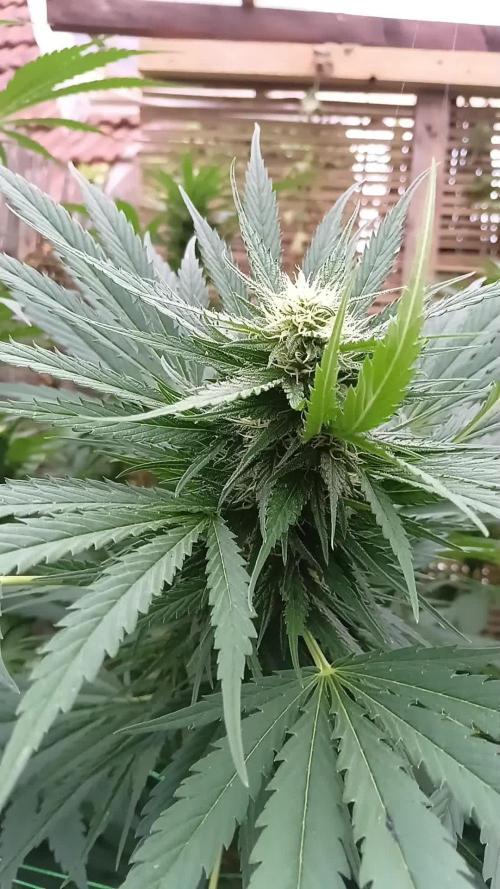
Daylight is now under 12Hours, and iam expecting them to finish soon-
iam hoping for warmer and dryer weather.
we had 6 days of continous, heavy Rain and wind.
For now all Plants are safe, because they are secured by 2 SCROG- nets, and a wonderful Roof.
we will see
Strain Information: Black Russian Early Version
enetics & Background
Black Russian Early Version results from crossing two legendary indicas with potent medicinal effects: White Russian and a splendid Black Domina mother. This is a selection of the famous "domina" phenotype - a real jewel well-known among Spain's best growers.
Growing Characteristics
Cultivation: Very easy to grow
Growth pattern: Moderate stretch during early flowering phase
Structure: Compact yet well-branched - one of the great indica yielders
Flower production: Large amounts of very dense buds
Unique trait: Very few leaves grow between buds
Aroma & Flavor Profile
Resin: Abundant, fruity-smelling with citrusy and earthy notes (likely from Afghan ancestry)
Taste: Denser than the aroma, very sweet and citrusy
Description: Like a fruit salad with lemon juice
Effects & Medical Properties
Type: Markedly indica effects
Duration: Long-lasting and relaxing
Onset: Very rapid - immediately noticeable when inhaled (smoked or vaporized)
Medical use: Highly recommended for medicinal usage
Tolerance: Low tolerance development - remains potent even with extended exclusive use
Why This Strain?
Perfect for outdoor competition due to its early finishing time, robust genetics, and reliable performance. The combination of ease of cultivation and exceptional medicinal properties makes this an ideal candidate for a successful outdoor grow.
Genotype 20% Sativa - 80% Indica
THC 24%
Maturation(Interior) EARLY VERSION - 45 days
Maturation(Exterior) early september
Flavor Sweet fruit
Production 500 g/m2 Indoor | +900 g/pl Outdoor
Odor High
Effect Narcotic
Sex Feminized
Lineage Black Russian x Ruderalis
Cups
3º premio extracción BHO THC Valencia
1º indoor Cannarias Cannabis cup 2012 Copa Asociaciones
2º Categoria Professionale - Secret Cup - Napoli 2018
4º Categoria Exterior- Copa Cata @cogollosdeloeste - Argentina 2022 (@jhonny.jamrock)
2º Premio Categoria Exterior- Copa Cata Cultivadores Primavera - Argentina 2022 (@jhonny.jamrock

Likes
12
Share


@NoProbation4Weed
Follow
- Day 63 of Flower Light reduction to 50%
- Day 65 of Flower Last time Watering
- Day 67 of Flower Lights out for 3 days
- day 70 of Flower Harvest
Trichomes are about 10% amber and 80% cloudy with 10% clear
Temperatures for drying gonna be 19°C and RH around 55%.
She is looking beautiful and her Smell is so intensive you cannot unsmell it. Its Loud!
Has Some Sweet doughy, Stanky, Cheesy and Garlic notes to it.
I cant wait for the smoke.
Has Some Fruity (Plum or Tangie like), Soapy and Floral Notes to it.
I cant wait for the smoke.


Likes
4
Share


@JefyKennedy
Follow
trichome control for harvest. Bloom 77.day
I will harvest on the 80th day 🌿

Likes
23
Share


@Chi_K24
Follow
Into week 20, ladies are putting on some weight and the smells comming off the plants are hard to pinpoint, the best I can come up with right now is a skunkey spearmint herb vibes!
As you can see in the photos I setup a temp shelter for the plants, it's calling for rain for the next 2-3 days and I want to avoid bud rot at all costs.
As of today the plants will only be watered with pure water. I am stopping the molasses supplements.
Plants are starting to change colour, I hope they have a nice fade soon.
2 more weeks maybe?lol
See you on the next update
Likes
20
Share


@TiRobotProds
Follow
Dernière semaine dans le noir complet , irrigation ph6 🌲🌲🤤🤤
Forte odeur de diesel d'encens 🦍.

Likes
6
Share


@RicoGrow
Follow
Hello,
I hope you're all doing well.
I'll consider this week a complete failure.
When I repotted my plants, I added mulch, but it was only 3 cm thick.
As a result, my plants were miserable for four days because it was too thick.
The soil was cold and remained very damp due to watering during repotting.
It smothered the fallen leaves, some of which even turned yellow. It seemed like a magnesium and calcium deficiency and an unbalanced pH. I re-evaluated my approach and, most importantly, added a light layer of mulch.
They've recovered well. It just goes to show that a small mistake can teach you something new every day.
This week, I added:
2 g of Epsom salt:
This powerful mineral is pure magnesium sulfate, one of the main components of chlorophyll produced by plants.
It's a chelating agent: it allows the solubility of other substances (such as molasses, humic and fulvic acids, neem oil, and spirulina) and acts as a heavy metal sequestrant.
5 g of Micronized Wild Horsetail Spray: silica, defense
5 g Fish Hydrolysate: amino acids, proteins
ppm 600
pH 6.5
Wishing you all a successful cannabis grow!
****************************************************
Bonjour,
J'espère que vous allez tous bien.
Cette semaine, je la compterai comme nul.
En fait lors de mon rempotage, j'avais fait un paillis, mais il était de 3 cm.
Du coup mes pieds, on fait la gueule pendants 4 jours, car il était trop épais.
La terre était froide, rester très humide dut à un arrosage lors du rempotage.
Elle étouffait les feuilles tombées, elles ont même jauni pour certaines. Comme un manque de magnésium calcium et un PH non ajusté.
Remise en cause et surtout un paillage léger.
Elles sont bien reparties. Mais comme quoi une petite erreur et on apprend tous les jours.
Dans ma terre cette semaine, j'ai rajouté.
2 g de Sel d Epsom:
Ce puissant minéral est du pur sulfate de magnésium, l'un des principaux composants de la chlorophylle produite par le règne végétal.
C'est un chélateur : il permet la solubilité d'autres matières (comme la mélasse, les acides humiques et fulvique, l'huile de neem, la spiruline) et agit comme un séquestrant de métaux lourds.
5 g de PRÈLE SAUVAGE Micronisée Aspersion : silice, défense
5 g HYDROLYSAT DE POISSON : acides aminés, protéines
ppm 600
PH 6,5
Je vous souhaite à tous une bonne cannabiculture
👍👍👊😁😁😁
Likes
22
Share


@Aedaone
Follow
Seeds were left in water overnight to simulate an all night soaking rain. The next day they were direct sown .75" deep into moist soil. They were left outside and because of the 40° nights took 4 days to pop. The soil was premixed with 15ml of rock dust and top dressed with the above listed nutrient at the listed ml rate per gallon of soil. 35ml of coop poop and 21ml of blood meal were mixed together and top dressed in a ring around plants, when they popped.
Likes
3
Share


@Saltlife420
Follow
Week 4: Girls have responded well to nutes.
Defoliation started this week. White spots started showing, After research we believe this to be because of our hard water and getting water on the leaves.
We also started LST using fishing line, however this did not work so we removed it.

Likes
65
Share


@Dendegrow
Follow
Week 2 of the flowering phase flew by 🌱💨. Unfortunately, I may have overdone it with potassium or kept the water level too high – the classic signs of clawing leaves were evident. Thankfully, they seem to be recovering now and are back under control 💪🍃.
My IR night experiment is showing clear results 🌌: The plants exposed to infrared radiation at night stretched significantly more. This might be especially beneficial for this indica-dominant strain as it leads to better canopy distribution, improved airflow, and reduced risks of mold and disease. Plus, the light distribution is much more efficient now, which I’m excited to see pay off.
On the downside, my Orange Sherbert turned hermaphroditic 😔. It’s hard to pinpoint the cause – overfertilization seems unlikely since I’m using only organic nutrients. I suspect it might be linked to an E-field experiment I’ve been running. To confirm this theory, I’ll conduct a new grow with a similar strain next year to see if the electric field negatively impacts cannabis development.
Stay tuned for updates! Drop a like and follow along for more grow insights 🌿✨. See you next week!
Woche 2 der Blütephase ist wie im Flug vergangen 🌱💨. Leider habe ich wohl etwas zu viel Kalium gegeben oder den Wasserstand zu hoch gehalten – die typischen Anzeichen von Adlerkrallen waren sichtbar. Zum Glück scheinen sich diese jetzt zurückzubilden und sind wieder unter Kontrolle 💪🍃.
Mein IR-Nachtexperiment zeigt bereits deutliche Ergebnisse 🌌: Die Pflanzen, die nachts mit Infrarotstrahlung bestrahlt wurden, haben deutlich stärker gestretcht. Das ist besonders bei dieser indica-dominanten Sorte wahrscheinlich von Vorteil, da es zu einer besseren Verteilung des Blätterdachs führt. Dadurch verbessert sich die Luftzirkulation, das Risiko von Schimmel und Krankheiten wird minimiert, und die Lichtverteilung wird effizienter. Ich bin gespannt, wie sich das weiter auswirkt!
Leider hat meine Orange Sherbert gezwittert 😔. Woran das genau liegt, kann ich schwer sagen. Eine Überdüngung halte ich für unwahrscheinlich, da ich nur biologischen Dünger verwendet habe. Ich vermute, dass mein E-Feld-Experiment eine Rolle spielt. Um das zu bestätigen, werde ich nächstes Jahr einen neuen Durchlauf mit einer ähnlichen Sorte machen und prüfen, ob das elektrische Feld tatsächlich eine ungünstige Rückentwicklung der Pflanze verursacht.
Bleibt dran, lasst ein Like da und folgt mir für weitere Updates 🌿✨. Bis nächste Woche!

Likes
57
Share


@ATLien415
Follow
🙏 Big thanks to Plagron and Zamnesia for putting on the Eternity Grow Cup 2025. This kind of platform means a lot to the community. The chance to push our grows, test out new techniques, and connect with other cultivators from all over has been inspiring. Appreciate the love and effort that went into making this event happen! Hope everyone enjoyed looking over my shoulder on this grow and best of luck to all participants!
REVIEW - Runtz (fem., photo.) from Zamnesia: ⬛⬛⬛⬛⬛⬛⬛⬛⬜⬜
The seeds from Zamnesia germinated rapidly, rooted strongly, went wild in veg, and produced an ample amount of high-quality medicinal flower. The diary speaks for itself on that front so this space will be more of a phenotype review. The plants were labelled A, B, and C from left to right respectively in photos. A and B were the 'clasicaly-appearing' sativa-esque leaves while C was the more 'indica-appearing' phenotype. Although A and B appear the same qualitatively, they did produce substantially different amounts of flower (despite their DLI being near max out for the entire tent footprint without supplementing CO2, so I do not think just being in the middle attributed to this). Past their different yields, A and B also have vastly different profiles. A is a classic gelato/ice cream cooler/Z terps, and my personal favorite of the plants (wish I had taken a clone of this one instead). B is the most on point for what I think of with Runtz, classic Z terps but with a slight tropical/rotten/sweetness to it. C had the misfortune of being ready to chop a little earlier than the other girls so her profile is mostly just spicey kush now. I did observe intersex flower sites but given the entire context of the diary and how the plants performed, I have to assume it was user error. No pollination observed in any of the flowers, as zero additional intersex sites occurred. The distinction between A, B and C is what I would expect from a typical F1 cannabis seed. I do not enjoy growing from seed much but these girls were manageable. Add to that the relative stability of the genetics for a Runtz recreation, and well, these are good quality beans for a great price. Not only is Zamnesia responsive and available, their confidence speaks volumes. How many vendors would have an in-house Runtz, knowing how much of a genetic-gravity-well it is in, and be confident enough to let ~200 randos grow it and show it?
REVIEW - Green Sensation from Plagron: ⬛⬛⬛⬛⬛⬛⬛⬛⬜⬜
I enjoyed using the green sensation, the NPK values on it make it versatile in application and a power-house in flower. I can't say I noticed anything better or dramatically improved, although comparing to Heavy 16 and asking for a marked improvement is big ask in my opinion. What I was able to do was seamlessly integrate the Green Sensation into my current routine. The additive stayed homogenous, was easily introduced into solutions with no adverse impact to the water contents or pH. Most importantly, the plants enjoyed the additive and it did accomplish the main goal of being able to wane off your primary line. In this respect, by using Green Sensation I was able to save resources by lowering my Heavy 16 inputs across the board approximately 50% and supplementing with Plagron's Green Sensation.


