


Likes
Comments
Share


@Naujas
Follow
84 days!!!! I came back after a 12-day vacation, and immediately rushed to cross it:) it's a pity that I didn't see her last 12 days, I only got a few photos while I was away :) but that's the point:) The girl coped with nature's challenges really well, there were cold, rainy, windy days that she endured, but there were also very hot days +35° C during which she warmed herself on the northern balcony where the sun shines for a maximum of 5 hours under ideal conditions:) but the result makes me very satisfied and happy, a cool strain :) good luck to everyone, the update will be after the harvest dries out:).


Likes
30
Share


@BudXs
Follow
We are an update away from the results. Both control plants chopped by way of spin trimmer. Non defo has the biggest cola, defo plant has the most mains and seems a bit heavier when wet. Results in a week or so
Sbg.com

Likes
16
Share


@Chaos85
Follow
everything coming along nice density being created benefits from the added cal mag can be seen even in the old damaged leaves turning out to be a great grow


Likes
Comments
Share


@Mrd1ez
Follow
Lastimosamente gracias a las bajas temperaturas y a la gran humedad constante (no puedo hacer mucho al respecto) la aparición de hongos en las hojas es inevitable. Mantengo a raya podando mas hojas infectadas y regando lo menos posible + secando el piso de la carpa en cada riego. Hoy 18/9 estamos en 1100 de EC a 50 días de empezar la flora.
Likes
7
Share


@nedreynolds
Follow
I added a C02 bag... hmm... probably not enough. Maybe time to look into a small tank system.
I will likely flip to flower soon. All the plants get to play!


Likes
13
Share


@Droot
Follow
as anticipated, the two inferior seeds didnt make it, and upon my first watering i forgot to check the PH of my of my water 🤦♂️🏽 i think the blue dream was affected slightly, ( you can see slight marks in the picture, this was worse a when it first sprouted) but both seem to be recovering very well. the zkittles does not appear to be affected
Likes
42
Share


@Fatnastyz
Follow
Day 22 - 8/5
- I'm liking Plagron, I'm just going to stop checking ppms in or out from now on, just 5.8 ph for now.
- 5.5" tall today!
- So easy, just making a gallon every other day with the grow, some silica (if i want...no pressure here), and some cal mag...not in that order of course LOL. Loving this easy mix!
Day 23 - 8/6
- No feed today, still on every 2 days
- Lana got another tip of a leaf! OOPS AGAIN!
- I went ahead and cut off the first 2 fan leaves and nodes.
Day 24 - 8/7
- Gave her Gal of easy mixing today
- 6" tall!!!
Day 25 - 8/8
- 6.5"
- No changes and No water today
Day 26 - 8/9
- Noticed some cal mag deficiency, will adjust
- Increased her cal mag to 3.5ml per gal (I had her on only 2ml/gal)
- Lana has struck again! Bit off half of another leaf. Poor plant!
Day 27 - 8/10
- 7" tall
- No water
Day 28 - 8/11
- Still 7" tall
- 5.8ph still
- She's starting to look a bit hungry too, will start to increase feed to full strength of the plagron next watering or two.
**She's moving right along...no thanks to pretty girl Lana LOL. She loves to just sun bathe in the tent. She gives me a look and I can't say no to that little face!!! Who could?!
I'm thinking about flipping her soon. There's this little voice in my head that keeps saying over and over "you should flip soon, you should flip soon" (cough, cough...spouse). We shall see though!

Likes
6
Share


@Barcelona_Farmers710
Follow
Se nos fue un poco de altura pero intentaremos arreglar el error farmers... al final quedo simplemente en podas apicales y de momento ramas muy finas. Iremos comentando el proceso Farmers!🍁

Likes
Comments
Share
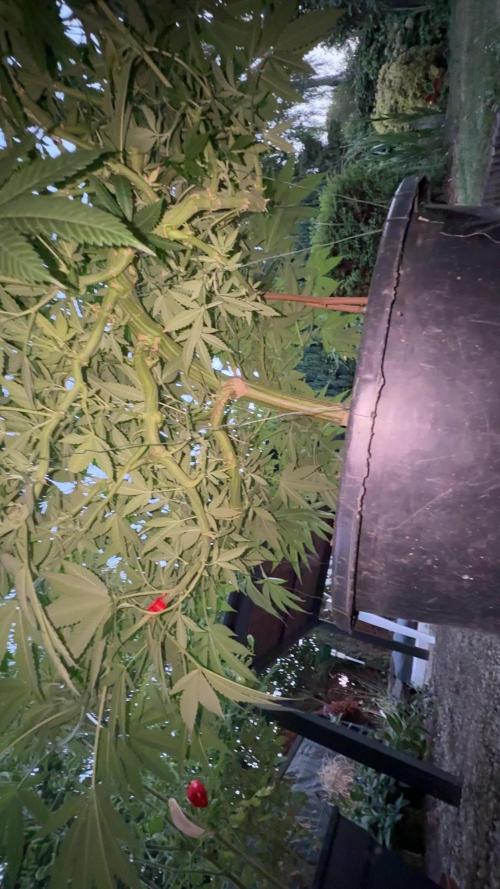


Likes
56
Share


@Ultraviolet
Follow
What's in the soil? What's not in the soil would be an easier question to answer. 16-18 DLI @ the minute. +++ as she grows.
Probably not recommended, but to get to where it needs to be, I need to start now.
Vegetative @1400ppm 0.8–1.2 kPa 80–86°F (26.7–30°C) 65–75%, LST Day 10, Fim'd Day 11
CEC (Cation Exchange Capacity):
This is a measure of a soil's ability to hold and exchange positively charged nutrients, like calcium, magnesium, and potassium. Soils with high CEC (more clay and organic matter) have more negative charges that attract and hold these essential nutrients, preventing them from leaching away.
Biochar is highly efficient at increasing cation exchange capacity (CEC) compared to many other amendments. Biochar's high CEC potential stems from its negatively charged functional groups, and studies show it can increase CEC by over 90%. Amendments like compost also increase CEC but are often more prone to rapid biodegradation, which can make biochar's effect more long-lasting. biochar acts as a long-lasting Cation Exchange Capacity (CEC) enhancer because its porous, carbon-rich structure provides sites for nutrients to bind to, effectively improving nutrient retention in soil without relying on the short-term benefits of fresh organic matter like compost or manure. Biochar's stability means these benefits last much longer than those from traditional organic amendments, making it a sustainable way to improve soil fertility, water retention, and structure over time. Needs to be charged first, similar to Coco, or it will immobilize cations, but at a much higher ratio.
a high cation exchange capacity (CEC) results in a high buffer protection, meaning the soil can better resist changes in pH and nutrient availability. This is because a high CEC soil has more negatively charged sites to hold onto essential positively charged nutrients, like calcium and magnesium, and to buffer against acid ions, such as hydrogen.
EC (Electrical Conductivity):
This measures the amount of soluble salts in the soil. High EC levels indicate a high concentration of dissolved salts and can be a sign of potential salinity issues that can harm plants.
The stored cations associated with a medium's cation exchange capacity (CEC) do not directly contribute to a real-time electrical conductivity (EC) reading. A real-time EC measurement reflects only the concentration of free, dissolved salt ions in the water solution within the medium.
98% of a plants nutrients comes directly from the water solution.
2% come directly from soil particles.
CEC is a mediums storage capacity for cations. These stored cations do not contribute to a mediums EC directly.
Electrical Conductivity (EC) does not measure salt ions adsorbed (stored) onto a Cation Exchange Capacity (CEC) site, as EC measures the conductivity of ions in solution within a soil or water sample, not those held on soil particles.
A medium releases stored cations to water by ion exchange, where a new, more desirable ion from the water solution temporarily displaces the stored cation from the medium's surface, a process also seen in plants absorbing nutrients via mass flow. For example, in water softeners, sodium ions are released from resin beads to bond with the medium's surface, displacing calcium and magnesium ions which then enter the water. This same principle applies when plants take up nutrients from the soil solution: the cations are released from the soil particles into the water in response to a concentration equilibrium, and then moved to the root surface via mass flow.
An example of ion exchange within the context of Cation Exchange Capacity (CEC) is a soil particle with a negative charge attracting and holding positively charged nutrient ions, like potassium (K+) or calcium (Ca2+), and then exchanging them for other positive ions present in the soil solution. For instance, a negatively charged clay particle in soil can hold a K+ ion and later release it to a plant's roots when a different cation, such as calcium (Ca2+), is abundant and replaces the potassium. This process of holding and swapping positively charged ions is fundamental to soil fertility, as it provides plants with essential nutrients.
Negative charges on soil particles: Soil particles, particularly clay and organic matter, have negatively charged surfaces due to their chemical structure.
Attraction of cations: These negative charges attract and hold positively charged ions, or cations, such as:
Potassium (K+)
Calcium (Ca2+)
Magnesium (Mg2+)
Sodium (Na+)
Ammonium (NH4+)
Plant roots excrete hydrogen ions (H+) through the action of proton pumps embedded in the root cell membranes, which use ATP (energy) to actively transport H+ ions from inside the root cell into the surrounding soil. This process lowers the pH of the soil, which helps to make certain mineral nutrients, such as iron, more available for uptake by the plant.
Mechanism of H+ Excretion
Proton Pumps: Root cells contain specialized proteins called proton pumps (H+-ATPases) in their cell membranes.
Active Transport: These proton pumps use energy from ATP to actively move H+ ions from the cytoplasm of the root cell into the soil, against their concentration gradient.
Role in pH Regulation: This active excretion of H+ is a major way plants regulate their internal cytoplasmic pH.
Nutrient Availability: The resulting decrease in soil pH makes certain essential mineral nutrients, like iron, more soluble and available for the root cells to absorb.
Ion Exchange: The H+ ions also displace positively charged mineral cations from the soil particles, making them available for uptake.
Iron Uptake: In response to iron deficiency stress, plants enhance H+ excretion and reductant release to lower the pH and convert Fe3+ to the more available form Fe2+. The altered pH can influence the activity and composition of beneficial microbes in the soil. The H+ gradient created by the proton pumps can also be used for other vital cell functions, such as ATP synthesis and the transport of other solutes. The hydrogen ions (H+) excreted during photosynthesis come from the splitting of water molecules. This splitting, called photolysis, occurs in Photosystem II to replace the electrons used in the light-dependent reactions. The released hydrogen ions are then pumped into the thylakoid lumen, creating a proton gradient that drives ATP synthesis.
Plants release hydrogen ions (H+) from their roots into the soil, a process that occurs in conjunction with nutrient uptake and photosynthesis. These H+ ions compete with mineral cations for the negatively charged sites on soil particles, a phenomenon known as cation exchange. By displacing beneficial mineral cations, the excreted H+ ions make these nutrients available for the plant to absorb, which can also lower the soil pH and indirectly affect its Cation Exchange Capacity (CEC) by altering the pool of exchangeable cations in the soil solution.
Plants use proton (H+) exudation, driven by the H+-ATPase enzyme, to release H+ ions into the soil, creating a more acidic rhizosphere, which enhances nutrient availability and influences nutrient cycling processes. This acidification mobilizes insoluble nutrients like iron (Fe) by breaking them down, while also facilitating the activity of beneficial microbes involved in the nutrient cycle. Therefore, H+ exudation is a critical plant strategy for nutrient acquisition and management, allowing plants to improve their access to essential elements from the soil.
A lack of water splitting during photosynthesis can affect iron uptake because the resulting energy imbalance disrupts the plant's ability to produce ATP and NADPH, which are crucial for overall photosynthetic energy conversion and can trigger a deficiency in iron homeostasis pathways. While photosynthesis uses hydrogen ions produced from water splitting for the Calvin cycle, not to create a hydrogen gas deficiency, the overall process is sensitive to nutrient availability, and iron is essential for chloroplast function.
In photosynthesis, water is split to provide electrons to replace those lost in Photosystem II, which is triggered by light absorption. These electrons then travel along a transport chain to generate ATP (energy currency) and NADPH (reducing power). Carbon Fixation: The generated ATP and NADPH are then used to convert carbon dioxide into carbohydrates in the Calvin cycle. Impaired water splitting (via water in or out) breaks the chain reaction of photosynthesis. This leads to an imbalance in ATP and NADPH levels, which disrupts the Calvin cycle and overall energy production in the plant. Plants require a sufficient supply of essential mineral elements like iron for photosynthesis. Iron is vital for chlorophyll formation and plays a crucial role in electron transport within the chloroplasts. The complex relationship between nutrient status and photosynthesis is evident when iron deficiency can be reverted by depleting other micronutrients like manganese. This highlights how nutrient homeostasis influences photosynthetic function. A lack of adequate energy and reducing power from photosynthesis, which is directly linked to water splitting, can trigger complex adaptive responses in the plant's iron uptake and distribution systems.
Plants possess receptors called transceptors that can directly detect specific nutrient concentrations in the soil or within the plant's tissues. These receptors trigger signaling pathways, sometimes involving calcium influx or changes in protein complex activity, that then influence nutrient uptake by the roots. Plants use this information to make long-term adjustments, such as Increasing root biomass to explore more soil for nutrients. Modifying metabolic pathways to make better use of available resources. Adjusting the rate of nutrient transport into the roots. That's why I keep a high EC. Abundance resonates Abundance.
Likes
18
Share


@AlienScrOG
Follow
Now i have found the wrong week 19... In this so much H2O2 and EC 2.3 ... Fail....now pump
Likes
9
Share


@Budhunter
Follow
Stardawg is beatiful.. I’ve grown it in the past and the plant was way smaller.. I think it will be the most yielding plant of this run and looks like may be the best taste too..
I finally managed to move however humidity is pretty high in my new place.. I am trying to put it down, hopefully it will work..

Likes
4
Share


@Uk420time
Follow
Coming along nicely .. introduced pk slowly and seems to be doing a really nice kob along with the boost .. how long left you recon guys ?? 3 or 4 weeks ? ... Happy growing grhomies 🤟❤️
Likes
54
Share


@MadeInGermany
Follow
Flowering day 21
since time change
to 12 / 12 h
Hey guys :-)
The lady makes a very nice look 😍.
The flowers are starting to grow fantastically 👍.
I'm already looking forward to the coming weeks.
This week 1 g GHSC Bloom Pro l substrate was added
It was poured twice with 1 l each time.
Everything was cleaned up.
Stay healthy 💚🙏🏻
👇🏼👇🏼👇🏼👇🏼👇🏼👇🏼👇🏼👇🏼👇🏼👇🏼👇🏼👇🏼
‘Powered by GreenHouse Feeding’
Copy the link for 10% off all Nutrients 👇🏼
https://shop.greenhousefeeding.com/affiliate/MadeInGermany_PassionGrower
👇🏼👇🏼👇🏼👇🏼👇🏼👇🏼👇🏼👇🏼👇🏼👇🏼👇🏼👇🏼
You can buy this strain at :
https://www.amsterdamgenetics.com/product/choco-cheesecake/
👇🏼👇🏼👇🏼
Use the coupon code: madeingermany
for 10% on all Amsterdam Genetics seeds
Water 💧 💧💧
Osmosis water mixed with Cal/Mag (24 hours stale that the chlorine evaporates) to 290 ppm and Ph with Ph- to 5.8 - 6.4
MadeInGermany



Likes
36
Share


@Dr_Boom
Follow
The humidity is still a concern as these girls continue to stack. I increased water today to about a gallon every three days, which I'm sure will drive the humidity numbers up. I really need to invest in an auto-watering system, lol. So far, I'm happy with these testers. They have been a non-demanding grow with zero problems, so far.
Likes
6
Share


@StonedandSteady
Follow
#AutoWhiteRussian and #AutoMontreal *Fems* breed by Team #DivineSeeds #DivineSeedsSquad #DivineSeedsBreedingCompany Looking Magnificent and Amazingly Great in thier 3rd week of Veg Growing under the #Growatt600w and in my #TopoLite 24×24×48 Grow Tent! I'm also using #TNBNaturals #TheEnhancer Co2 Despersal Canister and using thier Ph⬆️⬇️ for my Decolinated Tap Water!
#AutoWhiteRussian breed by Outstandingly Awesome Team #DivineSeeds #DivineSeedsSquad #DivineSeedsBreedingCompany
Yo!!! This Lil Beauty popped open in under between 16-18 hours of Germination using this Wet Papertowel Method, this New Heat Mat, Baked potato ToGo Container and Regular Tap Water Helped Tremendously! Heck Yeah Growmies and Growmets!!! Let's Grow!!!
DivineSeeds:
#AutoWhiteRussian
Origin:Afghanistan
Type:Indica/ Sativa/ Ruderalis
Flowering:65 days
THC:24 %
Harvest:400-600 g/m2
Height:100-150 cm
#AutoMontreal breed by Top of The Line Team #DivineSeeds #DivineSeedsSquad #DivineSeedsBreedingCompany
Yo!!! This Lil Beautiful Bean Popped under between 20 hours of Germination using this Wet Papertowel Method, this New Heat Mat, Baked potato ToGo Container and Regular Tap Water Helped Tremendously! Heck Yeah Growmies and Growmets!!! Let's Grow!!!
DivineSeeds:
#AutoMontreal
Origin:Canada
Type:50% Indica/ 40% Sativa/ 10% Ruderalis
Flowering:65 Days
THC:23%
Harvest:550-750 g/m2
Height:120-160 cm
https://divineseeds.net/
https://instagram.com/divine.seeds?igshid=osxe2v7en33v
I love and Appreciate Everyone!!! Thanks Again Team! Cheers Famz!!! Much Props and Much Topz!💯


Likes
3
Share


@Young_agronomist
Follow
07.09.2023-63 день и четвертый день без удобрений !
Только вода и отрегулированный пш
За день до харвеста срезал веерные листья 🍁
Завтра день икс