


Likes
Comments
Share


@PotusArg
Follow
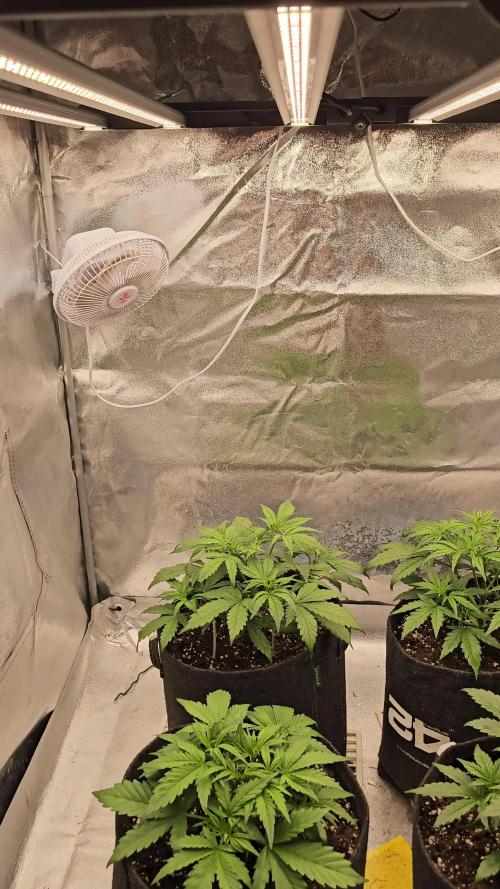
Week 3: The plants have adapted very well to the new pots and didn’t show any signs of stunted growth. I decided to do some main-lining so they grow evenly and maintain their height. I won’t lie, I was a bit nervous, but everything seems to be going smoothly. I’ve also added a new oscillating fan to improve air circulation.
Semana 3: Las plantas se adaptaron muy bien a las nuevas macetas y no mostraron signos de estancamiento en el crecimiento. Decidí hacerles main-lining para que crezcan de forma pareja y mantengan su altura. No voy a mentir, estaba nervioso, pero parece que todo va viento en popa. He incorporado un nuevo ventilador oscilante para mejorar la circulación del aire.


Likes
24
Share


@DarkVarein
Follow
This is the last week for white widow's and I'm really happy about results, the plant are very quick, and the smell is insane. Can't wait to smoke that 😀


Likes
40
Share


@GardenOfHerbs
Follow
- she was harvested this morning on day 75, all pics are right before/during/after harvest
- flushed for 12day, there was a slight fade but she was still pretty green, didn't want to wait any longer though
- now drying in my cardboard box, harvest report will be up in 10 to 14 days as usual when everything is nice and dry
- added 2 video's of her frosty ass haha
Likes
28
Share


@Professor_Chaos
Follow
Beginning of week..
I raised the lights a little.. They are at 50% power at 18" (roughly) from the plants. The ladies are getting from 420 to 500 PPFD. Went ahead and fed them some extra FloraMicro this week.. I'm guessing they are just very hungry girls.. And I'm thinking the pH in the rootzone issue is not clearing up at all.. BUT.. It seems like no matter what pH I water them with.. The runoff ALWAYS comes out at 5.8 or 5.9 with the Mandarin Cookies and 5.8 or 5.7 with the ETHOS Cookies.. So if you want to reuse your coco coir.. Make sure to remove ALL the roots. The girls dont look too bad at all.. And that's why I'm guessing they just needed more nutes in the mix.. We shall see how this week goes!
Mid week..
They are looking alot better! Mandarin Cookies is exploding woth growth.. ETHOS Cookies is growing slow but she is growing for sure.. I think I may need to remove a node or 2 on the ETHOS Cookies.. I could just leave it.. But the very top 2 are covering alot of tops.. I could make some clones from it.. Hmm.. All-in-all.. I'm happy with how these girls are growing for now tho.. This rootzone issue isnt going away.. But I think I found a way to make it work out.. I've been watering a little differently.. Here is a bit of an example:
Day 1: Feed at 6.5
Day 3: Water at 6.4
Day 5: Feed at 6.3
Day 7: Water at 6.2
Day 9: Feed at 6.5
Day 11: Water at 6.4
Day 13: Feed at 6.3
Day 15: Water at 6.2
Etc...
The runoff is staying above 5.5 each time.. But as I lower the pH, the runoff pH lowers as well (obviously).. So I think watering this way has helped keep these gorgeous ladies happy.. And theyare also very hungry.. I may have to start watering one plant every other day.. Water plant 1 tomo.. Water plant 2 the next day.. Then plant 1 the next day and then plant 2 the next day etc... 1 reason I want to start doing it that way is because I think the ETHOS Cookies isn't needing as much nutes as the Mandarin Cookies.. But they are looking great. Very happy and so are they! The heat has been insane lately.. So at the hottest part of the day I try to just turn the light down to 25% for 4 hours or so.. I hate having to do that.. But it's all I can do for now.. Or maybe change the light/dark hours.. Blah.. Whatever, they are happy!
End of week..
I supercropped 2 branches.. They pretty much healed up and are already back to normal.. Like it didnt bring them down any lower at all lol.. It straightened back up and its as if nothing happened.. Just a big ass (MOOSE) knuckle lol.. But I stopped using the Kushie Kush and was just using the normal Gen Hydro FloraBloom in the mix. Will be upping the FloraGro next week! Wow.. Such hungry ladies! It's been so long since I've grown a bigger photo period.. I forgot how much they can take!.. On to the next!...

Likes
38
Share


@MrLahey
Follow
Originally the right plant was stunted and I was concerned that topping it would stress it too much. As such, the left plant was topped during early veg but the right plant was never topped and it shows. The main cola on the right plant gets more ppfd (around 1000) than the left plant so I’ve been bending it down once or twice a day so that maybe the left canopy can catch up.
Are there any other techniques I can do to my plant (2nd week of flower) to allow the canopies for each plant to be equal?
Last week I did a very light dose of bloom and they responded very well. I will continue to supplement lightly until the sohum soil prepackaged nutrients run out. I would imagine it will be any week now that it’s depleted?
I am very happy with the grow so far since it’s my first ever real attempt. Other than the right plant getting shocked from the living soul or overwatering the grow has been going great! I can see baby buds and pistils forming! 😀
So excited for the day I can open the tent and get bombarded by the smell of the buds.

Likes
17
Share


@FrankieBones
Follow
Hi 420 Family.
Start of week 6, and we are well into the blooming stage. So far so good, these ladies have gained a lot of growth over the past 2 weeks, they have stretched a lot and have now shifted their energy into making buds. The one WW is a little ahead of the rest in maturity it seems, the other two WW's not far behind. PL's I think will flower for an extra week or two looking at the bud sites and the pistils. At this stage they are getting about 1L of bloom feed every 1.5 days but it does seem to pick up and they are getting more thirsty every watering. I guess they will eventually settle on about 1L per day.
D36 - 11 Aug - All good and no complaints, other than the stretchy PL's. Let's hope they just make for awesome bud sites.
D38 - 13 Aug - Steady as it goes... Bud sites are forming nicely and I have not again spotted any sacks on the WW that initial had about 6/8 sacks on the oldest branches, nodes closest to the main stem. Very happy that I didn't kill her; I am still keeping a close eye tho. The PL's have again stretched a little bit but not as much as last week, thank goodness. They were watered yesterday morning and will be letting them dry out properly before giving them another feeding.
D38 Heights:
WW1 - 46CM
WW2 - 45CM
WW3 - 62CM
PL1 - 65CM
PL2 - 72CM
PL3 - 76CM
Stay blessed and I wish you all a happy grow!


Likes
22
Share


Likes
11
Share

@Peca1973_Vv
Follow
It's not exactly how I expected it to be, explosive... but it's not bad either, we'll see, we're here, we're following, I hope that RF3 will have coverage for its story... I'll do my best 🍀
Likes
Comments
Share


@DaddyPrime2
Follow
6/28/24
she was about 16 inches before I tried some lst. she wasn't as bendy as before so it turned into supercropping which is fine. after transplant, she wasn't happy at all and I couldn't seem to figure out what was going on. I believe her soil is too compacted and I tried using perlite on top of the soil to top dress easier but it just held a ridiculous amount of water underneath. it became like 3 inches of just perlite and I think she was drowning. she's starting to perk up and be happy again.

Likes
19
Share


@bobtheblob
Follow
It was sometimes hard to understand her, and I feel like I failed a nutrition plan several times.

Likes
1
Share


@Herbangardener671
Follow
Trichromes cloudy with a touch of amber.
The smell is amazing similar to tropical fruits very sweet smell.

Likes
60
Share


@BOMbolenath
Follow
This week the weather is better. The buds are getting fat and she is developing well.
Terpes are amazing, sweet fruits and fresh mint.


Likes
11
Share

@GoodTimesOrganics
Follow
Hi liebe Community and Welcome Back! 💚
Woche 9 im Vergleichsgrow!
Bio Tabs NL. vs. Weedefix (Stuttgart/ Germany)
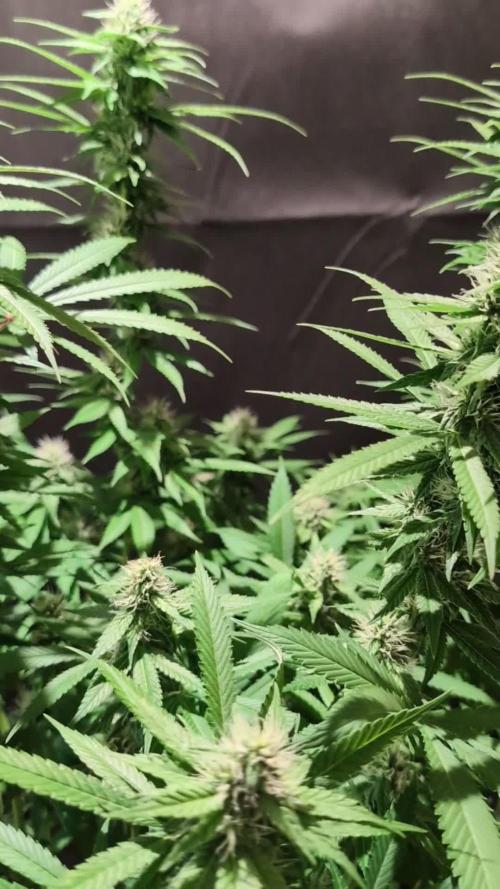
Hier im Weedefix Grow haben wir nun nach 73 Tagen des Einpflanzens eine Höhe von 118cm erreicht.
Blütetag: 28 (BW4)
Nach der vierten Blütewoche, lässt sich eher eineunterschiedliche Performance der beiden Düngersysteme beobachten.
Die Pflanzenmaße wirkt aktuell bei der Bio Tabs Pflanze insgesamt etwas mehr.
Der Stretch bei dieser Pflanze verläuft sehr homogen und alle Triebe sind im Schnitt 118cm hoch. Hier geht der Stretch nicht so in die Höhe.
Die Blütenentwicklung bleibt bisher sehr ähnlich.
Es bleibt spannend!
Diese Woche, habe ich einmal mit Wasser und 5ml Wachstum (Ferment mit Melasse und Hefeextrakten) gegossen.
Zudem kamen nochmal 5g Trichoderma von Mack pro Liter Wasser hinzu.
Ansonsten nur Wasser.
Die Bedingungen im Growzelt sind aktuell wieder top!
—————
🌞 Temp: 26
🌚 Temp: 18°C bis 19°C
💨 RH: 62%
VPD: 0,74 kPa
💡ppfd: 630 mpm
—————

Likes
141
Share


@1Right_Angle
Follow
July 18th
- PurpsBerry will not be Schwazzed, but she will have a little defoliation carried-out here to mark the end of 3rd week flower.
- CloudWalker and rOOF95 get visited today; meal planning n Mtce
20th, did some preventative mtce on all these plants today / yesterday. Bamboo tripods, secured around a stable spot on the main stalk. It makes a knob of side-branches and bamboo, snugged into a collar. Really stabilizes the plant
- CloudWalker / rOOF95 still Vegging, getting them ready for this next 3 week transition into Flower; (aug 13 is when my community hits only 14hrs of daylight)
- PurpsBerry is way ahead of that lol. This seems like it would easily be the 3rd week. Possibly more. Taking the Ripening to the limit. I believe this Plant is going to be “Tested”; tba
21st
- big winds have split one of the CloudWalkers; of course, the one that was topped. With 2 plants outside this summer, that have been modified by each FIM and Topping, both of them has failed and Split. Each was and is being repaired; rope / duct tape. But thats the last limb loss for any outdoor plants right now… LST ROCKS
- the other CloudWalker is Robust, and still on the Menu
Aug 8 ** working backwards, this is Officially when we are calling it week 1 of Flower, for both Machupi’s Lady and PurpsBerry


Likes
4
Share


@Farmeryo901
Follow
Experiencing what seems to be my first nutrient lock out. Bought a soil ph tester from homdepo its reading 7.0 so that what bring me to that conclusion on top of the slower growing and the slight yellowing around the leaves. I was being cheap and using the liquid ph tester that comes with the ph up and down and im regretting now seeing my plants in not the best condition. Im ordering a better ph pen today i used the vivosun one the i currently have got the water to 5.8 checked the run off and its at 6.2 hopefully that helps. Saturday im going to top dress and water at 5.8 aging and im thinking that should put me back on track
Any advice i could definitely use some tips and pointers
Likes
10
Share


@MadeInGermany
Follow
Flowering day 49
since time change
to 12 / 12 h
Hey guys :-)
All ladies look very healthy and delicious :-)
We're slowly getting closer to the end.
Watering was done twice this week, each time with 1.2 l (sewing materials see table above)
At the next watering there is a very light rinse with Clean Fruits so that the last nutrients can be slowly used up.
The trichomes are now checked every day.
I'm looking for my microscope with an app so I can take pictures of it 👍.
I wish you a lot of fun with the update and stay healthy 💚🙏🏻
👇🏼👇🏼👇🏼👇🏼👇🏼👇🏼👇🏼👇🏼👇🏼👇🏼👇🏼👇🏼
You can buy this Nutrients at :
https://greenbuzzliquids.com/en/shop/
With the discount code: Made_in_Germany you get a discount of 15% on all products from an order value of 100 euros.
👇🏼👇🏼👇🏼👇🏼👇🏼👇🏼👇🏼👇🏼👇🏼👇🏼👇🏼👇🏼
You can buy this strain at :
https://www.exoticseed.eu/
Water 💧 💧💧
Osmosis water mixed with normal water (24 hours stale that the chlorine evaporates) to 0.2 EC. Add Cal / Mag to 0.4 Ec Ph with Organic Ph - to 5.8 - 6.5
MadeInGermany

Likes
21
Share


@ButtersStotch
Follow
2020-07-21 (Day 62)
Likely 1 more week! We’re in the home stretch! Bit of foxtailing, this thing just looks so damn cool, everyone that sees it thinks it looks amazing. Open my patio door and you get blasted with a mixture of aromas. Stay tuned and watch her finish up!
Likes
7
Share


@dreamer08
Follow
I've been putting this grow diary off for too long. I'm somewhat new to growing, so it would help to have some of you share your thoughts as we progress through the next few days/weeks.
I've got a few strains going in my grow space. A mix of a couple autos and photos. This diary is all about the Auto Blow Dream by Victory Seeds.
I'm using a 3 gallon fabric pot, fox farms trio and this plant has a 1000w (185w draw) BestVA FS LED dedicated to it. Soil is a simple mix of peat moss and perlite, with some fishmeal and bonemeal added.
