


Likes
Comments
Share

@DogDoctorOfficial
Follow
🌿 Week 3 – Transplant Week – Lava Cake (Zamnesia Seeds) 🍰
Grower: Dog Doctor
Pheno Selection: Lava Cake #1 & #2
Pots: 11L Amnesia Fabric Pots
Light: Future Off – Black Series 600
Environment: Dual air systems (TrolMaster + Spider Farmer)
Feeding: Hand-watering (for now)
Monitoring: TrolMaster ecosystem (in progress)
⸻
🌱 Transplant Time – Rooted, Ready, and Rising
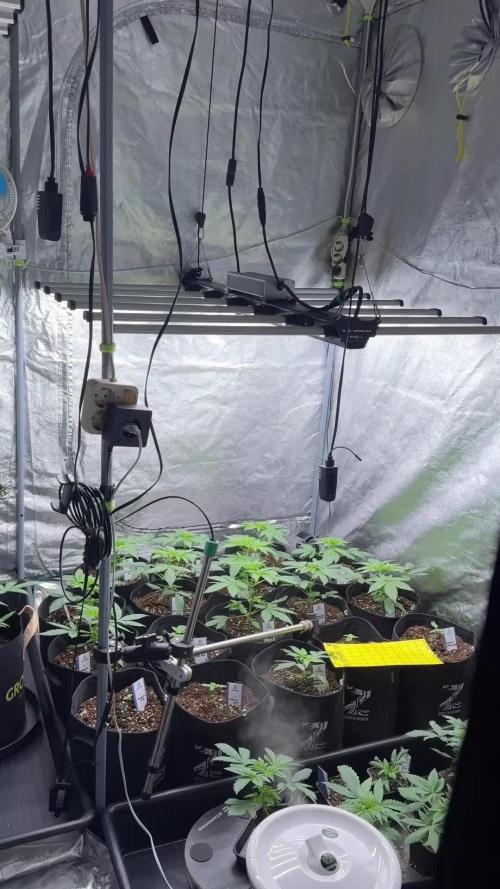
This week marked a major milestone: our two selected phenos, Lava Cake #1 and #2, were officially transplanted into 11-liter Amnesia fabric pots. The girls are thriving, roots are pristine white and full of life, and the energy in the tent is buzzing with potential.
We celebrated the moment properly—with photos in the studio, of course. They looked so beautiful, they deserved the spotlight. 📸 We’ll try this again next week, before they grow too big to carry!
⸻
Why Fabric Pots?
We chose Amnesia fabric pots for their root-focused benefits:
• Air-pruning the roots naturally, preventing circling and encouraging a healthy root ball
• Increased oxygen to the root zone, supporting microbial activity and faster nutrient uptake
• Better drainage, reducing the risk of overwatering
• Durability & sustainability—washable and reusable
Fabric pots turn the container into a living zone that breathes with the plant. And now, these queens have the space they need to express themselves fully.
⸻
🌿 Soil Mix & Nutrient Support
We prepared a rich, bio-balanced super soil transplant mix, boosted with Aptus Holland amendments:
🔄 Transplant Mix:
• Super soil base
• Aptus Mycor-Mix – inoculates roots with beneficial mycorrhizae
• Aptus Micro-Mix – promotes microbial diversity and root health
• Aptus Substrate Buffer Powder – stabilizes pH and nutrient flow
💧 Feed Mix (per liter):
• Aptus Regulator – 0.15 ml (stress support & nutrient flow)
• Aptus CalMag Boost – 0.25 ml (structure & balance)
• Aptus All-in-One Liquid – 1 ml (base nutrition)
• Aptus Start Booster – 2 ml (root & shoot stimulation)
💦 Water Stats:
• pH: 5.83
• EC: 1.01
• Water Temp: 18.5°C
We continue to bottom-water—placing the solution in trays and letting the girls draw it in themselves. This promotes downward root expansion and avoids oversaturation at the crown.
⸻
🌀 Airflow & Environmental Control
With multiple strains in one tent, proper airflow and environmental balance are essential.
• 2x 6-inch Extractors (one TrolMaster Aerofan, one Spider Farmer)
• 1x 6-inch Intake Fan
• All fans are filtered with carbon filters to purify air and manage odor, even early on. Prevention is key.
The Aerofan is controlled by the TrolMaster system, giving real-time response to temp and humidity. The Spider Farmer fan is managed by a GGS controller, running parallel automation.
• Room Temp: 27°C
• Humidity: 57.4%
• CO₂: 632 ppm
• Light: Full-spectrum from the Black Series 600—compact, clean, and consistent.
This environment isn’t just “good”—it’s being crafted as a living ecosystem. One that will evolve into semi-automation, allowing us to trust and fine-tune from the TrolMaster app.
⸻
🔍 What This Week Is (and Isn’t)
What it is:
• A foundational week: transplant, root expansion, environmental balance
• A chance to observe and support the transition without stress
• A moment to shift from “starter energy” to serious vegetative growth
What it isn’t:
• A week for heavy training—we’re letting them root down before any top work
• A time to overwater—bottom-feeding keeps everything stable
• A race—slow roots = strong fruits later on
⸻
💬 Final Words
Our Lava Cakes are happy, lush, and ready to grow into queens. With their roots now in rich, living soil, and the tent gradually evolving into a precision-controlled jungle, we’re laying the groundwork for a clean, healthy, and joyful flowering run ahead.
More studio photos soon. More lessons too. This isn’t just a grow, it’s a journey of discovery, shared with love.
Until next week—
Dog Doctor, with dirt on the hands and light in the heart 🌿✨
📲 Don’t forget to Subscribe and follow me on Instagram and YouTube @DogDoctorOfficial for exclusive content, real-time updates, and behind-the-scenes magic. We’ve got so much more coming, including transplanting and all the amazing techniques that go along with it. You won’t want to miss it.
• GrowDiaries Journal: https://growdiaries.com/grower/dogdoctorofficial
• Instagram: https://www.instagram.com/dogdoctorofficial/
• YouTube: https://www.youtube.com/@dogdoctorofficial
⸻
Explore the Gear that Powers My Grow
If you’re curious about the tech I’m using, check out these links:
• Genetics, gear, nutrients, and more – Zamnesia: https://www.zamnesia.com/
• Environmental control & automation – TrolMaster: https://www.trolmaster.eu/
• Advanced LED lighting – Future of Grow: https://www.futureofgrow.com/
• Root and growth nutrition – Aptus Holland: https://aptus-holland.com/
• Nutrient systems & boosters – Plagron: https://plagron.com/en/
• Soil & substrate excellence – PRO-MIX BX: https://www.pthorticulture.com/en-us/products/pro-mix-bx-mycorrhizae
• Curing and storage – Grove Bags: https://grovebags.com/
⸻
We’ve got much more coming as we move through the grow cycles. Trust me, you won’t want to miss the next steps, let’s push the boundaries of indoor horticulture together!
As always, this is shared for educational purposes, aiming to spread understanding and appreciation for this plant. Let’s celebrate it responsibly and continue to learn and grow together.
With true love comes happiness. Always believe in yourself, and always do things expecting nothing and with an open heart. Be a giver, and the universe will give back in ways you could never imagine.
💚 Growers love to all 💚


Likes
16
Share

@PPFDaddy
Follow
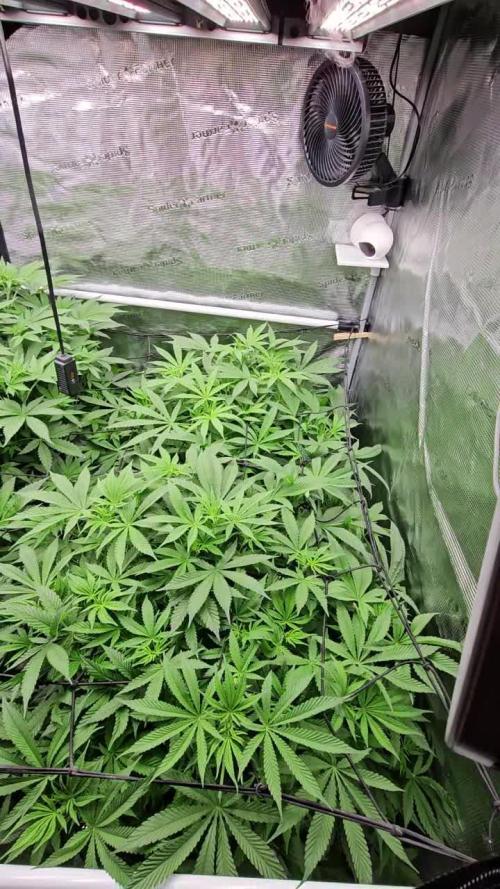
One week into flower and the Stickies are already making a statement. Volume nearly doubled since flip day, stretch in full swing, and the box is already running out of room. I thought they might take it easy this time. They had other plans.
Jungle mode is incoming and I'm here for it.
Most of the girls are showing exactly what you'd expect from a heavily indica-dominant strain: compact, structured and already stacking nicely. One of them is displaying a slightly more unusual phenotype, stretching noticeably more than the rest. An interesting outlier worth keeping an eye on as flowering progresses.
On the feeding side, I bumped the EC by 0.2 and kept Bud Ignitor in the stack. Flowering site density has visibly increased since I introduced it, and the results speak for themselves.
Environmental management is on point and the focus remains where it should be: maximizing quality and yield. That's the real game.
Stay tuned. The best is yet to come. 🙌 As always, critiques and advice are more than welcome. happy growing everyone!
Likes
20
Share


@Bertoxxulous
Follow
Hey folks, I'm finally back at it again. It took me a while for a couple of reasons:
1) I usually only grow in the winter.
2) I completely revamped my grow room after the issues I ran into with the last setup.
3) It took me a while to brainstorm exactly what I wanted to do.
I bought these seeds from D.C. Seeds and was very pleased with the experience. I'm very happy to give business to a fellow American and Veteran. I've only ever purchased seeds from the UK in the past and that experience has been "dodgy" to say the least (not the vendors fault, but the transit).
I've only ever grown photo's, but chose to go with all auto's moving forward. After calculating the intensity of my current light, with it being on a 20/4 rotation I'm very close to hitting 40 moles per day, at least directly under the light. It doesn't quite cover my 2' x 5' trellis. I'll eventually upgrade my light, but auto's should get me the best bang for my buck with this light. Also, I spent a pretty penny building this new grow room. The other obvious reason for growing auto's is their shorter seed to harvest time. I've got a small grow area, and never plan on expanding. Theoretically, auto's will allow me to produce the most out of my room.
A few things about my grow room:
1) I lined the whole closet with 1/2" plywood and put that piece of ply the air intake/outtake/power as the divider between each side of the closet
2) The grow room itself has ply on all wall surfaces so I could mount stuff to it and paint it
3) The other side of the closet is my storage/prep/power distribution/etc. area. Maybe I'll take a pic one of these days
4) My last grow my carbon filter/fan was venting into the other side of the closet. This created a headache for a number of reasons. I tapped a 4" hole through the floor and am now venting into my crawl space below the house.
5) I moved to bubbleponics to speed up my grows even more. I will be removing the drip system once the roots hit the water in the res.
6) The larger res. will hopefully make my life much easier. Late in the last grow I could only fit 3 gallons of water in the bucket and that sucker was pounding down at least a gallon a day. That required too much micro-managing for me (both ph and refills).
7) I no longer have a fixed trellis with chicken wire. The trellis is held in place by dowels that I can pull out by hand. The short sides of the trellis have hinges on the bottom, so I can fold it and pull it out easy-mode. Lastly, I'll be using string for the trellis so come harvest all I have to do is cut the string instead of dealing with trying not to destroy buds pulling them through chicken wire (it takes forever).
8) I built a light diffuser on the other side of the air intake
9) My res. is on a motorcycle lift I'm using a drill to move up and down
I have now started using Jack's as my primary nutes. They tell you the full break-down of each macro and micro nute, giving me more control and understanding. I think House & Garden is a good product, but when stuff goes bad it's more difficult to troubleshoot when you have no idea what each piece of their full lineup contains. I'm assuming it's kind of a proprietary type thing, which I understand, but knowledge is power. I am still using their Drip Clean (while the bubbler is going) and Roots Excelurator Silver, both excellent products. I'm still using Hydroguard, and will FOREVER. I'm a true believer now of why Hydroguard is necessary for any hydro application, IMO. I also purchased water soluble fulvic acid, but have decided not to use it for this grow....or at least while the bubbler is going (I'll elaborate below).
Ok...now that all that is out of the way....
I really wanted to use my well water instead of R/O to make my life easier. Soooo....I filled up my res., and put two seeds in the system immediately. Nothing happened after 1 1/2 weeks. I finally opened up the cubes and saw that the beans had popped, but it looked like maybe I drowned them, or they ddin't grow straight up or something. For round two, I didn't change the water out, and decided to soak the beans for 24 hours in R/O water first. I had the exact same problem. I'm still not really sure what happend, but I suspect it was the well water. My PPMs were sitting at ~500 with the well water, which was probably too spicy for the beans just starting. Also, my well water is questionable (even though it's at 165ppm), but I won't elaborate further....it's a long ass story and I've spent an absurd amount of money on it. Lastly, I did put the Fulvic acid in, and it was very messy. I really want to avoid having to clean my res. Once the roots get big it will be a real pain in the ass to clean. I'm leaning towards not using the Fulvic acid this grow just to see how things go.
I had 10 beans total of the Sour Apple and have already ruined 4. So here's hoping third times the charm.
So, I went back to my tried and true method:
0) R/O water for everything. Ditching the well water idea.
1) Soak beans in R/O water for 24 hours
2) Paper towel method between plates on a heating mat
3) Once the roots pop, I place them pointed down in the hole of the rockwool cube
4) Hand water once a day by dipping the cube in the pre-mix of 1/4 strength Jack's and everything else I've listed above. This put my PPMs at 300...a way more reasonable value for starts.
It's been exactly 7 days since I followed the above. It's probably hard to see but the cotyledons came up, and multiple roots have come out the bottom of the cubes....way faster than I've ever seen since I started growing. That means even though I'm doing my old process this already shaved at least a week off of when I'd normally put it in my bucket in the past.

Likes
10
Share


@cezario
Follow
Humidty Around 52% and temp around 20c lights on 75% capacity in the middle of week 2. Will be updating in a few days. So temperature shot way up, it got a lot colder outside so my heating started to work overtime and because the thermometer is in my livingroom, it got prettty hot in the growing room. It peaked at 30 and after i adjusted a few things it has now stabilized at 27 degrees celcius. Humidity went way down (-40%) so i turned on the humidifier and it's now back to aaround 55% Despite that te plants are looking good and the lights are now at 100%.Most plants are looking good, only the one in the front left of the tent is looking weird. It isn't growing it's main shoot, instead it looks like it is developing more of the side shoots. Will keep an eye on it the next few of days. I also sealed the room from light and adjusted the exhaust pipe for better air circulation.

Likes
29
Share


@olli0420
Follow
this week is going really good! I am flushing right now with just plain water. I was supposed to harvest but I decided to give it another watering since the ppm values were the maximum recommended for harvest and I want as less fertilizer in my buds as possible😁 next time I'll water I'll give them 4/5 liters per plant and when the soil is kinda moist and about to dry I will give them 24 hrs of darkness to increase resin and then FINALLY chop everything off!
I'm really excited to try them! they smell really amazing.

Likes
3
Share


@Altitonans_Fulmen
Follow
Tito's Living Soil Blueprint: Why You Can’t Treat Organics Like a Synthetic Hydro System.
When transitioning from synthetic hydroponics to true organic cultivation, many growers bring their old habits with them. It is a common pitfall: pulling out pH pens, measuring runoff, and liquid-feeding heavy doses of organic nutrients as if the medium were sterile coco or rockwool. But living soil operates on an entirely different set of rules.
To achieve the true potential of an organic garden, we must stop treating the soil as a mere holding tank for liquid chemicals and start viewing it as a self-sustaining biological engine. This will be a breakdown of why treating organic soil like a synthetic system fails, and how to shift ones methodology to unlock the true power of the soil food web.
Pouring massive amounts of raw elements into a living system all at once is the biological equivalent of force-feeding a newborn a massive takeout meal and expecting them to digest it instantly. In an optimal system, soil should never be breaking down more than roughly 5% of its total composition as organic matter at any given time. The math is simple: more intense chemical and biological reactions equal more physical heat. If the root zone temperature creeps even remotely over 72°F, oxygen hypoxia sets in, drastically reducing plant growth.
Organic rhizospheres and biological nutrient delivery require significantly more oxygen to maintain efficient parameters for growth—a reality that is drastically different from a pure synthetic approach where a complex rhizosphere is virtually non-existent.
The fundamental blueprint of organic growing relies on Cation Exchange Capacity (CEC). The goal is to build a medium with so much CEC that it can store massive amounts of excess nutrients safely. This provides the necessary buffering capacity to handle large biological reactions, a process typically managed in the time period between grows. Once the soil is fully loaded and stabilized, the rhizosphere maintains its own pH balance, allowing the plant to dynamically feed itself directly from its massive, built-in storage of CEC.
Treating Living Soil Like Coco creates a runoff-runaway trap. Applying a massive overdose of raw organic materials releases too many nutrients at once, leading to completely uncontrolled pH skewing. Running a synthetic-style management setup while simultaneously dumping organic inputs into the container does not make it an "organic" grow. Trying to judge a metric like pH after letting it run completely out of control with multiple simultaneous amendments is an uphill battle. Each input possesses unique chemical properties that drastically alter atomic decay chains and, consequently, pH.
Without an adequate structural buffer, the medium experiences unpredictable swings. Put simply, the sheer volume of inputs rapidly outpaces the soil's built-in buffering capacity.
Constantly reading the pH and Electrical Conductivity (EC) of input and output water in an organic soil is not true organic cultivation; it is just a synthetic indoor environment layout utilizing organic ingredients. This presents a distinct misunderstanding of how these two opposing approaches need to be separated. One cannot simply measure EC and pH to heavy runoff in a soil designed to store cations and expect to keep accurate tabs.
Even when using 100% organic certified ingredients, liquid feeds, and compost teas, the underlying methodology matters most. Measuring runoff pH and EC treats an organic soil system like a synthetic coco or rockwool grow. In a high-CEC organic soil, a runoff reading is highly inaccurate. A soaring runoff reading of 8.0 is often just the water physically washing past raw amendments on its way out of the pot. It does not mean the actual root interface is locked out; it simply indicates that the soil ran out of immediate storage capacity for those heavy inputs.
Synthetic growing relies entirely on direct nutrient delivery. Chemical salts are poured over the root system, the plant absorbs what it needs through basic osmotic pressure, and the excess is flushed away. True organic growing, however, relies on biological cycling. An organic soil should never be watered to heavy runoff, because doing so actively washes away the beneficial microbes, soluble humic acids, and organic buffers that the soil life works so hard to create to protect the root zone.
Applying inputs as an immediate, massive overload of raw elements causes chaotic chemical spikes. Dumping heavy amendments directly into a big pot mid-grow triggers unpredictable reactions. In a true living soil system, amendments are added in tiny, balanced amounts long before the plant ever meets the dirt. This deliberate timeline allows the soil’s Cation Exchange Capacity to naturally "park" and buffer those nutrients. When inputs outpace the soil's ability to buffer them, the system breaks down, and the runoff pH screams.
When faced with a fluctuating pH meter, a common reactive impulse is to throw agricultural sulfur at the problem. This is a classic example of trying to react mechanically to a digital number rather than letting the soil chemistry work. Elemental sulfur does not lower pH on contact. Soil microbes must first digest it and convert it into sulfuric acid.
Because this biological process takes weeks or even months, adding it mid-problem yields no immediate change. This leads to the temptation to add even more. Weeks down the line, the cumulative sulfur will finally convert, causing the pH to crash violently and fry the root system.
As a general rule, avoid using sulfur as a corrective knee-jerk reaction. If it is used at all, it should be applied strictly 2 to 3 weeks prior to flower as a precise, one-off addition to assist with Isopentenyl pyrophosphate synthesis. If a soil matrix is truly experiencing a severe alkaline lockout at a pH of 8.0, the new leaves at the very top of the plant will tell you directly by turning bright yellow while the veins stay dark green—the classic signature of alkaline drift and iron chlorosis. The solution is simple: put the pH meter away. Stop watering to heavy runoff. Only apply enough water to evenly moisten the soil matrix, and let natural inputs do their job to feed the microbes and naturally buffer the root zone.
Electrical Conductivity (EC) dictates plant water and nutrient availability by altering the soil solution's osmotic potential. This potential controls whether a plant can efficiently pull water into its roots or if it will actually lose water to the surrounding soil. If a grower cannot control the rate of what is going in (the rate of nutrient release) and cannot control the rate of what is going out (the plant's dynamic growth), the immediate medium's EC deviates. When EC deviates, osmotic potential goes with it, disrupting bulk flow and the entire vascular transport system of the plant.
Synthetic nutrient delivery relies on precise input measurements and an incredibly tight management of the wet-dry cycle to prevent the constant, violent spiking of EC caused by excess moisture loss.
Reducing EC to a mere measurement of "food in and food out" oversimplifies its true function. It acts as a balance of electrical conductance that must be maintained to regulate the flow of water. Failing to acknowledge this is a severe disservice to the beauty and potential of a true rhizophagy cycle in all its respiratory glory. True organic cultivation does not actually begin until biological cycling is actively linked to hydrogen exudation from the roots.
The vast majority of modern cultivation advice leaves growers completely in the dark regarding these biological mechanics. This is a product of market capitalism rather than basic chemistry. There are significantly lower profit margins for hydroponic companies when a grower uses ten times fewer mass consumables and relies on little more than water from seed to harvest.
By shifting focus away from "feeding the straw" and moving it toward nurturing the near-infinite soil food web, the plant regains absolute autonomy over its own rhizophagy cycle. It begins regulating its own nutrient intake dynamically, without a single digital EC pen in sight. This allows the grower to focus entirely on optimizing the macro-environment rather than micromanaging the root zone. The cultivation medium can be reused indefinitely so long as you can prevent a buildup of carbon and nitrogen in the soil; cover that in a later week.
To achieve a truly organic system that unlocks this rhizophagy cycle, the cultivation approach must shift entirely from feeding the plant directly to feeding the soil microbiome. Because the modern gardening community is heavily guided by synthetic methodologies, the subtle nuances and variations of this biological process are rarely highlighted.
The hydroponic industry is fundamentally built on a recurring revenue model of bottled minerals, flush agents, and sterile mediums. Conversely, a self-sustaining living soil system requires minimal external inputs after its initial build. This shifts the grower's role from a rigid chemical manager to a biological custodian. Because managing biology requires observing subtle environmental factors—like consistent soil moisture, oxygenation, and temperature—rather than reading a digital screen, commercial entities scaled for automated, synthetic delivery often dismiss it as unpredictable.
When the soil food web is fully unlocked, the plant takes the driver's seat, operating with a level of systemic efficiency that synthetic nutrient lines simply cannot replicate. In the commercial cultivation landscape, corporate structures are legally bound to protect shareholder interests and recurring profit margins, which often prioritize the sale of bottled consumables over the promotion of self-sustaining agricultural practices.
Under modern industrial cultivation models, biology is too often treated as secondary to business. By stepping away from the meters, understanding Cation Exchange Capacity, and feeding the microbiome instead of the roots, you break free from the chemical cycle—allowing nature to do what it has perfected over millions of years.
"When I was a child, I spoke as a child, I understood as a child, I thought as a child; but when I became a man, I put away childish things"
Likes
4
Share

@trerevilo
Follow
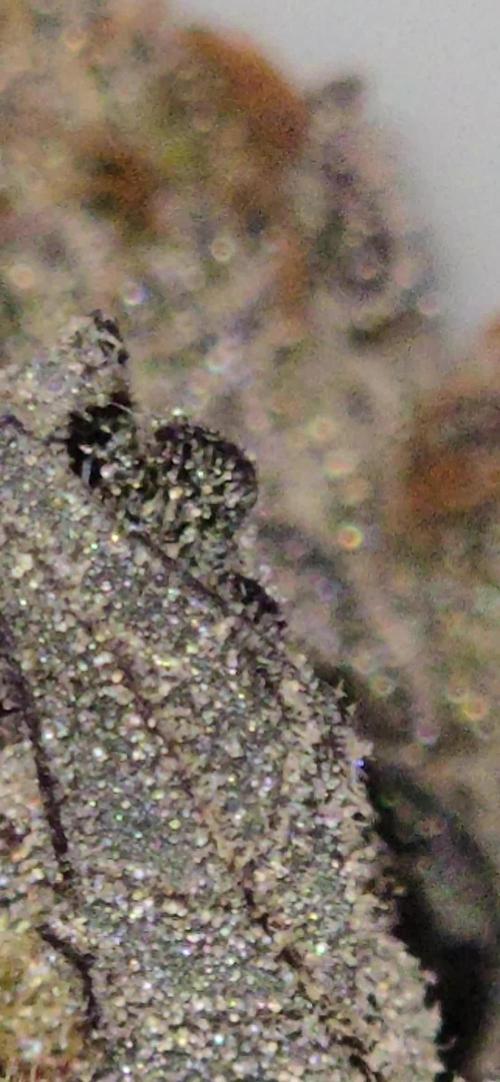
Chopped them down for a 24 hour hang dry before storing them in a temperature and humidity controlled environment. So freaking glad it's over! Time to chill out and enjoy the crop.

Likes
Comments
Share


@GrowDiaries
Follow
GG4 Sherbet Fastflowering by Fast Buds Genetics
Potent, resilient, and easy-to-grow Fastflowering monster. 27% THC that’ll hypnotize your taste buds.
: 'Highigan' (from Instagram & YouTube)


Likes
49
Share


@masterofsmeagol
Follow
7/11 Got half in of rain last night. Glad I didn't water. Ph of rain water is very acidic. Added supports to the blueberry cheese in the 50. I just used string and went diagonal and attached to the cage. Wrote a ton but it disappeared. Anyway looking at previous diaries I was wrong about senescence. It wad the life cycle of those earwigs that did that to my plants (see other diaries). This soil mix is amazing. These plants gave only gotten like two small feeds of big bloom. I showed my commercial buddy and I'll keep it between us what was said but it made me feel really good. I'm considering either expanding the cage in one direction with some lumber I already have or moving a couple outside tge cage. That way I have more room. He said he's seen plants structurally similar reach huge heights (14f) so I'm just trying to avoid future problems. I at least need to get the trellis on. I hope poor that's food enough. Did a real nice video this morning but nothing wanted to upload and it just uploaded the same one twice. I'll try again and hopfully it will go up. If not I'll put it up tomorrow.
7/12 Dad has surgery this morning. I did a quick video and took some pictures. I need to do some rearranging with the plants and cut a pallet to fit in the back. Then I can put a vertical trellis up. Haven't decided if I'll add on to the cage, remove a couple plants or just rearrange things but I'm leaning towards the later. They will need water again and I'm wondering if I should start nutrients but everything looks so good. By this time on past diaries I'd be losing all my leaves bu now. MI think it wad part ear wigs and part to many nutes. This soil mix is taking these plants through veg. I'll probably do a feeding soon but it will be organic and it will he small like a big bloom or ancient amber. Im leaning towards not using growbig this year as my plants seem to be doing great without it. We'll see. I'll keep this updated.
UPDATE: Went back over and gave plants a full watering. Some were slightly drooping. I was going to add nutes but decided against it as I didn't see any deficiency. So far NO Earwigs! I comed through the plants and I did find a jpn beetle which I happily killed. I mixed up 8 gallons of water and gave it to the 11 plants so it wasn't quite a gallon a plant. I need to rearrange the plants so I have room to move around. I also need to cut another pallet and use the spaces I'm not. Trellis needs to go up.
7/13 I think I've got the watering amount down. Now just to find how often which will depend on weather. I've watered very little this year. They loved that gallon. I was going to use big bloom and kelp me/you but looking at my garden I decided not too. My buddy asked what i was addingvthings for and to wait fir what i added to do what I wanted it to do. I see no nutrient deficiencies so why add anything? I think this soil mixture will get me all tgexway through veg. I dont plan on using much in fliwer either. Definitely good genetics. I really need to cut that palley and move the 1 10gallon to the far back coener. It will open thibgs up so much better. The garden looked so beautiful this morning. Getting very aromatic. I started untangling trellis netting but had to leave. I'll update what I do. Happy growing folks
UPDATE: Went back over as I had a slight intuition that I needed to check the garden. I found and killed at least 7 jpn beetles. That's what's been making holes. They tried to escape and bounced off a tarp but I got it. I went through the interiors and found two pillars. If these beetles are gonna be around I'm ordering a net. I'm also close to positive I'm going to extend my cage in the back a few feet. Things are getting unmanageable in here. My buddy said I'll be having problems soon if I don't do something. I'll document what I decide to do.
7/14 Found ONE jpn beetle in the garden this morning. I can manage those well enough. The birds help too. I check my garden multiple times a day so I manually remove many pests. However I've noticed some thrip damage on a leaf and a leafhopper damage on "A" leaf so there are "some" pests around but not enough to spray shit. A couple wasps were doing there job while I was there. Supposed to get thunder storms after three and tonight. Supposed to get over a half inch of rain tonight. I lifted the bags and decided to hold off and let mother nature take care of it as the bags weren't totally dry. Only problem I really have is space. I AM moving that 10gallon (that's the same size as some 20's) in the back. There's 27in not being used and a few feet the other way. My buddy cautioned me that I'm going to have problems since my plants are so crowded. I agree with him. I spoke with me father and we have most materials to extend my cage four feet in the back. I think that's my plan. I'll extend the structure before the stretch then I can put up the supports. We'll see how this goes.
UPDATE: Went back over to check the girls as I had a feeling I ought to. When I got there I saw that a couple of the blueberry cheese were pretty light (liftng the smart pot) but the others seemed to be fine. ONE 10th planet was light like that and the purple punch in the 10 gallon was as well. Each plant thar needed it got at least a half gallon of water. I'm waiting to see if we get the thunderstorms and the half inch of rain. I watered the MASSIVE blueberry cheese in the 50 but I only gave it 1 pitcher which is like 1/4 gallon or so. Don't know why I even gave it that. Looked fine but the soil WAS pretty dry. Next year I'm giving myself way more room. I was running trying to chase these jpn beetles. This time I have the dawn and water and a measuring cup to knock them in. This ain't my first rodeo. I did notice some bright yellow streaks on a leaf edge and I'm hoping it's not septoria. I doubt it but I have an anxiety disorder and I worry. I hope I can get the cage extended sooner rather than later. It's getting hard to move in there and more importantly I can't take any more plant pathogen problems. I'm considering starting a plant doctor regimen just to be safe.
7/15 Got a bunch of rain last night. No jpn beetles in the garden and not really much damage. I did notice this (I think it's leaf hoppers) that leave those dots close together on a leaf so it appears I've got a variety of pests. I'm considering how to approach this. I mean the damage is very minimal but I don't want it to get out of hand. Another thing I need to look out for is leaf septoria or any other fungal pathogens. I believe that has been part of my problems in the past. I think that's what caused my earlier grows to drop all their leaves so quick. I think I'm being overly cautious but its very crowded in there. With my father just getting out of surgery the girls will need to wait a little bit before before I can extend the cage. I could still cut the pallet and move the 1 10gallon and that would give more room. I rearranged a LITTLE BIT so they have a little more room but I've really got to get this cage extended.
UPDATE: IT Rained so hard I had to pull the car over. We hydroplanned the whole way home. After working ob my house I went to see what the damage would be like. NOT A SINGLE BREAK THAT I COULD SEE. I took a video but since the wifi here sucks I'll have to upload it tomorrow. Walking around in the cage even if I cant get it extended I think I'll be OK. It obviously will open me up to lots more issues but at the very least I can reorganize before I build on. The 10 gal purple punch would fit perfectly in the back and I have a pallet I can cut to fit it in place. Putting that one back and pulling the others forward will be much better than what I've got going on now. I'm also thinking about running an extension cord and putting fans under the canopy or at an angle to keep the wind moving. Just thinking outloud. However after that storm the girls looked as happy as I've ever seen them. All happy praying to the sun, thankful for the much needed rain. Mother nature does a pretty good job with out me messing with it. I've noticed a couple interior lowest leaves turn yellow and die like a nitrogen deficiency but everything else is fine. Also noticed a leaf that looked like a p deficiency but again, it was the VERY bottom leaf on ONE plant. Again the rest of everything looks fantastic. I'll keep an eye out for anymore nutrient deficiencies and if anyone that reads this sees some please let me know. I should've taken stills since they looked so good but I got it on video.
7/16 It POURED last night and throughout the day. TORRENTIAL rain. The branch breaking sheet rain that us outdoor growers learned to fear. My plants aren't trellised currently. I know what I need to do now. I have a pallet to put in the back corner and I'm moving the purple punch in the 10 there. And pulling others forward where there's more room. Then when I extend it (it's gotta be done this week) everything g will be in their proper place and I can just throw on a vertical trellis. I also noticed more (leafhopper) damage on a leaf. Different leaf of the same plant so I'm considering spraying something. I have a number of products but I was trying not to use them. Luckily I have these diaries so I can look back and see certain plants reactions to certain nutes or fungacide/insecticide/nutes and the doses used. I haven't been using much but if my plants will remain cramped I'm going to start the plant doctor. I'm seeing more pillar damage too but BT is super narrow so I'm thinking when I fo spray for pests I might use cap jack and be done with it. Then I can apply the BT in flower if it's necessary. I took a video but I have to wait until tomorrow to upload. I took a quick snapshot though.
7/17 Despite the torrential rain I don't have any breaks. I'm noticing more pest damage though. Another leaf on the same plant had those closely shaped round circles. I forget what pest it is but it's there. Caterpillars are there I'm sure so I may do a preclcentative spray. Just unsure what I'm going to use. I lost a COUPLE very bottom interior leaves that look like they just got used up. After this rain I think think the plants might benefit from a feeding. Probably next water after they dry out. I REALLY need that cage extended. I expressed that today and it should be done this week. I'm looking for pallets today. I have the little one that I can put in the back which will allow me to move the 10 gallon and move the other forward. That will help some but I need more room. I'll update as I go.
UPDATE: GOT A SMALL PALLET AND IT FIT PERFECT IN THE BACK ROW. I MOVED THE PURPLE PUNCH IN THE 10 GALLON ONTO IT. I SHIFTED A BUNCHVIF THINGS AROUND. I ROTATED ON BLUEBERRY CHEESE 180 DEGREES SO IT WOULD FIR BETTER. CROP ROTATION IS GOOD ANYWAY. I TOOK VIDEOS AND YOU CAN NOW SEE THE ROWS MUCH BETTER. 2 WITH 3 and 1 WITH 4. IT'S SIGNIFICANTLY BETTER THAN IT WAS. I CAN GET AROUND ALL SIDES OF EVERY PLANT NOW. GRANTED THE LARGE 50 IN THE BACK IS GOING TO HAVE SOME TROUBLE BUT ILL JUST STAKE IT TO THE CAGE. IT WILL GROW TOWARDS THE SUN ANYWAY. IM SUPRISED I DIDN'T LOSE A BUNCH OF LEAVES AFTER THIS RAIN. MOVING THINGS AROUND AND LOOKING ON THE INTERIOR OF PLANTS I FOUND A COUPLE LEAVES THAT HAD BEEN USED UP. I REMOVED A COUPKE LEAVES THAT HAD DONE THEIR JOB. I'LL UPDATE AS I GO ALONG.

Likes
6
Share

@Ninjabuds
Follow
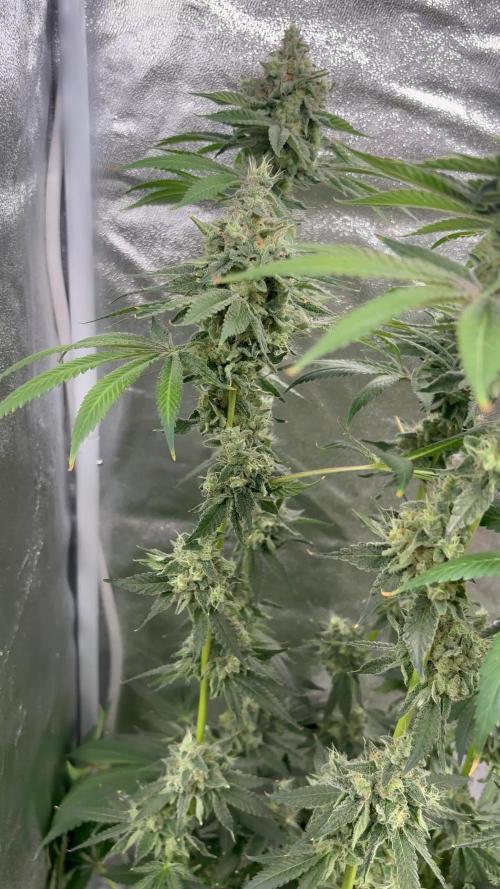
Gary Payton from Taste Budz Genetics is a real standout in my garden. The buds are huge and dense, with a beautiful neon green color that practically glows. The structure is amazing, and the skunky smell is so strong and pungent – it fills the whole room! This strain is definitely a heavy hitter, and I can't wait to see how it turns out. If you're looking for something potent and flavorful, Gary Payton is definitely one to try.
I recently upgraded to the GrowPro Solutions Under Canopy lights, and wow, what a difference! The colors on my plants are seriously popping – they look so vibrant. Plus, I think it really helped them finish strong. If you're looking to boost your grow, I'd definitely recommend checking these out.

Likes
3
Share


@herbalistssword
Follow
Took well to defoliation
Weather is so bad, she is not getting any sun. Looks like it'll be like this for the foreseeable future :(
The top was getting too bushy so I did some lst and opened her up to take up max sun on the odd day that it shines

Likes
Comments
Share


@Livetimegrower93
Follow
Week 4 at this point it's was going nicely but them brain box here got the bright idea to bend the main stem over and didn't do me or her any good
Likes
44
Share


@Roberts
Follow
Casey's Rollex OG is doing a lot better then last week. She has found the solution, and has started growing. She is looking good, and will be up for training soon. Nothing more to report at the moment. Thank you Spider Farmer, and DutchFem Seeds. 🤜🏻🤛🏻🌱🌱🌱
Thank you grow diaries community for the 👇likes👇, follows, comments, and subscriptions on my YouTube channel👇.
❄️🌱🍻 Happy Growing 🌱🌱🌱
https://youtube.com/channel/UCAhN7yRzWLpcaRHhMIQ7X4g


Likes
54
Share


@Hou_Stone
Follow
Tout se passe bien actuellement. j'ai l'impression de voir les premier pistils.
Due à mes différentes coupe , il y'a moins de branches sur les ztrawberry donc elle poussent plus haut que les AlienZ
-------------------------------------------------------------------
Grow Room: trafika urban hydroponics 100x100x200 cm
Lamp: kit trafika urban hydroponics ballast & lampe HPS : 250-600w
Extractor & carbon filter : Mars hydro 6 inch 402 CFM ( power 3/10 )
Soil : 20% perlite, 20% vermiculite, 60% universal soil
Average daily temperature & humidity : 20 à 29°C 35 à 60%
Average nigth temperature & humidity : 12 à 17°C & 50 à 70 %
Likes
Comments
Share
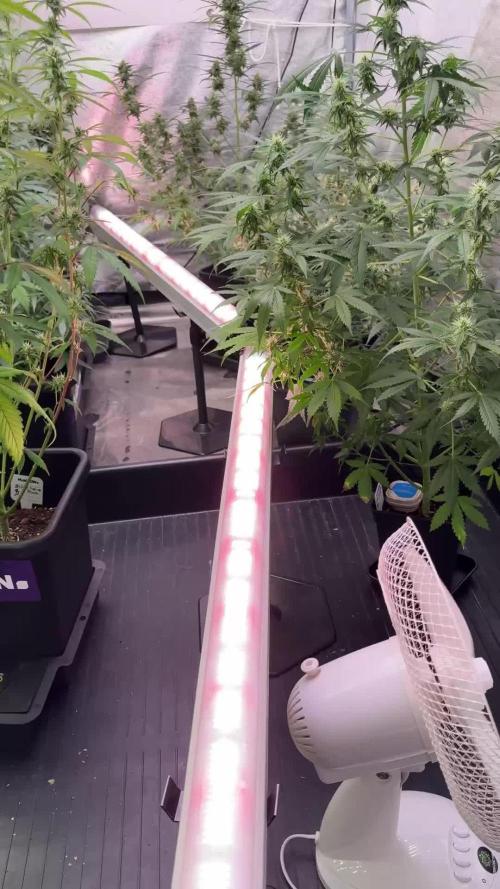
@DogDoctorOfficial
Follow
🌸 Pink Rosay Auto by Zamnesia | Pheno B | Week 9
💗 The Little Dwarf That I’m Very Glad I Kept
Some plants make you stop because they're enormous.
Some make you stop because they're covered in huge flowers.
And then there are plants that make you stop because you simply can't believe how much personality they've managed to fit into such a tiny body.
Pink Rosay Pheno B is one of those plants.
She's still a dwarf.
😂
There is no point pretending otherwise.
She's tiny.
She's compact.
She's becoming incredibly dense.
And honestly...
I absolutely love her.
When I look back at the beginning of this grow, I have to admit something.
If I had only been growing a few plants, I probably would never have given a phenotype like this the opportunity to finish.
She's just too small.
There would have been a temptation to look at her, compare her to the others, and think:
"Maybe this one isn't worth the space."
But that's exactly why I love having twelve different genetics in the 8×8 Adventure.
I didn't remove her.
I gave her time.
And now?
She's standing there covered in flowers and frost, looking absolutely adorable.
And I'm very, very happy I kept her.
🌸 Week 9 – Still Tiny. Still Beautiful.
Pink Rosay Pheno B is currently around 63 cm.
Sixty-three.
😂💗
Compared with some of the giants in this garden, she's practically a bonsai.
But here's the funny thing.
When I look at her now, I don't really see the height anymore.
I see the plant.
And the plant is beautiful.
Her structure is extremely compact, the internodes are tightly packed, and the flowers are becoming increasingly dense throughout that little framework.
She's not wasting much space.
She's not reaching endlessly upward.
She's simply putting everything she has into the structure she already built.
And that's becoming her signature.
Tiny frame. Dense flowers. Big personality.
💗 The Dwarf Is Getting Dense
This is probably the biggest change I'm seeing this week.
She's becoming really dense.
The flowers are no longer looking like little isolated flowering sites scattered across a miniature plant.
They're becoming proper little clusters.
The calyxes are becoming more pronounced.
The pistils are progressing.
And the resin is becoming increasingly visible across the flowers and surrounding sugar leaves.
There's a lovely contrast developing between the dark green foliage and the increasingly frosty flowers.
And honestly...
she looks fantastic.
Not fantastic for a dwarf.
Just fantastic.
That's an important distinction.
Because I don't want to judge her by the expectations I'd have for a much larger plant.
I'm judging her for what she is.
And what she is becoming is a beautiful, compact, heavily flowering little plant.
❄️ The Frost Is Starting to Take Over
And this is where things get particularly interesting.
The frost is becoming much more obvious.
The flowers have that increasingly sparkling appearance that makes you want to get closer and look again.
Then closer again.
And then...
"Okay, I need the macro lens." 😂📸
The resin is becoming part of her personality now.
It's no longer something you have to search for.
You can see it.
And I have a feeling she's going to become even more interesting as she continues toward maturity.
I wouldn't be surprised if, toward the end, she becomes one of those little plants where the amount of frost makes you completely forget how small she actually is.
She's certainly heading in that direction.
🌿 A Tiny Plant With Serious Density
One thing I really appreciate about this phenotype is how compressed everything is.
On a large plant, you can have flowers separated by considerable distances.
Here?
Everything is happening within a very small space.
Branches are short.
Nodes are close.
Flowers are packed into the architecture.
And now those flowers are gaining density.
It's almost like watching a miniature version of a full flowering plant.
Everything is there.
Just...
smaller.
😂
And that's what makes photographing her so much fun.
A wide photograph tells you the story:
"Look how tiny she is."
Then you get the camera close.
And suddenly...
"Holy shit, look at those flowers."
That's Pink Rosay Pheno B.
✂️ The Canopy – Now We Let Her Be
We already gave this little lady her selective defoliation when the canopy needed opening.
The objective was never to strip her.
It was to remove unnecessary congestion and give the remaining structure a little more room for light and airflow.
Now?
I'm leaving her alone.
She's doing exactly what I want her to do.
The remaining foliage is healthy.
The flowers are developing.
The structure is becoming denser.
And there is no reason to start interfering just because we have scissors available.
😂
This is another lesson this tiny plant has taught me.
Sometimes cultivation is intervention.
Sometimes cultivation is restraint.
And right now, restraint wins.
Let her finish.
💡 Small Canopy, Big Photon Story
The Future of Grow Black Series lighting continues providing the primary light from above, while the Lumiflora under-canopy system remains part of the overall flowering environment.
With a plant this compact, the relationship between light and structure is fascinating.
There isn't a huge vertical distance between the different parts of the plant.
Instead, everything is compressed into this little flowering package.
And as the flowers become denser, I'm very interested to see how she finishes under the same environmental philosophy as the much larger plants surrounding her.
She's another reminder that light doesn't dictate phenotype.
It gives the plant an opportunity.
The genetics decide what happens with that opportunity.
And Pink Rosay Pheno B decided:
"I'm going to stay tiny."
😂
Fair enough.
I respect the commitment.
🌱 The Experiment Is Working Exactly As Intended
This little plant is one of the best examples of why I wanted to run this 8×8 Adventure the way I did.
If I had selected plants purely based on early size, she probably wouldn't have made the cut.
And I would have missed this.
I would have missed watching an extreme compact phenotype develop.
I would have missed seeing how much flower she can actually carry inside that miniature architecture.
And most importantly...
I would have missed the lesson.
Not every plant needs to be a monster.
Not every phenotype needs to produce enormous numbers.
Sometimes the value of a plant is simply in what it teaches you.
And this little girl has already taught me plenty.
💗 The Sister Comparison Is Fascinating
Her sister is a completely different story.
Same genetic line.
Same room.
Same general cultivation philosophy.
And yet...
look at them.
One is compact.
The other is larger.
One has a very compressed architecture.
The other expresses herself differently.
One looks almost miniature.
The other carries herself like a more conventional flowering plant.
And that's exactly what phenotype hunting is about.
You don't grow two sisters to make them identical.
You grow them to discover how different they can become.
Pink Rosay Pheno B has certainly answered that question.
Very different.
And I'm glad she did.
💧 Feeding & Environment
The current conditions remain stable:
🌸 Flowering: Week 9
📏 Height: approximately 63 cm
💡 Light schedule: 12/12
🌡️ Day temperature: 29°C
🌙 Night temperature: 25°C
💧 Relative humidity: 60%
⚗️ pH: approximately 6.0
⚡ EC: approximately 2.0 mS/cm
🌡️ Solution temperature: 25°C
🌱 Substrate temperature: 26°C
🌬️ CO₂: approximately 639 ppm
? Pot size: 15 L
💦 Watering: approximately 1 L per plant / 24h
The feeding program remains centered around the same flowering nutrition approach used throughout the project.
No unnecessary changes.
No chasing numbers.
She's developing beautifully, so consistency remains the priority.
🌬️ Tiny Doesn't Mean Forgotten
One of the things I really enjoy about hand-watering this plant is that she gets exactly the same attention as the giants.
She may be tiny.
But she's still part of the experiment.
Every time I approach her, I get to look at the flowers.
Check the foliage.
Watch the resin.
Look for changes.
And because she's so compact, it's actually incredibly easy to observe her closely.
There aren't hundreds of centimetres of plant to inspect.
Everything is right there.
She's basically saying:
"Come on. You can't miss me."
😂💗
And I don't.
🔭 Looking Ahead – I Have a Feeling About This One
I'm not expecting a huge producer.
Let's be realistic.
She's 63 cm.
She's a dwarf phenotype.
Her total flowering structure is naturally limited by the amount of plant she has.
But that's not what I'm watching anymore.
I'm watching quality.
I'm watching density.
I'm watching resin development.
I'm watching how those flowers mature.
And I'm very curious to see where she ends up.
Because she has already exceeded what I expected from her.
She survived.
She flowered.
She developed.
She became dense.
And now she's getting increasingly frosty.
That's already a win.
And who knows...
perhaps by the end of this journey, she will become an even more interesting little specimen than I expected.
💗 Maybe I Should Have Kept More Dwarfs
This is something I've been thinking about.
If this had been a smaller garden, I probably wouldn't have grown a phenotype like this.
And that's exactly why having a larger project is so valuable.
You get to see the extremes.
You get to see the weird ones.
The tall ones.
The short ones.
The explosive ones.
The quiet ones.
The strange ones.
The beautiful ones.
And sometimes...
the tiny ones.
Pink Rosay Pheno B belongs firmly in that last category.
She's not here to win the height competition.
She's not here to dominate the tent.
She's here to show us what happens when her genetics decide:
"We're going small."
And honestly?
I'm loving every minute of it.
❤️ Final Thoughts – The Little Dwarf I Almost Didn't Keep
I think this might be my favourite part of Pink Rosay Pheno B's story.
Not how big she is.
Not how much she might produce.
Not whether she can compete with her sister.
It's the fact that she almost wouldn't have had this opportunity.
If I had fewer plants, I might have looked at her and decided she wasn't worth the space.
But because this is the 8×8 Adventure...
she stayed.
And now?
I'm really glad she did.
Because this little dwarf has become one of the plants I genuinely enjoy looking at.
She's cute as fuck.
😂💗
She's tiny.
She's compact.
She's becoming extremely dense.
She's getting frostier.
She's beautifully structured.
And she's completely comfortable being exactly what she is.
I don't need her to become a giant.
I don't need her to suddenly explode in size.
I don't need her to prove anything.
I just want to see her finish.
And I have a feeling that when she does, whatever she gives us is going to be very, very nice.
Perhaps later, when everything is finished and the entire garden has told its story, we'll decide what makes the most sense for this little harvest.
But that's a story for another day.
Right now...
she's still growing.
Still shining.
Still getting frostier.
Still being the tiniest girl in the room.
And still making me smile every time I look at her.
🌸💗❄️
Pink Rosay Pheno B.
The little dwarf.
The tiny survivor.
The compact beauty.
The one I almost didn't keep...
and the one I'm now very happy I did.
So let's give her the spotlight.
Because she has absolutely earned it.
A huge thank you once again to Zamnesia for these beautiful genetics, Plagron for the nutrition, Future of Grow for the Black Series lighting, Lumiflora for bringing the under-canopy lighting into the project, TrolMaster for the environmental control, and of course to everyone following the 8×8 Adventure on GrowDiaries.
Every phenotype doesn't have to be enormous.
Every plant doesn't have to be a champion.
Sometimes the smallest plant in the room gives you one of the biggest lessons.
And sometimes...
the little dwarf becomes one of your favourites.
This one certainly became one of mine.
Until next week...
Tiny plant. Huge personality. Getting seriously frosty. 💗❄️
Growers love and happy growing! 🌱💚
Likes
36
Share


@TheGreenLeopard
Follow
Loved growing this. Sang its praises rhe whole way through because it just looked like a beast. I like the pretty Cali strains but I always find the yields are close to frustrating for abilities not up up there. Overall the strain helped me take chances that paid off so I really enjoyed it. Will grow again.
Threnneighbors should smell this on the balcony this summer 😂💚🙏🏼


Processing
Likes
5
Share


@Alb1331
Follow
Second week I did a mild pruning taking off big fan leaves, so that I can allow more light to the canopy. The girls took well and bounce back, still dancing.

Processing
Likes
1
Share


@lawnichak
Follow
gained 10" in the last 7 days. 19" in the last 2 weeks. doing extremely light stress training. just enough to get the light evenly to the leaves. there are multiple colas coming up together. hoping for a decent amount from these plants. im doing a light defoliation each week. changed the way the lights hang in the 3rd tent to give more room to grow and light covers more of the plant now