The Grow Awards 2026 ๐Ÿ†
Likes
Comments
Share
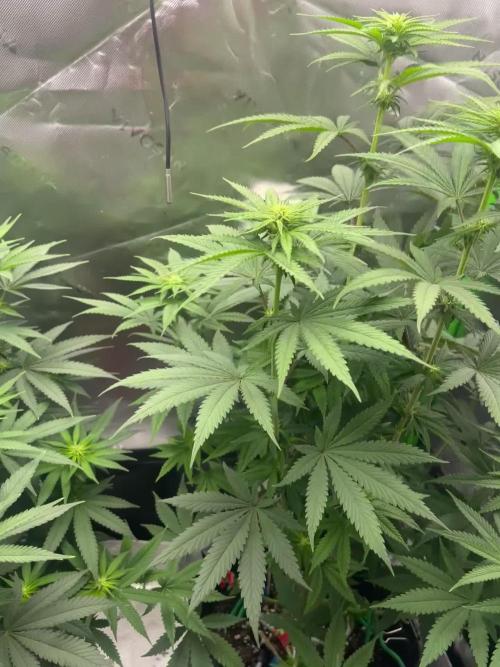
Strain: Fast Buds Rainbow Melon Photo Feminized Day 14 of Flower Day: 63 from sprout Medium: Growers Gold Light: Vivosun VS2000 at 75% VPD: 1.3 kPa Light Distance: 12 inches Watering: By hand, ~16 oz daily Nutrients: pH Perfect Advanced Nutrition Grow, Bloom, Micro 2 ml / L and 1 ml / L big bud. Automatic watering ready to go!
Processing
Likes
22
Share
This was a very stressful week as there were too many variables at play all at once; even my camera refused to cooperate for the first few days. The freshly transferred plants were starting to droop and I was unsure if it was transplant shock, nutrient burn, or because of the incomplete grow tent. My first batch of nutrients were mixed into a gallon bottle and was weighed by a friend using his scale; this set was enough to last weeks. For this new batch however, I didn't have my scale and used the table spoon as my measuring tool; needless to say when my TDS meter finally arrived, both runoff and the remainder of the mixed nutrients read 2800. Fortunately my light setup seemed to be inefficient still and the plants weren't drawing much nutrients and only ended up with a very light burn on the older growth. All pots were flushed back to recommend levels and the light lowered until the lux values read appropriate. This week ends my daily comments and I'll stick to this end of the week format going forward.
Likes
1
Share
Great grow!! Should end up with over a half a pound off of these 2 and the little I harvested about 2 weeks ago. I got 2 oounces dry off of her. They smell amazing and are covered with trichomes
Likes
11
Share
@DrDuhboto
Follow
This week I inoculated the room leaves and plants with Neoseiulus cucumeris, I have had minor thrip problems all summer, Usually I use lady bugs to combat them but none have been available this year. I inoculated the plants by shaking the bottle full of Cucumeris and bran over the leaves. I will do this a few times before pre flowers show. Cucmeris are predatory mites that eat the thrip larvae. And are supposed to work for spider mites as well. I added the scrog nets to the room and began training the plants through them. I then flipped the lights over to 12 and Initiated pre flower. All vegetative growth was very vigorous. The goal of this grow is to do a preliminary test to begin to determine if Mycelium provides any additional benefits to Cannabis when allowed to colonize in super soil before being added to bottom layer of the pot. The Process: 1) 8 weeks Prior to Germination Super Soil is mixed (see super Sub cools super soil recipe further down the page) and added to spinning two part composter, water is added and the super soil mix is allowed to break down for a week. 2) 7 weeks Prior To germination 1L of colonized mycelium is added to each side of composter. Mycelium is now allowed to colonize the super soil. 3) After 8 weeks total the Mycelium has had enough time to colonize throughout the super soil mix and is ready to be added to the bottom 1/3rd of the pots. See Pictures for an example of what this looks like.
Likes
11
Share
I mean actually using this tent for other grow, so might as well rate it. It's quite durable and like the shape and color of it but I like this tent less with every grow. Doesn't has the best placement of air vents and therefore steals quite a bit of space which is supposed to be for your plants because it develops too much negative pressure. The three squared "windows" at the bottem aren't really usable because too much light will come through. It's just gonna make your tent a hermie tent.
Likes
18
Share
@Hashy
Follow
Week 12 Light cycle=12/12 Light Power=130w Extractor controller settings High temp= 24c Low temp= c Temp step=0c High Rh= 40% Low Rh= % Rh step=0% Speed max=10 Speed min=1 Smart controller settings (during lights on). Lights on=10.01-21.59 Radiator on= below 22.0c Radiator off= above 23.0c Dehumidifier on= not in use Dehumidifier off= not in use Smart controller settings (during lights off). Lights off=22.00-10.00 Radiator on= below 18c Radiator off= above 19c Dehumidifier on= not in use Dehumidifier off= not in use Seperate feeding program. #1 and #2 go onto dragon force. #3 and #4 stay on schedule. Fri 8/3/24 ๐Ÿ’ง๐Ÿ’ง๐Ÿ’ง๐Ÿ’ง๐Ÿ’ง๐Ÿ’ง๐Ÿ’ง๐Ÿ’ง๐Ÿ’ง๐Ÿ’ง๐Ÿ’ง๐Ÿ’ง๐Ÿ’ง๐Ÿ’ง๐Ÿ’ง๐Ÿ’ง Method= automatic Feed=Bloom nutes. Neutralise=0.1ml/L Silicon=1.0ml/L Calmag=0.5ml/L Terra Bloom=3.0ml/L Sumo Boost=2.0ml/L P/K 9/18=0.5ml/L Easy Ph down=0.15ml/L Ec=1.65 PH=6.5/6.5 Time start=12.00pm Finish time=13.45pm (11ร—5 minute runs with 5 minute gaps) Total flow rate=190ml/min Flow rate per plant=47ml/min. Total volume made=8L Total volume left=3.5L Total volume used=2.25L Volume per plant=L (Est) Runoff. Total runoff=1.5L Ec=1.9 PH=6.2/ ๐Ÿ’ง๐Ÿ’ง๐Ÿ’ง๐Ÿ’ง๐Ÿ’ง๐Ÿ’ง๐Ÿ’ง๐Ÿ’ง๐Ÿ’ง๐Ÿ’ง๐Ÿ’ง๐Ÿ’ง๐Ÿ’ง๐Ÿ’ง๐Ÿ’ง๐Ÿ’ง #3 (Day 78)(Day 40 flower) ๐Ÿ“‹ Bloom nutes Sat 9/3/24 #3 (Day 79)(Day 41 flower) ๐Ÿ“‹ Sun 10/3/34 #3 (Day 80)(Day 42 flower) ๐Ÿ“‹ Lowered light power from 130w to 120w Mon 11/3/24 ๐Ÿ’ง๐Ÿ’ง๐Ÿ’ง๐Ÿ’ง๐Ÿ’ง๐Ÿ’ง๐Ÿ’ง๐Ÿ’ง๐Ÿ’ง๐Ÿ’ง๐Ÿ’ง๐Ÿ’ง๐Ÿ’ง๐Ÿ’ง๐Ÿ’ง๐Ÿ’ง Method= automatic Feed=water Neutralise=0.1ml/L Easy Ph down=0.008ml/L (3 drops total). Ec=0.2 PH=6.0/6.4 Time start=12.00pm Finish time=13.45pm (11ร—5 minute runs with 5 minute gaps) Total flow rate=190ml/min Flow rate per plant=47ml/min. Total volume made=13L Total volume left=3L Total volume used=10L Volume per plant=2.5L (Est) Runoff. Total runoff=2.5L Ec=2.25 PH=6.1/ ๐Ÿ’ง๐Ÿ’ง๐Ÿ’ง๐Ÿ’ง๐Ÿ’ง๐Ÿ’ง๐Ÿ’ง๐Ÿ’ง๐Ÿ’ง๐Ÿ’ง๐Ÿ’ง๐Ÿ’ง๐Ÿ’ง๐Ÿ’ง๐Ÿ’ง๐Ÿ’ง #3 (Day 81)(Day 43 flower) ๐Ÿ“‹ Tue 12/3/24 #3 (Day 82)(Day 44 flower) ๐Ÿ“‹ Wed 13/3/24 #3 (Day 83)(Day 45 flower) ๐Ÿ“‹ Lowered light power from 120w to 100w Thur 14/3/24 ๐Ÿ’ง๐Ÿ’ง๐Ÿ’ง๐Ÿ’ง๐Ÿ’ง๐Ÿ’ง๐Ÿ’ง๐Ÿ’ง๐Ÿ’ง๐Ÿ’ง๐Ÿ’ง๐Ÿ’ง๐Ÿ’ง๐Ÿ’ง๐Ÿ’ง๐Ÿ’ง Method= automatic Feed=Bloom nutes. Neutralise=0.1ml/L Silicon=1.0ml/L Calmag=0.25ml/L Terra Bloom=2.0ml/L Sumo Boost=1.5ml/L P/K 9/18=0.5ml/L Easy Ph down=0.15ml/L Ec=1.35 PH=6.7/6.8 Time start=12.00pm Finish time=13.45pm (11ร—5 minute runs with 5 minute gaps) Total flow rate=190ml/min Flow rate per plant=47ml/min. Total volume made=8.5L Total volume left=3L Total volume used=5.5L Volume per plant=2.75L (Est) Runoff. Total runoff for 2 plants=1.5L Ec=1.85 PH=6.4/ ๐Ÿ’ง๐Ÿ’ง๐Ÿ’ง๐Ÿ’ง๐Ÿ’ง๐Ÿ’ง๐Ÿ’ง๐Ÿ’ง๐Ÿ’ง๐Ÿ’ง๐Ÿ’ง๐Ÿ’ง๐Ÿ’ง๐Ÿ’ง๐Ÿ’ง๐Ÿ’ง #3 (Day 84)(Day 46 flower)***** ๐Ÿ“‹ H=82cm D=20cm DLI=40.0 Small defoliation. She is going to run a bit longer then the other fast flowers in this run. Looking good she just lacked the light when it was really needed. Back soon. Take it easy.
Likes
50
Share
Hello growers and tokers! ๐Ÿ‘‹ ๐Ÿ‘ฉโ€๐ŸŒพ ๐Ÿง‘โ€๐ŸŒพ.๐Ÿ”ฅ๐Ÿ’จ Hope you had a great week because these ladies sure have! ๐Ÿ˜ They're starting to get that sweet aroma this strain gives off, her aroma will be over powering my tent in full flower. Love it! Pictures and info were taken on day 12 of flower. I put 71cm tall because that's the average between the three girls. CC 1: 78cm CC 2: 68cm CC 3: 68cm CC 1 is killing it with the double main colas. ๐Ÿ’ช ๐Ÿ’ช ๐Ÿคฉ CC2 is my favorite. She's got a perfect shape, nice evenly distributed canopy. Took LST great. For me that's the goal when I do LST. CC3 doesn't fall behind in any way, she's looking great. There's a bunch of new growth everywhere so after 21 days i'll be doing some pretty heavy selective defoliation. Feeding 1,5L each, every other day. Will be increasing as they ask for more. How do they ask for more? When feeding if the soil is drier than normal I give a 150-200ml increment of water. I do that until they stop feeding so much then i just maintain that amount. I start reducing if it takes longer to dry. That works good for me. The old finger in the dirt trick. ๐Ÿ‘ Nothing like knowing exactly what your ladies need first hand. They've got a lovely green lush color. It's a delight growing this strain. I'll have to get me some more seeds for next run because this is a strain that will always have a spot in my garden. ๐Ÿ˜ ๐Ÿ˜ Hope you enjoyed this week's update and stay tuned for next week. If you like what you see check out the other strains in the garden. ๐Ÿ˜ Take care and stay safe! One love!
Likes
145
Share
@Salokin
Follow
Dear Growmies, With week 13 upon us, the journey with our plant enters an exciting new phase. The dance of the buds stretching around the colas has come to a natural pause, ushering us into the swelling stage. Each day, we're greeted by buds that are increasingly plump, a clear indication that they're on the right track. As they swell, our plant is starting to exude a sophisticated sweet lemon aroma that fills the air and promises a sensory delight. It's a fragrance that speaks to the complexity of her development and the nuanced profile we can anticipate. Notably, some leaves in the lower canopy are beginning to wilt, a process I view as normal age-related defoliation. It's a natural part of the lifecycle, as the plant focuses her energy on the swelling buds. In our efforts to optimize her environment, the GCX 9 lighting is now set to 100% flower spectrum and 75% veg spectrum. I'm carefully pushing the limits to provide maximum light without imposing stress or damage to our plant. This stage requires a delicate balance, pushing for maximum growth while maintaining the health and well-being of the plant. I As we watch the buds swell and smell the sweet lemon fragrance developing, it's a moment to reflect on the journey thus far and the growth we've fostered together. Let's continue this care and attentiveness into the next week, ensuring that our plant not only grows but thrives.
Likes
37
Share
@timbarin
Follow
Week 4/10 - 11/10 The plant dried up very nicely and no more eggs. She was moved back to her grow place and my gf topped her on Monday. Due to the excessive nitrogen she is getting only additives 6/10 she got only additives today. 7/10 steady growth is happy growth.. 9, 10 she was fed amazing growth 11/11 closing the week with a video of the progress. Catch up next week!
Likes
Comments
Share
@Dabking
Follow
I was told to never judge a strain purely off it's THC percentage. To smell a plant, and what your nose picks out is generally the strain that will jive the best with the endocannabinoid system in your body. This strain exemplifies that. It's only around 17% but the high is amazing. An under-rated strain for sure. Very easy strain to grow. Although the same strain, one looked pretty different and was much frostier despite getting the exact same treatment from seed to chop.
Likes
29
Share
@Grey_Wolf
Follow
Testing for Connoisseur genetics Outback haze #1 7th March 2022 Welcome to week 23 ๐Ÿ˜€ Both of these ladies are looking fantastic as they progress into the blooming stage ๐Ÿ’ช Absolute monster on the left is my favourite of the two but the other isn't too bad either . Neither have needed any feeds with the soil providing plenty of nutrition at this stage. 100% sativa's or in this case haze are fairly low maintenence when it comes to feeding . chuck in some manure or something ( I am using guano ) and they will happily grow along nicely . Did you know that Connoisseur genetics are looking for new testers for their newest strains?? to be considered you just need to have had a few diaries with harvests Thanks once again for stopping by ๐Ÿ‘ *****Major Update 10th March ***** Plant two developed ball sacks along with her pistils so unfortunately I had to pull her out and destroy the plant. I know some people might think I could have tried removing the sacs and giving the plant a chance . But I am trying to make myself some F1 hybrids and do not want any Hermies anywhere near my females . Now because this strain has Thai genetics there is always that chance they throw "nanners" but usually later in flower so for this one to show itself right on the start of flowering is enough for me to pull it , burn it with fire . Or in this case I'm gonna let the sun solarise it and then it'll be mulched with other plant materials from my garden.
Likes
5
Share
Likes
3
Share
Vanno tutte cose bene spero di raccogliere molti chili
Likes
52
Share
Another week has passed, and our beloved Cosmos F1 continues to amaze and astonish. It's as if the universe itself has bestowed upon her an extra dose of magic and wonder. I'm thrilled to share with you the latest chapter in our cosmic gardening adventure. As I gaze upon our beloved Cosmos F1, I'm filled with awe at her transformation. She has truly become a sight to behold, adorned with an abundance of frosty trichomes that shimmer like stars in the night sky. Her fruits have also become denser, promising a bountiful harvest that we can almost taste. While we estimate there's still another week until harvest, we'll remain patient and let her guide us to the perfect moment. In nurturing our cosmic beauty, I've continued to follow a simple yet effective regimen. I've provided her with pure water, ensuring she stays hydrated and refreshed. Additionally, I've incorporated Aptus Holland Enzym into her feeding routine, as I'm committed to preserving the vitality of the soil for future use. This approach not only benefits our current crop but also helps sustain the harmonious balance of life within our growing environment. Let's take a moment to appreciate the significance of this soil preservation. By cultivating in a manner that allows us to reuse the soil, we contribute to the sustainable practices of our gardening community. It's a small but meaningful step towards reducing waste and honoring the interconnectedness of our natural world. Last week, I mentioned my decision to defoliate our Cosmos F1. The room itself seemed to call for it, and our resilient plant welcomed the process with open arms, or rather, leaves. She embraced this adjustment with grace and resilience, showcasing her ability to adapt and thrive. I must say, defoliation has had a positive impact, allowing more light to penetrate her canopy and promoting healthy growth. As I reflect upon this journey, I can't help but express my gratitude to @James and to Royal Queen Seeds for bringing Cosmos F1 into my life. She truly embodies the essence of an all-in-one package, captivating both my imagination and senses. The experience of growing my first CBD strain has been nothing short of extraordinary, and I eagerly anticipate the cosmic culmination of our efforts. Together, we shall continue to revel in the wonders of the universe and allow its vastness to awaken our innate curiosity. Our Cosmos F1 is a testament to the marvels that can be achieved through patience, care, and a touch of cosmic inspiration. May our cosmic garden thrive and inspire others to embark on their own celestial journeys. Until next time, keep dreaming big and let the cosmos guide your green thumbs! As always thank you all for stopping by and for supporting me on this journey, i am super passion about growing and fell blessed to have you all with me on this new journey <3 <3 <3 Genetics - RQS COSMOS F1 Ligth - LUMATEK ZEUS 465 COMPACT PRO โ€จFood - APTUS HOLLAND โ€จ โ€จAll info and full product details can be find in can find @ https://www.royalqueenseeds.com โ€จโ€จhttps://aptus-holland.com/โ€จ โ€จhttps://autopot.co.uk/ โ€จโ€จhttps://lumatek-lighting.com/ With true love comes happiness <3<3<3 Always believe in your self and always do things expecting nothing and with an open heart , be a giver and the universe will give back to you in ways you could not even imagine so <3<3<3 <3 <3 <3 Growers love to you all <3 <3 <3 Cosmos F1: The World's First F1 CBD Cannabis Variety Cosmos F1 is the largest autoflowering cultivar in RQS catalogue of F1 hybrids. With her tall, typical Christmas tree structure and bright green foliage, Cosmos F1 is a testament to the beauty and vigour of Cannabis sativa. Plus, thanks to her pure genetics, which descend from Oregon CBD, she boasts the highest CBD concentration in our entire F1 seed selection. Aromas, Flavors, and Effects of Cosmos F1: A Vibrant CBD Super Variety True to the pure lineage from which she descends, Cosmos F1 boasts a delicious aroma that combines the freshness of crisp pine with the full-bodied, almost creamy aroma of modern Cookies varieties, and an unmistakable peppery bite. Thanks to her high concentration of CBD and low levels of THC, Cosmos F1 offers a balanced effect without intoxication. Cosmos F1โ€™s terpene profile is dominated by myrcene, farnesene, limonene, pinene, and caryophyllene. Combined with high concentrations of CBD, Cosmos F1 produces a clear, meditative effect that relaxes the body while leaving the mind functioning and focused. Her effects help unite the mind and body, creating a state of cosmic order.
Processing
Likes
22
Share
~~~~~~~~~~~~~~~~~~~~~~~~~~~~~~~~~~~~~~~~~~~~~~~~~~~~~~~~~~~ ==> Comments From Other "Living Soil/Super Soil" Growers Are Always Welcome <== ~~~~~~~~~~~~~~~~~~~~~~~~~~~~~~~~~~~~~~~~~~~~~~~~~~~~~~~~~~~ INTRODUCTION I am very excited about this grow as it is the first time with a new setup. I have added a new light and am going to try a super soil grow for the first time. I have a Mephisto Genetics Double Grape between paper towels and waiting to sprout. The space is about 18 inches by 24 inches. The ceiling slopes down, so I don't have much room at the rear of the space. For medium I am using Fox Farms Happy Frog augmented with perlite. The bottom third contains 0.5 pounds autoflower blend of a "super soil" additive from Nature's Living Soil. (https://amzn.to/2PUHc6k) I am using three-gallon cloth pots. The light is a Horticulture Lighting Group 135W QB V2 R-Spec LED kit. NUTRIENTS Tap water pHโ€™d to 6.5. pH lowered using 1.5 TBS unsulfured blackstrap molasses and apple cider vinegar. One-half TBS of vinegar lowered pH about 0.5 points. The medium was very dry. Slowly watered to allow the moisture to be equal throughout the soil ISSUES My while I have yet to put the seed in the dirt, I am concerned about temperatures. They are currently running at about 86F. I would like to get it down to about 80F. DAILY LOG DAY -2: STARTED SEED * Started seed in my traditional manner. Between paper towels soaked in 5% bleach solution, 0.25 tsp/0.5 Cup water. Temp 82F. DAY -1: ACTION *The smallest of tip has appeared. Will put in soil in a few hours. Day 0: SEED PLANTED. * Refrigerator filtered water. pH 6.5. 1 cup (250ml) added very carefully. * Covered with humidity dome. * Light from Soil: 32.5โ€ * Temperature: 82F DAY 1: SPROUT The sprouted seed has shown itself above the soil. A nice Christmas morning surprise. Now I can start counting the days. * Watered with about 200ml of water at pH 6.5. Used apple cider vinegar to lower the tap water pH. * I was pleased to find that my tap water does not contain chloramine. I was reading bad things about chloramine and "living soil." It can kill beneficial microorganisms. All I did was ask my water company and they replied saying "we found no mention of chloramine use in the system:" Just what I wanted to hear. * After looking at other diaries using 250W LEDs, I moved my light down to 25 inches. DAY 2: NO WATER FOR YOU * No watering today. There is plenty of water in the soil and I want the roots to stretch and work. * Working on increasing the humidity and getting more control over the temperature. DAY 3: WATER PLANT, NOT POT. ADDED MYCORRHIZAE. * Following the GrowWeedEasy watering suggestions for Kind Soil * 500ml water at 6.5 pH, around the plant and not across the full 3-gallon bag. * The fan gently moves the seedling to keep it strong. * Had minor unexpected run-off. I hope to avoid that in the future. * Added 1/8 tsp Great White Mycorrhizae dissolved in 100 ml of 50 ml water/50 ml molasses mix. Did not pH as it is such a small amount of solution compares to the watering earlier today. DAY 4: NO WATER, NO PICTURE * Nothing really new. So no reason for a picture. * The soil is dry on top, but the bottom of the pot is still damp. So I will watch it, but I don't expect to water today. * Adding a small intake fan has dropped the temps to about 82F, I think they can live with that. * A humidifier arrives tomorrow and I think that will be my last step to improve the environment. DAY 5: 500ml WATER, LOOKING GOOD * The plant is looking good. The second set of true leaves has a bend, but nothing to worry about. DAY 6: 500ml WATER. NEW HUMIDIFIER * It wasn't really necessary to water today, but I did simply to stay on the schedule I am using. * Given the lightness of the soil and the moving air, I don't anticipate any problems. * Added a humidifier yesterday evening. It's bringing the humidity up, but I need to keep the space closed and I'm a bit concerned about having to provide it with distilled water frequently. ~~~~~~~~~~~~~~~ WEEK ONE IN REVIEW ~~~~~~~~~~~~~~~ * Watered with 750 ml pH's tap water. Watered slowly to avoid any runoff. * The plant is looking very healthy. It looks as if the roots are really starting to work as the plant is darker green. * Balancing temperature and humidity is tricky, but I think I will be able to get it stabilized with a bit more work. * Target Relative Humidity: Seedlings - 65-70; Vegging - 40-70; Flowering - 40-50 ==> Beginning Next Week I Will Only Post Twice A Week, Mid-week And End Of The Week. <==
Likes
68
Share
Removed autoflower and put her in her own pot outside the tent. Foliars applied in strong blue 430nm with 4000Hz tone. 20-minute dose prior to application. In essence, you're seeing a combination of the infrared light reflected by the plant, which the camera perceives as red, and any residual visible blue light the plant reflects, which results in a purple hue. I was doing more stretching of the stems, adjusting weights, just a little too much, and it snapped almost clean. I got a little lucky in that it was still connected, wrapped her almost instantly while holding her in place with yoyo's. The core framework is now in place. If your soil has a high pH, it's not ideal; you want a pH of 6.4, 6.5, or 6.6, which is ideal. If you are over a pH of 7, you have no hydrogen on the clay colloid. If you want your pH down, add Carbon. If you keep the pH below 7, you will unlock hydrogen, a whole host of new microbes become active and begin working, the plant will now be able to make more sugar because she has microbes giving off carbon dioxide, and the carbon you added hangs onto water. Everything has electricity in it. When you get the microbes eating carbon, breathing oxygen, giving off CO2, those aerobic soil microbes will carry about 0.5V of electricity that makes up the EC. The microorganisms will take a metal-based mineral and a non-metal-based mineral with about 1000 different combinations, and they will create an organic salt! That doesn't kill them, that the plant loves, that the plant enjoys. This creates an environment that is conducive to growing its own food. Metal-based: Could include elements like iron, manganese, copper, or zinc, which are essential nutrients for plants but can exist in forms not readily accessible. Non-metal-based: Examples like calcium carbonate, phosphate, or sulfur are also important for plant growth and potentially serve as building blocks for the organic salt. Chelation in a plant medium is a chemical process where a chelating agent, a negatively charged organic compound, binds to positively charged metal ions, like iron, zinc, and manganese. This forms a stable, soluble complex that protects the micronutrient from becoming unavailable to the plant in the soil or solution. The chelate complex is then more easily absorbed by the plant's roots, preventing nutrient deficiency, improving nutrient uptake, and enhancing plant growth. Chelation is similar to how microorganisms create organic salts, as both involve using organic molecules to bind with metal ions, but chelation specifically forms ring-like structures, or chelates, while the "organic salts" of microorganisms primarily refer to metal-complexed low molecular weight organic acids like gluconic acid. Microorganisms use this process to solubilize soil phosphates by chelating cations such as iron (Fe) and calcium (Ca), increasing their availability. Added sugars stimulate soil microbial activity, but directly applying sugar, especially in viscous form, can be tricky to dilute. Adding to the soil is generally not a beneficial practice for the plant itself and is not a substitute for fertilizer. While beneficial microbes can be encouraged by the sugar, harmful ones may also be stimulated, and the added sugar is a poor source of essential plant nutrients. Sugar in soil acts as a food source for microbes, but its effects on plants vary significantly with the sugar's form and concentration: simple sugars like glucose can quickly boost microbial activity and nutrient release. But scavenge A LOT of oxygen in the process, precious oxygen. Overly high concentrations of any sugar can attract pests, cause root rot by disrupting osmotic balance, and lead to detrimental fungal growth. If you are one who likes warm tropical high rh, dead already. Beneficial, absolutely, but only to those who don't run out of oxygen. Blackstrap is mostly glucose, iirc regular molasses is mostly sucrose. Sugars, especially sucrose, act as signaling molecules that interact with plant hormones and regulate gene expression, which are critical for triggering the floral transition. When sucrose is added to the growth medium significantly influences its effect on floral transition. Probably wouldn't bother with blackstrap given its higher glucose content. Microbes in the soil consume the sugar and, in the process, draw nitrogen from the soil, which is the same nutrient the plant needs. Glucose is not an oxygen scavenger itself, but it acts as a substrate for the glucose oxidase (GOx) enzyme, effectively removing oxygen from a system. Regular molasses (powdered if you can), as soon as she flips to flower or a week before, the wrong form of sugar can delay flower, or worse. Wrong quantity, not great either. The timing of sucrose application is crucial. It was more complicated than I gave it credit for, that's for sure. When a medium's carbon-to-nitrogen (C:N) ratio reaches 24:1, it signifies an optimal balance for soil microbes to thrive, leading to efficient decomposition and nutrient cycling. At this ratio, soil microorganisms have enough nitrogen for their metabolic needs, allowing them to break down organic matter and release vital nutrients like phosphorus and zinc for plants. Exceeding this ratio results in slower decomposition and nitrogen immobilization, while a ratio below 24:1 leads to faster breakdown and excess nitrogen availability. Carbon and nitrogen are two elements in soils and are required by most biology for energy. Carbon and nitrogen occur in the soil as both organic and inorganic forms. The inorganic carbon in the soil has minimal effect on soil biochemical activity, whereas the organic forms of carbon are essential for biological activity. Inorganic carbon in the soil is primarily present as carbonates, whereas organic carbon is present in many forms, including live and dead plant materials and microorganisms; some are more labile and therefore can be easily decomposed, such as sugars, amino acids, and root exudates, while others are more recalcitrant, such as lignin, humin, and humic acids. Soil nitrogen is mostly present in organic forms (usually more than 95 % of the total soil nitrogen), but also in inorganic forms, such as nitrate and ammonium. Soil biology prefers a certain ratio of carbon to nitrogen (C:N). Amino acids make up proteins and are one of the nitrogen-containing compounds in the soil that are essential for biological energy. The C:N ratio of soil microbes is about 10:1, whereas the preferred C:N ratio of their food is 24:1 (USDA Natural Resource Conservation Service 2011). Soil bacteria (3-10:1 C:N ratio) generally have a lower C:N ratio than soil fungi (4-18:1 C:N ratio) (Hoorman & Islam 2010; Zhang and Elser 2017). It is also important to mention that the ratio of carbon to other nutrients, such as sulfur (S) and phosphorous (P) also are relevant to determine net mineralization/immobilization. For example, plant material with C:S ratio smaller than 200:1 will promote mineralization of sulfate, while C:S ratio higher than 400:1 will promote immobilization (Scherer 2001). In soil science and microbiology, the C:S ratio helps determine whether sulfur will be released (mineralized) or tied up (immobilized) by microorganisms. A carbon-to-sulfur (C:S) ratio smaller than 200:1 promotes the mineralization of sulfate, when the C:S ratio is low, it indicates that the organic matter decomposing in the soil is rich in sulfur relative to carbon. Microorganisms require both carbon and sulfur for their metabolic processes. With an excess of sulfur, microbes take what they need and release the surplus sulfur into the soil as plant-available sulfate A carbon-to-sulfur (C:S) ratio higher than 400:1 will promote the immobilization of sulfur from the soil. This occurs because when high-carbon, low-sulfur materials (like sawdust) are added to soil, microbes consume the carbon and pull sulfur from the soil to meet their nutritional needs, temporarily making it unavailable to plants. 200:1 C:S 400:1: In this range, both mineralization and immobilization can occur simultaneously, making the net availability of sulfur less predictable. This dynamic is similar to how the carbon-to-nitrogen (C:N) ratio regulates the availability of nitrogen in soil. Just as microbes need a certain amount of nitrogen to process carbon, they also require a balanced amount of sulfur. Both mineralization and immobilization are driven by the metabolic needs of the soil's microbial population. Sulfur is crucial for protein synthesis. A balanced ratio is particularly important in relation to nitrogen (N), as plants need adequate sulfur to efficiently use nitrogen. A severely imbalanced C:S ratio can hinder the efficient use of nitrogen, as seen in trials where adding nitrogen without balancing sulfur levels actually lowered crop yields. Maintaining a balanced carbon-to-sulfur (C:S) ratio is highly beneficial for plant growth, but this happens indirectly by regulating soil microbial activity. Unlike the C:N ratio, which is widely discussed for its direct effect on nutrient availability, the C:S ratio determines whether sulfur in the soil's organic matter is released (mineralized) or temporarily locked up (immobilized). Applied 3-day drought stress. Glucose will hinder oxygenation more than sucrose in a solution because glucose is consumed faster and has a higher oxygen demand, leading to a more rapid decrease in oxygen levels. When cells respire, they use oxygen to break down glucose, and this process requires more oxygen for glucose than for sucrose because sucrose must first be broken down into glucose and fructose before it can be metabolized. In a growth medium, glucose is a more immediate and universal signaling molecule for unicellular and multicellular organisms because it is directly used for energy and triggers a rapid gene expression response. In contrast, sucrose primarily acts as a signaling molecule in plants to regulate specific developmental processes by being transported or broken down, which can be a more complex and slower signaling process. Critical stuff. During wakefulness (DC electric current) life can not entangle electrons and protons. During the daytime, the light is sensed as multiple color frequencies in sunlight. Coherence requires monochromatic light. Therefore, at night, IR light dominates cell biology. This is another reason why the DC electric current disappears during the night. The coherence of water is maintained by using its density changes imparted by infrared light released from mitochondria in the absence of light. This density change can be examined by NMR analysis, and water is found to be in its icosahedral molecular form. This is the state that water should be in at night. This is when a light frequency is lowest and when the wave part of the photoelectric effect is in maximum use. 3600
Likes
Comments
Share
This nug is getting huge on top hole mackerel! I'm super excited for this idk what's I'm doing that it likes so much I just fed it grow dots and that's it just been keeping it wet with the self watering ac infinity bases! Check back in a week to see how far it has progressed!
Processing
Likes
Comments
Share
@robotzex
Follow
Things going well, some yellowing of random leaves i suspect a bit low on N,re ammended the medium with 50/50 mix of 4-4-4/2-8-4
Likes
12
Share
@thonhash
Follow
Acabamos con estas colombian jack,con 70 dรญas y un olor sรบper dulce,empezamos con el secado.