






@Naujas
Follow
the girl went out into nature, although the weather is not very suitable for them yet, but I think she will manage perfectly :) I will visit them once a week :).


@JBsTastyBudz
Follow
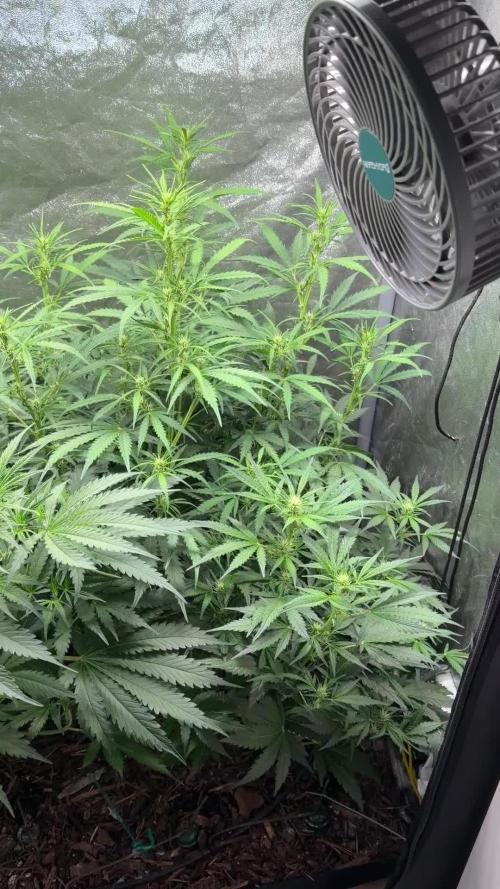
Sorry for the late video post.. I was assaulted and 2 of my 23 year old cats passed away 2 days ago.. So it's been a rough few weeks... Couple of yellow leaves.. Never had that problem using just RO water... Can't go to the grow store to get RO water right now. Transplanted 6-18-2020 switched to 12/12 🕒



@Organic_G
Follow
Wachsen wirklich perfekt, keine Mängel, super fette Stämme, extrem vital und gut am Stacken die Ladys…
Die Automatics sind auf einem Rekordrun wenn es so weiter geh, für 2. Woche Flower sind die extrem robust geworden…


@diversiv0
Follow
The plant is thriving and has grown 50% larger compared to last week. Some of its leaves are now the size of a hand, which is surprising for me as it's my first experience growing a plant. I am hoping that it will start flowering next week. The main stem is thick and resembles a finger. The pH level is still high, but I have purchased a fan to improve ventilation during flowering. I am planning to support the next stage with easy boom, vitamins, and amino acids. There is a smell in the room, but I'm not sure if it's the expected smell or a mix with the box's fabric. I named the plant Gaza because I planted it on the day of the escalation of violence in occupied Palestinian territories, which then led to the recent developments of the conflict in the area.


@CanadianFillmore
Follow
End of week 9 flush week, cut the blueberry ladies and put them in the mesh drying rack. Will update in 2 weeks with first smoke and dry weight, assuming she's dry in 2 weeks.
Flush week for the Super Lemon Haze, she'll get chopped this coming Sunday.


@Ninjabuds
Follow
My Rainbow Saltz plant is a medium-sized beauty in the tent. It's got really nice, healthy leaves and an incredibly strong aroma already. I'm excited to see how it develops!
Okay, This past week has been absolutely fantastic! The weather has been incredible, and I've been able to keep the windows open almost the entire time. My plants are thriving in the humidity, and the VPD has been perfect. Everything just feels so balanced and in check.


@RivenWaters
Follow
Starting 7 seeds, only six made it to the solo cups. ETHOS genetics seeds are ; Planet of the Grapes 55ind/45sat, Cotton Candy Grapes 70/30, Grape Diamonds 50/50, Apex Kush 90/10, and Skunk Hero x Afghgan Kush 100/0 ; DNA Genetics seed, Cataract Kush 99/1 Ind. dom.



@Kirsten
Follow
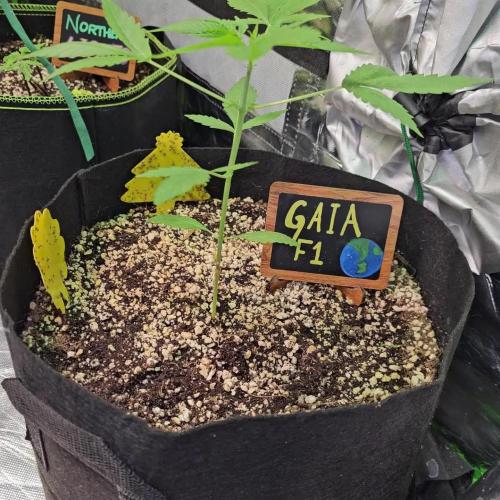
Gaia F1 is looking to be experiencing a bit of a growth spurt, which is nice to see!
Hopefully, she will start progressing a little bit more next week.
The leaves are a nice green colour looking very healthy, very pleased.
I have added an additional 100Watt UVA/UVB lamp, as the uppermost canopy of Acapulco Gold is blocking pretty much everything in the tent.
Hopefully, this will aid the shorter plants in surviving until I can harvest it. There will be so much more space and lighting. Can't wait! 😅
Here is what I did this week.
25.9.25:
I watered with 2L of dechlorinated water PH'd to 6.5 with;
💜 Sea K
PH: 6.5
PPM: 565
The fungus gnats have really increased since I did a watering of the whole tent.
I have some more sticky traps set out, and I will not water for several days.
Once it has dried the top soil, I will add some more Diatomaceous Earth to the top 5cm.
Thanks for checking in this week and see you in the comments 👌💚🙌🧡😁


@High_Grade_Dadli
Follow
Missed last week update but did some cutting girls have to live up to the mission 73 between the 5 plant....added one more which was a cutting from a seed plant harvested previous...didn't look like I did anything so cut dem a few day later 85 between the same plants... only cut the lower half of G4 n smaller inside branches( going to stop they dont hold up well)


@Ultraviolet
Follow
Seedling managing 93F 30%RH, around 20 DLI. Vpd is in the 3's. No I don't recommend.
Signum Magnum.
"A great sign appeared in the sky
a woman clothed with the sun
with the moon under her feet
and on her head a crown of twelve stars.
Sing ye to the Lord a new canticle:
because He has done wonderful things.
Glory to the Father, and to the Son, and to the Holy Spirit
As it was in the beginning, and now, and ever shall be, world without end."
The plant nutrient nitrogen exists in forms with both positive and negative charges. Ammonium (NH4+)(immobile in soil)(Cation) has a positive charge, while nitrate (NO3-) (highly mobile in soil)(Anion)has a negative charge. Nitrogen is unique among plant nutrients in that it can exist in both positively charged (ammonium, NH₄⁺) and negatively charged (nitrate, NO₃⁻) forms in the soil. This makes it a special nutrient. In that it is responsible for providing balance for reactionary trade offs when it comes to ph. Because ph itself in the medium will always slowly drift towards acidicity, such is nature. 80% of nitrogen should be nitrate and no more than 20% ammoniacal nitrogen.
Ca, mg, and K are the big 3 cations related to soil composition, pH & base saturation.
When nitrogen is in the form of ammonium, it can compete with calcium, magnesium, and potassium for absorption sites in the plant root. This competition can lead to a reduction in the uptake of these other essential nutrients. Nitrogen, particularly in its nitrate form (NO3-), can increase soil acidity, which can also affect the availability of calcium, magnesium, and potassium. The form of nitrogen applied (ammonium vs. nitrate) can influence its interactions with other nutrients. Ammonium nitrogen can have a more pronounced negative effect on the uptake of calcium, magnesium, and potassium compared to nitrate nitrogen.
Common forms of ammonium nitrogen include ammonium ion (NH4+), urea, and ammonium compounds like ammonium nitrate, ammonium sulfate, and ammonium phosphate.
Common forms of nitrate nitrogen include potassium nitrate (KNO3), sodium nitrate (NaNO3), calcium nitrate (Ca(NO3)2), and ammonium nitrate (NH4NO3).
Phosphorus is an essential plant nutrient, and its availability in the soil is strongly linked to the presence of oxygen. Plants primarily absorb phosphorus as phosphate (PO4), and oxygen is a key component of this molecule. Furthermore, the availability of phosphorus in the soil can be impacted by factors like soil aeration and temperature, which in turn affect the oxygen supply to the roots.
Phosphorus uptake in plants is most critical during the early stages of growth, particularly within the first few weeks of plant development.
Young plants actively growing tissues have a high demand for phosphorus. They may absorb up to 75% of their total phosphorus requirements within the first few weeks of vegetative growth, with up to 51% of uptake happening overnight, primarily in the first few hours or early nightfall.
⑨Anaerobic root respiration, or respiration without oxygen, is detrimental to plants because it's less efficient and produces toxic byproducts, leading to reduced energy production, nutrient uptake issues, and ultimately, root damage and plant stress.
⑨Anaerobic respiration, unlike aerobic respiration, doesn't utilize oxygen as the final electron acceptor in the electron transport chain. This results in a significant drop in the amount of energy (ATP) produced, which is necessary for various plant functions, including growth, nutrient uptake, and maintenance of cellular processes.
⑨In the absence of oxygen, plants produce byproducts like ethanol and lactic acid during anaerobic fermentation. These byproducts can be toxic to the roots and inhibit their function,
⑨When oxygen is depleted in a medium, the pH tends to decrease (become more acidic) due to the production of metabolic byproducts. This is particularly relevant in biological systems where aerobic respiration relies on oxygen as the final electron acceptor.
⑨When oxygen is scarce, plants may switch to anaerobic respiration. This process produces carbon dioxide (CO2) as a byproduct.
⑨CO2 dissolves in water to form carbonic acid (H2CO3). This acid lowers the pH of the medium, making it more acidic.
⑨Anaerobic conditions can impair a plant's ability to regulate its internal pH, leading to a drop in cytoplasmic pH and potentially cellular acidosis.
⑨The change in pH can also affect the availability of certain nutrients to the plant, as pH influences the solubility of micronutrients like iron, manganese, zinc, copper, and boron.
⑨The lack of oxygen in the plant medium leads to a decrease in pH due to the production of carbon dioxide during anaerobic respiration and impaired pH regulation within the plant.
In plant cells, cellular acidosis, a drop in the internal pH of the cytosol, is a significant stress response, particularly during conditions like flooding or hypoxia. This acidification can be triggered by a decrease in oxygen levels, leading to the production of metabolic byproducts like lactic acid and CO2. The plant's ability to tolerate and recover from these conditions depends on its cellular mechanisms to regulate pH and mitigate the effects of acidosis. When plants are subjected to low oxygen environments, such as those experienced during flooding, anaerobic metabolism, which produces lactic acid and ethanol, becomes the primary source of energy. This can lead to a build-up of these acidic metabolites in the cytosol, causing a drop in pH.
OXYGEN
Atomic oxygen (single oxygen atom, O) is the lightest form of oxygen, as it has the lowest mass of the oxygen molecules. Oxygen also exists as a diatomic molecule (O2) and an allotrope called ozone (O3), which have higher masses due to the number of oxygen atoms combined.
Atomic Oxygen (O):
This refers to a single oxygen atom, which is the most fundamental form of oxygen.
Molecular Oxygen (O2):
This is the common form of oxygen we breathe, consisting of two oxygen atoms bonded together.
Ozone (O3):
This is an allotrope of oxygen, meaning it's a different form of the same element, consisting of three oxygen atoms bonded together.
Since atomic oxygen has the fewest oxygen atoms, it naturally has the lowest mass compared to O2 or O3.
Ozone (O3) Lifespan:
Ozone has a relatively long lifespan in the stratosphere, particularly at lower altitudes. For example, at 32 km in the middle latitudes during spring, ozone has a lifetime of about 2 months.
Oxygen (O) Lifespan:
Atomic oxygen, on the other hand, has a much shorter lifespan. At the same altitude, its lifetime is about 4/100ths of a second.
Ozone-Oxygen Cycle:
The ozone-oxygen cycle involves the rapid exchange between atomic oxygen (O) and ozone (O3). UV radiation can split molecular oxygen (O2) into atomic oxygen (O), which then reacts with O2 to form ozone (O3). Ozone can also be photolyzed by UV radiation, creating atomic oxygen again, which can then react with O3 to reform O2.
Dominant Form:
The partitioning of odd oxygen (Ox) between ozone and atomic oxygen favors ozone in the lower stratosphere. This means that a much larger proportion of odd oxygen exists as ozone than as atomic oxygen, especially in the lower stratosphere.
Recombination:
Atomic oxygen has a high energy and reactivity. When it encounters another oxygen atom, they can combine to form O2. This process releases energy, contributing to the heating of the atmosphere.
Ozone Formation:
Atomic oxygen can also react with molecular oxygen (O2) to form ozone (O3). Ozone plays a significant role in absorbing harmful UV radiation.
Other Reactions:
Atomic oxygen can react with various other molecules in the atmosphere, like nitrogen (N2), water (H2O), and carbon dioxide (CO2), forming different compounds.
UV light below 240nm (peak 185nm) creates ozone (O₃) through a process called photolysis, where UV light breaks down dioxygen molecules (O₂) into single atomic oxygen atoms (O). These single oxygen atoms then react with other oxygen molecules to form ozone (O₃). Specifically, UV-C light with wavelengths shorter than 240 nm can cause this photolysis.
UV light with wavelengths between 240-280 nm, (peak 254 nm) breaks down ozone (O₃) into dioxygen molecules (O₂) and atomic oxygen atoms (O). 280nm does not have the energy potential to break apart the stable bond of (O₂) into enough (O) to make (O₃)
At ground level, atomic oxygen (single oxygen atoms) has a very short lifespan. This is because it's highly reactive and quickly combines with other molecules to form stable diatomic oxygen (O2) or other compounds. While the exact timeframe varies depending on the specific circumstances, its lifespan is typically measured in nanoseconds or picoseconds.


@AsNoriu
Follow
Day 22. Girl is getting somewhere ;))
Finally got fan and he is noisy, so no wind supplement for this girl ...
Planning to water her today . 50 ml of 6.3 pH water will go in.
Last video when i turn pot upside down, if any roots will appear - i will write here.
Day 26. Side branches started to grow, no sex signs yet ....
Day 27. 70 ml 6.3 pH water in. I got my "in" too ;)))
Happy Growing !!!


@SkunkyDog420
Follow
Hallo zusammen 🤙.
So das war es für sie.
Wir sehen uns in 3 Wochen mit dem Erntebericht wieder.
Bis dann
Rabattcode für den BIOTABS-Webshop https://biotabs.nl/en/shop/ GDBT420, damit erhalten Sie 15 Prozent



@DadasGrow
Follow
So this is the start of the fourth week with me. I find this very engulfing. I like spending an hour with them a day and move the little ones out of the bigger fan leaves shadow by tucking the larger ones away giving the little ones a chance to get more light and flourish. I’m noticing more the strain my one girl went through compared to the others, her leaves being smaller than the other girls. I’ve tried to give them the best environment I can and realize I still play a huge role in their life. This is my first grow and I love it. I hope they grow up well and flourish. They were fed last week and had a bit of nutrient burn so this week I gave them just water. I’m not sure how much longer I should veg but I hear in the scrog game the longer you veg the better. Hoping for the best for everyone on GrowDiaries and their grows!


@Smith420
Follow
Still waiting for amber colors before I harvest watching daily. Watering with just Poland spring as needed and will will allow soil to dry up a day or two prior to harvesting. As usual I hope everyone nothing but the best and appreciate each one of you. Have a great day!!


@valiotoro
Follow
Hello everyone week 6 of flower has passed for this Cinderella Jack auto 👸🏼
Its the last week for my princess she’s ready 🤩
Mars hydro SP-6500 power 75%
have a great day and wish you all happy growing 😎👨🌾🏻


@maxpain
Follow
Its week 10 ....6 week of flower first grow and its orgainic...looking good smelling good ...cant wait to smoke it....