Likes
Comments
Share
@Alvareas
Follow
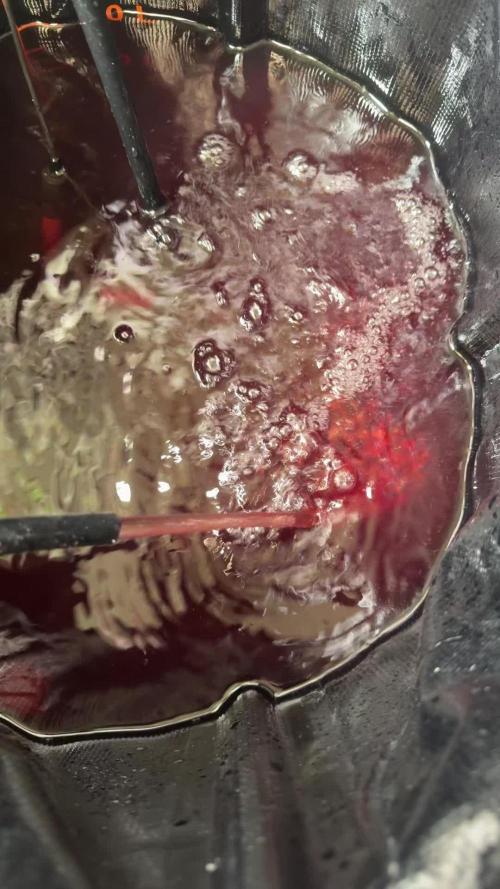
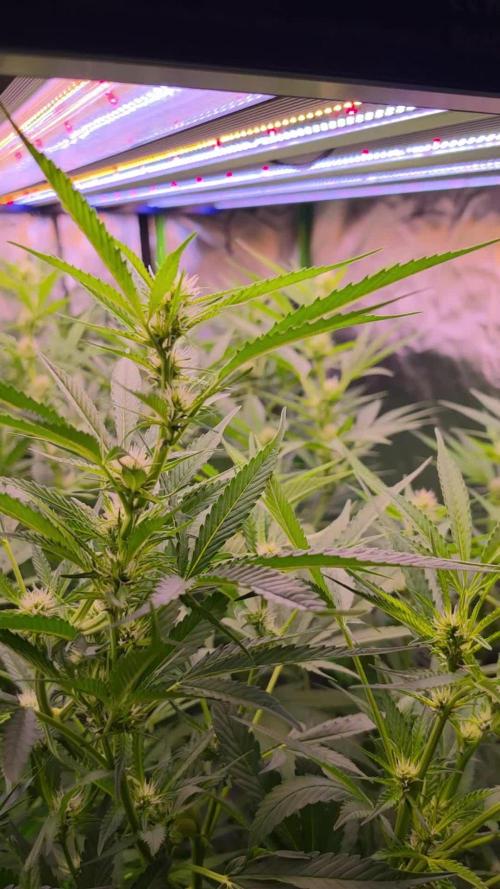
Woche 4 / Vegi Woche 3 Der Grow: Am Anfang der Woche wurde das erste Mal getoppt. Ziel des toppen war es, 6 neue Haupttriebe zu haben. Da die Triebe der ersten Nodien viel kleiner waren, als die der zweiten, habe ich solange gewartet, bis die Triebe der vierten Nodien, so große Blätter hatten, dass sie nachdem toppen, gleich mit Photosynthese beginnen können. Dann wurde über den vierten Nodien getoppt und die Triebe, samt Blätter, der ersten Nodien entfernt. Die Pflanze hat das toppen gut verkraftet. Ich mache von jeder Woche Zeitrafferaufnahmen und man konnte sehen, dass alle Triebe gleich nach dem toppen weitergewachsen sind. Den Rest der Woche, habe ich die Pflanze, einfach wachsen lassen. Die Triebe haben sich gut entwickelt und die Pflanze ist wie erwartet kompakt geblieben und extrem buschig geworden. Vermutlich werde ich in der nächsten Woche, die 6 Haupttriebe erneut toppen, um auf 12 Haupttriebe zukommen. Dazu aber im nächsten Update mehr. Im letzten Update hatte ich geschrieben, dass ich die Bodenfeuchtigkeit, versuche bei 55% zuhalten. Dies scheint jedoch zu viel zu sein. Nachdem ich die 55% einige Zeit gehalten habe, wurde der Topf, in der Drainageschicht, sehr nass. Ich hatte zwar noch keinen Drain, aber das der Topf in dem Bereich sehr nass war, hat mir gezeigt das sich dort Wasser sammelt. Aber eigentlich sollte der Bereich trocken sein. Deshalb habe ich die Bodenfeuchtigkeit langsam gesenkt und peile jetzt die 50% an. Man konnte auch sehen, dass sich die Blätter im Verlauf des Tages nicht mehr komplett aufgestellt haben. Sondern ehr leicht nach unten hingen. Was für eine beginnende Überwässerung spricht. Mittlerweile ist der Bereich der Drainageschicht, wieder komplett trocken. Den VPD habe ich im laufe der Woche langsam erhöht, bis auf 1,4kpa am Ende der Woche am Tag und auf 1kpa in der Nacht. Diese Werte werde ich jetzt so weiter fahren, bis zur Umstellung auf die Blüte. Der DLI wurde am Anfang der Woche auf 30 erhöht. Die Parameter in Woche 4: Durchschnittliche Tagestemperatur: 27 Grad Durchschnittliche Nachttemperatur: 22 Grad Durchschnittliche Luftfeuchtigkeit Tag: 63% Durchschnittliche Luftfeuchtigkeit Nacht: 61% Durchschnittliche Bodenfeuchtigkeit: 53% LED Leistung: 30% = 110 Watt Beleuchtungsdauer: 18 Stunden DLI: 30 Controller Einstellung Tag: Advanced AI VPD 1,4 Controller Einstellung Nacht: Advanced AI VPD 1,0 Durchschnittlicher VPD Tag: 1,3 Durchschnittlicher VPD Nacht: 1,0 Umluft: Stufe 1 oszillierend
Likes
Comments
Share
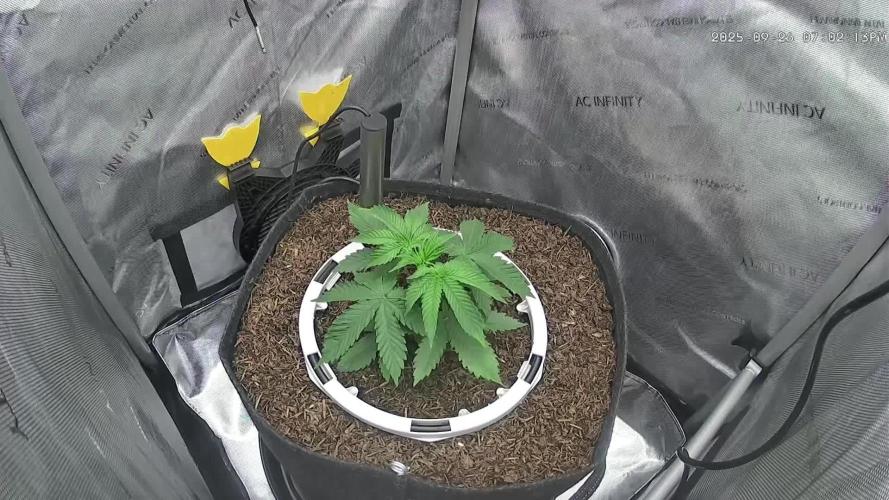
Jan 23: soaking the autoflowering seeds 1 Thin Mint (TM) 1 Northern light (NL) Jan 24: paper towel Jan 26 NL sprouted EDIT : None of the Thin Mints seeds made it I had a lot of problem with the paper towel going dry since it's so dry here now in the middle of winter.
Likes
8
Share
Ganja Farmer Seeds - AK 2.0 XL auto Day 19 from sprout Starting on week 3 soon Light: ViparSpectra XS2000 Watering every other day to every 2 days Started LST on the GaniaFarmer seeds. They have much faster growth than the Fastbuds growing in the same 4x4. I decided to LST only and not top the Ganja Farmer seeds. See you next week!
Likes
2
Share
We are around week 4-5 and everything going as planed. Going to start the mainline before next feed. Only having to water 2-3 times a week.
Likes
4
Share
🌿 LSD — Week 9 from Seed (Week 6 Flower) 12/12 from Seed | Photoperiod Genetics behaving differently āø» Quick Recap — Understanding the Structure These are photoperiod plants, but grown 12/12 from seed, which changes everything. From the very beginning, they grew under the signal of: ā€œThe season is ending.ā€ Because of that, instead of building long vegetative structures, they: • prioritized vertical growth early • reduced lateral expansion • focused on reproductive sites sooner šŸ‘‰ What we’re seeing now is the result of that decision: • a dominant central cola (main ā€œcollarā€) • symmetrical but limited side branching • a very uniform structure across all three plants And honestly… they look like magicians because they adapted perfectly to the rules they were given. āø» 🌸 Current State — Week 6 Flower • Bud formation: clearly established, stacking nicely • Early frost: already visible → great sign for terpene/resin development • Structure: clean, upright, central dominance • Stem strength: very solid — supporting weight without stress • Defoliation: light work done to improve airflow and light penetration There’s also something interesting: šŸ‘‰ These plants show a strong tendency to throw roots from stems/branches That’s a sign of vigorous internal energy and high adaptability āø» 🌱 Environment & Philosophy • Room: 28°C / 68% RH • Outside: ~10°C / 87% RH Given the external conditions, stability inside the room is actually very solid. And this is important: We don’t chase numbers. We observe them. • Focus is on plant response, not just meters • We aim for leaf VPD, not just room VPD • Right now → conditions are within a healthy working range āø» Feeding No changes this week. The current feeding schedule is: • stable • well-tolerated • supporting healthy development šŸ‘‰ When something is working, we don’t interfere. āø» šŸŽ­ New Team Member This week we officially welcome: Mr. Baggy šŸ‘œ He’s here, he’s learning, and he’s already part of the process. (Photos included in this update) āø» šŸ”® What to Expect (Next Weeks) • Bud swelling phase continues • Resin production increases significantly • Aroma profile begins to fully express • Minimal structural changes from here on Because of the 12/12-from-seed structure, don’t expect: • massive lateral expansion • large canopy reshaping šŸ‘‰ This run is about refinement, not expansion āø» āš ļø What Not to Expect • No explosive stretch (that phase is done) • No heavy training interventions • No drastic feeding changes unless needed We stay consistent. We observe. We adjust only if the plant asks. āø» About the Genetics (Why they behave like this) These LSD genetics are showing: • strong apical dominance • efficient energy allocation to the main cola • early transition to reproductive mode under 12/12 šŸ‘‰ In a normal veg cycle, these plants would likely: • branch more • widen their structure • delay flower development But here, they adapted to a compressed timeline — and it shows beautifully. āø» šŸ™ A Note to the Community To: • longtime followers • new visitors • curious growers • supporters, skeptics, lovers, haters Everyone has a place here. Big thanks to: • the GrowDiaries platform • the breeders behind the genetics • the sponsors supporting the journey • and the entire growing community āø» 🌿 Closing Things are moving fast now. From here on, it’s about: • observation • patience • and letting the plant finish its story And honestly… they’re doing it beautifully. šŸ“” DELETED @ 1K Please stay tuned.we never quit https://www.youtube.com/@DOGDOGTHEDOCTOR NEW šŸ™ Thank you for your patience and continued support. FOR DISCOUNT CODES AND MORE JUST FOLLOW THE LINK https://website.beacons.ai/dogdoctorofficial šŸ“² Don’t forget to Subscribe and follow me on Instagram and YouTube @DogDoctorOfficial for exclusive content, real-time updates, and behind-the-scenes magic. We’ve got so much more coming, including transplanting and all the amazing techniques that go along with it. You won’t want to miss it. GrowDiaries Journal: https://growdiaries.com/grower/dogdoctorofficial Instagram: https://www.instagram.com/dogdoctorofficial/ YouTube: https://www.youtube.com/@dogdoctorofficial Deleted by Youtube Vimeo : https://vimeo.com/dogdoctorofficial Under construction stay tuned āø» Explore the Gear that Powers My Grow If you’re curious about the tech I’m using, check out these links: šŸ”† Lighting & Environmental Control • Future of Grow — Advanced LED lighting technology https://www.futureofgrow.com/ DISCOUNT CODE: DOG20 • Lumiflora — Under-canopy LED lighting https://lumiflorade.com/ • TrollMaster — Environmental controllers and automation gear (past collaboration) āø» Genetics • Zamnesia Seeds — Genetics used in this project https://www.zamnesia.com/ āø» 🌱 Soil, Substrates, Boosters & Root Support • Plagron — Substrates, bio mixes, and supportive products https://plagron.com/en/ āø» šŸŽ’ Storage, Curing & Preservation • Grove Bags — Curing and storage solutions https://grovebags.com/ āø» šŸ“ø Photography Equipment & Tools (Not sponsors, but part of my creative toolkit) • Sony A6700 • Sony full-frame macro lens + few more • Stacking photography workflow - learning • iPhone (for behind-the-scenes shots) We’ve got much more coming as we move through the grow cycles. Trust me, you won’t want to miss the next steps, let’s push the boundaries of indoor horticulture together! As always, this is shared for educational purposes, aiming to spread understanding and appreciation for this plant. Let’s celebrate it responsibly and continue to learn and grow together. With true love comes happiness. Always believe in yourself, and always do things expecting nothing and with an open heart. Be a giver, and the universe will give back in ways you could never imagine. šŸ’š Growers love to all šŸ’š šŸ“ø P.S. – The Eye Behind the Lens All photos in this diary (for now — except for the ones showing the camera, which I took with an iPhone) are taken with a Sony A6700 paired with a Sony full-frame macro lens and a few more. Photography is part of the story — it’s how we share the fine textures, the glow, and the quiet details that words can’t always capture. I’ve also started experimenting with photo stacking — a technique where multiple images, each taken at a slightly different focus point, are layered together to create one perfectly sharp image from front to back. It’s not digital enhancement or AI; it’s pure photography — a way to reveal the plant’s beauty in microscopic depth, from trichome to petal. You’ll even see a few shots of "ghost me" capturing the shots — camera, lens, setup — because every grow deserves not just to be cultivated, but documented like art. FOR DISCOUNT CODES AND MORE JUST FOLLOW THE LINK https://website.beacons.ai/dogdoctorofficial NEW DISCORD - Official Server Invite Link : https://discord.gg/ksjAkA5T74
Likes
12
Share
Likes
10
Share
Likes
12
Share
Eccoci qui... Tutto va per il meglio, questa settimana ho eseguito Lollipopping e Defoliation per far si che le cime principali sprigionino al meglio il loro vigore. Siamo verso la fine del progetto ora bisogna solo aspettare la fine... Grazie a tutti per il supportošŸ”„šŸŒ²ā¤ļø
Likes
36
Share
@Cauli
Follow
Passion Fruitz was chopped after 81 Days. The separated branches were hung into a tent to dry for around ten days at 18°C and around 45-55% percent humidity. After that they were put into a jar and dry trimmed. Vape Review will follow :)
Likes
12
Share
I have at least 3 weeks to go on this Green Poison, hoping the Ohio weather holds out for me āœŒļøšŸŒ±āœŒļø
Likes
50
Share
@Ferenc
Follow
Day 79, 28th of November 2020: If I say I was very excited to grow her then it is true. She is like a very sweet and adorable animal so quiet and no problem with her at all. You know what I mean..... No any issue she grows creating nice buds not big strech.... Totally perfect for begginners..... I am very happy about it. She was a great decision to be grown ;) Fertilization is still the same every second day with the rationand mixture above stated. The lamp is on 11.15 min and off 12.45 min. Last week was 15 min longer light cycle.... So every week 15 min shorter light cycle until the 5th week. So far -45 min. It switches on at 6 am and off at 17.15 pm.
Processing
Likes
6
Share
5 out of 6 ended up female, pretty happy with that ratio, last week of 12 hour light 12 hour dark week 3 I change to 11/13 to mimic season ending sooner or island (hawaiin) sun cycle that is supposedly known to help express phenos more and make plant finish quicker. a tip i heard from dj short
Likes
17
Share
@Tazard
Follow
I let her go another week. The trichome photo was on Wednesday and I was just starting to amber. I’ll harvest her today 22/2/2020 and then do a harvest report in a couple weeks after she’s cured up some.
Likes
2
Share
The thoughts shared in this journal are my own—a snapshot of personal understanding at the exact moment of writing. It is not intended as a reference of absolute fact, but rather as an exercise in ἐπίνοια (epinoia): an exploration of thought, intuition, and creative insight. Epinoia(ἐπίνοια) is a Greek term meaning thought, intention, purpose, or conception, stemming from "mind" (nous) and "upon" (epi), representing the mind's reflective or creative process, used in philosophy (Aristotle, Gnosticism) and theology to discuss understanding and divine names, appearing once in the New Testament for the "intent of your heart" (Acts 8:22). It signifies the mind's operation to form ideas or designs, contrasting with raw data or innate perception, and in Gnosticism, it's an emanation of divine wisdom (Sophia). "Φsis" is a stylized spelling of the Ancient Greek word Ļ†ĻĻƒĪ¹Ļ‚ (physis), which translates directly to "nature" or the intrinsic essence of a living thing. Exploring the deep intersection of science, intuition, and creative insight often leads to breakthroughs that challenge our understanding of what is possible. When we approach high-performance cultivation not just as a hobby, but as an exercise in pushing a biological system to its absolute genetic ceiling, the results can transform from simple data points into profound proof of concept. Achieving a highly optimized environment requires a shift in mindset away from empty promises and directly toward verifiable proof, building true confidence through a detailed archive of past lessons and strategic adjustments. This philosophy turns a standard space into a precise mass and energy balance equation, where every variable is managed to eliminate biological bottlenecks entirely. In a recent project four individual plants produced 344 grams, 280 grams, 445 grams, and 255 grams respectively, resulting in a total harvest of 1,324 grams, or 47.2 ounces, of dry product. Operating with a 600-watt light source inside a four-by-four footprint, this brings the final efficiency to an exceptional 2.21 grams per watt. To put this in perspective, the standard traditional indoor benchmark has long been established at 1.0 grams per watt, while expert commercial operations target 1.5 grams per watt, and elite commercial systems push the envelope between 1.8 and 2.0 grams per watt. Reaching 2.21 grams per watt places the outcome squarely within the top 0.1 percent of global benchmarks, acting as a true statistical outlier that demonstrates what happens when flawless environmental parameters meet a cultivar pushed to its maximum potential. Reaching this level of mastery demands that we move past the common trap of the mirror fallacy, where the ego mistakes its own limited perspective for universal truth and views different ideas as personal threats. True progress requires curiosity and dismantling the illusion that our immediate viewpoint is the objective standard, shifting the focus instead toward how a system actually operates under the absolute laws of physics. In a high-performance setup, maximizing output is never about adding random additives or forcing growth, but rather about systematically removing the limitations that hold the organism back. By maintaining a perfect vapor pressure deficit, ideal root-zone oxygenation, and precise structural canopy training every single minute of the cycle, the plant is freed to express 100 percent of its DNA potential without any lingering genetic latency. Managing a dense canopy inside a tight footprint presents the ultimate challenge of mitigating stagnant air and preventing moisture issues. Overcoming this bottleneck relies on a sophisticated synganic approach, which seamlessly marries the precise control of synthetic mineral inputs with the natural resilience of active organic living soil. This method transforms the room into a closed-loop system where the internal microclimate is entirely isolated from external weather fluctuations and pests. Rather than openly exhausting the atmosphere, the air is continuously recirculated, enriched, and scrubbed using 264-nanometer ultraviolet light. The foundation of this thriving ecosystem is a comprehensive substrate composition designed to provide perfect aeration, structural integrity, and biological buffering. The primary media base integrates expanded clay aggregates, coir chunks, premium coco coir, sphagnum peat moss, horticultural perlite, vermiculite, pumice, and volcanic basalt rock. To continuously condition the soil and fine-tune mineral availability, the mixture is amended with agricultural gypsum, wollastonite, dolomitic limestone, basalt rock dust, micronutrient-rich volcanic ash, greensand, crushed seashells, biochar, and shungite. This mineral architecture creates an incredibly stable environment where active soil biology naturally prevents salt toxicity and ensures steady, reliable nutrition throughout the entire life cycle. Living organisms within the substrate play a vital role in maintaining this delicate biological balance and breaking down organic material. Red wigglers continuously process organic matter into easily accessible plant nutrients while aerating the media; specialized predatory mites offer excellent biological control against common soil pests, and pillbugs excel at breaking down tough, woody elements. These biological components are further supported by a rich layer of organic amendments including high-phosphorus steamed bone meal, high-nitrogen dehydrated blood meal, fish bone meal, cold-processed kelp meal, dehydrated moringa powder, spirulina powder, and marine crustacean biomass rich in chitin. Combined with biological inoculants like mycorrhizal fungi, premium worm castings, and concentrated humic and fulvic acids, the entire system operates as a flawless biological transducer of light and energy. Ultimately, shifting our perspective to view a grow space as a complete mass and energy balance equation changes the entire nature of agriculture. Success ceases to be a matter of luck or anecdotal habits and instead becomes the predictable result of meticulous design, patience, and the strategic elimination of failure. When science, biology, and engineering converge so harmoniously, we gain a deeper appreciation for the intricate natural systems that sustain life and growth. By sharing these detailed insights and refining our techniques, we can continue to unlock the absolute maximum potential hidden within the living world around us. Comprehensive Substrate Composition: 1. Substrate Base & Aeration Media Expanded Clay Aggregates (Hydroton Pebbles) Coir Chunks & Horticultural Coco Coir Sphagnum Peat Moss Horticultural Perlite Horticultural Vermiculite Horticultural Pumice Volcanic Basalt Rock 2. Mineral Amendments & Soil Conditioners Agricultural Gypsum (Calcium Sulfate) Wollastonite (Calcium Silicate) Dolomitic Limestone (Calcium Magnesium Carbonate) Basalt Rock Dust (Trace Mineralizer) Azomite (Micronutrient-Rich Volcanic Ash) Glauconite (Greensand) Crushed Seashells (Calcium Carbonate Source) Pyrolyzed Carbon Feedstocks (Biochar & Horticultural Charcoal) Elite Shungite (Carbonaceous Mineraloid) 3. Organic Nutrient Amendments Steamed Bone Meal (High Phosphorus) Dehydrated Blood Meal (High Nitrogen) Fish Bone Meal (Phosphorus & Trace Calcium) Cold-Processed Kelp Meal (Ascophyllum nodosum) Dehydrated Moringa Oleifera Powder (Botanical Nutrient) Spirulina Powder (Arthrospira platensis / Cyanobacteria Nutrient) Marine Crustacean Biomass (Shrimp & Crab Chitin) 4. Biological Inoculants & Organic Acids Mycorrhizal Fungi Inoculant (Endomycorrhizae / Ectomycorrhizae) Vermicompost (Premium Worm Castings) Humic & Fulvic Acids (Concentrated Humates) Human Body 65% Oxygen (in all liquids and tissues, bones, and proteins) 18% Carbon (everywhere) 10% Hydrogen (in all liquids and tissues, bones, proteins 3% Nitrogen (in all liquids and tissues, proteins 1,5% Calcium (lungs, kidney, liver, thyroid, brain, muscles, heart, bones) 1% Phosphorus (urine, bones, DNA) 0,35% Potassium (enzymes) 0,25% Sulphur (proteins) 0,15% Sodium (in all liquids and tissues) (in terms of salt) 0,05% Magnesium (lungs, kidney, liver, thyroid, brain, muscles, heart) Plant Mother-nutrients: Carbon 47%, Oxygen 43%, Hydrogen 4%. Macro-nutrients: Nitrogen 3%, Phosphorus1%, Potassium1%, Calcium1%, Magnesium0.5%, Sulfur0.5%. Micro-nutrients: All the rest combined 1% More energy, more blueprint. Although CO2 is a naturally occurring gas that both humans and plants use, it is invisible and odorless and can be fatal at high-levels. If you’re supplementing carbon dioxide in your grow room, ensure there are no leaks in any CO2 devices and always use a CO2 monitor and alarm. 0.02% Life unsustainable 0.03% Life OK 0.04% Current ambient atmospheric co2 0.04%-0.1% =400-1000ppm standard indoor co2. 0.1%-0.2% = 1000- 2000 ppm (prolonged exposure: drowsiness). 0.2%-0.4% = 2000-4000ppm (Headaches, fatigue, stagnation, stuffiness, poor concentration, loss of focus, increased heart rate, nausea). 1% is toxic 5% is quick death. "Dabo vobis quod oculus non vidit, nec auris audivit, nec manus tetigit, quod in cor hominis non ascendit."
Likes
14
Share
This lady has been Transplanted on day 39 since she was planted (may 10th) and I've prepared the 15L pot with the complete line of biotabs using 2 spoons of startrex for every 5L, sprinkled a couple of grams of mycotrex on the transplant hole before putting the plant and then I added 3 slow release tabs one biotab for every 5L of soil, so that's why in this case I added 3, after the Transplant was done I immediately watered the plant with 1ml/L of orgatrex and 1g/L of bactrex, I hope you guys enjoy my work this season!!
Likes
13
Share
Pues esta es la última semana el sÔbado 12 corte las red mandarine y hoy martes le toca a la 8 ball
Likes
5
Share
She performs and performed exceptionally well! First try with HST and she did not disappoint šŸ‘ šŸ™Œ. An absolute joy 😊 .. From start to finish she was not a mission at all..
Likes
5
Share
@MMorrelo
Follow
finally have some time for my plants. i will upload some photos and videos this week! ------------- updated again i spotted male flower on one of the branches removed it immediately (it was immature), after removal i peeled it in other room with gloves and was sure it was 100% male flower because it was not like calyx inside. its the 2nd time i find male flower on plant number 1, very strange i never saw plant only popping one random male flower. i thought plant would just be hermie and it would have a lot of male flowers. the plant is 100% female but popped random male flower again. It is late flower of this strain and i think i can handle this problem and finish that plant. Any expert ideas? any of readers encountered this problem? p.s. sorry for bad english, it is not my native.
Likes
2
Share
@PapaTerps
Follow
Blue Zushi - Dutch Passion Day 96 - Watered with 3 litres of RO tap water, with defined nutrients, pH'd to 6.3. She required extensive defoliation this week, to allow more light to reach the lower bud sites. She is bulking really well and is probably just about finished, so I'm expecting her to begin the maturity process now šŸ‘šŸ»