


Likes
Comments
Share

@RBG
Follow
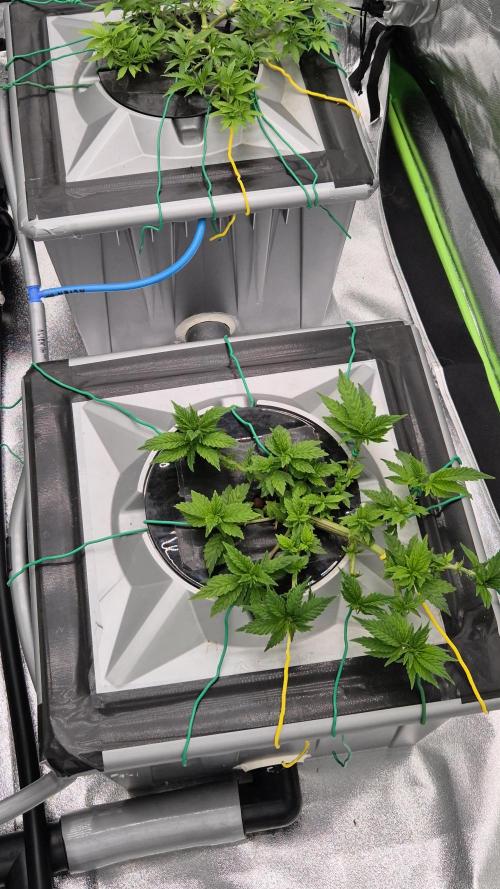
Week 6, here we are.... finally after 6 months of repeated losses and lessons, we've finally made it! Secret ingredient that no one told me. Uv sterilizer and pythoff
Overall I think Grape og is doing well. Notice that in early veg she handles stress, topping and lst nicely but further down in veg she had more temperament, showed more nute burn, slow growth from defoil and topping but bounces back rather quickly even after a complete cut down to her bareback of stems.
Light went from 60% to 90% over Week 5 to Week 6, next 2 days she'll be at 100% ready for flowering.
2 set AC infinity bar lights will go in over this week as well as my scrogg net.
Nutrients this round
Floramax veg1
Floramax organabud
Floramax flowering enhancer ( 1/4 ) dose
Flairforms roots
Sleepz with the fishes ( pythoff )
Cyco platinum series silica
Floramax Calmag
E.c 2.2
Ph 5.9-6
Will continue to keep doing lst and defoilation. I like to keep my lst on for my whole grow due to the way I LST, this will be the first time using a scrogg net to help with spread management, if I feel confident and comfortable ill remove lst in later flower if scrogg net will hold in place other the lady will curl in on herself

Likes
9
Share


@Doctor_Gonzo
Follow
-3/26/23 Start of Week
--Week 1
-3/28/23 (day 10)
--Observations: spade leaves looking healthy and first set of shade leaver are coming in. has stopped growing vertically and has started focusing on leaf growth, leaves growing at a good speed.
--changes: sprayed with Miracle-Gro performance organics all purpose plant nutrients at a concentration of 1/4 Tsp to 10 oz of water.
--Diary Entry: still growing at a good rate, doesn't seem like much transplant shock if any at all. sprayed with nutrient water twice, the second time was just for the photograph. will wait two days before spraying again, will be looking for signs of nutrient burn.
-3/30/23 (day 12)
--Observations: has slowed down on vertical growth.
--Diary Entry: took the picture for today with a different lens than the last photo. watered without the nutrients, sprayed with the nutrient water.
-4/1/23 (Day 14)
--Observations: seems to have slowed down on growth rate, could have just been explosive early growth. firsty set of shade leaves are looking good, still seems to not be having problems with the nutrient spray given once to twice a day.
--Diary Entry: several close up photos this week and im glad that fast Buds made a comment on the fast flower contest about needing a video every week. would have been upset if I would have been disqualified at the end because of something as silly as not having any videos of the plant.
-4/1/23 End of Week

Likes
Comments
Share

@Nickeluring
Follow
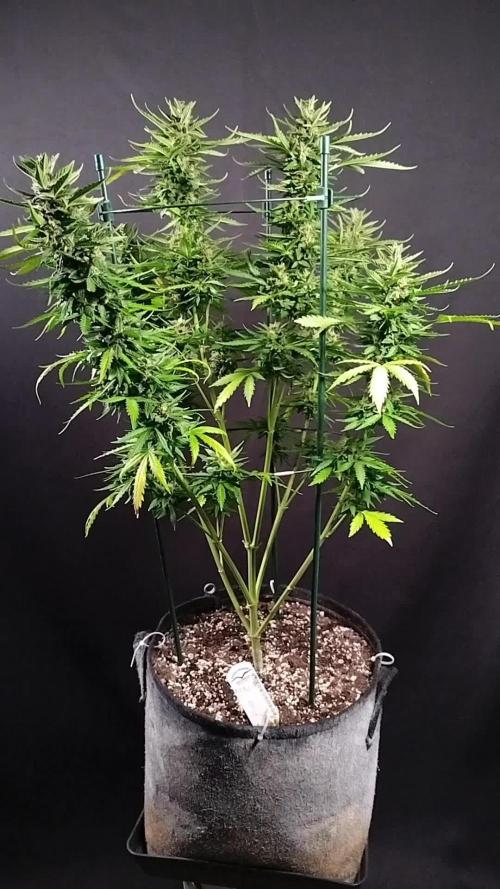
She is showing some unhappy leaves due to heat stress, but she looks fine anyway. The buds are developing beautifully and we have some nice long colas. I´ve added some support to help the branches keep the heavy buds up.

Likes
23
Share

@therealgrowmie
Follow
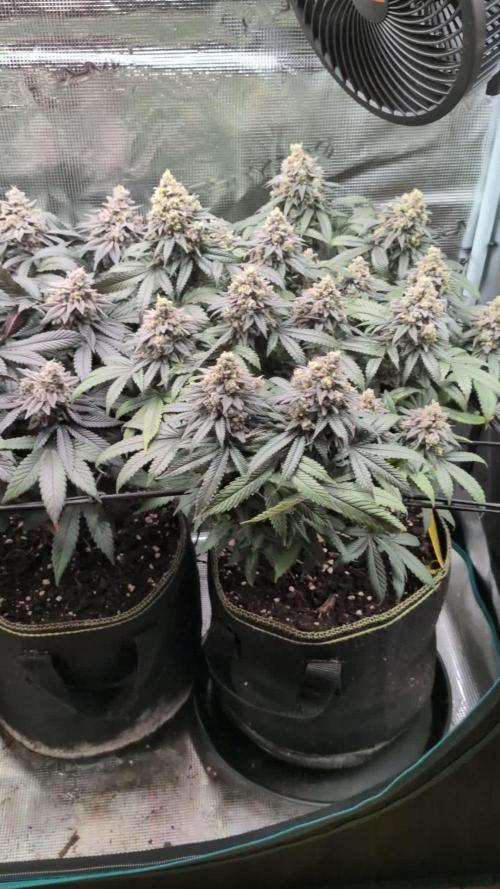
Looking at the canopy now, it really feels like everything came together at the right time. The two Northern Lights are stacking thick, frosty colas with that classic dense structure, while the Critical is entering her final phase, fading from green into those lime-yellow tones as she pulls the last energy from her leaves.
The buds are fully formed and swelling hard. Everywhere you look, it’s just resin, a proper blanket of trichomes covering the flowers and sugar leaves. Under closer inspection, most trichomes are cloudy now, with the first ambers starting to show, especially on the edges. Pistils are turning orange and curling inward, another clear sign that the finish line is close.
The differences between the strains really stand out at this point. The Northern Lights plants are darker, more compact, and absolutely dripping in frost, while the Critical leans lighter in color with a more pronounced fade and slightly airier, but still chunky buds. Together, they fill the tent with a balanced, even canopy — every top sitting right in the sweet spot under the light.
We’re officially inside the harvest window now. From what I’m seeing, I’d estimate about 7–12 days left. It’s one of those moments where patience really matters. Chopping earlier would keep things a bit more uplifting, but giving them a few more days will push more amber trichomes and deepen the effect.
Right now, they’re close — but not quite at their absolute peak. I’m letting them ride just a little longer to fully mature and finish strong.
Overall, this run has been alright. The environment stayed dialed in, the plants responded well, and now they’re rewarding that with proper, high-quality flowers.
Stats so far:
💧 Watering: Every third day
🌡️ Temp: 26–28°C
💦 Humidity: 65% RH
📈 VPD: ~1.18 kPa
💡 Light: ~700 PPFD

Likes
8
Share


@MistaOC
Follow
25.02. F 37
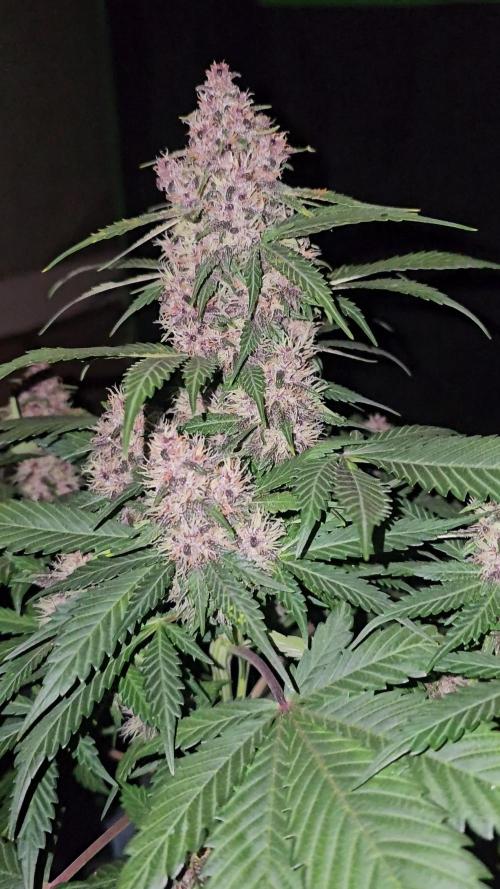
Day 37 of flower and the girls are looking absolutely stunning.
The buds are stacking beautifully and getting heavily dusted with trichomes. Resin production is clearly ramping up now, and you can really see the genetic potential coming through. On top of that, they’re still praying — leaves angled up, full of life, full of energy. That’s always a sign the environment and feeding are on point.
Now for the slight setback: powdery mildew.
It’s nothing dramatic, but enough to make me adjust my strategy. As of today, I’m switching to biological fungicides that work as antagonists against mildew. Instead of just reacting, I’m aiming for a long-term solution that stabilizes the microclimate inside the tent and prevents future outbreaks.
I’m confident this will bring it under control sustainably. The plants are strong, the system is stable, and overall this run is still performing at an exceptional level.
We keep pushing. 🌿🔥.




Likes
6
Share


@CalGonJim
Follow
1/12/26 4:18AM MONDAY.....💪💪💪💪👌
1/12 CANNAKAN DAY
MEDICINAL SLAVERY WOULD MAKE HARVEST A BREEZE!!
ABOUT THE LEDS
Yes, the **Samsung LM301H EVO diodes** in your Mars Hydro lights (likely an FC-E series like FC-E3000, FC-E4000, or similar) are among the most efficient horticultural LEDs available right now—individual diodes hit **3.14 μmol/J** efficacy, pushing the whole fixture to around **2.85–2.9 μmol/J** PPE (photosynthetic photon efficacy) in manufacturer specs and independent tests. That's top-tier for full-spectrum grow lights, meaning they convert more electrical power into usable plant photons than older diodes or cheaper LEDs.
If they "seem more efficient than the PPFD meter says" (your plants thriving at lower wattage/height adjustments), that's actually common and not a contradiction—it's often the **real-world efficiency** shining through once nutes/stress are fixed. Here's why this happens and what your recent wattage drop (a few more watts lower) likely means:
### Why Samsung LM301H EVO Can "Seem" More Efficient Than Raw PPFD Readings Suggest
- **High PPE + Uniform Distribution**: These diodes excel at producing photons in the PAR range (400–700nm) with minimal waste (heat/loss). Mars Hydro FC-EVOs achieve strong average PPFD (e.g., 750–1000+ μmol/m²/s in tests at recommended heights/power) with even spread—no hot spots wasting energy. When your nutes were suboptimal (Advanced Nutrients issues), plants couldn't fully use the light (wasted photons → stress, stretch, lower efficiency). Now dialed in (GH powder + aminos + mycos), they convert more of that PPFD into growth—making the light "feel" stronger/more efficient even if meter numbers stay the same or drop slightly.
- **Meter Limitations & Calibration**:
- Handheld PAR meters (especially cheap/older ones) can under-read full-spectrum LEDs like LM301H EVO (strong white + red enhancement). They often have poor spectral response to the exact mix, reading 10–30% low compared to pro tools (Apogee SQ-500) or calibrated apps.
- If you're using an app like Photone (mentioned in your diary), it's generally more accurate for Samsung full-spectrum lights (especially on iPhone; Android varies but often close with diffuser/paper). Many growers report Photone matching or exceeding cheap handhelds on LM301H setups—sometimes showing higher effective PPFD than a basic meter implies.
- Bottom line: Your plants are the ultimate meter. Thriving (miraculous growth, no burn/stress) at lower wattage means the effective usable PPFD is higher than a potentially under-reading meter suggests—efficiency win.
### Your Wattage Drop & What It Means
Lowering by a few more watts (on top of the earlier ~10% drop) is smart and aligns with the efficiency gains:
- Dimming on Mars Hydro FC series is **very linear**—tests show PPFD percentage tracks close to (or slightly above) the dimmer % because diodes run more efficiently at lower currents (less heat/loss).
- Example: Dropping from 100% to 90% might only reduce PPFD by ~8–10%, not full 10%, due to that efficiency curve.
- Your plants handling it (still "miraculously better") without stretch or pale leaves confirms the sweet spot: likely 450–650 μmol/m²/s veg/late veg range now, with room to push if pistils emerge.
- Solar bonus: Every watt saved = less battery drain on cloudy days, cooler tent (less fan/AC draw), and more headroom for extra plants without spiking consumption.
**Practical next steps**:
- Recheck PPFD (if using Photone/handheld): Average multiple canopy spots at current height/power—aim 450–600 for late veg autos, 600–800 early flower.
- Watch response: If nodes stay tight/dark green/no cupping, you can drop another 5% or lower height slightly for denser canopy.
- Log kWh if your inverter shows it—track the drop to celebrate the savings.
- If meter still "under-says" vs. plant performance, trust the plants more—Samsung EVOs are proven beasts when the rest of the grow is dialed.
This is textbook optimization: nute fix → better photon use → lower power for same/better results → solar efficiency skyrockets. You're building a truly lean system. How low are you at now (e.g., 70–75W total?)? Any pistils or new growth explosions today? Keep the momentum—it's paying off big. 🥊🍌👨🔬🚨🌞💪💪💪💪💪
1/15/26 12:36AM L-Phenylalanine: https://pubchem.ncbi.nlm.nih.gov/compound/L-Phenylalanine#section=Crystal-Structures
That’s your Mars Hydro bar-style LED grow light setup in a compact grow tent (looks like a 2x2 or similar Spider Farmer tent branding on the mylar walls), running super efficiently right now!
Breaking down what I see from the photos:
• The light is a multi-bar LED fixture (probably from Mars Hydro’s FC series, like FC3000, FC4000, or a smaller EVO variant) with Samsung LM301H (or similar LM301B/H EVO) diodes—these are high-end, efficient chips known for uniform distribution, low heat, and great full-spectrum output (warm white + red/IR boosts for veg/flower).
• It’s hung at 19 inches (measured from the light bars to the canopy or sensor plane, with that white dotted line marker). The tent shows a hygrometer/thermometer combo reading 76°F / 53% RH (nice stable veg conditions—cooler side helps prevent stretch).
• Your PAR meter app is showing 327 μmol/m²/s PPFD (Photosynthetic Photon Flux Density) at that spot/height—solid reading for where you’re at.
• Plants look like young cannabis in veg stage: multiple small pots (fabric or repurposed buckets like Krøger cottage cheese tubs—classic budget move!), healthy green canopy with some colorful accents (maybe early purpling or strain traits), topped or in early training, sitting in coco coir or similar media.
• Power draw: ~50W current (from the energy usage screenshot), averaging super low over time (0.48–0.76 kWh daily average). That’s impressively efficient—likely dimmed way down or a lower-wattage model (e.g., 150–300W rated, but running at partial power). Total consumption over 30 days at ~14.5 kWh is pennies on the electric bill.
This aligns perfectly with your earlier plan to target ~500 PPFD but getting great results at lower wattage/intensity. Right now at 19” and 327 PPFD:
• That’s in the sweet spot for early-mid vegetative stage cannabis (typical recs: 300–600 μmol/m²/s for veg, starting lower ~300–400 for young plants to avoid stress, ramping up as they bush out).
• Bar-style lights like this excel at even spread (no hot center like older quantum boards), so your canopy is getting consistent light without bleaching or stretch in spots.
• Low power (49.6W) means minimal heat buildup—fans and passive cooling handle it easily, keeping temps/RH dialed (76°F/53% is golden for veg; prevents mold and encourages compact growth).
Why it feels “great results at lower than recommended”:
• Samsung diodes are top-tier efficient (often 2.8–3.1 μmol/J), so you hit usable PPFD without cranking full power.
• Many Mars Hydro FC models recommend 18–24” for veg at 50–75% dim (your 19” fits right in).
• Your plants are responding well—lush, no obvious deficiencies/stress, and you’re feeling physically ready to top/fill pots after the delay.
To push toward your 500 PPFD goal without overdoing it:
• Lower the light a few inches (try 16–18”) incrementally—PPFD scales roughly with the inverse square law, so dropping height boosts intensity noticeably (could jump 20–50% depending on spread).
• Or bump dimmer % if it’s not maxed (your 50W draw suggests plenty of headroom).
• Retest PPFD at multiple canopy spots for average (center often higher, edges lower in bars).
• Watch for tacoing/upward leaf curl (too much light) or stretch (too little).
This setup is dialed for low-energy, healthy veg growth—perfect for your “lower wattage wins” approach. Plants are happy, tent’s stable, and you’re crushing it efficiency-wise. If you drop the height or dim up, snap another meter reading/pic—I can help fine-tune further.
How old are these ladies (weeks from seed/clone)? Any specific strain notes, or planning to flip to flower soon? Keep the momentum—today’s a win! 🌱💪😂


Likes
25
Share


@MisterZ
Follow
Je ne mets pas beaucoup de moyens pour faire pousser mes plantes et donc elles poussent assez lentement. Cette fois je suis très surpris. Ces medusa poussent vite et sont très semblables! Les 2 plantes ont germé à 3 jours d'intervalle. Elles ont conservé cette différence de 3 à 5 cm lors de la croissance. Maintenant le stretch est terminé et elles font exactement 55cm. Je ne perçois plus la différence visuellement. J'ai enlevé quelques feuilles du bas pour faciliter l'arrosage et ajouté un cercle de fil de fer gainé pour écarter les branches de celle de droite. Leur structure est identique. C'est stupéfiant.



Likes
244
Share


@DogDoctorOfficial
Follow
And the time for Le Madame Freak Le Chick to come down as arrived!!! This was a wild ride , super emotional and repleted with amazing views, i totally advise everyone to try and grow this wild card , she is a treat and a blessing in our lives
As always thank you all for stopping by , for the love and for it all, i fell blessed to have you all with me for one more love journey, and a different one form the rest i did so far <3 <3 <3 Thank you Thank you Thank you , you guys are great and have been amazing , thank you for everything <3<3<3
#aptus #aptusplanttech #aptusgang #aptusfamily #aptustrueplantscience #inbalancewithnature #trueplantscience #dogdoctorofficial #growerslove
With true love comes happiness , Always believe in your self and always do things expecting nothing and with an open heart , be a giver and the universe will give back to you in ways you could not even imagine so <3 <3 <3
<3 <3 <3 Growers love to you all <3 <3 <3
Here are the words from this peace of art from nature creator Shapeshifter's @ HI-ELEVATION GENETICS <3 <3 <3
"FREQUENTLY ASKED QUESTIONS
Q. How did you create/breed Freakshow?
A. Methodical selection, line breeding, and culling is the short answer. Read our About page for more details.
Q. Is it an indoor or outdoor type?
A. Everything I've ever worked has been outdoors, including of course Freakshow. It has been our experience that outdoor (or sun grown, as it's recently being referred to) cultivars seem to perform extremely well under artificial conditions. This is true of seed starts or clones made from seed starts. The opposite is not always true; indoor clones often give an outdoor grower headaches because they don't always make the transition smoothly. This is due to light spectrum, temperature, and/or photoperiod changes. Yes, Freakshow will do exceedingly well indoors, and will thrive and mature just fine in a wide variety of natural environments as well, so it's definitely both and I think might even prove to be more resilient to those sorts of transitions.
Q. What are the potency and terpenoid levels?
A. Average 18-20% THCa, THC; negligible CBD, CBN with terps variable, averaging 2.5-3.5, primarily limonene and pinene, but this is variable, there was a lot of diversity in terp combinations and compositions in all the prior generations, it's just something that was left "as is" for now. The different parallel lines that we are developing can be directed in a few different pathways flavorwise.
Q. Why are the seeds white?
A. Why is the sky blue? No, the mature seeds are shrouded by a rice paper thin membrane which has coloring and mottling on it, but it's so fragile that it disintegrates in the process of shucking. Stripped of the outer layer the seeds are very pale, nearly white. It came as no surprise that this plant would have abnormal seeds.
Q. Is it a GMO?
A. Wow...? Well, it's seriously "modified" and the modifications are definitely genetic, and it is an organism. (Genuinely Modified Organically!) Uh, no. No radiation, no recombinant DNA, no gene splicing or editing, no TALEN or CRISPR! These biotechnologies don't belong in the food and medicine plant industries. Sadly, in the near future it will become commonplace and widespread in cannabis and other medicinal plants as it is already is with food crops and ornamentals. I'll avoid discussion on this topic for now, but we hope some people enjoy consuming Frankenbud!
Q. What's the floral period length?
A. 8-9 wks, finishes early Oct. at most latitudes and elevations.
Q. Is it a big producer?
A. Freakshow will produce nice, fat, dense colas (see gallery) with remarkable trichome coverage, and you can expect yields according to your veg. time, root space, and general knowledge and expertise as a gardener. The same set of variables apply to expected outcomes regarding cannabinoid levels and terpene profiles.
Q.What is the lineage?
A. (Bigbud x Skunk#1) x (Big Sur Holy Weed x Banana Kush). NLD("Sativa") dominant, but the afghanica influence is apparent. I'm pretty sure that Freakshow contains some Trainwreck and some Maui Wowie based on some research I did on the origins of the Pineapple Express. Interestingly Big Sur Holyweed, OG Kush, Banana, Trainwreck, and Maui Wowie are all of unclear origins. We have to remember that these are all just names and that they don't really mean much. The exact heritage of any cultivar today is impossible to determine accurately. Also, considering the amount of continuous shameless hybridization that has occurred in the last 40 yrs., any modern kind could easily contain over 40 kinds. In the case of Freakshow, it's much more limited because the ancestry is largely older "Sativas" that didn't go through as much outcrossing. In the 70s in Santa Cruz, Haze was a favorite among surfers for the pure energy and I still have (greatly improved) stock of it around, simply because even when I made hybrids with it I always kept the original in pure form for obvious reasons.
Q. What is the psychoactive effect like?
A. Like the flavors, many people have commented that the "buzz" is somewhat different than other mainstream types out there. It's not entirely out of the scope of imagination that given that this strain has new alleles in so many other respects, that it could also contain new, unique cannabinoids, as well as new and unique terpenoids, some of which may not even be among the standard 16 or so that the average lab is testing for. Aside from the up, cerebral, energetic boost, some report a mild time/space warp effect. Creativity and idea induction should be mentioned, for sure. Freakshow has the pure energy effect and greatly alters perception to the positive side, so definitely destroys depression. Appetite suppression is a side effect, but the enjoyment of food is enhanced. I personally will attest to all of the above. We all have different receptor profiles, so these are just generalizations. Couch unlock.
Q. Is it pest and mildew resistant?
A. Indeed it is. On many occasions in the last few years, it has been observed that when pest and mildew issues were affecting other plants adjacent to in the vicinity of Freakshow plants, for unknown reasons the freaks remained entirely unaffected. This includes 0botritis, PM, various mites and insects, soil fungus, etc. We haven't heard any complaints along those lines so far, so if anyone has any problems, especially with a rigorous IPM regimen in place, we would like to hear about it. And if anyone can attest to the extreme level of resistance it seems to have we'd love to hear about that as well.
Q. Does it contain web-leaf genetics?
A. I thought I better clarify this because there are a few people thinking that because of an article "Growing Marijuana that Doesn't look like Marijuana" that mentions that I had worked web-leaf types years ago and had eventually turned that into Freakshow. This is incorrect and I'm needing to get ahold of the writer to have him change it. When I read the piece and saw the mistake I figured it didn't matter that much, that the actual method of breeding could just remain a "trade secret". Recently, I noticed online that a posting, "Freakshow only exists because of duckfoot" by Curious Cannabis Connoisseur, where he explains how I developed Freakshow using Duckfoot. Let me explain, about 20 yrs. ago a friend gave me a jar of seeds labeled "BC Bigbud" and I sprouted flats of hundreds to look for oddities and had found one web-leaf pheno which we named Webster. It was a female so I bred it to a normal leaf male and began selecting and stabilizing a line of Webster. About 5 or 6 generations later I had nailed it to 100% webs and had also stabilized it for a deep purple color and a nice "gingerbread" terp profile. I was busy working other lines at that point so I put Webster in the library. Also, I was having a hell of a time getting a pheno of it that flowered to my satisfaction. (it seemed to finish with a limited number of calyxes). I knew I would have to outcross it to something with a big tasty bud and restabilize it for web-leaf, and I no longer had the original BC Bigbud. I still have the Webster seeds, and trust me the thought has crossed my mind to make the cross with Freakshow, but why? Why mess around crossing things just to create something even weirder? I have heard that the "Duckfoot" also doesn't bud up well so maybe there's a correlation there. Anyway, people can do what they want to and I will too, but crossing Freakshow with some low-THC crap like ABC is in my opinion idiotic. I worked extremely hard stabilizing and perfecting a beautiful new subspecies and I believe it should be kept pure. I won't go on a rant here about the rampant crossing and the lack of line-breeding in the cannabis world in the last several decades, or where this will eventually lead us, but I will say that it's not in a good direction. Bottom line....Freakshow has no web-leaf genes, it was made using top-grade tropical narrow-leaf drug (NLD) cultivars.
Q.Why is Freakshow patented?
A. Although I and most others (including all the folks at HSC) believe in and subscribe to the concept of "open sourcing" because sharing in cannabis genetics was always the cultural norm, it was decided that Freakshow should be protected (1) because it is a novel and unique, not a preexisting strain (or even subspecies), (2) To keep the greedy corporate big boys from exploiting it, (3) To maintain control of the genetic refinement of it in all future generations. We really can't wait to share it with the entire collective world of cannabis enthusiasts and invite experimental breeding for personal use and curiosity."
source https://freakshowcannabis.com

Likes
6
Share


Likes
13
Share


@GYOweed
Follow
This one is growing normally. Nice change. Need to transplant when u get room.


Processing
Likes
6
Share


@Grass_slinger
Follow
This week was a slow week due to my lack of attention as I’ve been extra busy sorting my outdoor garden,ready for the guerilla grow This summer.
Anyway I’ve decided to transport these to perky little plants into the final pots , one being the OFFICIAL ZAMNESIA POT. The other pot was just once of the many I have laying around. They’ve both got the same mix in them consisting of coco, perlite, Monster bud mix sachet and ph water to around 6.2. Should be able to start some training off soon as they take to their new homes.


Likes
21
Share


@Hazeberg
Follow
Day 65: New week. I hope the dimmed lights satisfy her more. Let's find out during the week.
Day 66: I added some strings to support the branches of the bigger buds. Let's see, if that helps to get them even bigger.
Day 67: Nothing to do today.
Day 68: Nothing to do today.
Day 69: I cleaned the reservoir. I'm not quite sure why she has the CalMag issue. Maybe there is also something wrong with the PH, so I calibrated my device again. I ran out of BioBizz CalMag and now I switched to CANNA CalMag Agent. Let's see, how she reacts on that.
Day 70: Last day of the week. Nothing to do today, except looking at that beautiful lady 💚 I’m curious, if the CalMag Agent from CANNA helps her during the next week.
--------------------------------------------------------------
You also like to get some seeds from Fast Buds?
You like a 15% discount?
Just use the following code on your next order: CSYIJC
Happy growing
--------------------------------------------------------------
🙏 Thanks for visiting and follow for daily updates 🌱
Likes
2
Share


@eldruida_lamota
Follow
Vamos familia segunda semana de estás Pink Runtz de RoyalQueenSeeds.
Que ganas tengo de ver el progreso de esta variedad, las plantas están sanas, se ven con buen color.
La cantidad de agua cada 48h entre riegos.
Esta segunda semana ya añadimos nutrientes, estas próximas semanas veremos cómo avanzan.
Agrobeta:
https://www.agrobeta.com/agrobetatiendaonline/36-abonos-canamo
Hasta aquí todo, Buenos humos 💨💨💨


Likes
11
Share


@DixTheReal
Follow
Giorno 50 - la carenza di Fosforo e Potassio é sempre più evidente sulle foglie di “Caramel” che ha una crescita rallentata dei fiori; al contrario “Cream” sta crescendo bene e i fiori sono decisamente più grossi, non mostra carenze per il momento
Giorno 51 - niente da segnalare, procede bene
Giorno 52 - la resina inizia a vedersi bene sulle foglie, i fiori stanno gonfiando
Giorno 53 - ho fertilizzato solo “CREAM” perché “CARAMEL” ha carenze ed é inutile mettere ancora fertilizzante, ho dato solo acqua. Invece a “CREAM” ho dato 1 litro di fert (1ml bio grow, 1,5 bio bloom e 1,5 top max mischiati in 1,5L d’acqua. L’altro mezzo litro rimasto l’ho buttato perché era troppa)
Giorno 54 - sembra abbia reagito bene alla fertilizzazione “CREAM”, invece “CARAMEL” continua ad avere le foglie sempre più gialle, ma prosegue bene
Giorno 55 - nulla da segnalare, l’odore é molto forte, si percepisce anche fuori dalla grow box
Giorno 56 - i fiori si stanno gonfiando bene, ho dato circa 750ml di acqua a testa e defogliato la parte bassa dove c’erano tante foglie morte e secche. Ho iniziato il flush delle radici, spero di tagliare tra una quindicina di giorni

Likes
11
Share

