


Likes
Comments
Share


@SupremeTimmy
Follow
🤙Everything goes according to plan. Blueberries show a confident growth and filling of space with green ☘️
▪️I water every other day through a powerful sprayer with clean water 💦 without fertilizers
▪️My close landing technique in action took only 2 week, and we have 18 major growth tips on almost the same plane
▪️the lamp is still 25cm from the tops, improved the cooler mount now it is exactly in the middle under the lamp
▪️the plants are tremendously strong and dynamically developing, in this regard, I worry about the fact that they will stretch overnight and touch the hot♨️ surface of the diode. update: 18 day installation of SCROG
I use tents of the 🔸SecretJardin company version 4.0; they come with a stunningly comfortable SCROG; they are elastic and allow you to adjust the crown of the 🌱 plant by installing an additional staple

Likes
Comments
Share


@Billy_Piff
Follow
Amazing plant to grow. By far my favorite out of the sweet seeds f1 fast line. Flower looks feels and smells like indoor. Couldn’t be happier and couldn’t recommend this enough especially to anyone growing with shorter flowering seasons.

Likes
11
Share

@BalconyBoy
Follow
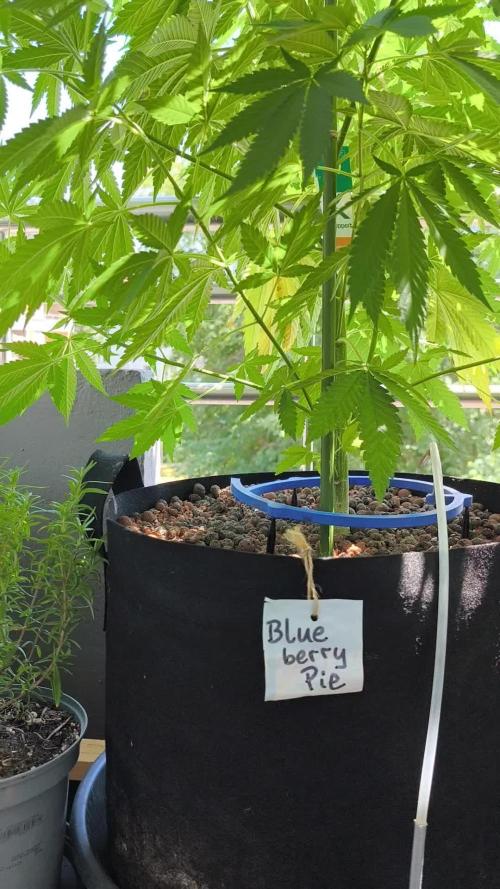
13.07.26 die Luft nach oben wird langsam knapp für die Blueberry Pie, nun mist sie 1,50m und hat noch 30cm bis zur Decke. Gleichzeitig sehe ich an den Triebspitzen nun mit deutlich mehr Pistillen den Übergang zur Blütephase und damit vielleicht das Ende des Höhen Wachstums.
2025 habe ich Ende Juli den Blütedünger ausgebracht, ich denke heuer werde ich das etwas früher tun und mich im Laufe der Woche daran machen. Ernsthafte Mängel sehe ich noch nicht, aber ich habe bereits 3 große Blätter entfernt die gelb geworden sind, was in dieser Saison eine Premiere ist.
Auch die großen Pflanzen haben letzte Woche Tüten mit Raubmilben gegen Thrips bekommen und trotz eigentlich zu niedriger Luftfeuchtigkeit, sehe ich weder neue Fraßstellen noch Thripse.
Die automatische Bewässerung liefert aktuell 3x je 2 Minuten Wasser, was 3x2x700ml = 4.2l entspricht
2x2 Minuten (2.8l) waren bei den Temperaturen nicht genug
Danke fürs vorbei schauen und angenehme Woche euch allen!

Likes
24
Share


@TKush
Follow
Started to flush the Pineapple Express today. Trichomes are cloudly, harvest in one or two weeks.

Likes
31
Share


@BudXs
Follow
Super busy with a move and a big garden reno. Sorry, this is the only update for this week


Likes
39
Share


@Grassland
Follow
Day 1 of week 9 in flower. I took some close up pictures of trichomes yesterday they are at the end of week 12. Judging the looks of the trichomes I can go longer before flush/ harvest. The buds are slowly adding weight. The plant smells great I am happy with the progress. I will be lowering my center light down to 15cm for the last 10 day push. Early in veg the plant has a Indica look to it and its leaves. Late in flower the leaves look more Sativa. Friday May 14th I will check trichomes tomorrow which is the end of week 9 in flower. End of week 9 trichomes are getting there. One more week will be 10 weeks in flower the estimated flowering time. Video for comparison tomorrow first day of week 10. Buds are defiantly gaining size as branches bend from their weight.

Processing
Likes
Comments
Share


@MG2009
Follow
07/07/2020
She drank 2 liters of OVERDRIVE this week, so one more week watering with OVERDRIVE and MICRO to supplement growing seeds, they getting fat.
07/10/20/20
New pistils popping out on sides of buds none on top so filling out. I guess she responding to (OVERDRIVE) Her last stage of flowering has begun should be done in 2 weeks 🙏 so one more week watering with OVERDRIVE and MICRO then water only for the flush week. And Harvest???
Likes
2
Share


@Jaschkoo0
Follow
I dryed them slow. I deleted the original report si i had to make a new one without all the data about watering and so.
Likes
21
Share


@ethnoGrow420
Follow
Scrofulous still filling out. Added superthrive this week.Also went to automated watering. Watering twice a day Q9hrs

Likes
8
Share


@Ieiogrow94
Follow
Eccoci di nuovo qui!!!
Super eccitato per questa nuova collab con Anesia Seeds, team davvero al top, che mi ha dato l’opportunità di testare questa nuova genetica e di condividere i progressi con tutti voi!!!
Come sempre partiamo nei bicchieri per poi travasare.. Questa volta verrà svolto tutto sotto la Lumatek Zeus 465 ProC, mi aspetto molto da questo ciclo!!
Settimana pazzesca!!!!
Piante davvero incredibili!!!
Grazie a tutti per il supporto ❤️🍀🔥


Likes
2
Share


@kissrubb
Follow
Actualización 05/10/2024
¡Hola, growers! Perdón por no poder compartir las semanas completas, pero poco a poco volvemos a la normalidad. Las fotos que ven corresponden al día 01/10/24 y, como pueden ver, están llenas de terpenos y tricomas por todas partes. Tanto la Fruit Gum como la Biscotti x Candy Rain son dos de las cepas más resinosas que he cultivado y, además, desprenden un olor increíblemente fuerte.
La Fruit Gum tiene esos toques dulces y nostálgicos, como a chicle de mascar, que me transportan directamente a mi infancia. En cuanto a la Biscotti x Candy Rain, su aroma es como el de una clásica galleta americana casera, ¡muy intenso! Ambas cepas me están impresionando mucho por su resinosidad y aromas únicos.
Cabe destacar que las genéticas de Uktha Genetics me han sorprendido gratamente; los resultados están siendo fantásticos. Eso sí, estas cepas comen como camiones, pero mientras se mantenga un control exhaustivo de las fertilizaciones y del medio de cultivo, no hay problema de sobrefertilización.
Pronto cortaremos una de las plantas que está bastante adelantada. Espero que disfruten tanto como yo este proceso y, como siempre, ¡buenos humos para todos! 🌱💨

Likes
5
Share


@Mr_nugs_lover_David
Follow
This amnesia pro has peformed amazing, both phenos #1 and #2 have produced beautiful hard dense colas, full of citric lemony terps, ideal to use for daytime, very nice cerebral buzz. Hope you guys have enjoyed my work! Peace 💚💛❤️👨🌾

Processing
Likes
10
Share


@Barcelona_Farmers710
Follow
Seguimos en fase de Vega con alguna que otra plaga... pero de momento todo bajo control, pasaremos a foliar con delta 9 para ver los resultados. Pasaremos a flora con el nuevo equipo Led para intentar reducir el calor de los focos y ahorro energético. Iremos informando farmers buenos Humos!🍁

Likes
26
Share


@PatriciaGant
Follow
Dane, We all should help one another.
Human beings are like that.
We should live by each other’s happiness - not by each other’s misery.
We don’t want to hate and despise one another, share the Joint.
And mother earth is rich and can provide for everyone.
We can Grow enough Happiness, In this paradise, there is room for everyone.
We only exist to bring joy into the world and The way of life can be free and beautiful,
but we have lost the way.
Grow High and Give the world A smile.
At the end we own nothing more then all our memories, lets make them amazing for everyone,
nothing to loose only everything to win.
A last kiss goodby, a second one, softer and long as a sign, that you are woth it.
That Everyone worth who loved and give.
Enought Hippie Talk, now have a nice day and an even better grow, thx for watching by.
((From Seed 🌱
((From Clone 🌿
week report:
(36 got her own tent now so big she becomes

Processing
Likes
37
Share


@TheIceCreamParlour
Follow
Hey! Welcome to my next grow. Decided to give autos a swerve for a while for a few reasons. I've had a bad run of germination from my last few attempts. Also some of the plants I have been growing have flowered far too early which would be a huge waste of valuable tent space.
Big shoutout and thank you to the team at RQS. James contacted me and asked if I could run one of their strains in my setup. I'm a big big fan of blueberry strains so decided to give the Haze Berry a go! James sent me 5 seeds out along with a sweet box of goodies.
To my delight all 5 seeds have germinated in water so all 5 are now in the tent. Seeds in soil today (11.02.19). They will undergo the full Ice Cream Parlour experience meaning topped at the 3rd node. Supplemented with 1200ppm co2. LST and Scrog under the usual Maxibright 315w laps and an extra LED to boost them along mid flower.
Keep checking back for updates. I'll be giving this strain my complete attention aiming for a big yeild and quality buds.
Update - I put seeds into water on 8.02.19. Moved the sprouted seeds to 20 litre pots on 11.02.19. Now 13.02.19 they have broken the surface of the coco and showing their cotyledons. I will start supplementing 1200ppm Co2 from tomorrow.
Likes
56
Share


@Prilyfe13
Follow
May 10, 2024 Day 85
A new week and I'm not sure these 2 are ready for flushing. They have way too many white pistils. Plenty of orange, though. Banana Purple Punch A has more orange pistils.
Both got a gallon of nutrient water today. So they are definitely still drinking somewhat heavily. And they haven't slowed down yet. I'll keep an eye on them though. Flushing will have to happen sometime. I'd say in the next 3 waterings. That's just a guess based on their current progress. It just seems that they aren't done swelling and there's absolutely no purple coming through yet.
Banana Purple Punch A still looks great. Her buds are starting to weight down the taller tops and they are slightly leaning toward the outside of the plant. It's actually quite good. It's opening up even more space for the lowers to get as much light as possible.
Air flow is great as well. This is especially important because she is in the back directly under a clip fan. So it's more prone to mold. At least that's what happened in my last grow. This time I have another clip fan across from this one, so the air circulates throughout the whole tent, top to bottom.
Banana Purple Punch B looks great! She's not bending any tops, but I don't expect her to with how strong her branches are. Practically immovable. However, she's definitely getting more jiggly. And she has huge buds top to bottom. I wonder if that's the reason she doesn't budge. No room. Lol. Honestly, she may be really compact, but I have her branches spread out enough for good airflow. There's just a couple of clusters that are a bit too dense with foliage, but it doesn't seem to be a problem. Lots of airflow and light.
She's a bit behind her sister plant. Way more white pistils and orange on this one. No signs of purple whatsoever. Just a healthy growing plant.
I'll be checking trichomes later today if I'm up to it. I hurt my back earlier. Regardless of that, I'll be getting trichome pics today or tomorrow. Probably tomorrow with videos at the end of the week. It's been quite some time since I last took trichome pics. Bad planning on my part. However, I'm excited to see how much further along they are from last time.
I won't be changing the light for another few days I think. Then I'll drop the power down. As I said before, I don't think they are ready for flushing, so not ready for light changes.
The environment is still a bit off. Today the temp is 76° but the humidity is still high at 56%. This is sure to ruin something. I'm still trying to get the humidity down. I have a feeling I just don't have enough air exchange in my bed room. I'm going to continue messing with it until it's right though.
Grow System Environment:
Temp: 74.1°
RH: 54.2%
VPD: 1.29 kPa
May 11, 2024
Not a lot going on today. Just some pictures.
Banana Purple Punch A is looking really good. She looks to have another week or so. I'm really confused as to why my plants take so long to grow and finish up.
Banana Purple Punch B has completely caught up with her sister plant. She has the same amount of orange pistils. That tells me there isn't much left to go. If she caught up, that means Banana Purple Punch A is even closer to being done than I think. Maybe.
I'll check the trichomes again tomorrow. No pics unless they are done. I doubt they will be. Especially Banana Purple Punch B. On the other hand Banana Purple Punch A could have only a couple days left and just isn't going to turn purple or fade at all.
I'm going to start flushing in a couple days I think. They both look about ready for it. Plus, they are about as big as they are going to get. I think the flush will bring out the colors. So next watering will be the beginning of the flush cycle. It should be in a couple days.
Also, both ladies have slowed down on their water intake. So the reservoirs should be empty in 2 to 3 days. Probably 2 days. Then I can clean them out and get to it.
The lights are going to be turned down when flushing begins. I'm going to aim for a DLI of 36 mol/m²/d for the rest of the grow. It shouldn't be anymore than a week of flushing before they are done.
The environment is still messed up. It got down to 49% yesterday for a couple hours, but then this morning it was right back up to 54%. The temp is fine at 76° Still not cold enough at night, but I have time. A few days to work it out. I'd like to be down to 65° by then for the last week of their lives.
Grow System Environment:
Temp: 73.1°
RH: 53.7%
VPD: 1.27 kPa
Update: I decided to check the trichomes anyway.
Banana Purple Punch A has quite a few cloudy trichomes. Very few amber and a bit too many clear. I'd say she has about 5 days left.
Banana Purple Punch B also has quite a few cloudy trichomes. However, she has about 15% to 20% clear trichomes. Amber trichomes are basically nonexistent. There's a few here and there, but mostly on the sugar leaves and not on the buds themselves. I'd say she has another 7 days left.
Honestly I don't want to harvest them separately. I'd rather harvest them at the same time, so I might harvest them in 6 days. Right in between. Maybe 7 days if Banana Purple Punch A isn't quite there yet.
To be honest, I have no real idea with this strain. They seem to be getting there, but there's no purple, still a lot of clear trichomes and it's been 12 weeks. So it could be another 2 weeks for all I know. I'd like to push them as far as they need, but I have 4 other plants that need to come in the tent ASAP. So I may have to chop a bit earlier than I really want to.
I'll post some trichome pics tomorrow and see what you all think. Comments are welcome. Lol
May 12, 2024
Some pics today. I'll try to keep this one short.
Banana Purple Punch A looks good. I checked the trichomes. Not done yet. I'm sticking by my 5 days estimate. So 4 days left.
She doesn't seem to be drinking at all. She is, but it's a trickle. Definitely not like it was. I'll have to empty the reservoir out tomorrow and start the flushing cycle.
Banana Purple Punch B also looks great. I also checked her trichomes. She is about the same as her sister plant. Not enough cloudy trichomes, but the amber ones are starting to show up. A good sign. She might be ready in 4 days. I'm still guessing 5 to 6 days.
She also isn't drinking nearly as much as she was before. A great sign that she should be starting the flush.
For trichome pics, I'll be posting some tomorrow. Nothing to post today.
I'll be dropping the light power when I start flushing. Which should be tomorrow or the next day. As I've said before, the DLI will be around 36 mol/m²/d.
The environment is a lost cause. I cannot for the life of me get the damned humidity to a reasonable level, so I'll continue to open the tent every couple of hours throughout the rest of the grow. Happily, it's only a few days to a week. The temp is a bit high today as well. 77°. I'm already working to drop it a bit without going over 60% humidity. I should be able to get it down to 74° without a problem. It's just the humidity that's killing me.
Grow System Environment:
Temp: 73.9°
RH: 55.6%
VPD: 1.25 kPa
May 13, 2024
Flushing day! I decided to rinse out the basins and begin the flush. I was going to wait another day, but I think it's time. They have about a week left I think. Honestly it should be done by now, but they aren't. Lol. No matter. They should be done in about a week. Maybe slightly less. So they have been given 4 ml of Flawless Finish. It should be the only dose I have to give. Maybe one more, but I doubt it. I still need to dry the containers out. That will take a day or two. So maybe a half gallon in a few days, just to get that last push in.
Banana Purple Punch A looks great! Some more lean happening with the tops. Nothing bad or anything, just a slight lean. Perfect for heavy buds. I didn't bother checking her trichomes today. No point. You can tell she's not ready just by looking at her.
Banana Purple Punch B may need even more time. I'm going to have to decided what to do. Wait for this one to be done then harvest both? Or harvest one at a time as they finish up? Decisions decisions. I'll figure it out in a week.
Her branches are really jiggly now. No lean exactly, more like a sway. When she gets moved her top heavy branches sway a bit. Great sign for a heavy yield from a 17" plant. Or is it 19"? Either way, it's going to have a fantastic yield compared to her size.
One advantage I am seeing with the longer finish is it will give me time to dry some Tropicana Cookies I am harvesting in a couple of days. I'll be wet trimming this time around and the dry time should only take about 5 to 7 days. Maybe 10, but I'd rather not try to stuff 4 plants in a 2x2 to dry. It's a recipe for disaster. 2 at a time stacked on top of each other.
I'll be dropping the light intensity tomorrow or later this afternoon. Maybe even tonight during lights out so in the morning it will be ready for the new day of less light. As I've said before... Over and over... I'll be dropping the light power to 70% which should drop the DLI down to 36 mol/m²/d. Oh, btw, I use the Photone for my light measurements. It has a PAR meter, Lux, DLI and I Believe color spectrum? Kelvin? No clue what that does. I focus on DLI. It's a better reading than just PPFD.
The environment is still messy... as always... I'm keeping the temp down to 74°. The humidity at 58%. So it's still too high, but I've done all I can to drop it down and it won't even go below 50% with the tent door wide open. It just won't. So unless I can get the humidity in my room down to like 30%, the humidity in the tent remains over 50%. Hopefully pulling the plants out daily is enough to prevent mold and other issues. There's also the two circular fans. They aren't at full power, but they don't need to be as there's two. Plenty of airflow. I'll really need to keep an eye on these plants. Maybe I'll take them out multiple times a day. Like 2 or 3.
Grow System Environment:
Temp: 74.5°
RH: 56.2%
VPD: 1.25 kPa
Update: I ordered a new dehumidifier for grow tents today. It should be here tomorrow. I'm guessing a lot of my problem with the humidity is my current dehumidifier. It barely pushes air. Cheap and well used. The new one is from Vivosun. A much more reputable company.
May 14, 2024
Trichome day! Alright, so I took some video today. Not the best quality, but I hurt my back so I'm all shaky. The pics were a lost cause. Lol
Banana Purple Punch A looks great! More leaning branches. This late in the grow, I don't care. They aren't leaning that bad and it's only showing how heavy these buds are.
Trichomes are mostly cloudy with a bit left of clear and nowhere near enough amber. 5 to 6 more days I think.
Banana Purple Punch B is so pretty. She has the faintest purple coming from the flowers, but not much. It is a sign that we may end up with a purple plant during flush.
Trichomes are partly cloudy with 30% clear and next to no amber. She still has time to go. I'd say another 7 to 10 days. Now I'm overshooting it just incase.
I don't think the plants noticed a difference in the light drop, or they did and it's not doing anything. However, I'm not sure what it should be doing. I'm guessing preserving trichomes? Makes sense. Anyway, it's staying at 36 mol/m²/d DLI.
The environment is still an absolute mess. The humidity is at like 59% and as always, I can control the temp, but nothing changes the humidity. And it's like 55% humidity out today. Fail. Lol.
Grow System Environment:
Temp: 74.3°
RH: 59.0%
VPD: 1.16 kPa
May 15, 2024
Nothing to do today. They are still watered and whatnot. No changes in color yet either. I'm starting to think these both will be green phenomes. Or maybe they really aren't ready yet. It's just weird. What am I doing wrong to get all my plants to grow for so long? Oh well.
This round is just different because of the other 4 plants that need this space. I really need them to finish up ASAP. No trichome check today. I can still t ell they aren't ready. The bottoms still have a majority of white pistils and the tops are just not there yet. I think they can get denser. They aren't quite rock hard yet, so I know they still have time.
Banana Purple Punch A looks amazing. More leaning branches that are swaying in the breeze. No fade yet, but the leaves are starting to look ready for the fade. Maybe.
Banana Purple Punch B is strong as ever. Definitely still packing on weight. Definitely not ready for harvest. Still another week I think. I'll check trichomes tomorrow on this one. I think I'll wait for her to be done then I can harvest both plants at once.
The light seems to be just being a light now. I can't really see what it's doing, but I know the frost is there. Lol. So it must be doing something.
The environment is killing me. Still over 60% and my room has climbed up to 60% as well. I have a heater running and the dehumidifier that I think is done working. My new one should be here today. And not a moment too soon. I should have replaced this one months ago. Unfortunately, I don't have much control over the heat anymore. The humidity is just over powering it and I can't get anything to change. I'm going to crank the heat and see if that helps. Like set it to 80° and see what happens. It's currently set to 74°. And 8 don't think that temp is high enough to combat the humidity. Crank it up!
Grow System Environment:
Temp: 72.9°
RH: 63.0%
VPD: .00 kPa
May 16, 2024
Today is looking pretty good. I checked the trichomes on Banana Purple Punch B as she has the longest to go. I figure when she is done, Banana Purple Punch A will be as well.
I've also watered them with plain water. PHed to 6.2. just a half gallon in the reservoirs. I'm not ready to let them dry out yet.
Banana Purple Punch A looks great! Her branches are starting to lean a bit harder and her buds look amazing. No purple yet. Or at all. I'm not sure. But I'm certainly sure that the fade hasn't begun yet.
I'm not bothering with trichomes for now. I'll just wait to see what her sister does. I'll check trichomes in a couple of days.
Banana Purple Punch B looks amazing. Her buds are fat and dense. She smells great and stays strong. A bit more swaying. But it's the whole plant now. Wonderful!
I checked the trichomes on this one. She is developing quite nicely. I'd say another 5 to 7 days? Maybe a little less if we're lucky. There's more cloudy trichomes than before and finally some amber. Much less clear as well.
She definitely is nowhere near fading, so that's a concern for time.
The light stays the same.
It seems to be perfect for these two. So no changes.
The environment is still a nightmare, but it's 86% humid outside and 63% in my room. Happily, not really, the humidity is down to 60%. Not good at all, but better than 63% or even 65%. I'm really hoping these ladies are super resilient. They should be. It's FastBuds and they have great genetics. The temp is fine. I haven't a bit higher to help some with the DLI. So it's hanging out around 76° to 77° for now.
The new dehumidifier works way better than the other one. But a cool thing is that they are both small, so I fit them both in and it seems to be kinda working. It's keeping the humidity below what it is in my room, but not low enough. I know it will drop when I figure out how to drop it in my room. I really need a big dehumidifier for my room. That would solve quite a bit.
Grow System Environment:
Temp: 75.8°
RH: 62.8%
VPD: 1.07 kPa
Likes
10
Share


@StickyFingah420
Follow
Extrema producción de tricomas de esta variedad! Gran parte de los frutos lo usaré para extraer rosin, su resina se ve ideal para este propósito.
Fragancia exquisita a ponche de fruta dulce, con notas ácidas y un fondo de especias.
Como mencioné anteriormente dejaré la parte de la reseña de efectos, sabores y sensaciones para cuando los cogollos estén secos y curados, por ahora solo puedo apreciar lo que mi vista y olfato me permiten captar.
Totalmente conforme por la calidad de estas flores y agradecido de los amigos de Sweet Seeds por la confianza.
Será hasta la cata entonces, buenos humos!
Likes
13
Share


@KukulcanValley
Follow
Hi everyone,
This is week 18 from seed. Week 8 of flowering stage.
We are almost done, this is the flushing week. We can appreciate some leave color changing.
Drop your comments.
Happy growing.


Likes
5
Share

