


Likes
Comments
Share


@CalGonJim
Follow
10/20 1230AM MONDAY. 11:14 AM I found some Halloween pictures.🎃🎃
IF YOU LOSE 1 MORE DEATH STAR IM TURNING YOU INTO DARTH VAPORIZER!!
Why u do dis 2 meesa Dimi???
10/21 5am 500mg Phe. & Proline spray in 1L, then an .25pb
10/21 238PM I asked Grok about EC readings. "Good question, CalGonJim! When using an EC meter, you don’t typically subtract the baseline EC of your water from the final reading—here’s why and how to handle it properly, tailored to your grow with **Blueberry KO** and **DDA** at 02:36 PM PDT on Tuesday, October 21, 2025.
### EC Measurement Basics
- **EC Definition**: Electrical Conductivity measures the nutrient concentration in your solution, expressed in mS/cm or µS/cm. It reflects all dissolved salts, including those from water and additives.
- **Baseline Water EC**: Tap or RO water has its own EC (e.g., 0.2–0.5 mS/cm for tap, 20% means flush with pH 6 water.
4. **Adjust**: If EC exceeds 1.4 mS/cm (**BKO**) or 1.8 mS/cm (**DDA**), dilute with water or flush to avoid burn.
### Your Context
- **Current Mix**: 500 mg/L proline + 500 mg/L phenylalanine adds ~0.6–0.8 mS/cm. With your base (1.5 mL/L Grow A&B + 0.25 mL/L each additive), expect 1.6–1.8 mS/cm total. If your water’s 0.3 mS/cm, it’s still 1.6–1.8 mS/cm—don’t subtract.
- **Action**: Test your 1-liter mix now, apply, and check runoff tomorrow. If **BKO** shows stress, drop to 300 mg/L each.
No subtraction needed—just roll with the total EC and keep an eye on your plants. How’s that surprise **BKO** sprout doing with your latest drench?""
10/22 502AM I SAW A CAT!!!!! CANT DO ANTYTHING ELSE..... GOT CHURUS OUT.....TAPPING ON THE GLASS, HE WONT COME BACK....BUT LOUD AND CRAZY ALL NIGHT.....HOW CAN THE CAT NOT HEAR ME???????
10/21 1PM Effects of essential amino acid (EAA) and glutamine supplementation on skeletal muscle wasting in acute, subacute, and postacute conditions.
https://pubmed.ncbi.nlm.nih.gov/38843393/
10/25 12pm afternoon. in 1 liter: 500mg Phe., 250mg TMG Powder, 260mg Proline as root drench and spray.


Likes
4
Share


@GothBotanical
Follow
Week 9 has officially started, and she's entering the final phase with some real beauty. Buds are swelling up across the canopy with a thick layer of frost and lots of white pistils still pushing. Trichomes are now clearly visible under magnification with early signs of cloudiness, but no amber yet. The lower fan leaves have started to fade naturally, and I’m starting to see hints of purple coming through on some of the sugar leaves and bracts. I gave her a full-strength compost tea at the end of Week 8 and topped off the auto-watering base to keep her coasting. Temps have been high due to a heat wave, spiking around 88°F, but airflow and moisture have been stable thanks to the dual fan setup and bottom watering. I also added DE to the topsoil to knock back a few gnats and placed sticky traps nearby. No training this week so far, just light tucking and one small defoliation session in the center of the canopy to improve airflow. She's healthy, sticky, and starting to ripen — right on track for harvest in the next couple of weeks.

Likes
13
Share


@Rungood
Follow
La plante grandit de jour en jour et ses bud commence a faire des superbes filament orangé ,aucune carence pour le moment... wait and see
Processing
Likes
8
Share


@GrownwithLED
Follow
The plants stopped growing in height and are now in FULL FLOWERING mode. Every day more and more flower clusters appear and start to build colas at the sidebranches now. The trichome production is also in full swing, the plants get stickier every day and smell DELICIOUS. The Barbarian (=AK-47 x Barbara Bud) plants have a sweet sandelwood-smell like the AK-47 but also with peach undertones from the Barbara Bud in it. I LOVE THE AROMA!
Likes
18
Share


@Gdubgrows
Follow
Day 39 - Watered the Gold Leaf today by dunking it. 8.4 PH going in and 6.3 for the runoff. The PPM was only 500 or so, but I'm guessing it is because of the dunk. The soil test was still 5.3 on one side and up to 5.7 on the other. I checked right away so maybe it has gone up. GDP #1 seems to need water, but GDP #2 will need another day. The Gold Leaf is reaching the 25" limit for flipping, but the net should help show things down a little so the other 2 can catch up.
Day 40 - Both GDPs needed water and got dunked. PH was 8.5 and the runoff showed 6.2. A soil PH check came back at 5.9. I am hoping that the small jump will help. I realized I would not be able to test the runoff with the stand and saucers I was using so i got new ones. This lowered my potential flipping height, but with the SCROG I am hoping to keep the goldleaf down long enough for the GDP to catch up.
Day 41 - The Gold leaf is tall enough to bend down and the GDPs are almost there. I'm anxious to see how many bud sites I can get through the net before I defoliate and flip to flower. I don't think I should wait much longer with 3 plants in a 2x4 and the gold leaf getting close to 25 inches.
Day 42 - 2x4 is too crowded so decided to order a 5x5 and move them over before I flip to flower. The gold Leaf is dry again. Watering with 3 gallons to try and get the PH up and the PPM down. The PH of the water I am using is 7.5
Day 43 - Watered Gold Leaf today. Going in the PH was 7.5 and the PPM 250. The runoff showed 5.9 and the PPM was 870. The soil test after work showed on one side as 6.1 and the other 6.0. Getting better, but I want to be closer to 6.5 before I flip them. The 5x5 tent will give me the room needed for that.
Day 44 - Watered the GDPs today. The water going in had a PH of 7.5. The PPM was around 255. The runoff had a PH of 6.2 and a PPM of over 850. Both were very similar. At least one more week without nutes unless there is a problem.
The ladies all seem to be showing a bit of magnesium deficiency. I started using a foliar spray for now with 1ml cal mag in 500ml of water with a PH of 6.5. Might need to add cal-mag to the next watering. The 2x4 is way too crowded with the 3 of them in there together. Hopefully the new tent shows up soon.
Day 45 - The Gold Leaf is getting worse. It looks like lockout again. The other side of the spectrum this time. Probably too alkaline... 😒 From now on I will be feeding with water with a PH of 6.5. For now I added a few drops of micro and bloom to the foliar spray and applied it once more. It seems like it will need more water in a day or two so that should help.


Likes
29
Share


@starke
Follow
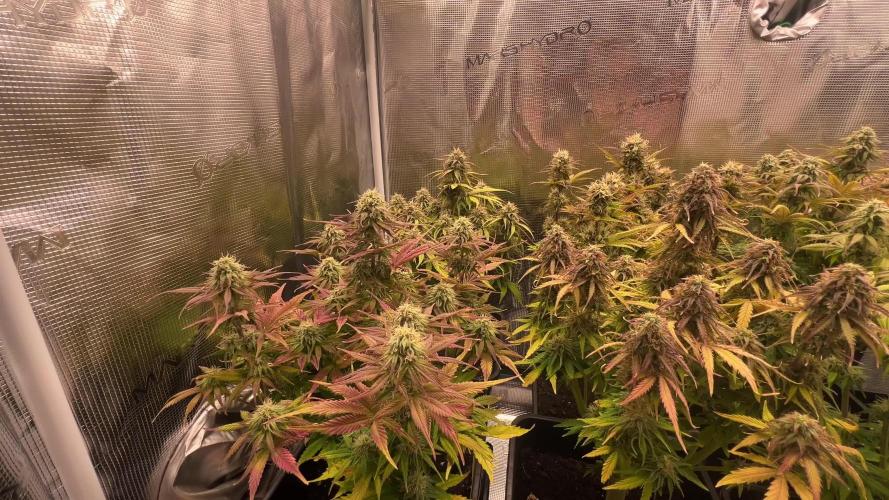
After 5 days away, I couldn't wait to be back and see how they were doing 😍 I'm glad the automatic watering machine worked and they all are doing great, yeay. The fade has started and they look beautiful, just like their Mama ❤️ They have only been fed with water while I was gone and got a good (last?) feed on the last day of week 14, which is Day 98 in total and Day 51 of Flower. Their mom was sent into darkness on Day 62 of flower and since they are so similar, my guess is roughly the next 10 days. Yeay 🙌 I missed this bud. Happy week everyone ✌️



Likes
10
Share


@mutantfarmer
Follow
This week I turned on automatic watering 2 times a day for 10 minutes. After that, the plant began to overflow, then I realized my mistake and temporarily returned to manual watering. Otherwise, everything went quietly and calmly, since the killer is building up the root system, events and rapid growth have not yet taken place.


Likes
3
Share


@Weedzoks
Follow
Welcome everyone
Here is the diaries of a friend, this is his first culture.
He chose for this session five Hulkberry from Royal Queen Seeds, a BubbleGum offered by Zamnesia, as well as a Big Bang Auto from GreenHouseSeeds.
All these ladies are under HPS 600W, 150cm square area.
Here we go!


Likes
33
Share


@DWCbuds
Follow
After 3 failed germinations from growerschoiceseed.com I decided to order from ILGM.com. 2nd time around decided to germinate just 1 seed and it worked out well. Started soaking seed in ph adjusted water 6.5 for 48 hours. Seed showed small cracking so I placed the seed in damp paper towel. Let that sit for another 48 hours then placed in rock wool that I had soaking in ph 6 water for 24 hours. Placed Rockwell in DWC and turned both lights on at 12". She sprouted after 2 days. No nutrient yet.
Processing
Likes
63
Share


@TheFairyBudMother
Follow
Just trying to get back to normal life after the Thomas fire.
I believe I have two phenotypes of some gorilla glue lineage as the seed came from a very tasty dispensary quarter. Even though the little ugly plants look grotesque, they are loaded with bud sites. I have photos and videos and notes of the past few weeks so I will try to back annotate.
Gradually ramped light down from 18 hours to 12 after power outages due to the fire, and it was about good time to flip anyway.
It is so much easier to control temperature during the winter in my space. The lights keep the space at a pretty steady 74 F.
I haven’t pushed PPM and am keeping Ph in the 6-6.8 range.
I’m using peony rings as support and to spread a little but I am not training for a perfectly flat canopy as I had excellent popcorn nugs in my last grow even with the lights over 2x further than optimal.
Defoliated the lower branches but I am not defoliating aggressively, but will continue to remove any withering leaves.
Sorry for the slow updates. The fire has been pretty traumatic for my city and myself, and I’m just getting back to normal life. My home, family and pets are safe, and the fire is mostly contained.
Thank you for checking out my diary. Happy holidays and I hope Santa Ja brings you a giant tree!
Likes
15
Share


@Style_weed
Follow
Dopo aver raccolto la piu piccola che era la più matura ho iniziato il lavaggia di altre 3 mentre a 1 inizierò dalla prossima volta... I fiori più maturi sono bellissimi e il profumo è altrettanto fantastico!!! Le annaffierò altre 3 volte con sola acqua e siamo al traguardo!!!
Likes
44
Share


@RakonGrow
Follow
150-200PPFD 20/4
Mein Grow Stuff
Messen :
+ Messgerät - X-Sense WLAN Hygrometer 1 Basis SBS50 + 4 Sensoren
+ + Basis
+ + 4x WLAN Sensoren RH und Temp
+ Amtra Digital PH Tester
+ Amtra Digital TDC&EC Tester
+ Photone App (android Samsung S21 5G werkscallibriert (geprüft mit lichtreferenz))
+ GEHE ph-Wert 500 Testkit
+ + Testflüssigkeit
+ + Pimpette
+ + Probenröhrchen
+ + Propfen
+ Pimpette 10ml
Zelt :
+ Keimung und Vegetative Phase
+ + Growbox - DiamondBox Silver Line SL60 (60x60x160cm) (hohe luftfeuchtigkeit)
+ Blütenphase
+ + Spider Farmer 70x140x200cm Indoor Grow Tent
Licht :
+ SpiderFarmer SF1000 (100Watt) Dim (hohe luftfeuchtigkeit) (Vegetativ)
+ Sanlight EVO 1.5 3-60 mit Bluethoot Dimmer (niedrige luftfeuchtigkeit) (Blüte)
Abluft / Filter / Rohr:
+ 2x Abluftset - PrimaKlima PKEC-125-TC Set
+ + PKEC-125-TC Abluft
+ + PrimaKlima Aktivkohlefilter K2601 Flat (bis 70%rH) + Staubschutz
+ + Luftschlauch Aluflexrohr (Ummantelt), 3 Meter, ø 127mm
+ + Verbindungschelle 50mm (Metall mit Schaumstoff mit Aufhängemöglichkeit)
+ + 1x Universal-Schlauchschelle, 60-165mm
Samen :
+ 3x Royal Dwarf Automatic (RQS) (buy from Zamnesia Seeds)
Töpfe :
+ Nothers GZjiyu 6 Stk Pflanzsack Pack 2 Galonen = 8 Liter Stofftöpfe
Medium :
+ BioBiz LightMix
+ + Urgeisteinsmehl für Ergänzungsstoffe
+ Vulkangranulat (Aquabedarf , drenage)
Ventilator :
+ pro Zelt
+ + 2x Ventilator - Spider Farmer Grow Ventilator (EC 10Watt)
PH Korrektur:
+ 500ml Plagron PH-
+ 1000ml Canna PH+
Dünger :
+ Dünger - Canna Terra Kit
+ + 1000 ml Terra Vega
+ + 1000 ml Terra Flores
+ + 500 ml Rhizotonic
+ + 500 ml PK13/14 (wird nicht genutzt , da unnötig)
+ + 1000 ml Cal-Mag Agent (fals ich den mal brauche)
Entfeuchter :
+ Entfeuchter - MeacoDry ABC 10Liter
Zubehör :
+ 1L Nanoprotect Isopropanol 99,9% (Reinigungsmittel)
+ 1x Topfuntersetzer 30x30cm
+ Grießkanne 5 Liter
+ Pflanzendrath 1mm x 5m
+ Sprüflasche 0.7L
+ Drucksprühflasche 2L
+ Messbecher
+ + 1L
+ + 0.5L
+ + 0.25L
+ Eimer 10L
+ Gartengießkanne
+ + 5L
+ + 10L
+ Plastikabdeckung mit löchern fürs Sämlingstadium (ehemals Kuchenabdeckung)
+ Luftschlauch Aluflexrohr, 3 Meter, ø 127mm
+ GrowPRO Schere Curved
+ Gardo Gartenschere GDGSB 180
+ GrowPRO Pflanzendraht für Low Stress Training, 5 mm, 4,9 Meter
+ Dosierspritze, 5ml
+ 2x Universal-Schlauchschelle, 60-165mm
+ LIMITADA 15 Stücke Pflanzenbieger Verstellbar
+ 6er Steckdose
+ 2x Zeitschaltuhr (mechanisch)
+ Müllsack (umbau zur Trockenkammer)
+ Pappe
+ 2 x Gafa-Tape (Rolle)
+ Klettband 3m
+ Airpump Kit
+ + Air-Pump
+ + Luftschlauch silicon
+ + Air-Stone
Trychome analyse :
+ Samsung S21 5G optical Zoom
+ DIGIMICRO Mobil
+ + x300 optical zoom
+ + HD Video
+ + 12MP photo
+ GrowPRO Mikroskop 40x mit LED
CureBox :
+ CASO VacuBoxx E-Set Vakuumbehälter-Set aus Borosilikatglas mit Tritan Deckel
+ + 145x60x105
+ + 170x65x125
+ + 200x80x150
+ + 220x80x165 (about 40-50g dry buds space)
+ + manual vacuumpumpe
+ + adapter für automatische vaccumpumpen
VideoSystem:
+ GoPro Hero3+ Black
+ + Zeitraffer : 1 Bild pro Minute , gerendert in H.265 60fps .
+ + 12MP Bilder
+ + 1 Sekunde Film entspricht 1 Stunde Real .
+ + Ohne Dunkelzeiten.
+ Bild/Videoprogramme
+ + Photoshop (Bildsequenze render Video, Ausschnitt und Beschriftung)
+ + XMedia Recode (H.265 Neucodierung)
Likes
91
Share


@Greenwolvesfarmer
Follow
Me encantó la cepa y su facilidad de cultivo ! Aun que tuve muchos problemas ambientales y climáticos . Me atrasé unas 3 a 5 semanas con estas nenas , pero nos recuperamos bien ! Usamos malla scrog chilena #kanovicultivo , lo mejor que he usado en malla scrog , no se le comparan , su espacio preciso! .
Las 4 comenzaron en pequeños vasos , luego de 1 a 2 semanas , trasplanté a macetero de 5.8lts , finalizaron 3 en maceteros textil 19lts y 1 en macetero de 20lts AirPot !
Comencé a brindarle 20hrs de luz / 4 hrs oscuridad , a la 3era semana 19hrs de luz y a la 5ta semana bajé hasta el 18 / 6 .
Usé un panel QB de 480w regulables , chips marca Samsung de 3500k , chips epistar UV 660nm iR , el mix completo gracias a mi bro MKleds chile ! Se pasó ! De todas maneras recomiendo una potencia mínima de 600w ( QB LED ) para espacio de 120x ..
Usé un bio estimulante chileno , que a mi parecer fue uno de los mejores que he visto y usado ! El grande #trichomemania , te cuento que este producto activa un mecanismo de defensa en la planta (SAR) , haciendo que reaccione y se trate de defender con mayor producción de resina , terpenos y tricomas ! Es increíble ! A los 24hrs tienes resultados , un saludo grande a los hermanos ! El mejor producto 10000000%....
Grande eva seed , buenisima esta cepa , me dí cuenta que si se deja madurar un poco más , su sabor es más frutal candy , exquisita cepa !....
Estamos probando con un papel de blunt organico 100% libre de tabaco marca *jamaican buzz*...al fumarla su efecto es notorio , enseguida viene el efecto psicoactivo y cerebral , se viene a la vista un tanto distorsionado el entorno ...la vision un poco más brillante , y a la vez relajado ..
Hoy 18 de agosto estamos probando con un papel de celulosa organico marca lion rolling circus ( foto al final del album ) , quema bastante bien , al parecer ya está casi en su totalidad secado , combustión lenta , buen sabor afrutado citrico con toques candy diesel ...uuff efecto despues de 3 quemadas ya por los cielos , totalmente cerebral y estimulante , un gusto charlar con amigos !
Al manipular su fruto , la planta expele un olor afrutado con limon maduro y skunk , con finales de candy terra , una delicia , muy buena cepa , ahora mientras escribo me siento un tanto "mareado" con esa mitad de blunt ! Buenisinaaa!...
____
La verdad cuando comencé a cortar cada planta era como llenar "infinitamente" el armario donde dejaría secandola , se llenó casi la mitad y un poco más sólo con 1 planta cortada ! Increíble producción , yo estimo unos 90g por planta aprox , ya he consumido un buen peso además ...veremos en estos días que esté por completo su secado ! Esta riquísima , sus efectos fuertísimos ...100% ...
___
Una cosecha buenísima, muy parecido como obtengo resultados en comparación con el sodio , todo bien me gustó la experiencia !....
Además tuve la oportunidad de hacer extracción en seco de su materia vegetal . Obtuvimos entre un 18 a 20% de retorno ! Para mi primera vez , geniaaaal ! Su utilizó prensa de 12 toneladas , de apretó a 80°C por 4 minutos .
.
.
Usen lemon king ! Una delicia .


Likes
4
Share


@Phrdvd
Follow
Top! Questa settimana è stata fantastica tutte le piante hanno strecciato in maniera uniforme!
Fantastico con delle auto
Le mie piccoline hanno patito 4 giorni di caldo con temperature sopra i 30°! Ora ho sistemato l'areazione e la temperatura va al massimo sui 28°!
Ho incrementato la Co2 leggermente, in modo che le piante superino bene quelle ore di caldo! E sembra che stiano bene tutte! A voi il giudizio

