


Likes
Comments
Share

@GoodTimesOrganics
Follow
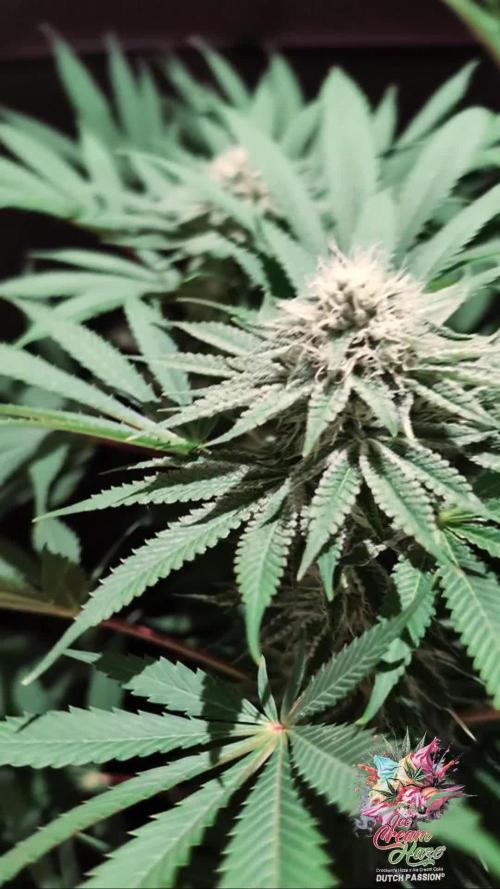
Hi liebe Community! 💚 Nach der vierten Blütewoche bilden sich die Trichome nun richtig schön aus.
Ein Dichter Tepich aus Stigmen überzieht die Blütenansätze und es fängt langsam an überall Frosty zu werden.
Die Blütenstruktur zieht sich nun den Großteil des Stammes entlang und es entsteht ein dich besiedelter Blütenteppich.
Insgesamt ist die Pflanze sehr Vital und hat eine sehr schöne Wuchsform und eine schöne Blütenstruktur😉
Die Wachstumsbedingungen im Growzelt sind weiterhin am Optimum und Stabil:
———————
🌞 Temp: 24,3°C
🌚 Temp: 20 °C
💨 RH: 56%
VPD: 0,97 kPa
😎PPFD: 830 mqm
———————
Stay Tuned! 💚

Likes
5
Share

@RevvshiWoW
Follow
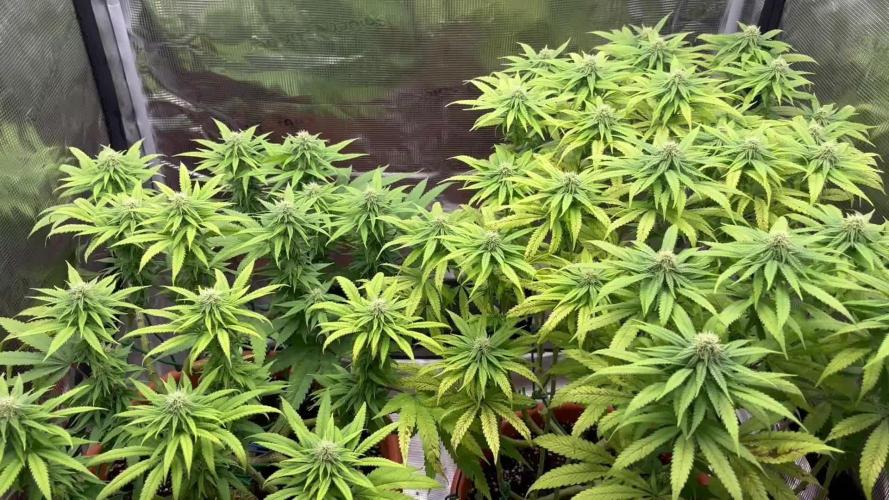
Week 3 of flowering is now complete, and I’m very happy with how the buds are looking so far – there’s definitely some real potential here! The next topdress will take place next Friday, marking the start of week 5.
I’m currently dealing with quite high temperatures, reaching up to 30°C at times, but the humidity is holding steady at around 60%, which is helping to keep things in balance.


Likes
23
Share


@RadDad
Follow
Hey all,
Its been a few weeks so lets take a peak at our Blueberry manifold. Last time we topped our girl down to the 3rd node and removed all other growth except the two growth tip and their fan leaves. Over the past two weeks shes continued to grow an addition four pairs of leaves on each arm. This wee we will cut those branches back to the 3rd node and then clean all other growth from the plant except what remains on the 1st and 3rd node of each side. This should give us 8 main colas that will grow up from these eight remaining growth tips.
Continuing to feed as normal while trying to get the soil PH up to a proper level.

Likes
4
Share

@GREENPHOENIX6262
Follow
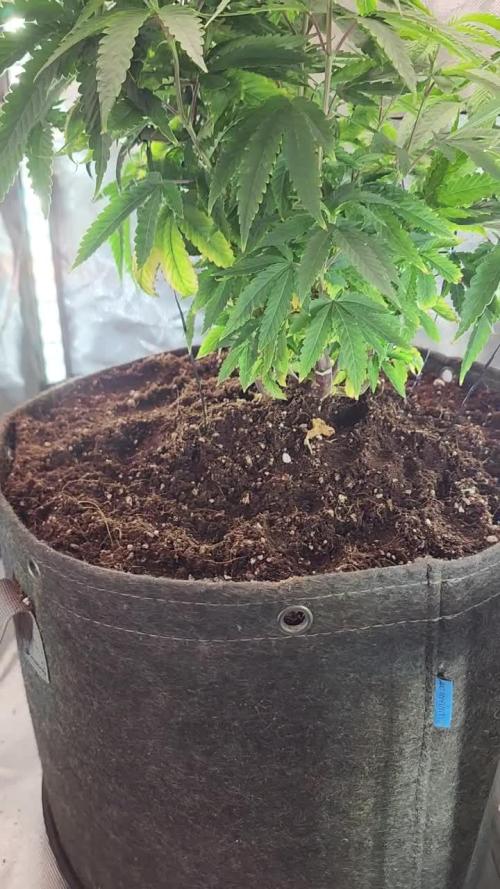
12/30 - Transplant will be completed by the end of the day - still running high humidity and high temps - Increased Myco/Silica/Nitro feeds - Heavy LST coming week . 😎😎😎😎😎😎😎😎
01/01 - First update of the year - if you are reading this, peace and prosperity to you and yours - Did not get a chance to transplant just yet, looking to transplant by the end of the week - So far this mother has been rocking out just fine - looking to pluck clones by mid Jan - Had a little PH burn on the tips - flushed for PH balance correction.
01/03 - Still have yet to transplant - working on increasing root mass volume before transplanting to minimize transplant shock - Myco and Nitrogen feeds have increased - She is being grown as a mother for cloning - slight leaf tip burn - minor flush to adjust burn - temps and humidity still running high - transplant will be completed by the end of the week.
01/04 - Transplant complete - dropped her into a 7 gallon pot - Running a scog net for even canopy distribution - medium is a coco/perlite/worm casting mix - added supps ( Myco, Microbes and Silica)

Likes
57
Share


@Bread_n_Buds
Follow
** A tip if you like trichomes have the patience to scroll down to the micro photos, they are scary.
Black Runtz is a crazy beauty, a black isolate phenotype of the very famous Zamnesia Runtz. In the last week before this one you will find the white phenotype with a green apple flavor, but here is the spectacle of nature that manifests itself in the form of a stunning red/purple plant with spectacular trichomes and buds.
**Remember that for all the varieties we have at least two plants, one left to grow straight and one worked with the techniques. This is the plant left to grow straight.
Technique used // In this case we let the plant grow up to the 6th internode then we did the FIMMING or FIM (Fuck the Missed) - This technique by cutting about 70% of the brunch and the leaves growing in the center is going to give the plant the indication to slow down the growth upwards and distribute the power on the lateral branches that with a bit of LST in fact gave some wonderful secondary flowers. No popcorn thanks to Pruning of the things at the bottom, guys leave only everything that sees the light well in flower.
Better with the techniques or the normal ones? This time we have two very different phenotypes, a plant with medium internodal distance. I prefer the plant to grow straight, but I know that it can be obtained very well with a main lining or repeated topping.
Flower quality // From one to 10 stars 15. The plant has resined very well on all sides, the resin is really abundant and above average. The color of the trichomes is something exceptional really we have dark purple heads, light purple, lilac, really a racobalen of shades of red / purple.
The buds were washed as recommended by Zamnesia.
Check the article in your language // https://www.zamnesia.io/it/guida-growing-cannabis/333-lavaggio-delle-ceme
Fertilizers// I am very happy with how I managed to dispose of the plant that at a certain point, before going to the wash, was fed for a few days only with additives and then went to the wash and we are very very well discolored. I predict a very tasty flower, grown organically and washed successfully, the flavor and taste will be epic.
All the Plagron fertilizers and additives in the green / 100% organic version have fully satisfied me. Choose the soil according to your style and calculate the sheet on the website www.plagron.com -
Brother, if you are stubborn use additives, listen every now and then... and then come and tell me about it.
Fertilizers are available in convenient all-inclusive packages on the Zamnesia website.
This strain is already a legend in the normal version, imagine in the Black version... try it!
--- https://www.zamnesia.io/it/11159-zamnesia-seeds-black-runtz.html
Zamnesia Description // Black Runtz comes from a truly legendary genetic heritage. Our breeders used three modern classics from the United States to create this strain: Zkittlez, Gelato and Runtz. With 20% THC and aromas of grapes and berries, Zkittlez has passed on its delicious flavors and relaxing effects. The ice cream contributed to Black Runtz’s immense flavor profile, giving it high concentrations of the terpenes limonene and humulene. Finally, Black Runtz inherited the high potency of the original Runtz, a strain with a respectable 21% THC. The end result of this three-way cross is a strain with 55% indica genetics and 45% sativa. Black Runtz boasts a fast flowering time, very high potency, and contrasting yet balanced terpenes that enhance its delicious flavor profile.
Music and Frequencies // For about 4-6 hours a day, my plants listen to 432Hz frequencies specially designed for their well-being, and sometimes a little black music to give them those vibes that only music can give. www.radionula.com
All the best that mother nature has to offer is available at
---- www.zamnesia.com


Likes
11
Share

@Pete_vs_Nature
Follow
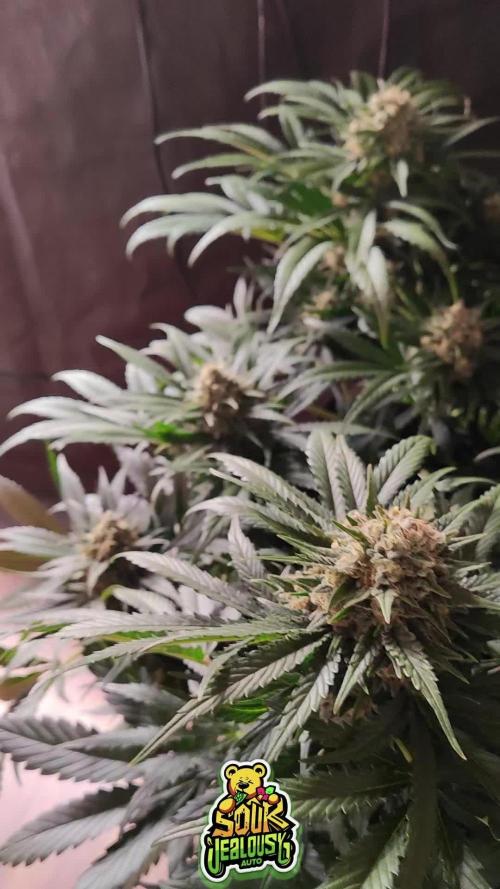
Okay now this has been ridiculous. SJ re-affirmed my choice as stability anchor, in case my Haze experiments go wrong (they kinda did*) - and she delivered big time 😵
*they did, with a funny and unbelievable twist: I am the proud owner of two seeds, this one likely is " Mephisto OSMH × 42FB SourJealousy — F1 Fem Auto (rodel)
Her flower is extremely dense, which comes with a challenge for spotting bud rot. So far I have not found any bud-rot during hand-trimming, but given her structure and my extended drying, I am not too concerned with finding a spot or two. Here's my logs, excuse the dump:
----
42 Fast Buds : Sour Jealousy #2
State: Age: 73 days | Life: Content & relaxed throughout all phases. Very healthy & confident representation throughout.
Trichomes: ~10% amber | Pistils: Slow, gradual fade towards 80% brown (indica representation; full white pistils possible at correct harvest time)
Flower Development:
Very evenly matured and ripe flower with light senescence fade (-) deeper into sub-canopy.
Larf: ~1.5%
Fully matured/ripened to freshly maturing/ripening ratio: 2.6:1, or 72% : 28%
Hand-trimming: 6h 46/h
Drying: Extended low VPD drying (12d) with increased botrytis risk. Temporary humidity stabilization → grove bags nested in RH container.
Flower State: 62% RH on all but top main colas (still burping). Monoterpenes noticeably degraded (30%+ perception)
Pharmaceutical Profile: Under my (drying) conditions: very long lasting, mellow. Sedative-leaning but daytime-profile with strong, pleasant body aura / high. Strong focus / immersion, some tendency to wander off. Relaxed, focused working / occupation. Creates ""bubble"" reducing distractions, without inducing artificial happiness other than from (largely) increased comfort. Reduced motorical drive slightly debilitating but never couch-locking. High THC contents (apparent during use) create ceiling for daytime profile.
Smell: sweet forward, reminiscent of sweet almond profiles, creamy elements. On rupture: deep herbal profile with surprising mint and earthy notes (background); + a ""vibrant, lively spin"" on those herbs as a warm, almost fennel-like umami / wet nest inside profile (only on well preserved flower).
Taste: no good data (combusted with tobacco)


Likes
4
Share

@Enki_Weed
Follow
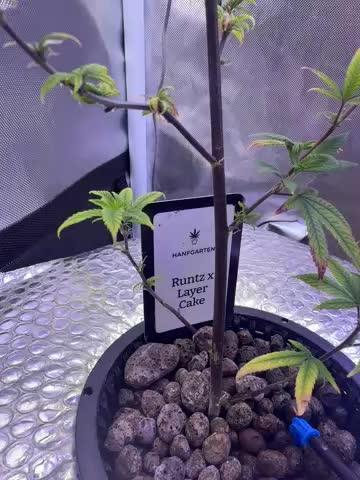
Week 6: Veg – Reset & Silicon Boost 🌿
System-Update: Komplette Reinigung der DWC (35L). Umstellung auf Osmosewasser + CalMag (Base EC 0,45).
• pH-Wert: Stabilisiert bei 6.0 (nach anfänglichem Silic-Rock-Jo-Jo).
• EC-Wert: Aktuell 1.24 mS/cm (Leicht steigend, Beobachtung läuft).
• Wassertemp: Perfekte 18,9°C – 20,3°C.
Nutrient Mix (pro 35L):
• Plagron Silic Rock: 35 ml (First in!)
• Hesi Hydro Wuchs: 175 ml
• Hesi Wurzel Complex: 175 ml
• Hesi Power Zyme: 70 ml
Strain-Check:
• AK: Absolut vital, tiefgrün, reagiert sehr gut auf das LST mit den Biege-Clips. Zeigt leichte Adlerkrallen (N-Limit erreicht).
• Tuntz Lake Cake: Wurzeln sind da, aber der "Take-off" verzögert sich im Vergleich zur AK. Sie wirkt etwas nährstoffsensibler.
Maßnahmen: Lichtabstand leicht vergrößert, um Transpirationsstress ("Canoeing") zu mindern. EC wird durch Zugabe von reinem Osmosewasser leicht gesenkt, um der Tuntz Lake Cake den Start zu erleichtern.


Likes
2
Share

@galaxytab
Follow
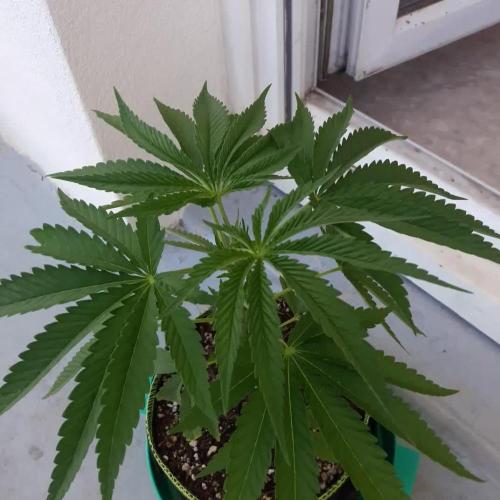
Début de 3ᵉ semaine de croissance avec cette très jolie BAD GUY by UKHTA SEED. Cette semaine je lui ai fait un TOPIN, ce qui consiste à couper le haut de la plante de façon à ce que son énergie aille sur les branchages. Pour le moment tout va bien et pour le mieux du monde.
Nous nous revoyons la semaine prochaine pour la suite de ce grow

Likes
7
Share


@tomeugironella
Follow
Starting flower on this tiny grow . I topped them 4 days ago , lets see how they do with their first flowering stage feed ! What are your thoughts guys ?

Likes
79
Share


@DudeGrowsWeed
Follow
Mexican Airlines is just awesome!!! Tons of bud sites all developing nicely. My only concern is my Alien vs Triangle hermied on me and I just hope I yanked her before she dropped any pollen on my Mexican Airlines. I think I caught it early enough and should be fine, but I guess there's a chance of some seeds. If so, I'm calling them Mexican Aliens! 😃
Likes
13
Share


@Inhaledmonkfish
Follow
Amazing week buds have grown loads both plant really top heavy both smell amazing and look beautiful!!

Likes
1
Share


@Hydroponicfarm7
Follow
Subimos la temperatura de la sala y vaya si se noto, las plantas crecieron más en 2 semanas que en un mes, una pena no haber podido aclimatar antes la sala

Likes
2
Share


@youdan
Follow
siamo nella seconda settimana e tutto va velocissimo, prossima settimana iniziero l'allenamento, vorrei poter fare 8 apicali perfetti sperando di farcela.

Likes
9
Share


@Gruenerfinger85
Follow
Die 6 Blütewoche hat angefangen.
Ab jetzt werde ich anfangen die Pflanzen zu spülen, die Trichomköpfe sind schon sehr weit vorgeschritten was den Reife grad angeht.
Deshalb muss ich das besondere Aufmerksamkeit schenken.
Bis nächste Woche.

Likes
22
Share


@MadeInGermany
Follow
Flowering day 52
since time change
to 12 / 12 h
Hey guys :-)
All ladies look very healthy and delicious :-)
We're slowly getting closer to the end.
This week it was poured 3 times with 1.2 l each (sewing materials see table above)
At the next watering there is a very light rinse with Clean Fruits so that the last nutrients can be slowly used up.
The trichomes are now checked every day.
I'm looking for my microscope with an app so I can take pictures of it 👍.
I wish you a lot of fun with the update and stay healthy 💚🙏🏻
👇🏼👇🏼👇🏼👇🏼👇🏼👇🏼👇🏼👇🏼👇🏼👇🏼👇🏼👇🏼
A thank you for this wonderful strain goes out to
Herzog
https://instagram.com/herzog030?utm_medium=copy_link
and the Exotic Seeds team
You can buy this Nutrients at :
https://greenbuzzliquids.com/en/shop/
With the discount code: Made_in_Germany you get a discount of 15% on all products from an order value of 100 euros.
You can buy this Strain at :
https://www.exoticseed.eu/
Water: Osmosis water mixed with normal water (24 hours stale that the chlorine evaporates) to 0.2 EC. Add Cal / Mag to 0.4 Ec Ph with Organic Ph - to 5.8 - 6.4
👆🏼👆🏼👆🏼👆🏼👆🏼👆🏼👆🏼👆🏼👆🏼👆🏼👆🏼👆🏼
MadeInGermany

Likes
8
Share


@CalGonJim
Follow
3/16 324AM PRETTY GOOD
⚡️ 3/16 2:41PM nside the Genetics: How Ice-T & Montel’s Strain Was Born
Seedsman Seeds https://www.youtube.com/watch?v=q5eMAVat60M
3/19 330AM 👨🔬⚡️**Adding L-Proline (the amino acid supplement growers use) to plants on soft water can provide some helpful support against the stresses you're dealing with, but it's not a full fix—think of it as a stress-buffer rather than a mineral replacement.**
Soft water (low in calcium and magnesium) often triggers **Ca/Mg deficiencies** in bloom stage (especially with Cha Ching or MaxiBloom, which don't supply much Ca/Mg on their own). This leads to issues like tip burn, leaf curl, weak cell walls, nutrient lockouts, oxidative damage (ROS buildup), and overall plant stress that feels like "the plant is struggling to hold it together." Proline steps in here as an **osmoprotectant**—it's one of the compounds plants naturally ramp up under stress.
### What Proline Actually Does in This Situation
- **Helps with osmotic/water balance** — Soft water can disrupt turgor pressure and water movement inside cells (similar to mild drought or salinity stress). Proline stabilizes cell membranes and helps the plant retain water better, reducing wilting or limpness.
- **Reduces oxidative stress** — Ca/Mg shortages cause free radical damage. Proline acts as an antioxidant and protects proteins/enzymes, so deficiency symptoms (yellowing, spotting, slowed bud development) don't spiral as fast.
- **Improves overall resilience** — In cannabis and general hydro/soil grows, L-proline (or full amino acid mixes containing it) has been shown to boost stress tolerance, speed recovery, and even support better nutrient uptake indirectly. Studies and grower reports note it helps under nutrient imbalance, drought-like conditions, and environmental swings—exactly the secondary stresses soft water creates.
- **Bloom-stage bonus** — Since you're already in late flower with Cha Ching/MaxiBloom, proline can support resin/terpene production and bud density without pushing excessive veg growth.
It won't magically add the missing Ca or Mg (those are still critical—soft water + high-P bloom nutes often screams for CalMag), but it can make the plant more tolerant while you correct the root issue.
### How Much Effect to Expect Right Now
- **Positive but moderate** — Many hydro/RO growers add amino acids (including proline) specifically for soft water setups and report less burn, better leaf health, and stronger finishes. It won't turn a severe deficiency around overnight, but it can slow the damage and give your plants a fighting chance in the final weeks.
- **No downside at proper doses** — It's very safe and plants use it quickly.
### How to Add It (Practical Dosing)
- **Source**: Pure L-Proline powder (available cheap online—make sure it's the plant-grade L-form, not human supplements).
- **Root feed** (with your Cha Ching/MaxiBloom): Start at 0.5–1 g per gallon (about 100–200 ppm). Mix into your res or feed water once a week. pH as normal.
- **Foliar spray** (often more effective for quick stress relief): 0.25–0.5 g per gallon + a drop of surfactant. Spray lightly every 5–7 days in the dark period.
- **With your current nutes**: Yes, it layers fine—reduce if you see any tip burn. Many run it alongside MaxiBloom + Cha Ching in soft water without issues.
- **Best timing**: Now through harvest is perfect, especially if you're noticing stress signs already.
**Real talk**: The biggest win will still come from adding a proper CalMag supplement (like Botanicare or General Hydro's) at 0.5–1 ml/gal or whatever your PPM tests call for. Proline + CalMag together is a strong combo for soft water grows. If you're running pure RO/soft, most experienced growers treat this as standard.
3/19 445am BKO Blueberry KnockOut!! (Gelato 44 by RQS & Bubbles Blueberry F4 by Grimm Brothers Seeds) my own creation!!👨🔬
A spoonful of butter helps the sugar go down, Im helping.
3/19 10:42PM mmm butter and sugar are just a few ingredients shy of cookie dough, good enough.
Now ICE-T BODYCOUNT Grows efficiently in a one gallon with very little effort No real LST, lower than normal lighting, so cheaper to grow. MONTEL: growing great in such a small container!! Should have topped, she is tall. Colors are coming in now, very strong also growing great at low watt so very efficient as well!!!
3/21 1:38PM https://www.stonedgenie.com/collections/cool-bongs?&sort_by=price-descending This hits like a hand pipe, the chambers are just the right size its just the best..I put on a silicone funnel I tore apart for a dental guard. dont smoke from metal or glass directly.


