


Likes
Comments
Share


@Reskap
Follow
J’ai fait un peu de lst et de défoliation. J’ai des mouches de terreaux j’ai donc ajouter des pièges collant jaunes. Mes plantes sont tout de même petites quand je compare à d’autres journaux mais c’est la première fois. D’ailleurs si vous avez des conseils pour faire mieux je suis preneur


Likes
7
Share


@Car1bGrow
Follow
First week went well, got two plants in coco coir and one in soil. One of the plants in potting soil came up a day after the other two but they’re doing fine
Likes
102
Share


@Hashy
Follow
This was my 1st photoperiod grow on growdiaries and I'm glad I tried these Fast flowering photoperiods for it. Big thanks to Heather and the Fastbuds team. I have grown the Gorilla Cookies auto before so this photoperiod fast version has something to live up to. She grew way taller then i was expecting, hence the many bends and breaks. To be honest she was great to grow and the favourite plant of the grow. Because this grow was going so good I decided to switch back to photoperiods for the next few grows i just wish i had left her in veg for 1 more week.
Total dry weight for the grow, decent buds=136g
Light power
Total= 200.43Kw
18hrs for 28 days = 504hrs
12hrs for 67 days = 804hrs
Total hours for lights= 1308hrs
200.43÷1308=0.153Kw/hr average.
Average 153w/hr
Total g/W=0.89g/W
Power used for grow=508.78Kw @0.30p =£152.63
Each gram cost £1.12
The buds have been curing for nearly 2 weeks so I haven't had a sample yet. There will be more pictures added once I try the buds and write up a smoke review but for now I'll just leave a video of the grow and a picture.
Thanks to all who have viewed my diaries and a big thanks to all that posted likes and comments, it's much appreciated.

Likes
2
Share

@Ultraviolet_
Follow
We become aware at such times of man's wonderful ability to bring seemingly unrelated elements into harmonic balance, and receive a glimpse into a world where everything exists in conscious sympathetic attunement to everything else. When we listen to a piece of music that seems to strike a beautiful chord somewhere inside us, or view a painting that simply glows with harmonic awareness well executed, we probably do not spare much time to contemplate the wonderfully intricate combination of vibrations that our sensors make it possible for us to perceive. We tend to appreciate the relationship between the parts of something by an awareness of the harmony or dissonance of the whole. This ability enables us to say "what a beautiful house!" instead of "analysis has proven that this collection of building materials exhibits certain elements of harmonic proportion." While this ability to instinctively appreciate the beauty of true harmony has an important role to play in evolution, a more analytical understanding of the laws involved can be most useful. This is especially so if we wish to create works of art where each part exists in true harmony, not only with the other part of that particular whole, but with the universe within which the creator and the created exist.
Everything vibrates. From the most dense matter to the most subtle cosmic rays, everything which our senses allow our thoughts to become aware of, can be specified in terms of wavelength or frequency of vibration. These two terms define the same thing, but from different points of view.
The following are the approximate wavelengths of various energy carriers:
Cosmic rays 0.000,000,001 mm
Gamma rays 0.000,000,1 mm
X rays 0.000,500 mm
Ultraviolet rays 0.003 mm
Visible light 0.006 mm
Infrared 0.01 mm
Sound waves 1 meter
Radio waves 300 meters
Violet light 400 nm to 450 nm
Blue light 450 nm to 500 nm
Green light 500 nm to 570 nm
Yellow light 570 nm to 590 nm
Orange light 590 nm to 610 nm
Red light 610 to 700 nm
1 nanometer (nm) = 0.000,000,1 cm = 1/10,000,000 cm
If a guitar string is plucked and we hear a sound, it is not too difficult for the human mind to associate this sound with the vibration of the guitar string. With color it is quite different. It is difficult for us to conceive that the color of a substance is not an inherent property of the substance itself, but an indication picked up by our senses of that substance's ability to absorb or reflect the light which happens to be shining on it at that moment. Neither the matter nor the light is colored. What happens is that the brain learns to differentiate between the frequencies reflected or transmitted by the substance the eyes are focused on. The same thing happens with sound. When we say "Oh! Listen, they're playing my favorite song," what we really mean is: "My brain has stored within it a particular pattern of frequencies. I have compared the new information being received with this stored pattern and have deduced the answer that the two patterns are similar within certain specified tolerances." The 'pleasure' involved could have something to do with our running the pre-recorded pattern at the same time, in 'sympathy' with the new pattern as it is received.
The word sympathy describes very well our ability to appreciate color and sound. It also describes the reason behind certain elements of harmony. For instance, if a substance vibrating at 100 cycles per second (tone 1) is in the proximity of another substance vibrating at 200 cycles per second (tone 2), we could perceive, if we had the right equipment, a certain sympathetic relationship between the two.
We will see from this that there is a uniform doubling of the first tone seen in the second. At various points along the waves, the two are the same in amplitude. At other points, they are at opposite poles to each other. This doubled frequency has more points of similarity to the original than any other frequency except the original itself. If the equipment we had available for measuring these two frequencies was a soundboard amplifier and a pair of ears, then we would hear what would sound to us like one tone. If we had the opportunity to hear one at a time, we would hear that although they sound the same, one is higher in pitch than the other. This characteristic of 'the same but different in pitch', musicians have called the octave. Any two tones produced where one has exactly doubled the frequency of the other is called an octave. Speaking in ratios, an octave would appear then as the ratio 2:1 or 1:2, depending on whether we are talking of an octave up or down.
A single note produced by almost any instrument will contain more than one wavelength or frequency. It will have a dominant frequency, the wavelength of which we would call the note's 'fundamental' or 1st harmonic. It will also have a varying number of upper harmonics, gradually fading in intensity into infinity or silence.
Natural harmonics always have the same pattern of intervals between them. The interval between the 1st and 2nd harmonic is a perfect octave; between the 2nd and 3rd a perfect fifth; between the 3rd and 4th a perfect 4th; and so on, the intervals becoming smaller and smaller until they lose any relationship with the western 12 tone scale as it exists at the moment. Just as an octave has certain elements of sympathy with its fundamental, so some intervals have been noted to be more perfectly in sympathy with the fundamental than others. The ratio of the 'perfect 5th' or interval of 7 semitones, as it occurs in the harmonic series, is 3:2 or 2:3, while that of the 'perfect fourth" is 4:3 or 3:4. All the tones in the western 12 tone scale can be expressed in terms of the ratio between the upper tone and its fundamental. This would seem to be an ideal way of generating a scale from any given fundamental and several attempts have been made to do this, the Pythagorean system being probably the most well known. Although when working with a single tone instrument playing on its own, the Pythagorean formula works wonderfully well, if we had several instruments tuned this way together and asked them to play almost any western music, we would find that at times they sounded quite out of tune to each other.
The lack of flexibility of the various scale systems based on the harmonic series has led to what is known as the 'tempered' scale. This uses as its primary unit of interval the ratio of the octave or 2:1. It then proceeds to divide the interval between any fundamental and its upper octave into 12 smaller intervals by applying the ratio: two to the one-twelfth power, to one (21/12:1). This equals 1.059463094, so by multiplying any frequency by this number, we will obtain the tempered semitone next up from our fundamental. We will also find that any tone twelve semitones up from any other tone, in a scale generated in this way, will have exactly double the frequency.
If we took the note middle C on a piano and halved the wavelength, we would have the note C one octave above. If we halved this, we would have the C above, and so on. However, within about 6 octaves, we would find that although a 'sound' was being produced, no human ear could perceive it. If we kept on going, halving and producing upper octaves of our fundamental C, we would proceed through the infrared band, into the visible light spectrum. If we happened to be outside during the day, we would, for one octave only, see the note C with our eyes. The next octave above would already be in the ultraviolet band, and outside the eye's sensitivity range. If we can think of color as being an indication of a substance's vibratory rate or wavelength, we may begin to see a relationship that could exist between the color and sound spectrums.
The logical extension of what has so far been said is that there exists a scale in the color spectrum that corresponds exactly to the scale in the sound spectrum, each color tone being an octave of the equivalent note in the sound range.
This is not the end of the story but only the beginning. If we can for the moment accept that any wavelength in one band has upper and lower octave stretching out to infinity, then the next question is 'fine, but what shall we use as our fundamental? A particular color? A particular sound frequency?' The musicians among us will probably say 'A 440'. This means that the note A should vibrate at 440 Hertz, or 440 times per second. They would tell us that this is standard pitch has been adopted by most orchestras around the world; pianos are tuned to it, instruments are constructed to formulas based on it, and so to them it would probably seem the most appropriate place to begin. Some of these musicians may know of the battle that is still raging with regards to this being the standard, but few would know why A = 440 Hz was chosen except that it worked when it was set to be a suitable compromise between the many different pitches in use at the time.
432 Hz is said to be mathematically consistent with the patterns of the universe. Studies reveal that 432 Hz tuning vibrates with the universe’s golden mean PHI and unifies the properties of light, time, space, matter, gravity, and magnetism with biology, the DNA code, and consciousness. When our atoms and DNA start to resonate in harmony with the spiraling pattern of nature, our sense of connection to nature is said to be magnified.
Another interesting factor to consider is that the A=432 Hz tuning correlates with the color spectrum, while the A=440 Hz is off. Audiophiles have also stated that A = 432 Hz music seems to be non-local and can fill an entire room, whereas A=440 Hz can be perceived as directional or linear in sound propagation.
Once you adopt the idea that sound (or vibration in general) can have an equalizing and harmonizing effect (as well as a disturbing effect), the science of harmony can be applied to bring greater harmony into one's life or tune to specific energies. There is a form of absolute and relative harmony. Absolute harmony can, for example, be determined by the tuning of an instrument. The ancients tuned their instruments at an A of 432 Hz instead of 440 Hz - and for a good reason. There are plenty of music examples on the internet that you can listen to in order to establish the difference for yourself.
Attuning the instrument to 432 Hz results in a more relaxing sound, while 440 Hz slightly tenses up the body. This is because 440 Hz is out of tune with both macro and micro cosmos. On the contrary, 432 Hz is in tune. To give an example of how this is manifested microcosmically: our breath (0,3 Hz) and our pulse (1,2 Hz) relate to the frequency of the lower octave of an A of 432 Hz (108 Hz) as 1:360 and 1:90.
It is interesting to note that 432 Hz was the standard pitch of many old instruments and that it was only recently (19th and 20th century) the standard pitch was increased. This was done in order to be able to play for bigger audiences. Bigger audiences (more bodies) absorb more of the lower frequencies, so the higher pitch was more likely to “cut through”. One of the oldest instruments of the world is the bell ensemble of Yi Zeng (dated 423 BC), tuned to a standard F4 of 345 Hz, which gives an A= 432 Hz. The frequency of 345 Hz is that of the platonic year! Similarly, many old organs are tuned in A=432 as well; for example, St. Peter’s Capella Gregoriana, St. Peter’s Capella Giulia, S. Maria Maggiore in Rome.
Maria Renold’s book “Intervals Scales Tones and the Concert Pitch C=128 Hz” claims conclusive evidence that 440 Hz and raising concert pitch above scientific “C” Prime=128 Hz (Concert A=432 Hz) disassociates the connection of consciousness to the body and creates anti-social conditions in humanity.
The difference between concert pitch A=440 Hz and Concert A=432 Hz is only 8 cycles per second, but it is a perceptible difference of awareness in the human consciousness experience of the dream we share called existence.
Likes
14
Share


@CeGrow
Follow
woche 11
nr1.:
tag 73:
trichome teilweise milchig, noch keine bernsteinfarbenen
noch etwas zeit zu ernte
nr2
tag 77
noh etwas zeit zur ernte, trichome teilweise milchig


Likes
6
Share


@HighstreetterpS
Follow
Ma strain préférée, un goût de gâteaux crémeux et des trychome a foison



Processing
Likes
16
Share


@Sur_cannabico
Follow
Tras 18 horas de Germinación se raliza el primer transplante de la variedad green gelato de RQS a su primera maceta de 0,4 lts. Y al paso de 12 horas de luz en fotoperiodo 18/6 ya se asoman a la superficie 🌱
Potenciamos el desarrollo radicular aplicando micorrizas (Red roots) de Quemanta Nutrientes
Veremos como evolucionan al paso de los días

Likes
Comments
Share

@Chucky324
Follow
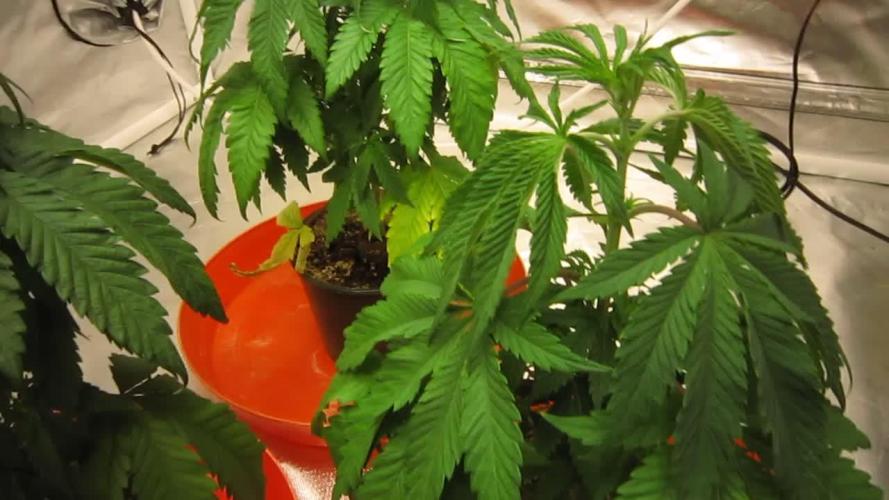
Hello This is the end of week 4 and the beginning of week 5 of veg.
Well... I looked... and found... I have 3 females from regular seeds.
What a surprise. I thought I would get at least, 1 male.
Now that I know what sex they are, I'll top them soon to get ready for training.
The plants look a little wilty because... these pics were taken 1/2 hour before lights off... and they are getting ready to sleep.
OK. Have fun.
Chuck.


Likes
19
Share


@Chubbs
Follow
420 Fastbuds Week 2 Veg
FBT2306
The two of these are starting off great. The few rust spots stopped and stayed on the couple leafs it showed up on. I feed 500ml of solution every other day. I did start the General Hydroponics 3 part Flora series as well as the Calimagic. On week one I started 1/4tsp per gal ratio every other feed, so far no burn so will probably bump it up this coming week and see how they respond. All in all Happy Growing.


Likes
10
Share


@Dunk_Junk
Follow
She's done!!
Super, super stinky!!!!!!!!
Covered in trichomes!!!!!!!!!!!
Will be harvested within 24h.
Likes
2
Share


@CannaIGrow
Follow
Plant is growing well. Probably the prettiest one outta the bunch so far.


Likes
Comments
Share

@Kannisho
Follow
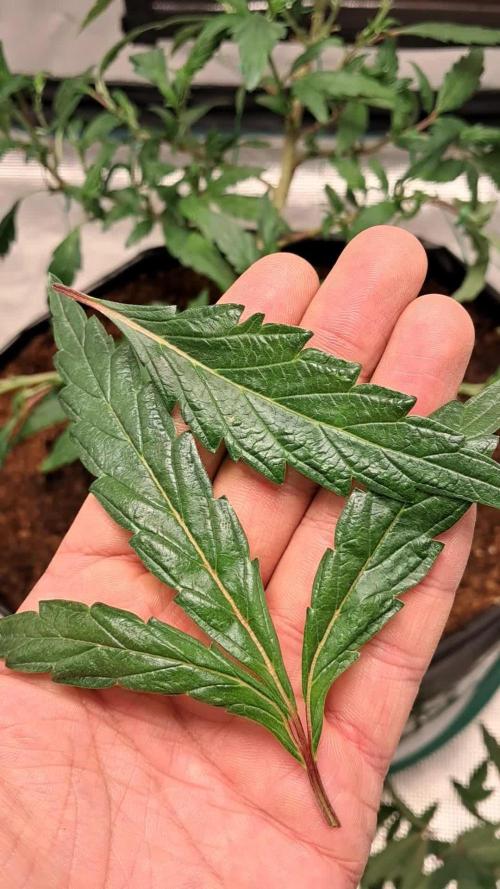
Se han realizado riegos foliares con 0.5ml de parte A y parte B de crecimiento de C21Nutrients 1 vez esta


Likes
47
Share


@KilgoreTrout
Follow
January 8th 2018
Growing out well, everything is stable and good. Planning on flipping to flower on Sunday. Can’t wait to see buds.


Likes
11
Share


@BudBeezy
Follow
Welcome to week 10 of my grow diary. As I mentioned last week, I am now letting the plant grow as it wishes. It has put on a good amount of leaves. The stem is getting thicker and thicker. I like the structure very much and I hope the plant will develop beautiful massive buds in the future. The flowering phase should start in the next few weeks. The weather can stay like this. It only rained on one day.
See you next week ✌️
Likes
8
Share


@Slobasian
Follow
Have about 10 flavors still trying to decide on what exactly I’m doing I chopped them in half, I’m excited to see these flowers from the outdoor grow I have


Likes
14
Share


@Surfettuccini
Follow
Last week I went away for a while and I had to leave my babies alone. Temperatures dropped so also maturation slowed down. When I arrived home this is what I found! She got darker and colas got even bigger and more sticky. She smells like pine but the odor is not very strong. It is also a little bit cheesy and mouthwatering. My dog was really attracted and tried to eat some. She is amazing! Tomorrow I will upload some better photos I took with my reflex.