


Likes
Comments
Share

@Esjey
Follow
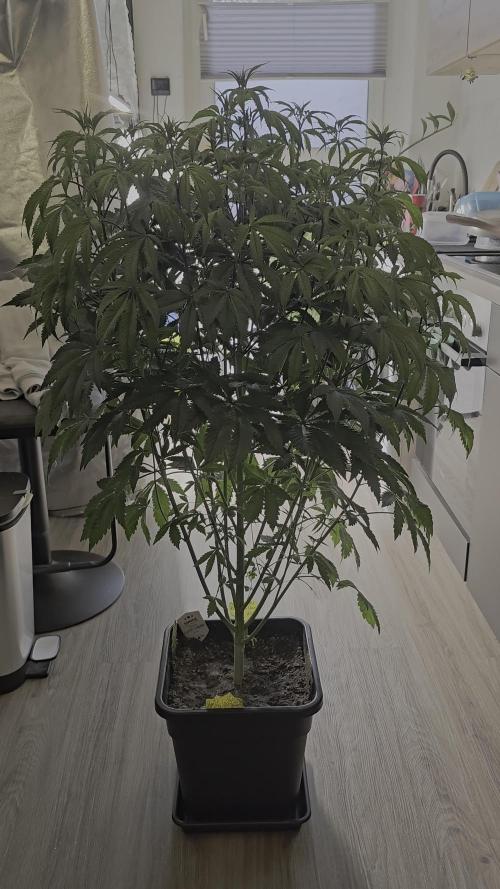
Frst time i see colors like this without blooming 🧐 wtf strong and big mf still growing.

Likes
15
Share


@Rinna
Follow
What a run this was, harvested at day 70 of 12/12. Pheno #1 was the iciest from the start and hasn’t disappointed ever since. Amazing and beautifully stacked buds with and insane amount of trichomes! She looks truly amazing, very exotic bud structure too! The smells are out of this world with artificial cherry, cookies and gas terps. Can’t wait for her to be dried and cured for the final smoke test!

Likes
6
Share


@Mr_nugs_lover_David
Follow
She's growing I little slow so I'm gonna wait a little before I top her I don't like to top a plant when is that small so I'll keep watering and once se gets a lil bigger I'm gonna beak tje apical dominance and then start training her

Likes
43
Share


@Hashy
Follow
********************************************
Week 16 Fading (flower week 10)
********************************************
Light cycle=12/12
Light Power=100w 42%
Extractor controller settings
High temp= Day 26c, Night 20c
Low temp= c
Temp step=0c
High Rh= Day 50%, Night 55%
Low Rh= %
Rh step=0%
Speed max=10
Speed min=2
Smart controller settings (during lights on).
Lights on=9.00am
Top fan on=+22.5c
Top fan off=-22.0c
Dehumidifier on=+50% and -26c
Dehumidifier off=-50% or +26c
Smart controller settings (during lights off).
Lights off=9.00pm
Dehumidifier on=+55% and -20c
Dehumidifier off=-55% or +20c
VPD aim=0.6-1.3
DLI aim=30-45
EC aim=0.2-0.5
PH aim=6.0-6.5
NPK(0/0/0)
💧💧💧💧💧💧💧💧💧💧💧💧💧💧💧💧
Method= Autofeed 6 drippers.
Feed=water
Volume=8L
Easy Ph down= 0.02ml/L ( 4 drop total)
Ec=0.2 PH=6.5/6.5
Runs=16
Run times=5min (250ml each)
Gap times=15min×14, 45min×2
Total runtime=80mins (4.0L each)
Total flowrate= 100ml/min (50ml/min each)
Auto start time=10.00am
Auto stop time=4.05pm
💧💧💧💧💧💧💧💧💧💧💧💧💧💧💧💧
********************************************
********************************************
📅1/9/24 Sunday (day 106, day 64 flower)
📋H=99cm D=16cm Dli=38.9 Ppfd=900
📅2/9/24 Monday (day 107, day 65 flower)
📋
📅3/9/24 Tuesday (day 108, day 66 flower)
📋 a few issues through lack of light to some lowers. Plodding along nicely.
📅4/9/24 Wednesday (day 109, day 67 flower)
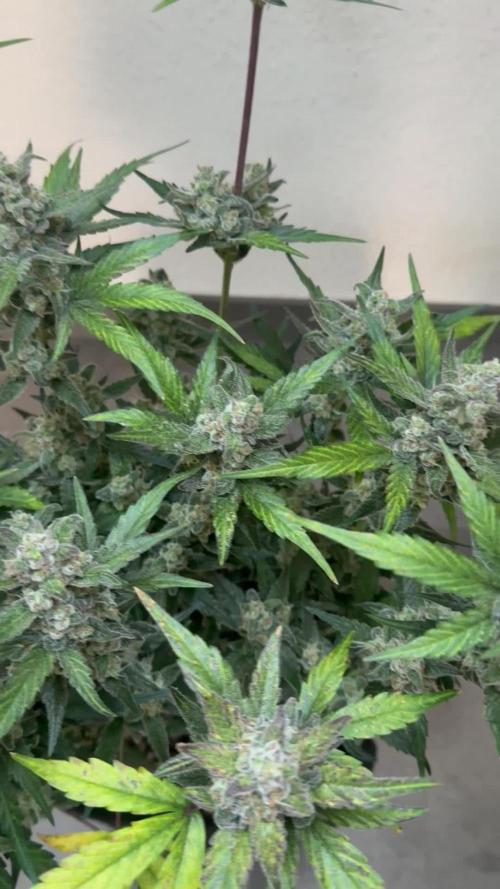
📋 where she's fading at the top a leaf has died, possible cause bud rot. Will investigate at the end of the week.
📅5/9/24 Thursday (day 110, day 68 flower)
📋 I'm not happy with a main cola, may have got rot because the buds have got so dense and close together, or could be because that particular cola is right near the light and its burned the leaves, I'll chop the top off that cola and inspect it. After inspection there a 8 very dense buds all clustered together and some inside leaves have died and the rot had started to form inbetween 3 buds, only a slight bit of rot but I'm discarding the whole top. Was 52g wet. Because of this and a few other colas have dense buds I'm only going to let her go for a few more days. Had a joint got paranoid and cut 3 more tops off, they was ready and no sign off rot 136g wet from those 3 tops.
Total weight so far 188g
💧
Method= automatic
Feed=water
Volume=10L
Ec=0.2 PH=6.1/6.5 (PH D=0.02ml/L) 5d
Volume left=1L
Volume used=9L (112ml/min)
Volume each=4.5L (56ml/min)
Runoff.
Total runoff=0.8L
Ec=2.4 PH=/6.5
💧
📅6/9/24 Friday (day 111, day 69 flower)
📋 Now in the tent on her own for a short while.
📅7/9/24 Saturday (day 112, day 70 flower)
📋 incrased light power to 125w
********************************************
Weekly roundup.
📋 Obviously I had the issue with rot starting to form on my main top and lost that which I'm gutted about, I could have chopped that off last week really. I'm just letting the lowers mature a little bit longer.
I gave her 3 more days after this week before harvest so next update is harvest. I encoded some pics from those 3 days.
Take it easy.
Back soon with harvest report.
********************************************


Likes
13
Share


@YOUNGSTERBR
Follow
acho que ainda consegui produzir uns tricomas com as correções da água, mas como o estágio da floração já estava bem avançado, as folhas começaram a descolorir muito cedo, tive que colher 3 plantas precocemente, as outras 3 menos vou tentar seguir mais 2 semanas, não estão mostrando tricomas Ambar ainda!

Likes
18
Share


@KushAllDayLong
Follow
Week 10! First week of flower! I was eager and may have jumped the plan I had the other day of waiting another week but after some sound advice from a few people that inspired me to flip them to flower and watch them flourish!!
Day 1..fed fox farm trio with some added aloe vera, very little..won't add anymore from here on out..I added some peroxide as well!! I opened the tent this evening and they were praying up to the mary Jane gods!! Just what their daddy wants to see!! Let's get this smoke to the heavens for the loved ones!! Aye!!!
Thanks again to everyone who inspires me and has helped me along the way! Oh and I ordered a trellis net so it should be set up in the coming days!!
I was going to enter the solo cup challenge with the mini Starbucks cup you see but I didn't realize time was ticking and i may end up throwing her away unfortunately as I dont have a tent to put her in with a light set at the right hours or whatever!! She wouldn't survive on 12 12 or would she?
Day 2 of flower - I opened the tent this morning and the girls are reaching for the sky even more! I forgot to mention I made some fresh Aloe Vera tea/juice for the last feeding I did before flipping to flower..next run I'm going to try not using aloe vera on one of my plants to see the differences..I feel the aloe vera has helped my girls alot but I'm not too sure!! I made a video on youtube about how I made it!! If you have some time and are interested in making your own...
Day 3..I opened the tent and BAM!! These girls know how to make you feel good!!
https://youtu.be/ud9Yi-F5HSQ ( one of my high school friends band is called Katastro, Andy Chaves..lead singer, passed away in a tragic car accident this past year and it's been really tough on everyone!! R.I.P Brobro! The link above is a song I listen to, it's helps me through on tough days and sometimes it helps me shed a much needed tear!! I'm here for anyone that is struggling..have a good day!!
Day 4 of flower..Half way through the day I made the video above titled day 4 of flower..they are all looking happy but the Watermelon Zkittelz is really taking off!! If you have any advice please send it my way!!
Day 5 of flower in the books. Plants look healthy, few minor adjustments next watering for one of the girls..but for the watermelon Zkittelz she's taking off like crazy!!
Also I'm doing a SPIDAR FARMER SF1000 NEW YEARS GIVEAWAY (PURCHASED BY ME ) ON MY NEW YOUTUBE CHANNEL. IF YOU ARE INTERESTED COME CHECK IT OUT AND GIVE ME A LIKE COMMENT AND SUBSCRIBE TO ENTER THE GIVEAWAY!! I FIGURED WHEN I UPGRADE MY LIGHT SET UP WHY NOT GIVE ONE AWAY TO ONE LUCKY WINNER!!
FOLLOW THIS LINK BELOW TO ENTER:
https://youtu.be/pqEeoWQjCAM
End of Day 6 of flower - the girls are filling out and stretching high!!! Let's go!!!
THANK YOU!!
CHEERS!!
One love!!
Likes
133
Share


@Kitties_and_Colas
Follow
Thought i could change last week to "Harvest" this works too lol....this plant is not a super heavy hitter and despite being an indica dom its actually a pretty good daytime smoke, I've been smoking a little with coffee the last few mornings without it zapping my motivation..would we grow again?..meh..maybe...the weights as usual are approximate..my hubby "eyeballed" half of what was dry and passed it on to family..the remainder of the dry stuff weighed 45 grams.. this is only to last until our next harvest in 2 weeks..thanks for reading and happy growing everyone!!❤️🐱💡🌱
Likes
10
Share


@Prop207
Follow
25 ml PBPB
15 ml sb
15 ml Cm
Ph 5.8
Nodes are staying compact, not much stretching. She's drinking a quart a day.
Ph was rock solid like my cock.
Likes
17
Share


@Bendedknee
Follow
The buds are really starting to form now, I’m getting a lot of purple and some black sugar leaf this is gonna be a wicket show.
Oh my freaking sticky icky and I thought growing weed was tricky


Likes
29
Share


@Cheeba_Inu
Follow
The buds are still bulking a little more as of day 64. The trichomes are pretty milky/frosty so the harvest is getting close, but I am not going to rush it if the plant is healthy and the buds are not suffering. My best estimate right now would be between day 68 and 78 for harvest.
Day 67: areas of amber colored trichomes are appearing on the calyxes, under 10 percent of total. this is what I have been watching for to indicate harvest time so I will be giving water from here out and begin cutting down the plant in a few days.
Thanks for reading!


Likes
Comments
Share

@Grow4ever
Follow
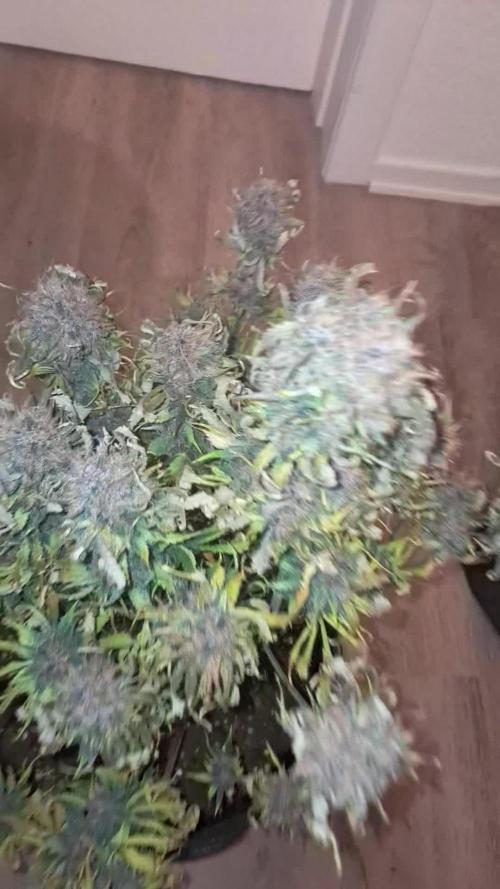
Overall auch ein toller grow mit vielen learnings.
Hab Sie zum Schluss mal 3-4 Tage im Dunkeln und ohne zu gießen stehen lassen, da ich weg war.
Entspchend trocken sieht Sie bei der Ernte aus.


Likes
6
Share


@eldruida_lamota
Follow
Que pasa familia, vamos con la cuarta semana de crecimiento de estas Lemonpaya feminizadas de fastbuds.
Vamos al lío, de las 3 plantas, me quede con 2 por espacio, siempre pongo alguna semilla de más por si no abriese alguna por no perder ese hueco del indoor.
También se trasplantaron a su maceta definitiva, en este caso de 7 litros que además provocó un shock que también solucione.
El ph se controla en 6.2 , la temperatura la tenemos entre 20/22 grados y la humedad ronda el 50%.
Hasta aquí todo, Buenos humos 💨💨💨
Processing
Likes
4
Share


@Green_Thumb
Follow
My oldest girl had her flush this week and its about time for her to finish up. I will continue the journal for my 2nd oldest so stay tuned!
Likes
12
Share


@Staffedition
Follow
Привет друзья. Моей растихе сегодня 60 дней.
Начал применять LST технику на 19 дне и продалжаю применять её через день, а 18 августа добавил ДЕФОЛИЗАЦИЮ
С 20.08 ДЕФОЛИЗАЦИЮ делаю каждые 3,4 дня
С 20.08 LST технику делаю каждые 4.6 дней
На сегодняшний день влажность 60%
15 дней назад заметил высокий Ph 7.9
С 48 дня Ph не ниже 5.8
На сегодняшний день Ph 6.0
Начал кормить с 60 дня Canna Terra Vega
PPM 550
Погладитель влажности, выполняет свои функции. Посмотрю на динамику.
Всем мира и добра!
https://t.me/smail_seeds
#Smail_Seeds
Likes
6
Share


@masterofsmeagol
Follow
I STARTED ON THE DIARY WAY TO EARLY. I HAD TO POP ADDITIONAL SEEDS DUE TO AN ENTIRE PACK NOT GERMINATING. AFTER THAT I EITHER BURNT OR INJURED A COUPLE SEEDS REMOVING A FEW HELMET HEADS. IM FEELING BETTER ABOUT THIS SEASON NOW THOUGH THAT THINGS ARE FINALLY IN THE RIGHT CONDITIONS. IM CONSIDERING POPPING A COUPLE MORE 10TH PLANET JUST IN CASE. WE'LL SEE.
4/20 Happy 420 and Easter to everybody! Checked the girls this morning and at noontime. It was a good idea to switch lights. I'm seeing positive growth under both the duel 1500 lumen cfl's and the 1000 watt l.e.d. with an actual draw of 105 watts. The single 150 hps couldn't go low enough without raising the temp. I may add it layer after transplant in edition to the l.e.d. the plant I had to put a straw on has perked itself up and now has 3 fingered leaves. I'll have to bury up the stem a little on a few after they fill these solo cups. I WATERED everything that was under 20 grams dry weight which was most everything. I'm seeing a dramatic difference thus far. I'm wondering if I should start a couple more 10th planet in case one doesn't make it. The kush seedlings have finally showed a little more advanced growth then the seeds popped later which makes me feel good. It will be interesting to see how these turn out. They are going to be extremely resilient high yielding potent plants that will make it to harvest early. Words have power.
4/21 The lighting switch is working out good. When the plants fill out the solos I'll put the hps back up and use both until they go to their final spits outdoors. I watered everything under the led light which is all pink/special kush. I watered a couple in the aerogarden if the were under 20 grams of dry soil weight. I may have to up the amount of water but I'll be keeping an wye out. Still wanting to pop a couple more 10th planet. I've seen the first 3 fingered leaf. Can't wait for this season.
WENT BACK OVER AT 6PM AND EVERYTHING IS LOOKING GOOD. I HAVE THAT ONE PINK KUSH THAT STRETCHED AND I HAD TO PUT A STRAW ON IT IS PICK8NG UP WELL. IM JUST GOING TO HAVE TO BURU IT DEEPER WHEN I GO TO GALLON POTS. IT WAS NICE TODAY AND I GOT A LOT IF SELF CARE DOWN AND HAD SOME OTHER TROUBLES BUT SEEING MY GIRLS GROW UP MAKES ME HAPPY. IM GOING TO USE THE PAR METER AGAIN TOMORROW AND BEGIN CLEANING AND SANITIZING MY GROW AREA. I HAVE A LOT TO DO.
4/22 WATERED EVERYTHING AS IT WAS WITHIN 20 GRAMS DRY WEIGHT. Plants are improving. I'm FINALLY reaching REAL veg with a couple seedlings that have grown their first 3 finger leaves. I'm looking forward to the transplant to 1 gallon. They seem to explode after that. That and the few that stretched can be buried. Now it's time to hurry up and wait. The thing is, now that some have stretched they are growing leaves which makes it top heavy on a ciuplecdue to the elongated stem. Still looks good though. I also rotated the plants to minimize hot spots.
4/23 Things are doing well. I watered everything but two in the back of the aergarden that were still over 20-grams over dry weight and i added soil to the 10th planet cups. Not because they were stretching but just so I can weigh it with the others so I can water properly. I'll check on them later. The oldest seedlings have their first three fingered leaves. I've been shopping around for soil. I think I'll round up all my 1 gal pots and wash them as these will need a transplant in a while. I should check the ppfd again. I also need to ready my outdoor area and sanitize it. Plenty of stuff to do. May still end up popping a couple more 10th planet. Not sure.
EDIT: WENT OVER THIS AFTERNOON AND LOCATED ALL MY ONE GALLON POTS (AND A COUPLE OF THOSE SLANTED ONES THAT ARE A LITTLE MORE THAN A GALLON). FPUND THE 3'S TOO BUT IM GOING INTO ONES THEN HOME BABY HOME. AT LEAST THATS THE PLAN. I EMPTIED LAST YEARS GROW BAGS AND BURNED THE LAST OF TEO CANNABIS STALKS. I STILL NEED TO DEEP CLEAN THE CAGE. I JEED TO SPRAY THE PALLETS WITH THAT PESTICIDE THAT KILLS EARWIGS (THE ONES I CANT REPLACE). I ALSO NEED TO GET ALL THE LOOSE SOIL THATS FALKEN OVER THE YEARS AND THE LEAVES OUT OF THE CAGE. LEAF BLOWER AND A RAKE WILL TAKE CARE OF THAT. I HAVE A BRUSH BURNER AND I WAS THINKING ABOUT USING IT BUT THEN REALITY SUNK IN. AT LEAST I GOT SOME WORK DONE. WASHED UP NIDE AND PUT ON HAND SANITIZER TO CHECK ON THE GIRLS. THEY LOOK GREAT TO ME. I QUICKLY SHOT TWO PICS AND BEAT FEET. I SHOULDVE NOT GONE IN AT ALL BUT THAT WAS THE POINT OF ME GOING THERE. TO CHECK IN THE GIRLS. IM SURE THEY'LL BE FINE.
4/24 Had to go back and water. I watered the two in the ag that weren't watered before. Most of the cups under the l.e.d were right on the cusp (220, 218 ect.) I watered a couple and left the others that weighed a tad more and misted the top with a spray bottle so it won't totally dry out. I'll check later but they are growing at a rapid pace now. I'll probably end up watering. I'll probably have to up the volume. I think I'm going to go get a bag of ffof to put in the house and warm up. That way I cam transplant whenever I want. I'll check around for prices.
EDIT: Went to the local grow store and bought 3cf of Fox Farm Ocean Forest which will be mixed with the 2cu bag of Happy Frog I already have when I transplant into the 1 gallons pots. I got prices for all the soil so now I just need to figure out how many bags of each I need. I want to get it early so it's still there. I'll be doing my math.
Went back over and and as predicted the three cups under the led were "almost" within ten grams of dry weight. They probably could've waited (212, 211, 208) but they are close to breaking the ten grams over dry limit that seems to be doing good for me. I showed my commercial buddy cause he hasn't seem them a while and I could tell he was impressed. I'll take pictures tomorrow. I cleaned the cage a little bit more. My buddy thinks going into 1 gals is the better option than going into 3's. If I have to then it would just be the bigger plants and I have a few gallon and a half ones I'll use for the bigger plants. Still debating whether to pop more seeds and pheno hunt or just go with what I've got. What I've got is looking good. I just don't want to lose any. Might be smart to start a couple extra.
4/25 WATERED EVERYTHING I think. I might think about increasing water volume of water I give at a time. I'll probably stick with whats working since I use the scale anyway. The kush under the l.e.d dries out faster than the cfl. They both are working good and I'm getting some good node development. The earlier plants are actually looking like a pot plant. I may start next week with a weak nutrient solution like ancient amber or the first fox farm one. Worked on some more of the cage. I'm ready to go!
4/26 WATERED EVERYTHING BUT THE BACK ROW OF THE AEROGARDEN WHICH WERE STILL IN RANGE. Plants are getting big. Transplant with the kush might be next week. 10th planet is doing incredible for being so young. Mk Ultra doing good as well. I thought about popping a few more and then pheno hunting but I'll probably stick with what I've got. I'm loving what I'm seeing.


Likes
26
Share


@Growin_it
Follow
Caught the start of what looks like a nutrient deficiency. Gave the plant a good soaking with a cal-mag and microbial solution.
Will start adding molasses to the mix this week.

Likes
12
Share


@Italianganya88
Follow
Habe alle Pflanzen Entlaubt, um eine bessere Luftzirkulation und um den unteren Blüten mehr Licht zu bekommen.


