


Likes
Comments
Share

@All_our_small_plants
Follow
2000 ml alle 2 Tage
PH-Wert: 6,2
EC-Wert: 2.1
Temperatur: 22ºC
Luftfeuchtigkeit 62%
Schädlingsbekämpfung: Nematoden
PPFD: 510 µmol/m²/s
DLI: 33
Düngemittel: Mineralischer Dünger 3,5-6-6
Besonderheiten: Wurden direkt in die erde gepflanzt in einer Kokos-Quelltabletten.
-Tag 65 Heute haben wir sie mit 2000 ml Wasser gegossen, versetzt mit 1,5 ml Calmag, 5 ml Canna PK 13/14, 1 ml Plagron Green Sensation und 1 ml Plagron Power Buds. Der EC-Wert lag bei 1.460 mS/cm und der pH-Wert bei 6,2
-Tag 67 Heute haben wir sie mit 2000 ml Wasser gegossen, angereichert mit 1,5 ml Calmag, 6,5 ml Canna PK 13/14, 1 ml HY-PRO Epic Blast sowie 0,32 ml HY-PRO Generator. Der EC-Wert betrug 1.510 mS/cm und der pH-Wert lag bei 6,2 😍
-Tag 69 Heute haben wir den PH wert des Runoff Kontrolliert und er ist leicht zu hoch mit 6,6. Der EC-Wert lag bei 230. Wir haben ihr angepasstes Wasser mit Mikroorganismen gegeben.

Likes
14
Share


@Hempface86
Follow
Day 68 and as you can see she's finally getting some decent trichome production and she is starting to smell in a good way.. this autoflower must have a decent amount of ruderalis in it as the site says we're looking at 14% THC which is on the low end but as we know it's not always about the numbers .. Sensible Seeds thank you again for this grow and guys if you want a certain strain that you can't find I can guarantee you they got it they are one of the biggest warehouses / seed banks that I've come across and they have great deals on bulk seeds of name brand breeders.. hope all is doing well God bless happy growing and everyone have a Happy Thanksgiving 🦃
https://www.sensibleseeds.com/

Likes
37
Share


@Kirsten
Follow
So the plants survived without light in my garage for 2 days, thank goodness!
FBP2 is the best plant by far. She had stacked lots of tight buds, orange pistils coming in nice. Nice bushy structure to her. Super happy with her progress.
Royal Critical is doing great, progressed further than all the others so far, lots of orange pistils, curling inwards towards the buds, still white pistils too, so not ready obviously. Not as dense a structure as FBP2, but much better than FBP1 and FBP3, which you can see are way behind both the others. They're looking super straggly. Not sure that they'll improve much at this stage unfortunately.
Still I'm pleased overall with this grow, as it's my first and I have learnt a lot about the necessity for LST, and genetics being different from plant to plant.
Hopefully we'll be able to harvest the Royal Critical here soon, then FBP2. As for the other 2 plants, I guess I'll have to wait and see.

Likes
3
Share

@ohcibi
Follow
Update June, 10th
Found fungus gnats on samy. Put a safety yellow card into taktloss as well. Fingers double-u'd that they don’t spread.
Update June, 7th
Flip flop flippidy flop flippidy flip flop floppidy flop!
FFW - First Flower Week. Set the clock to 12/12 today and enabled the „flower mode“ of my lamp which basically just enables the red LEDs. So them plants ended up in the red light district now.
This week will be continuing/finishing the scrogging and lsting and waiting for the stretch to set in. Only one row of scrog squares is left by now so the timing should be perfect.
Plants looking good and healthy. I’m at week 7 of my fertilizer schedule and fed another 3 liters today.
Likes
190
Share


@Burmese
Follow
Hi everyone, Here’s the update for week 6 along with a video.
Soil(Organic grow)
Day 35~42
She becomes alot bushy and start showing pre flowers this week.Continue LST and all going well.I just tuck-in the fan leaves under the strings.The space become so tight.You can see in my video.Most of the bud sides are visible to light.Only some are covered by fan leaves.So I am still thinking about defoliation.May I know your opinion about defoliation auto?
Here’s my nutrient solution giving for this week.
Soil
RO water
EM leaf solution- 1ml/L
Egg shell with vinegar- 0.5ml/L
Epsom salt- 1tsp/gal
pH- 6.1
ppm-200
Run off
pH- 7.0
ppm- 1300
Coco(Synthetic grow)
Day 35~42
Huuuuuh... Coco made my grow so difficult.I made alot of rotation this week.Coco #1 is now fully recovered in 1 gallon pot and Coco#2 seedling is not well.I transplant Coco #1 into 10 gallon final pot again.So it’s like 1gallon soil to 10gallon Coco.I don’t know why she can’t thrive directly in Coco/perlite mixed.She needs a bit touch of soil to recover.From now on golden days are coming.I Hope so.She will be introduced to my ScrOG soon as you can see in my video.Here’s my nutrient solution giving after transplanting.
Coco
RO water
G/M/B- 0.5ml/L
B52- 0.5ml/L
Voodoo juice- 0.5ml/L
Cal-Mag Plus- 0.5ml/L
pH- 6.2
ppm- 250
Run off
pH- 6.8
ppm- 750
Stay tune guys..
Happying growing to you all...
✌️ 🇲🇲


Likes
10
Share


@TheMedicatedFarmer
Follow
Day 21 flower: they were thirsty. Work had me away a few days. So defoliation and 1750ml of H2O. Ppfd set to 725.
Day 22 Flower. These flowers took almost 1 gallon of H2O. That’s with no run off. Ppfd is set to 750. 6.49ph water. The soil was dry after 2 days. So I am going to have to watch the water. 1 more week and then we apply the bloom.
Day 23flower also added my heater and they are bouncing back. I amended the soil. My ph meter died so I over night ordered a new one..
Day 25 flower. Ok def moisture and temp. Side note I was not home for due to some medical stuff. So today ph set 6.5, more water.3500ml with no run off. And the plants looks way better. Also temps were drifting close to under 60. So temps at 77 and humidity 55. I also think when I started I never really saturated the pots the most water I ever gave was 1/2 gallon twice. So I think from the start I was battling a 1/2 dry pot.


Likes
8
Share


@Slobasian
Follow
I chopped every plant In half just going slow trying to fill every inch turned light on to 450 watts


Likes
18
Share


@Borberad
Follow
Woche 13 ging nur zwei Tage. Für meinen Geschmack war die Pflanzen an Tag 58 ausreichend reif. Zuvor wurden ja schon die Headbuds geerntet, da es kleine Opfer an den Pilz gab. Die letzten Tage verbrachten die Pflanzen bei 48h dauerhafter Beleuchtung und abschließenden 12h Dunkelheit. Ob eines von beiden einen positiven Effekt hatte lässt sich nicht klären aber kaputt gehen, kann davon nicht viel und ich kann Argumente für beides nachvollziehen, von daher kombinieren wir mal beide Varianten. Alles in allem war es jeden Tag eine Freude das Zelt zu öffnen, zu sehen wie die Blümchen sich entwickeln und sich von ihrem Duft betören zu lassen.
Da die Gesetzeslage es so möchte, werden nur 250g für den Konsum im Cannatrol getrocknet und gecured. Somit sollten wir rechnerisch bei 50g Trockengewicht auskommen. Der Rest landet in einem Wurmkomposter, um zumindest die aufgebrachte Energie nicht ganz zu verlieren. Bleibt Sauber! 💚🍀🌍

Likes
3
Share
@Wierie
Follow
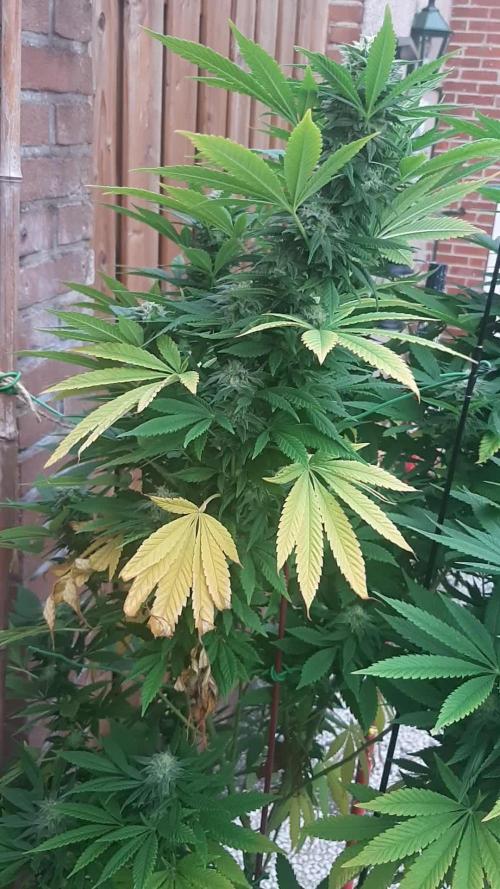
Good day friends...
So i seen my plant started to change..
The buds just started puffin up, so i started givin pk13/14 on saturday...
So far so good..
Other then that just feeding her and keepin her dry ...
Im givin 10 drops of plagron pk13/14 on 0.5 liters mineral water..
(Half the dosage)
Thats it for this week..
Have a good day there friends 🌴


Likes
14
Share


@Lady_NugWitch
Follow
Too late with the ph issues on the 1 plant... Not 1 issue with the second plant. Either way they are both gorgeous girls!!!

Likes
13
Share


@russrahl
Follow
Just finishing up week 3 of flower. Did another defoliation on day 21 but you can’t tell now...lol everything’s been rolling along nicely so far. Been feeding them around 8 gal of water every 2-3 days. Well that’s it for now, easy growing so far! Cheers 💨

Likes
89
Share


@Gunnen
Follow
So here we are roughly at end of Week 14. Some photos are from after that point as we are getting close to harvest. What can I say about these plants other than what they already are showing. I royally gave them some bad treatment with pH lockout, and still managed to come back together and finish strong. Noticing, these are all the same strain, with some clearly different phenotypes showing through. To that matter, they all are amazing and showing some real quality signs. The trichomes are almost all cloudy and I have a few amber coming in. The terpenes are coming out and the plants are finishing out the remainder of nutrients in the soil with some good flushing as well. Right now the ladies are in the dark for the next 48-72 hours. After that time period, I will check the trichomes one last time before I chop them to hang. The size of these nugs is not only impressive in terms of length, but the density is also there to back it up. These are some dense, resinous, long ass nugs! Corona virus has the best smell and smells almost like it's got a blueberry undertone going on. It is also packed with resin, which is a bonus, however the nugs are smaller than the other two plants. Big Red has the longest and most nugs out of the three. It's smell is not really much to speak of, and the resin is decent comparing to the others. Stubby has the thickest, densest and most crystal coverage out of all three of them. Unfortunately it is shorter and the overall yield is not as impressive as the other two. So they all have their pro's and con's, but I am thinking I am looking towards a decent harvest with some well grown bud. This might be a grow I am not as ashamed of in my history! 😆
Happy Growing, cheers! 👊😁

Likes
12
Share


@Staffedition
Follow
Привет друзья. Моей растихе сегодня 164 дня
Сегодня перестал кормить и начал проливать чистой водой
20.10 перевёл свет в режим 12/12
Начал применять LST технику на 19 дне, а 18 августа добавил ДЕФОЛИЗАЦИЮ
С 20.08 ДЕФОЛИЗАЦИЮ
С 20.08 LST технику
На сегодняшний день влажность 54%
5.09.2023 заметил высокий Ph 7.9
С 48 дня Ph не ниже 5.8
На сегодняшний день Ph 6.0
Начал кормить с 60 дня Canna Terra Vega
PPM 150
Всем мира и добра!
Не забудь поставить лайк❤️, если понравилась как прошла неделя
И читайте наш TELEGRAM: https://t.me/smail_seeds
#Smail_Seeds 😀
Likes
3
Share


@CoC407
Follow
The plants are growing fast, we forgot to check pH in this week but no problems.
Likes
50
Share


@AsNoriu
Follow
Day 106. Joe is well behind, trimmed her a bit, catching up, but only 8 days left till harvest, will be week or so too early for normal time i guess... smells of rubbed leaves reminds very specific strain, cant recall yet ... very sticky already, bottoms miss light and penetration a lot ! But bulks ;) i see signs of fade starting too.
Watered today, one more left. No work needed, just waiting ;)
Mars TSL2000 is a bit too far in my mind, but stil gives enough power for Joe to have nicely stacked bottom parts. Good light , no doubts !
Happy Growing !!!

Likes
1
Share

@ChronicNerve
Follow
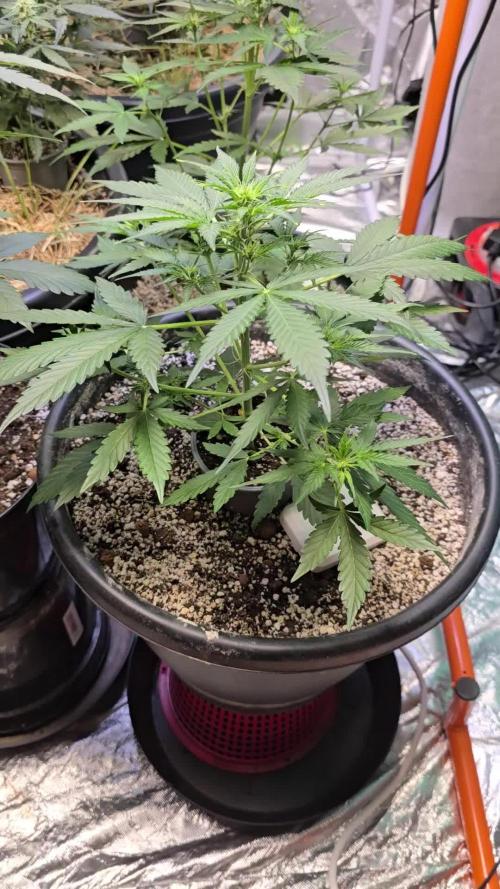
The Gaia is a very compact F1 plant compared to the Atlas and the Apple Fritter Auto. It appears to be flowering about a week slower, so it will be interesting to see how much more it stretches over the next week. There have been no problems thus far; it has been a very simple growing experience. I moved it from the seedling lights to the quantum boards in the main tent.