Likes
Comments
Share
The whole grow was full of ups and downs I neglected her basic needs from the get go but she did recover and push along with me.. the growing conditions were not prime and fir that she did me proud .. The buds are tight and have a very nice smell to them .. If I had grown this lady in a bigger pit with warmer temps she would have been amazing ... I'm excited to try her again sometime in the spring hopefully .. the buds I tried a little but of were not bad tasted smooth and cash was white when burned ..
Likes
5
Share
@BigGGrows
Follow
Took her down at day 94 in her 14th week. I did notice budswelling and density increasing in this final week. She was exposed to heat wave temperatures above 95f degrees in the greenhouse, yet took it well. I just had to water heavier than normal and at a daily rate....a rate of about 1/2 a gallon a day. She was flushed for 2 weeks using only TPS signal, ph water, and unsulfered molasses. She smells earthy, bold, and sweet....like a bold caramel latte. As soon as the leaves started fading i figured it was time for the chop. Next week (15) will be the actual harvest info, as she is in drying now and weights cannot be supplied at the moment.
Likes
10
Share
@Hempire
Follow
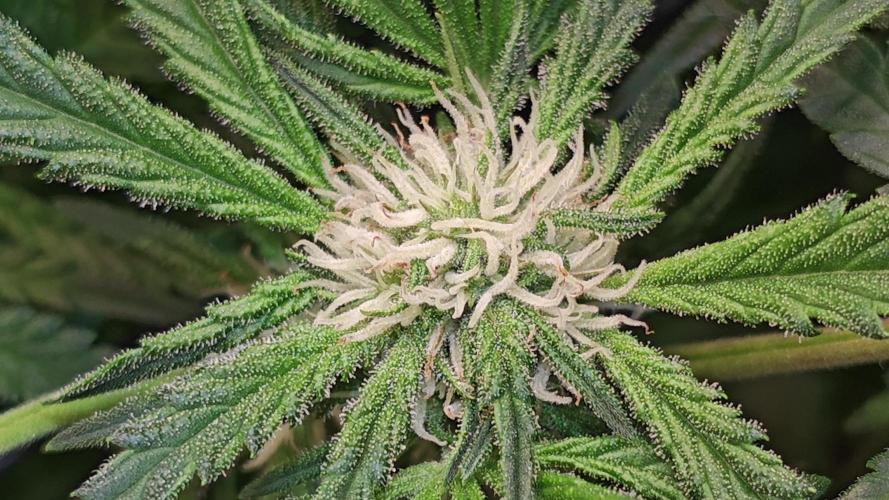
Hello growers ! This week started the pistils colours white into orange /red. Let’s check at the final of the week it should be ok for the harvest :)
Likes
4
Share
Es geht in die Blüte 😃 Ich kenne den Strain noch nicht und rechne trotz topping mit einer starken Streckung in den erst ca. 4 Wochen. Ich liebe es ja jedes Mal zu sehen wie schnell sich die Pflanzen entwickeln und nach Umstellung des Lichts verändern. Ab jetzt werde ich bei jedem gießen den Mineralischen Dünger von Plagron verwenden. Trauermücken nerven hart sollten aber dank fressfeinden bald Geschichte sein. Ich bin gespannt 😉
Likes
40
Share
This girl is also unbelievable at 30 inches she is grand. The growth has been amazing again. She is looking great. I have added 1000 watt Hps for supplemental light. 4 and a 1/2 hrs of extra light. I have split that into 2 and a 1/2 hours in the evening and 2 hours in the morning. I think that puts me somewhere in the area of 16 to 17 hours of light.
Likes
74
Share
Week 9 Flower A short week as she was taken down on Day 61 flower. In the end, she produced nice and fat buds allround. She's faded very well, with most of her fans leaves being plucked off as they died. I do this to prevent any mould or anything while she finishes off. All of her buds are dense and coated in trichomes. She's a super sweet smelling girl that I just can't wait to try! Harvest update coming asap! Thanks for following and happy growing! 🐺
Likes
52
Share
Once again she passes my expectations, late to the show with trichome production. I'm surprised there is purple on the bud, maybe Purpinator does work. I thought I could see hints under the grow lights and thought my eyes were deceiving me, I was just being hopeful. But nah 2 of the 3(under the UV) have developed a beautiful tone of purple. I was never going to bother with a deep freeze but maybe the whole bud will change given conditions, that would be something, fingers crossed. 🤔 was a little skeptical that reducing temps humidity would change density, but it does, buds are solid something I've not been able to achieve before. Rule of thumb is never to surpass 60% RH in the flowering phase and try to progressively reduce it down to 40% in the last 2–3 weeks before harvest. The plant will react as it seeks to protect its flowers, responding by producing denser buds and a higher concentration of resin. Cannabis plants are sensitive to sudden temperature changes, especially in the flowering stage. Extreme heat or cold can impact bud density and overall yields. In nature as a defense mechanism from cold, the plant sensing sudden dips in temperature will attempt to remove the pockets of air within the bud, it achieves this by compacting itself in doing so to better protect itself from cold snaps which are normally indicators in nature that worse weather is on the way. Terpene levels are the highest just before the sun comes out. Ideally, you want as many terpenes present in your plants as possible when you harvest. Cannabis plants soak up the sun during the day and produce resin and other goodies at night. The plant is at its emptiest from "harvest undesirables" so to speak right before the lights on. Boiling cannabis roots during harvesting slows down the drying process. When you boil cannabis roots, it shocks the plant, closing the stomata on the leaves. This prevents massive moisture loss through the leaves, leaving only the floral clusters actively losing moisture at a reduced pace. I've always run a strict 60/60 and it took almost twice as long to dry to a snap than previous grows where I didn't boil for what it's worth. Chlorophyll is good for the plant but not for you. When you harvest the buds, even after you flush them, if you flush them, they’re still filled with chlorophyll. Freshly cut buds are greener than dried buds because they still contain loads of chlorophyll. However, when rushed through the drying process, the buds dry but retain some chlorophyll, and when you smoke it, you will taste it. Chlorophyll-filled buds are smokable, but they aren’t clean. Slow drying gives the buds enough time and favorable conditions to lose the chlorophyll and sugars, giving you a smoother smoke. How the plant disposes of the chlorophyll and sugars by a process of chemically breaking them down and attaching the decomposed matter once small enough to water molecules which then evaporate back into the ether. Time must be given to the process to break down the chlorophyll and sugars. Think of it like optimizing the environment for decay. All the nutrients it could ever need are in abundance, it eats nutrients based on its demand for growth, which is dictated primarily by available light. Plant growth and geographic distribution (where the plant can grow) are greatly affected by the environment. If any environmental factor is less than ideal, it limits a plant's growth and/or distribution. For example, only plants adapted to limited amounts of water can live in deserts. Either directly or indirectly, most plant problems are caused by environmental stress. In some cases, poor environmental conditions (e.g., too little water) damage a plant directly. In other cases, environmental stress weakens a plant and makes it more susceptible to disease or insect attack. Environmental factors that affect plant growth include light, temperature, water, humidity, and nutrition. It's important to understand how these factors affect plant growth and development. With a basic understanding of these factors, you may be able to manipulate plants to meet your needs, whether for increased leaf, flower, or fruit production. By recognizing the roles of these factors, you'll also be better able to diagnose plant problems caused by environmental stress. Water and humidity *Most growing plants contain about 90 percent water. Water plays many roles in plants. It is:* A primary component in photosynthesis and respiration Responsible for turgor pressure in cells (Like the air in an inflated balloon, water is responsible for the fullness and firmness of plant tissue. Turgor is needed to maintain cell shape and ensure cell growth.) A solvent for minerals and carbohydrates moving through the plant Responsible for cooling leaves as it evaporates from leaf tissue during transpiration A regulator of stomatal opening and closing, thus controlling transpiration and, to some degree, photosynthesis The source of pressure to move roots through the soil The medium in which most biochemical reactions take place Relative humidity is the ratio of water vapor in the air to the amount of water the air could hold at the current temperature and pressure. Warm air can hold more water vapor than cold air. Relative humidity (RH) is expressed by the following equation: RH = water in air ÷ water air could hold (at constant temperature and pressure) The relative humidity is given as a percent. For example, if a pound of air at 75°F could hold 4 grams of water vapor, and there are only 3 grams of water in the air, then the relative humidity (RH) is: 3 ÷ 4 = 0.75 = 75% Water vapor moves from an area of high relative humidity to one of low relative humidity. The greater the difference in humidity, the faster water moves. This factor is important because the rate of water movement directly affects a plant's transpiration rate. The relative humidity in the air spaces between leaf cells approaches 100 percent. When a stoma opens, water vapor inside the leaf rushes out into the surrounding air (Figure 2), and a bubble of high humidity forms around the stoma. By saturating this small area of air, the bubble reduces the difference in relative humidity between the air spaces within the leaf and the air adjacent to the leaf. As a result, transpiration slows down. If the wind blows the humidity bubble away, however, transpiration increases. Thus, transpiration usually is at its peak on hot, dry, windy days. On the other hand, transpiration generally is quite slow when temperatures are cool, humidity is high, and there is no wind. Hot, dry conditions generally occur during the summer, which partially explains why plants wilt quickly in the summer. If a constant supply of water is not available to be absorbed by the roots and moved to the leaves, turgor pressure is lost and leaves go limp. Plant Nutrition Plant nutrition often is confused with fertilization. Plant nutrition refers to a plant's need for and use of basic chemical elements. Fertilization is the term used when these materials are added to the environment around a plant. A lot must happen before a chemical element in a fertilizer can be used by a plant. Plants need 17 elements for normal growth. Three of them--carbon, hydrogen, and oxygen--are found in air and water. The rest are found in the soil. Six soil elements are called macronutrients because they are used in relatively large amounts by plants. They are nitrogen, potassium, magnesium, calcium, phosphorus, and sulfur. Eight other soil elements are used in much smaller amounts and are called micronutrients or trace elements. They are iron, zinc, molybdenum, manganese, boron, copper, cobalt, and chlorine. They make up less than 1% of total but are none the less vital. Most of the nutrients a plant needs are dissolved in water and then absorbed by its roots. In fact, 98 percent are absorbed from the soil-water solution, and only about 2 percent are actually extracted from soil particles. Fertilizers Fertilizers are materials containing plant nutrients that are added to the environment around a plant. Generally, they are added to the water or soil, but some can be sprayed on leaves. This method is called foliar fertilization. It should be done carefully with a dilute solution because a high fertilizer concentration can injure leaf cells. The nutrient, however, does need to pass through the thin layer of wax (cutin) on the leaf surface. It is to be noted applying a immobile nutrient via foliar application it will remain immobile within the leaf it was absorbed through. Fertilizers are not plant food! Plants produce their own food from water, carbon dioxide, and solar energy through photosynthesis. This food (sugars and carbohydrates) is combined with plant nutrients to produce proteins, enzymes, vitamins, and other elements essential to growth. Nutrient absorption Anything that reduces or stops sugar production in leaves can lower nutrient absorption. Thus, if a plant is under stress because of low light or extreme temperatures, nutrient deficiency may develop. A plant's developmental stage or rate of growth also may affect the amount of nutrients absorbed. Many plants have a rest (dormant) period during part of the year. During this time, few nutrients are absorbed. Plants also may absorb different nutrients as flower buds begin to develop than they do during periods of rapid vegetative growth. 432 Hz is said to be mathematically consistent with the patterns of the universe. Studies reveal that 432 Hz tuning vibrates with the universe’s golden mean PHI and unifies the properties of light, time, space, matter, gravity and magnetism with biology, the DNA code and consciousness. When our atoms and DNA start to resonate in harmony with the spiraling pattern of nature, our sense of connection to nature is said to be magnified. Another interesting factor to consider is that the A=432 Hz tuning correlates with the color spectrum while the A=440 Hz is off. Audiophiles have also stated that A = 432 Hz music seems to be non-local and can fill an entire room, whereas A=440 Hz can be perceived as directional or linear in sound propagation. Once you adopt the idea that sound (or vibration in general) can have an equalizing and harmonizing effect (as well as a disturbing effect), the science of harmony can be applied to bring greater harmony into ones life or a tune to specific energies. There is a form of absolute and of relative harmony. Absolute harmony can for example be determined by the tuning of an instrument. The ancients tuned their instruments at an A of 432 Hz instead of 440 Hz - and for a good reason. There are plenty of music examples on the internet that you can listen to in order to establish the difference for yourself. Attuning the instrument to 432 Hz results in a more relaxing sound, while 440 Hz slightly tenses up to body. This is because 440 Hz is out of tune with both macro and micro cosmos. On the contrary, 432 Hz is in tune. To give an example of how this is manifested micro cosmically: our breath (0,3 Hz) and our pulse (1,2 Hz) relate to the frequency of the lower octave of an A of 432 Hz (108 Hz) as 1:360 and 1:90. It is interesting to note that 432 Hz was the standard pitch of many old instruments, and that it was only recently (19th and 20th century) the standard pitch was increased. This was done in order to be able to play for bigger audiences. Bigger audiences (more bodies) absorb more of the lower frequencies, so the higher pitch was more likely to “cut through”. One of the oldest instruments of the world is the bell ensemble of Yi Zeng (dated 423 BC), tuned to a standard F4 of 345 Hz which gives an A= 432 Hz. The frequency of 345 Hz is that of the platonic year! Similarly many old organs are tuned in an A=432 as well; for example: St. Peter’s Capella Gregoriana, St. Peter’s Capella Giulia, S. Maria Maggiore in Rome. Maria Renold’s book “Intervals Scales Tones and the Concert Pitch C=128 Hz” claims conclusive evidence that 440 Hz and raising concert pitch above scientific “C” Prime=128 Hz (Concert A=432 Hz) disassociates the connection of consciousness to the body and creates anti-social conditions in humanity. The difference between concert pitch A=440 Hz and Concert A=432 Hz is only 8 cycles per second, but it is a perceptible difference of awareness in the human consciousness experience of the dream we share called existence.
Likes
20
Share
Ze is zo mooi. Ik ben echt tevreden met haar. We hebben mooi weer dus heb haar uit de tent gehaald en in de volle zon geplaatst. Ik denk dat ze nog anderhalve week te gaan heeft. Nog 2 keer voedingsstoffen meegeven en daarna alleen water. Wordt vervolgd...
Likes
5
Share
@AustinRon
Follow
TH 1Q2025 - Week 6 - Bolt 3 
(ON Haze X Original Haze) X Northern Lights #2 “Todd’s Haze” Objective - 8 Female Plants, Topped ONCE @ Flip, 12” when topped - Modified Sea of Green Week’s Objectives - Auto-Fertigation Installed and operational - Twice/Day, 440 ml/ Day (Initial Rate) - 220 ml/Event Weeks Observations - We have a smattering of pistils showing - looks like pre-flowers with Haze morphology - Confirms (for me) the known property of Haze - that 7+ weeks of veg (from seed) is required BEFORE the plants can initiate flowering. (Noting that CUTS will be ready to flower @ Flip. Seeds Wet: 1139PM, 28.2.2025 Germinated: 2.3.2025 Flip: 21.3.2025 Harvest: 77 Days, DATE: 6.6.2025 _________________________________________ __ Fri Apr 11, 2025 TH 1Q25 22:F:3:1 EC: 1.8 LightDistance: [ 20.5, in] # We’re in STRETCH, ~1.5”/day! LightIntensity: [ 640, µMol/m2/s] - [x] TM-7: [ 0.125, g] # Prep - [x] Fertigation: [8.5:8.5:3.4:3.4:3.4:0:3.4] # [Primer A:Primer B:CalMag Fuel:Silica Skin:Lush Green:Root Anchor:Peak Bloom] - [x] Photosynthesis Plus: [ 6, ml] - [x] Quillaja 60 Powder: [scant] - [x] PCAL 1660: [ 0.5, gm] # Once or Twice/Week - [x] TM-7 (µNutrients): [ 0.125, g] __ Sat Apr 12, 2025 TH 1Q25 23:F:3:2 LightDistance: [ 18, in] # We’re in STRETCH, ~1.5”/day! LightIntensity: [ 703, µMol/m2/s] LightDimmer: [ 85, %] We’re bringing up Intensity SLOWLY, as the plants adapt. Allowing the plants to grow INTO the LightField and naturally raise PPFD as it does. - [x] TM-7: [ 0.125, g] # Prep - [x] Fertigation: [7.8:7.8:3.1:3.1:3.1:0:3.1:0.0] # [Primer A:Primer B:CalMag Fuel:Silica Skin:Lush Green:Root Anchor:Peak Bloom:Resin Bloom] - [x] Photosynthesis Plus: [ 6, ml] - [x] Quillaja 60 Powder: [scant] - [x] PCAL 1660: [ 0.5, gm] # Once or Twice/Week - [x] TM-7 (µNutrients): [ 0.125, g] __ Sun Apr 13, 2025 TH 1Q25 24:F:3:3 LightDistance: [ tbd, in] # We’re in STRETCH, ~1.5”/day! LightIntensity: [ tbd, µMol/m2/s] LightDimmer: [ 85, %] - [x] TM-7: [ 0.125, g] # Prep dilution in 250 ml plain water - [x] Fertigation: [7.8:7.8:3.1:3.1:3.1:0.0:3.1:0.0] # [Primer A:Primer B:CalMag Fuel:Silica Skin:Lush Green:Root Anchor:Peak Bloom:Resin Bloom] - [x] TM-7: [ 0.125, g] # Delivered - [x] Photosynthesis Plus: [ 6, ml] - [x] Quillaja 60 Powder: [scant] __ Mon Apr 14, 2025 TH 1Q25 25:F:3:4 LightDistance: [ tbd, in] # We’re in STRETCH, ~1.5”/day! EC: [ 1.9, mS/cm] - [x] TM-7: [ 0.125, g] # Prep dilution in 250 ml plain water - [x] Fertigation: [7.8:7.8:3.1:3.1:3.1:0.0:3.1:0.0] # [Primer A:Primer B:CalMag Fuel:Silica Skin:Lush Green:Root Anchor:Peak Bloom:Resin Bloom] - [x] Photosynthesis Plus: [ 6, ml] - [x] Quillaja 60 Powder: [scant] - [x] PCAL 1660: [ 1, tsp] # Once or Twice/Week __ Tue Apr 15, 2025 TH 1Q25 26:F:3:5 EC: [ 1.8, mS/cm] # [Primer A:Primer B:CalMag Fuel:Silica Skin:Lush Green:Root Anchor:Peak Bloom:Resin Bloom] - [x] Fertigation: [8.7:8.7:3.5:3.5:3.5:0.0:3.5:0.0] - [x] Photosynthesis Plus: [ 6, ml] - [x] Quillaja 60 Powder: [scant] - [x] Terps Plus: [ 2, ml] - [x] PCAL 1660: [ 1, tsp] # Once or Twice/Week __ Wed Apr 16, 2025 TH 1Q25 27:F:3:6 Stretched another 1.5” Main Canopy @ 740 (PPFD) Fertigation 1L/Plant/Day - 2 x 500 ml, 6 hour freq LightDistance: [ 17, “] LightIntensity: [ 740, µMol/m2/s] EC: [ 1.8, mS/cm] 
Fertigation Amount: [ 2.0, gal] # We’re a little low at a gallon/day … Light Intensity: [ 750, µMol/m2/s] # Adjust Light Height to Achieve. Light Dimmer: [ 100, %] # Photone is ok, but I think reads low . . . # [Primer A:Primer B:CalMag Fuel:Silica Skin:Lush Green:Root Anchor:Peak Bloom:Resin Bloom] - [x] Fertigation: [17.5:17.5:7.0:7.0:7.0:0.0:7.0:0.0] # [ 10, 4, 4] - [x] Photosynthesis Plus: [ 12, ml] - [x] Terps Plus: [ 2, ml] - [x] Quillaja 60 Powder: [scant] - [x] PCAL 1660: [ 2, tsp] # Once or Twice/Week’ __ Thu Apr 17, 2025 TH 1Q25 28:F:3:7 LAST HAND WATERING: FRIDAY We Start Auto-Fertigation Light Distance: [ 13.5, in] # 2“ Today EC: [ 1.8, mS/cm] # [Primer A:Primer B:CalMag Fuel:Silica Skin:Lush Green:Root Anchor:Peak Bloom:Resin Bloom] - [x] Fertigation: [16.9:16.9:8.5:8.5:6.8:0.0:6.8:0.0] # [ 10, 5, 4] - [x] Photosynthesis Plus: [ 12, ml] - [x] Terps Plus: [ 2, ml] - [x] Quillaja 60 Powder: [scant]
Likes
6
Share
@IvanPalma
Follow
En la segunda semana de floracion le he sujetado un par de hojas muy grandes a la rama porque estan tapando las demas plantas, ahora solo utilize el engordador de cogollos, he tenido que dejar el calentador encendido porque con las 12 horas de luz la habitacion se esta enfriendo mucho y las temperaturas han bajado hasta los 16 grados, prefiero no estresarlas pero por lo demas van bien. He notado tambien que algunas hojas grandes de abajo, como que se pudren o se ponen muy debiles y se caen solas.
Processing
Likes
8
Share
@Max1973
Follow
Day 49 - lookin good..... been bending her, trimmin abit, messin with the water solution..... ph and ppm have been all over the place..... lol she's been transitioning from grow to flower, and once she settles into night mode, the solution and growing should stabilize...... the new fan is cool... tents working properly now, neg pressure, drawing in air behind the floor fan, blown around the bottom, and cpu extractor fan pushing the air out the top of the tent, straight into the filter..... really nice way to run a little tent, low airflow........ keeps the impurities out of the buds..... the stalks have all tuffened up since trimmin, and pretty strong now.... should hold the full weight that's about to occur all over the place...... i've simplified the nutrients, they were gettin alittle confusing, so started doin nuets differently, .... so, just making my own nuet solutions, nothing fancy just base amount of normal elements .... should be a pretty good christmas ...... Day 51 - pics/vids... 👍😎
Likes
1
Share
Привет садовники !
Likes
10
Share
@Nix6969
Follow
Buenas noches comunidad. Esta noche se ven creciendo con gran vigorosidad estas cepas Chilenas Pure Inferno y Bloodnana, actualmente esta finalizando su 3era semana y entrando a la 4ta., desde sus 2 hojas reales. las nenas se alimentas bien y se ven felices actualmente se da alimenta con fertilizante Advance nutrients. comenzando la floracion estan bastante grandes. en riego, se da una ves por semana advance nutriens y 2 solo agua sola. penultima semana con big bud. PH:6.3 EC:1220
Likes
3
Share
Día 6 de diciembre ,tenemos una amanecida de gran niebla que se mantuvo en la mañana con ello una alta temperatura en la noche del cultivo amaneciendo este a 90% de humedad Después del encendido de la luminaria y colocar dos pequeños humificadores de usar y tirar..en dos horas ,la humedad se mantiene bien. 55% En el día de antes de ayer se le aplicó un buen riego. Día 7 Humedad en el cultivo de un 60% Hoy le e metido otro riego con todos sus nutrientes de vegetación y metiéndole un poco de floración La EC 1100 El ph 6 Un ventilador dejó de ser oscilante para quedarse fijo.. hahaha meteré otro en unos días más grande y oscilante .
Likes
12
Share
day 42 images are in last week, I can not count XD. bridal is stacking a lot of weight and is constantly shifting/leaning every morning, good things. I would chop any day but I will wait it out. water, tiny bit of humic and folvic to reduce chloromine, chlorine- air stones day 45 took a few nugs off on day 42, dried for 3 days. Tried bridal and blackberry. As a heavy recreational, thc is up there! bridal felt like having a blindfold over your eyes somewhat sativa uplift but heavy weight feelings. Very good. Lasted as good as 30%'s. Dr. Thunder was also very nice, nug was smaller so mixed with blackberry to have a small j. Also feels very good indica. Both trials were chopped on week 6 day 1. Very pleased with the results. I was worried bridal was more sativa; which charasteristica I am not looking for. So I believe this is a very good heavy hitter run with 4 plants. I can chop any day, but I am waiting for pink paradise to finish seeds. day45 took top nugs from bridal party, blackberry oreo bigstuff and dr. thunder. No touching pink paradise!! day 46 can chop anytime just waiting on pink paradise seeds to finish, bridal party leaning more day 47 bridal leaning hard from weight. day 48 stacking, day 48 video