


Likes
Comments
Share


@MaltedMadness02
Follow
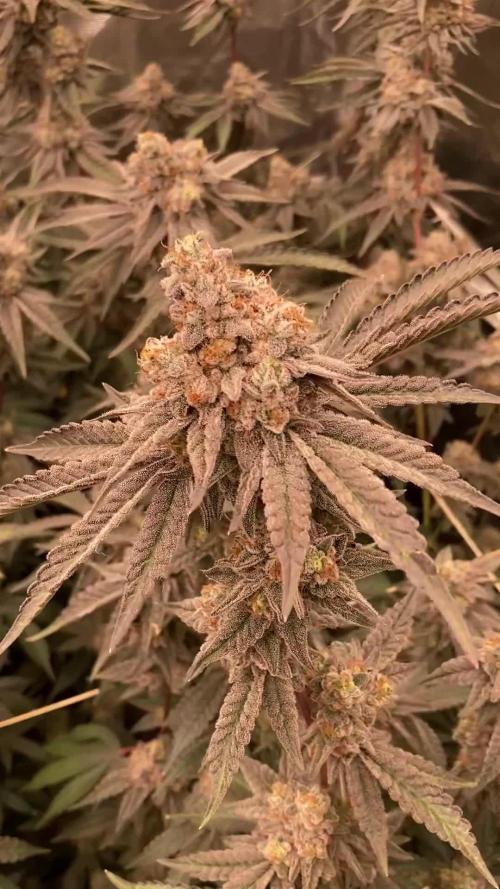
Really coming along, I'm very happy to watch her do her thing in this second half of flower. She's very earthy with some notes of pine. Smells just like the dank stuff I've been smoking my whole life! Man I can't wait to keep growing. I hope to expand the grow operation here soon, hopefully with another tent. I want to keep autos in different stages so I can streamline everything, have a plant popping while one vegges, while another flowers. Keep the flow steady and my fridge full of weed lol. Speaking of, I am using my fridge to dry! The Lotus Method for anyone familiar.

Likes
199
Share


@Teamdirtbag2
Follow
Things are going good.... POOL is FULL..... I have transplanted everything in the greenhouse. Some in soil.... I know soil??? Wtf have I lost my mind....
Banner 1,2, and 3 have not shown sex... so we will wait...
Slurricane is pretty... but small... her clone's 2 are in soil.. 1 is in perlite, and it is in a circle. I did it for fun because she is a B***H... Haha no strings attached.....
We wait on Fire OG, and Foul Mouth both are female... we are waiting for some flowers to arrive.
I'm starting to flush Shiskaberry and Blue Gelato 41. Today ...
I'm smoking the Gorilla Zkittles.... I am really pleased with taste and high.
In the greenhouse flowering right now is 6 strains.... mostly clones... but 8 separate pheno's... fuck I'm even confused... hahaha..everything is labled.... most have dates on them... I will have to try to go back on foul mouth and fire OG to find out when I started flowering them..... shit.... I will know when there done... hahahahahaha
I have so much in veg... 25 plants.. 14 strains... so like I said... "The Pool is Full"...... I transplanted all my sprouts... which adds the following:
Citrus Farmer .... 3
Critical Kush .... 1
Tahoe Kush .... 2 so far.. 1 may still sprout 🙏
Spliff's Strawberry ....2
CBD Spliff Berry.... 2
Everyone else is fine... I might have missed someone...
Oh..... Diesel Fire OG, and Sour Fire Kush are all fine.
And the other Spliff's are coming along.... Purple Berry Kush and Moon Walker Kush.
Also Strawberry Lemonade..
Shit there is too much..... 👊😎
Dam this is a little to much... LMFAO

Blue Gelato 41 · Barney's Farm
Gorilla Zkittlez · Barney's Farm
ShiskaBerry · Barney's Farm
CBD Lemon Potion Auto · Barney's Farm
Pineapple Express Auto · Barney's Farm

Cream Mandarine Auto® · Sweet Seeds

Foul Mouth · Dungeons Vault Genetics

Fire OG · Custom Breeder & Strain

Slurricane · In House Genetics

Moon Walker Kush · Spliff Seeds
Strawberry Lemonade · Barney's Farm
Purple Berry Kush · Spliff Seeds

Diesel Fire OG · Relentless Genetics
Spliffs Strawberry · Spliff Seeds
CBD Spliff Berry · Spliff Seeds
Citrus Farmer · Dungeons Vault Genetics
Tahoe Kush · In House Genetics
Likes
15
Share


@VanHealzing
Follow
Day 55 of flower
1 and 3 are finishing off a bit earlier then expected, so I started my flush to get ready for the harvest .
2 and 4 i belive can make it to day 65.
#4 looks like it's parent, Purple Urkle.
#2 looks like GDP
So I think I will he keeping 2 and 4

Likes
3
Share


@Kushizlez
Follow
Day 1-14
(March 24th)
(Day 14) I sprouted 5 Puro Loco and 1 Slurricane F1 (Archive) seeds in a mini aerogarden hydroponic system on March 10th and they they were getting way too hot in the small space I had it in. It was also given flowering nutes from seed. They started curling and cupping like crazy so I decided to transplant them into soil in solo cups and 1 gallon pots. They’re in my veg tent currently and I’m pretty optimistic that they will all recover nicely. I plan to veg them out for 3-4 more weeks, transplant into 1.7g or 3g pots for their final containers and then flip into flower at the same time as my flower tent. I’m using a dimmable 600w hps in a 4x4 tent with living soil/coco blend and nature’s pride dry amendments plus a few other rock dusts, foliars, teas, microbes ect. I’m keeping the humidity around 80% with my humidifier in my sealed tent. I won’t be topping, scrogging, supercropping ect. Just a little lst here and there.
Recent events have caused me to move the plants in my veg tent plants into the flower tent and veg them out there. So that leaves me with an unoccupied veg tent where I can veg these girls out and flip them at the same time as my flower tents. I also have to move my tents by mid June so that worked out well I guess. Just have to buy a carbon filter before the flip.
I also found and sprouted a bag seed of some Guava Cake a few days ago that was very nice. If it’s not a vigorous grower, I will scrap it because I’m not trying to risk the herm.
Since I have to pack as many female plants as possible in this tent before the flip, I’m going to throw in 5 stunted black garlic seedlings. These ones are from a 12/12 from seed grow box I couldn’t keep lightproof. One of them just identified as male so I will pull his ass. He was the only one showing so hopefully any more males will be visible before the flip. I forgot to add, these were started on March 1st.
So let’s just say all these plants are one month old but this will be the first recorded week.


Likes
22
Share


@BlumenBot
Follow
2/9 - she got her 3rd topping and training today. Cleaned up older fan leaves and she got week 7 nutes feeding 1g today.

Processing
Likes
3
Share


@Wizardgreen317
Follow
This plant smell like lemonhead candy no lie the terp on this at night is crazy all I smell is lemons and gas ⛽️. My next door neighbors are fucking telling me it leaking and the can smell it lol .. I guess everything going good but yeah it you knw genetics then there’s nothing like getting same smell on all your plant it like a jackpot lol they icing up super just to be real and I hope I can grow this again lol I gotta clone or two off of it so I should be back in business lol .. long story short I like this plant in soil and I believe if this shit was in coco I would never got that lemon terp I been watering more and let that temp get down so the stretch would stop
Likes
8
Share


@pzwags420
Follow
I switched the light timer to 12/12 and turned the carbon filter on. I wish I had more space to grow vertically, but the height of my box and grow light distance limits me from vegging too long. I hope to have a larger set up in the future 😀. At the start of week 7 The girls are chugging along (Cal/Mag really seemed to help) and I'm looking forward to seeing the bud structure and that Blueberry smell! I will be going on vacation in a little over a week for 8 days 😅. This is also why I started flowering now..so that I can be home during the majority of the stretch period(12 days from flip). The day I leave I will apply nutrients and thoroughly saturate the coco and then the girls will be watered with the blumats from my 5 gal reservoir (hopefully that is enough and there isn't too much PH drift). On day 5 of week 7 I applied 1 gal of nutrients until runoff. Week 7 went well.
Processing
Likes
2
Share


@K8T80
Follow
Giving her banana peel tea everyday 100mls with a 200ml of water. Hairs are turning orange and now just waiting for them to fatten up.

Likes
30
Share


@XperencdGmanXG
Follow
this little shogun that could has stretched to the max! She is actually a little big bush now. Too bad this season was not as ideal as it could have been. She has started to flower 7 to 8 weeks to go.

Processing
Likes
16
Share


@GRow_M8s
Follow
* Cold temps early this week, lights 24/7 from day 31 to keep temps steadier (24-25c°).
* GWK #2 leaves pointing down day 32-33 , cold soil and a little underwatered the next day.
* Watering 700ml/pot with 6.5 ph, 19 c° temp tap water with,
~ Active vera (biobizz), EM microorganisms, co2 tablet.
* Organic NPK to the others two ( Stomper #3, SODK day 33 ss, 28 day SODK. 25 gr/ pot.
* Smells not something special yet, LST going good, we ll keep pushing it a few more days.
¤ 🌱Stomper #1 with aggresive LST starting day 14, not a good idea, small stretch so far, burn tips with no extra food maybe its light burn tip.
¤🌱 Stomper #2 starting LST week 3, more nods, bigger plant better performance for this style.
¤🌱 Stomper #3 the stressed one, no techniques here just a bit of defoliation.🤞
▪️︎🌿GWK #1 starting LST day 14, good reaction, taller nods than stomper.
▪️︎ 🌿GWK #2 starting LST day 21,not a big difference with #1, great response,bit sensitive to cold temps ( 2 days to rehab).
☆ 🌴SODK with different style of leaves, more indica dominant, but lighter green colour, starting LST n defoliation day 21, probably will stay in tent alone more than a week.🤪
* Day 34 -> foliar spray with Acti-vera (biobizz) 2ml/l.
* Not much stretch this week, maybe the cold temps at the beginning of the week or just the genetics, healthy plants till now, no defficients.
🔚 Last day of this week released the 4 of them (stomper #1,2 & GWK #1,2) from LST to get stretchy + second weeks 5 watering at 23c° with EMs and 0,5ml/l snake poison (boron + other minerals).1
🌱 Healthy leaves n buds progressinge except GWK #2 cause stress earlier this week. 💧1ltr each n 600ml for stomper #3. 1st watering with 700ml at day 32.
🍃Last update -----> Day 35 ✅

Likes
23
Share

@PersonalSmok3s
Follow
Solid run!
Always preforms well, happy I’ve got some more flowering in my other tent 😻👏
Not much to say, if you want a more in depth rundown go read my original diary from 2 years ago.
PersonalSmok3s 😸🌱💚

Likes
6
Share


@GERGrowDesigns
Follow
Welcome to Flower Week 3of Sweet Seeds Sweet Mandarine Skittlez F1
I'm excited to share my grow journey with you from my
Sweet Seeds Project . It's going to be an incredible ride, full of learning, growing, and connecting with fellow growers from all around the world!
For this Project , I’ve chosen the Feminized Photo strain Sweet Mandarine Skittlez F1 :
Here’s what I’m working with:
• 🌱 Tent: 120x60x80
• 🧑🌾 Breeder Company: Sweet Seeds
• 💧 Humidity Range: 50
• ⏳ Flowering Time: 7weeks
• Strain Info: 19-24%THC
• 🌡️ Temperature: 26
• 🍵 Pot Size: 16
• Nutrient Brand: Narcos
• ⚡ Lights : 600W x 2
A huge thank you to Sweet Seeds for allowing me to try my Best with this amazing collection from Photo Strains they managed to Sponsore . Big thanks for supporting the grower community worldwide! Your genetics and passion speak for themselves!
I would truly appreciate every bit of feedback, help, questions, or discussions – and of course, your likes and interactions mean the world to me as I try to stand out in this exciting competition!
Let’s grow together – and don’t forget to stop by again to see the latest updates!
Happy growing!
Stay lifted and stay curious!
Peace & Buds!
Likes
37
Share


@eezeegrow
Follow
Babies are growing soooo fast. Very happy about this strain! Can't wait for a tasting session... 😉

Likes
46
Share


@Dreadnug
Follow
Two phenotypes - one purple and one white/green. The purple was very difficult to train and resulted in a couple inadvertent breaks - luckily it was repairable. The other trained very well, very flexible and worked very good for SCROG. Both produced heavily and are beautiful. The purple tends to be much more fluffy, with very long pistil hairs - the longest of any grow I have done. The white was super dense, very crystally and sticky. It will be very interesting to see how they smoke. Also, the purple tended to do very well with some nute mistakes I made as well as fluctuating pH in my water feeding. The white did not do as well in this regard but was able to get to harvest fine.
Wet bud weight is prior to trimming. The buds off of these plants were HUGE!!!!
Plant #1: (Purple): Wet weight - 76.58oz prior to trim; 15 colas; Terps: White - 60%, Clear - 20%, Amber - 20%
Plant #2: (White): Wet weight - 71.65oz prior to trim; 16 colas; Terps: White - 70%, Clear - 30%,
After 3 days of drying, took them down to trim for my jars.
After a few hours filled mostly quart jars 3/4 full but also tried an Infinity jar and a gallon mason jar to minimize the number of smaller jars.
Dry weights into jars:
Plant #1: 14.79 oz
Plant #2: 11.76oz
I did pull them after a day to dry rack them for 12 hours due to a little bit higher moisture content then I would have liked ( 70%rH). Re-jarred on 6/1/23 and now holding steady at around 60% rH.
Cure Check In (Week 2): 6/10 - 6/12/23: rH ~ 63 - 66%. Daily air exposure & fanning. Very smelly. Looking good - another couple weeks and will be ready.

Likes
13
Share


@madlangs
Follow
All going well apart from it looks like I burnt a few leaves on Tangie after giving the pk 5-8. She must be a bit sensitive. Only give half strength treats to her in the future
Ppfd around 800
22.12.24
Gave all 1L each
2ml/L bio heaven
2ml/L acti Vera
2ml/L top max
Recharge quarter tsp/L
27.12.24
10ml/L pk 5-8 gave all 1L apart from purple lemonade and cosmic queen
29.12.24
Purple lemonade 78cm
Small jelly breath
64
Large one
89
Slurricane 93
Lemon haze
99
Tangie
73
Hubbabubba
59
Cosmic queen 56


Likes
2
Share


@PalmaGrow
Follow
Se inicia nueva semana con transplante a maceta final donde se orientará las ramas para maximizar producción
21 - 27 julio

Processing
Likes
10
Share


@CanadianFillmore
Follow
Start of week 4, the blueberries had major bud growth during week 3 and they filled in nicely. There are a few signs of deficiency in the larger fan leaves, but overall I'm very happy with how the blueberries are growing. The Super Lemon Haze is showing signs of deficiencies, she's also hungrier than the blueberries, she got an extra 2 liters of nutes at 1/4 mute strength, the last two weeks. She may require full strength nutes in the extra feeding, to help with the deficiencies. Still, bud site development is coming along nicely on the SLH.

Likes
9
Share


@HollowSource
Follow
The banner is so thick with leaves its insane. Find myself endlessly defoliating her. She isn't as wide as the skittles but she still has a load of potential tops. I'm going to start nutrients again and aim to flip her to flower in a week.

Likes
20
Share


@ReginaldJohnstonX3
Follow
I cut back on the megacrop and started adding bud explosion this week
Likes
5
Share


Likes
24
Share


@OGOZHigh
Follow
Leider spielt das Wetter nicht so mit daher langsame Fortschritte.
Update : 21.06
Das Wetter wird besser und die Ladys geben langsam richtig gas 🥦🔥