Likes
Comments
Share
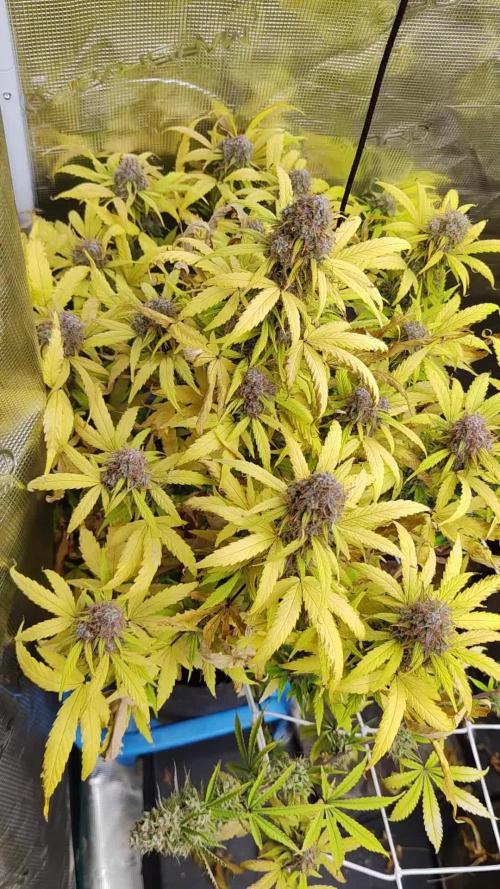
Cosechamos la purple bud la más pequeña y compacta, solo 1 ejemplar de esta variedad, las hojas no se han vuelto purpura pero si los cogollos con algunos matices rosas púrpuras y rojizos muy bonitos y con muy buen aroma
Processing
Likes
8
Share
Impresionante, mirad que flores se están formando aquí , Zambezaseeds si a echo un buen trabajo con estas candy caramelo version fast flowering. 6 semanas de floración y ya no queda casi para cosechar, Añadi esta semana overdrive y retire big bud de advanced nutrients. Las flores no son muy grandes pero si se ven flores muy compactas y con mucha resina. Ph controlado 6.2 , humedad entorno al 50% y temperatura media de 26.5 grados, que cara al verano no está mal. Todas estas flores fueron logradas gracias a una buena iluminación (ts-600 mars hydro) y vaya resultados. Estas semanas sigo actualizándoos todo , sin más novedades me despido, un saludo fumetillas y buenos humazooos 💨💨💨
Likes
3
Share
The flush begins...
Likes
8
Share
@Prshwdp
Follow
Not much happen during this week. Plants look healthy and on a good track. They drink roughly 2l a day
Likes
13
Share
Day 1-12/12/21 seeds placed in glass of water for 24hours! Day 2-13/12/21 seeds are placed on paper towel!! Day 4-15/12/21 seeds are in soil!!! Day 6-17/12/21 seeds have popped out soil!!!
Likes
7
Share
@Bluemels
Follow
Tag 75: Die Pflanze sieht echt schlimm aus 😱 Ich hoffe das meine Rettungsmaßnahmen bald Wirkung zeigen 😕 Tag 80: Auf anraten habe ich mir eine ph pen usw. gekauft. Der Ph wert liegt bei 8 😱 ! Deshalb werde ich keinen Calmag Dünger mehr verwenden. Und den Ph wert einstellen müssen und abwarten...
Likes
10
Share
@Andres
Follow
el resultado seco de 177 no es real debido a que yo bastante para hacer brownies. pero estoy satisfecho con los resultados y recomendable. un olor y sabor unico
Likes
21
Share
Likes
15
Share
Gracias al equipo de AnesiaSeeds, Marshydro, XpertNutrients y Trolmaster sin ellos esto no sería posible. 💐🍁 Elementz: Presentamos Elementz: Unleash The Elemental Fusion, una oferta trascendente de Anesia Seeds que te atrae al corazón mismo del reino elemental. Esta maravilla feminizada surge de un linaje de genética formidable, que combina la potencia incomparable de GM-UhOh con la energía vibrante de Epic Buzz. Prepárate para ser catapultado a la estratosfera, ya que Elementz cuenta con un extraordinario contenido de THC que oscila entre el 33 y el 38%. Cada inhalación es una odisea, con un perfil de sabor que entrelaza intrincadamente notas de uva madura, frutas exóticas y un toque especiado, creando una experiencia sensorial tan compleja como deliciosa. 🌻🚀 Consigue aqui tus semillas: 💡TS-3000 + TS-1000: se usaran dos de las lámparas de la serie TS de Marshydro, para cubrir todas las necesidades de las plantas durante el ciclo de cultivo, uso las dos lámparas en floracion para llegar a toda la carpa de 1.50 x 1.50 x 1.80. https://marshydro.eu/products/mars-hydro-ts-3000-led-grow-light/ 🏠 : Marshydro 1.50 x 1.50 x 1.80, carpa 100% estanca con ventanas laterales para llegar a todos los lugares durante el grow https://marshydro.eu/products/diy-150x150x200cm-grow-tent-kit 🌬️💨 Marshydro 6inch + filtro carbon para evitar olores indeseables. https://marshydro.eu/products/ifresh-smart-6inch-filter-kits/ 🍣🍦🌴 Xpert Nutrients es una empresa especializada en la producción y comercialización de fertilizantes líquidos y tierras, que garantizan excelentes cosechas y un crecimiento activo para sus plantas durante todas las fases de cultivo. Consigue aqui tus Nutrientes: https://xpertnutrients.com/es/shop/ 💻 Trolmaster Tent-X TCS-1 como controlador de luz, optimiza tu cultivo con la última tecnología del mercado, desde donde puedes controlar todos los parametros. https://www.trolmaster.com/Products/Details/TCS-1 📆 Semana 5: Comienzan a formarse los cogollos, las hojas se llenan de resina cada dia y el olor es bastante fuerte. Parece que ha terminado de estirar. Practico una defoliación intensa para airear los futuros cogollos y dejar mas espacio en el cuarto de cultivo. Agrupo de nuevo las macetas en su lugar optimo para asi rellenar por completo la carpa @marshydro completa Me quedé algo corto de nutrientes pero estoy muy contento con los resultados, cada vez le voy encontrando mas su punto optimo. Siempre es mejor quedarse corto que pasarse.
Likes
2
Share
Aug 15 is a month since popped Trying mainline
Likes
32
Share
Still going… since I got some positive feedback, I made a video. I think this helps so much imagining the size of the space! Daughter is doing great… cozy environment! And since day and night time schedule of my plant and my personal live aren’t in sync I do now own a green LED headlight, which - if it is working as advertised - shouldn’t stress the plants, when watering during the night. 11/15 new phone: Media Update
Likes
27
Share
------------------------------------ ~SEEDSMAN PEYOTE ZKITTLEZ~ ------------------------------------ Description Peyote Zkittlez is an Indica-dominant hybrid strain bred by pollinating Peyote WiFi with the sweet-tasting Zkittlez. Peyote WiFi is itself a cross of Peyote Purple and the US Indica WiFi strain. Zkittlez is a 3-way cross of Grape Ape, Grapefruit and a third, top secret, strain. Peyote WiFi is an Indica-dominant strain which is a cross of Peyote Purple, derived from a single purple pheno-type which was back-crossed for several generations to cement its qualities, and WiFi, a US Indica strain created by crossing The White with Fire OG. This plant is medium-sized with large, broad leaves and takes around 75 days of flowering before it is ready to harvest producing very generous yields of highly potent weed - up to 650 gr/m2 indoors and 1500 gr/plant when cultivated outdoors. The THC potential of this strain is very high with plants attaining 26 - 28%. Zkittlez is a sweet-tasting Indica-dominant (80%) cannabis strain which produces high yields boasting high levels of THC. This is a very colorful strain displaying green and purple colors with bright orange pistils. Zkittlez is a 3-way cross between Granddaddy Purple, Grapefruit and Afghani. It is suitable for growing in all environments and takes between 60 - 65 days to complete flowering indoors. Outdoors it will be ready to harvest during late September in northern latitudes. Yields are very good and vary between 450 - 600 gr/m2. Zkittlez' scent is very sweet and entices with ripe tropical fruits and candy which also follow through in the taste as well. THC production is in excess of 20%. The effect is very uplifting, especially for an Indica strain. Therapeutically it is used to combat stress, depression and anxiety as well as for those with ADHD. Peyote Zkittlez will make a superb, highly potent and high-yielding Indica-dominant addition to all seed collections which is certain to become a growers' favorite. Get yours from Seedsman now. *description credit to Seedsman Seeds __________________________________________________________________________________________________________________________________________________________________________________________________________________________________________________________________________________________________________________________________________________________________________________________________________________________________________________ BREEDER/BRAND: Seedsman PRODUCT TYPE: Seeds THC GENETICS: Peyote WiFi (The White x Fire OG) x Zkittlez VARIETY: Mostly Indica FLOWERING TYPE: Photoperiod SEX: Feminised THC CONTENT: 20%+ YIELD: Indoors: up to 650 gr/m2; Outdoors: up to 1500 gr/plant GROWS: Indoors, Outdoors FLOWERING TIME: 60 days MEDICAL CONDITIONS: Anxiety, Depression, Stress MEDICINAL PROPERTIES: Yes EFFECT: Powerful, Relaxing __________________________________________________________________________________________________________________________________________________________________________________________________________________________________________________________________________________________________________________________________________________________________________________________________________________________________________________ THE SETUP: ~Planted into Jiffy Peat Pellets that were hydrated with de-chlorinated water with SuperThrive added then ph'd to 6.0 @ 80℉ ~Grown 100% organic in 10g fabric pots with Mother Earth 70/30 Coco/Perlite medium amended with 2tbs/g of Down To Earth 4-4-4 / 2 cups/g of Earthworm Castings / 1tbs/g of Dr. Earth Flower Girl 3-9-4, 1tbs/g of Dr. Earth Bat Guano, 3/4 cup of Down To Earth Azomite and 1 tsp/g Down To Earth Fish Bone Meal. ~24hr light cycle during Germination / 19/5 light cycle for Vegetation and 12/12 for Flower ~Straight water ph'd @ 6.2-6.8 when needed and weekly Compost Tea's. __________________________________________________________________________________________________________________________________________________________________________________________________________________________________________________________________________________________________________________________________________________________________________________________________________________________________________________ WEEKLY UPDATES: 9/13- With approx. 10 weeks of growth behind her now she's going into her 5th week of flower now and let me tell you the pictures don't do her justice... This is one phenomenal cultivar! 😍 She was given Compost Tea yesterday and today was still fairly heavy so I skipped watering and just removed a few leaves to maintain light penetration, turned her pot and sat and chatted with her awhile! 9/15- Well she really must have liked that last batch of Compost Tea as she looks exceptionally vibrant today! She's continuing on her mission of stacking her flowers, which are developing beautifully and have a delicious sweet citrus aroma to them right now. I did not water yesterday, so today I watered with 1.5g of straight de-chlorinated water that was ph'd to 6.5 @ 72℉ and rotated her pot... Damn she is looking great! 🤩💖 9/17- Yesterday I top dressed her with 1/2 cup of Down To Earth Bio-Fish then watered it in with 1.5g of straight de-chlorinated water that was ph'd to 6.5 @ 72℉. Her flowering is continuing beautifully and she's smelling stronger every day it seems! I'm staying on top of tucking leaves blocking light and turning her pot daily as well. 9/19- Five weeks of flower on the books! We're halfway there now, she's stacking her flowers tightly going into Week Six and she's looking phenomenal! 🤩 When I watered her today I added 1 tbsp/g each of Kelp Extract and Fish Emulsion (both liquid) to the 1.5g of straight de-chlorinated water she received, which was ph'd to 6.2 @ 74℉. ~Thanks for stopping in! Things should be getting a lot more interesting in the coming weeks...Stay lifted and be Blessed! 😎🙏~
Likes
5
Share
Keine Probleme gehabt mit der Pflanze. Kann ich nur empfehlen 🤙. Bis dann. Ende
Likes
1
Share
@vonlantz
Follow
I added some hazel nut shells as a mulch and so far I think I'll let her grow as she is without LST. As I noticed - not sure if it's true or not - that outdoor LST stunned 2 of my plants. Whereas a really weak at the beginning plant - without leaves up to 3 nodes - right now outgrew both champs. I transplanted BPP weird enough, so now she leans to the side so much. That's because I am used to LST and like to have some room for a plant to lay on the ground. But this time I holding my hands to not to do any LST and let her grow naturally. Day 26 - I sprayed fungicide on her, because many times ended up with botrytis
Likes
22
Share
@RBGreenry
Follow
Start of a new week, week 12! I was originally going to cut this morning but with using the flushing additive I am using it does contain sugar etc so just to make sure the lady uses up everything, I'll be doing an extra 3/4 days of just plain PH adjusted water to finish her off then pull her down and get her ready to dry n cure ✌️
Likes
19
Share
@valiotoro
Follow
Hello everyone 😎 Week 4 for my girl She is doing very well,growing at fast pace and with a beautiful green colour on the leaves. For the feeding schedule half grow half bloom + 1ml/L power buds Have a nice day 😎
Likes
8
Share
@artems
Follow
During the first week of growth, The Scrooge faced less-than-ideal conditions due to low humidity levels. Despite this challenge, the strain displayed resilience, with new growth emerging. While the environment wasn't optimal, The Scrooge showcased its genetic potential, hinting at promising development ahead.
Likes
7
Share
Here we are guys. Finally I changed led, it suits for blooming /flowering. Now have 130w- full spectrum, 100w- warm white (3000k) and 30w- deep red. Gonna change last one cause it has 630nm, so I think it useless. Last feeding was extremely strong, 1000ppm! WW ate without problem, but NL overdosed a bit. There is not a problem if you use organic feeds as A.C.T.
Likes
56
Share
Once again she passes my expectations, late to the show with trichome production. I'm surprised there is purple on the bud, maybe Purpinator does work. I thought I could see hints under the grow lights and thought my eyes were deceiving me, I was just being hopeful. But nah 2 of the 3(under the UV) have developed a beautiful tone of purple. I was never going to bother with a deep freeze but maybe the whole bud will change given conditions, that would be something, fingers crossed. 🤔 was a little skeptical that reducing temps humidity would change density, but it does, buds are solid something I've not been able to achieve before. Rule of thumb is never to surpass 60% RH in the flowering phase and try to progressively reduce it down to 40% in the last 2–3 weeks before harvest. The plant will react as it seeks to protect its flowers, responding by producing denser buds and a higher concentration of resin. Cannabis plants are sensitive to sudden temperature changes, especially in the flowering stage. Extreme heat or cold can impact bud density and overall yields. In nature as a defense mechanism from cold, the plant sensing sudden dips in temperature will attempt to remove the pockets of air within the bud, it achieves this by compacting itself in doing so to better protect itself from cold snaps which are normally indicators in nature that worse weather is on the way. Terpene levels are the highest just before the sun comes out. Ideally, you want as many terpenes present in your plants as possible when you harvest. Cannabis plants soak up the sun during the day and produce resin and other goodies at night. The plant is at its emptiest from "harvest undesirables," so to speak,k right before the lights come on. Freshly cut buds are greener than dried buds because they still contain loads of chlorophyll. However, when rushed through the drying process, the buds dry but retain some chlorophyll, and when you smoke it, you will taste it. Chlorophyll-filled buds are smokable, but they aren’t clean. Slow drying gives the buds enough time and favorable conditions to lose the chlorophyll and sugars, giving you a smoother smoke. How the plant disposes of the chlorophyll and sugars by a process of chemically breaking them down and attaching the decomposed matter once small enough to water molecules, which then evaporate back into the ether. Time must be given to the process to break down the chlorophyll and sugars. Think of it like optimizing the environment for decay. Plant growth and geographic distribution (where the plant can grow) are greatly affected by the environment. If any environmental factor is less than ideal, it limits a plant's growth and/or distribution. For example, only plants adapted to limited amounts of water can live in deserts. Either directly or indirectly, most plant problems are caused by environmental stress. In some cases, poor environmental conditions (e.g., too little water) damage a plant directly. In other cases, environmental stress weakens a plant and makes it more susceptible to disease or insect attack. Environmental factors that affect plant growth include light, temperature, water, humidity, and nutrition. It's important to understand how these factors affect plant growth and development. With a basic understanding of these factors, you may be able to manipulate plants to meet your needs, whether for increased leaf, flower, or fruit production. By recognizing the roles of these factors, you'll also be better able to diagnose plant problems caused by environmental stress. Water and humidity *Most growing plants contain about 90 percent water. Water plays many roles in plants. It is:* A primary component in photosynthesis and respiration Responsible for turgor pressure in cells (Like the air in an inflated balloon, water is responsible for the fullness and firmness of plant tissue. Turgor is needed to maintain cell shape and ensure cell growth.) A solvent for minerals and carbohydrates moving through the plant Responsible for cooling leaves as it evaporates from leaf tissue during transpiration A regulator of stomatal opening and closing, thus controlling transpiration and, to some degree, photosynthesis The source of pressure to move roots through the soil The medium in which most biochemical reactions take place Relative humidity is the ratio of water vapor in the air to the amount of water the air could hold at the current temperature and pressure. Warm air can hold more water vapor than cold air. Relative humidity (RH) is expressed by the following equation: RH = water in air ÷ water air could hold (at constant temperature and pressure) The relative humidity is given as a percent. For example, if a pound of air at 75°F could hold 4 grams of water vapor, and there are only 3 grams of water in the air, then the relative humidity (RH) is: 3 ÷ 4 = 0.75 = 75% Water vapor moves from an area of high relative humidity to one of low relative humidity. The greater the difference in humidity, the faster water moves. This factor is important because the rate of water movement directly affects a plant's transpiration rate. The relative humidity in the air spaces between leaf cells approaches 100 percent. When a stoma opens, water vapor inside the leaf rushes out into the surrounding air (Figure 2), and a bubble of high humidity forms around the stoma. By saturating this small area of air, the bubble reduces the difference in relative humidity between the air spaces within the leaf and the air adjacent to the leaf. As a result, transpiration slows down. If the wind blows the humidity bubble away, however, transpiration increases. Thus, transpiration usually is at its peak on hot, dry, windy days. On the other hand, transpiration generally is quite slow when temperatures are cool, humidity is high, and there is no wind. Hot, dry conditions generally occur during the summer, which partially explains why plants wilt quickly in the summer. If a constant supply of water is not available to be absorbed by the roots and moved to the leaves, turgor pressure is lost and leaves go limp. Plant Nutrition Plant nutrition often is confused with fertilization. Plant nutrition refers to a plant's need for and use of basic chemical elements. Fertilization is the term used when these materials are added to the environment around a plant. A lot must happen before a chemical element in a fertilizer can be used by a plant. Plants need 17 elements for normal growth. Three of them--carbon, hydrogen, and oxygen--are found in air and water. The rest are found in the soil. Six soil elements are called macronutrients because they are used in relatively large amounts by plants. They are nitrogen, potassium, magnesium, calcium, phosphorus, and sulfur. Eight other soil elements are used in much smaller amounts and are called micronutrients or trace elements. They are iron, zinc, molybdenum, manganese, boron, copper, cobalt, and chlorine. They make up less than 1% of total but are none the less vital. Most of the nutrients a plant needs are dissolved in water and then absorbed by its roots. In fact, 98 percent are absorbed from the soil-water solution, and only about 2 percent are actually extracted from soil particles. Fertilizers Fertilizers are materials containing plant nutrients that are added to the environment around a plant. Generally, they are added to the water or soil, but some can be sprayed on leaves. This method is called foliar fertilization. It should be done carefully with a dilute solution because a high fertilizer concentration can injure leaf cells. The nutrient, however, does need to pass through the thin layer of wax (cutin) on the leaf surface. It is to be noted applying a immobile nutrient via foliar application it will remain immobile within the leaf it was absorbed through. Fertilizers are not plant food! Plants produce their own food from water, carbon dioxide, and solar energy through photosynthesis. This food (sugars and carbohydrates) is combined with plant nutrients to produce proteins, enzymes, vitamins, and other elements essential to growth. Nutrient absorption Anything that reduces or stops sugar production in leaves can lower nutrient absorption. Thus, if a plant is under stress because of low light or extreme temperatures, nutrient deficiency may develop. A plant's developmental stage or rate of growth also may affect the amount of nutrients absorbed. Many plants have a rest (dormant) period during part of the year. During this time, few nutrients are absorbed. Plants also may absorb different nutrients as flower buds begin to develop than they do during periods of rapid vegetative growth.