Likes
Comments
Share
@valiotoro
Follow
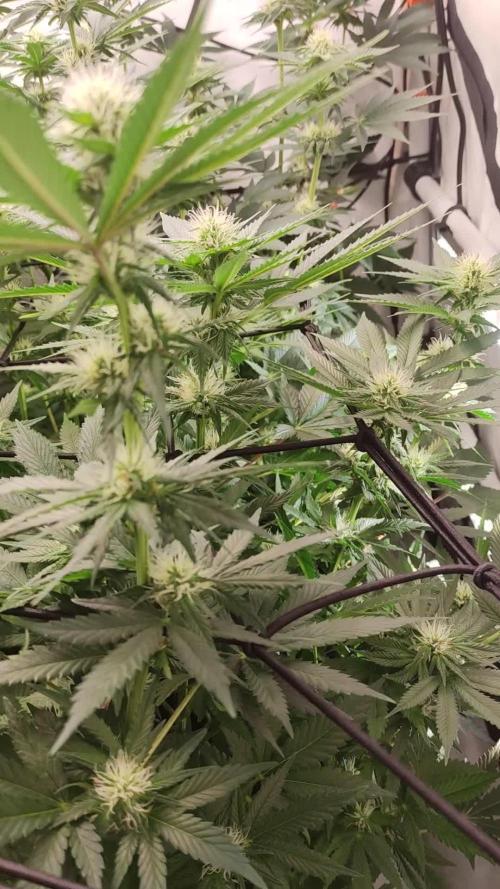
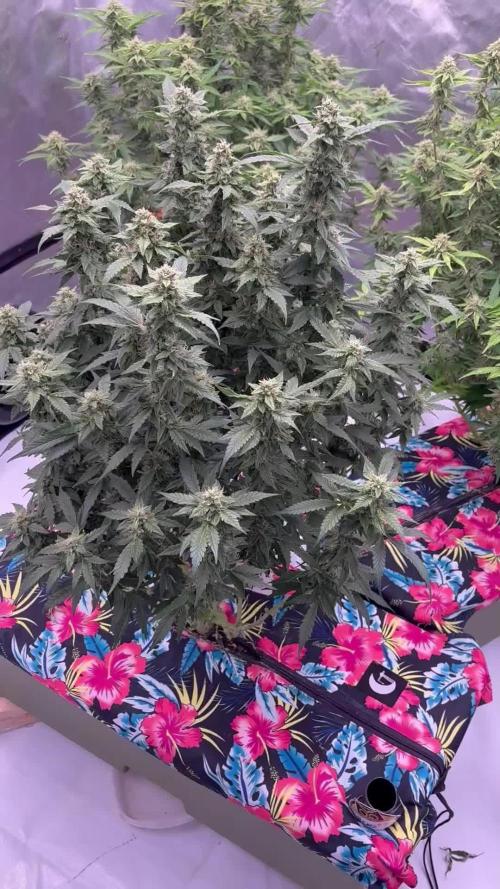
I'm gonna need a parachute Insane! One girl’s nearly finished, and the other two are in that last push.
Processing
Likes
13
Share
So all the plants are topped twice now and have all took well , my next step will be lowering my scrog net into position and also attach some gutter for collecting my runoff
Likes
27
Share
Gelato-K By Kannabia Seeds Week #19 March 15th-22nd Week #8 of Flower About 4 weeks left. She continues to stack and swell her buds are cover in trichomes.
Likes
13
Share
Sep 13: still going. Smells nice but the buds are not forming normally. Bad phenotype but apparently not a hermie. Will keep going for another couple weeks at least.
Processing
Likes
35
Share
Welcome to the 2018/19 indoor grow season!!! I am totally psyched to be growing Cream & Cheese CBD from Seedsman as one of the first strains this season. This strain looks like it should be amazing, 21% THC and 18% CBD!!! I'll definitely be cutting clones as she goes/ I started this girl in my humidity dome using a single 18W T5 that came with the dome. That seemed to be too weak for the seedling stage and resulted in a larger stretch than I would prefer, but I'm confident it will grow out of its funk in time. I am seeing some signs of burn, I guess the soil must be too hot. I started to try to flush through with straight ph'ed water, but then I started seeing signs of overwatering (rookie mistake, I know). Now I'm just trying to keep a little water on the bottom tray so it generates some humidity in the dome. There's also a heat mat under the tray I have the heat mat on a timer also, 30 min on/30 min off cycling all day. It seemed to get too hot on 24/7. I'll be transplanting and moving to my 2'x4' tent in about a week. They will live there during veg, then I'll be moving to a 4'x8' tent (not purchased yet) for flower. I'm also planning on adding some COB LED's in the flower tent. Then I'll dedicate my 2x4 tent to mothers, clones and seedlings. Its going to be a little different this season with both photo period and autoflowering strains going at the same time. But I'm looking forward to it! πŸ‘ Stay tuned...
Likes
18
Share
Green light is radiation with wavelengths between 520 and 560 nm and it affects photosynthesis, plant height, and flowering. Plants reflect green light and this is why they appear green to our eyes. As a result, some growers think that plants don’t use green wavelengths, but they actually do! In fact, only around 5 – 10% of green light is reflected from leaves and the rest (90 – 95 %) is absorbed or transmitted to lower leaves [1]. Green wavelengths get used in photosynthesis. Chlorophyll pigments absorb small amounts of green wavelengths. Light that doesn’t get absorbed is transmitted to leaves that are shaded out from direct light. This means that leaves at the bottom of the canopy get more green light than leaves at the top. A high proportion of green wavelengths compared to other colors tells lower leaves that they are being shaded out, so they are able to react accordingly. Lower leaves may react by opening or closing their stomata or growing longer stems that help the leaves reach brighter light [1, 2, 3]. When it comes to growing cannabis, many cultivators are interested in the quality of light used for the flowering stage. In many plants, flowering is regulated by two main photoreceptors: cryptochrome and phytochrome. Both photoreceptors primarily respond to blue light but can also respond to green, although to a lesser extent. Green can accelerate the start of flowering in several species (although cannabis has yet to be tested) [1, 4, 5]. However, once flowering has begun, it’s important to provide plants with a β€œfull spectrum” light that has high amounts of blue and red light, and moderate amounts of green, in order for photosynthesis to be optimized. Green light mediates seed germination in some species. Seeds use green wavelengths to decide whether the environment is good for germination. Shade environments are enriched in green relative to red and blue light, so a plant can tell if it is shady or sunny. A seed that senses a shaded environment may stay dormant to avoid poor growing conditions [1]. Some examples of plant species where researchers have documented this response are: ryegrass (a grass that grows in tufts) and Chondrilla (a plant related to dandelion) [1, 6]. Although green wavelengths generally tell plants NOT to germinate, there are some exceptions! Surprisingly, green wavelengths can stimulate seed germination in some species like Aeschynomene, Tephrosia, Solidago, Cyrtopodium, and Atriplex [1, 6, 7]. Of course, light is not the only factor affecting seed germination – it’s a combination of many factors, such as soil moisture, soil type, temperature, photoperiod, and light quality. When combined with red and blue light, green can really enhance plant growth [1, 8]. However, too much green light (more than 50% of the total light) can actually reduce plant growth [8]. Based on the most current research, the ideal ratio of green, red, and blue light is thought to be around 1:2:1 for green:blue:red [9]. When choosing a horticultural light, choose one that has high amounts of blue and red light and moderate amounts of green and other colors of light. Not many studies can be found about the effect of green light on cannabis growth or metabolism. However, if one reads carefully, there are clues and data available even from the very early papers. Mahlberg and Hemphill (1983) used colored filters in their study to alter the sunlight spectrum and study green light among others. They concluded that the green filter, which makes the environment green by cutting other wavelengths out, reduced the THC concentration significantly compared to the daylight control treatment. It has been demonstrated that green color can reduce secondary metabolite activity with other species as well. For example, the addition of green to a light spectrum decreases anthocyanin concentration in lettuce (Zhang and Folta 2012). If green light only reverses the biosynthesis of some secondary metabolites, then why put green light into a growth spectrum at all? Well, there are a couple of good reasons. One is that green penetrates leaf layers effectively. Conversely red and blue light is almost completely absorbed by the first leaf layer. Green travels through the first, second, and even third layers effectively (Figure 2). Lower leaf layers can utilize green light in photosynthesis and therefore produce yields as well. Even though a green light-specific photoreceptor has not yet been found, it is known that green light has effects independent from the cryptochrome but then again, also cryptochrome-dependent ones, just like blue light. It is known that green light in low light intensity conditions can enhance far red stimulating secondary metabolite production in microgreens and then again, counteracts the production of these compounds in high-intensity light conditions (Kim et al. 2004). In many cases, green light promoted physiological changes in plants that are opposite to the actions of blue light. In the study by Kim et al. blue light-induced anthocyanin accumulation was inhibited by green light. In another study it has been found that blue light promotes stomatal opening whereas green light promotes stomatal closure (Frechilla et al. 2000). Blue light inhibits the early stem elongation in the seedling stage whereas green light promotes it (Folta 2004). Also, blue light results in flowering induction, and green light inhibits it (Banerjee et al., 2007). As you can see, green light works very closely with blue light, and therefore not only the amount of these two wavelengths separately is important but also the ratio (Blue: Green) between these two in the designed spectrum. Furthermore, green light has been found to affect the elongation of petioles and upward leaf reorientation with the model plant Arabidopsis thaliana both of which are a sign of shade avoidance symptoms (Zhang et al. 2011) and also gene expression in the same plant (Dhingra et al. 2006). As mentioned before, green light produces shade avoidance symptoms which are quite intuitive if you consider the natural conditions where the plants grow. Not all the green light is reflected from the highest canopy leaves in nature but a lot of it (50-90%) has been estimated to penetrate the upper leaves at the plant level ((Terashima et al., 2009; Nishio, 2000). For the plant growing in the understory of the forest green light is a signal for the plant of being in the shade of a bigger plant. Then again, the plants growing under unobstructed sunlight can take advantage of the green photons that can more easily penetrate the upper leaves than the red and blue photons. From the photosynthetic pigments in higher plants, chlorophyll is crucial for plant growth. Dissolved chlorophyll and absorb maximally in the red (Ξ»600–700 nm) and blue (Ξ»400–500 nm) regions of the spectrum and not as easily in the green (Ξ»500–600 nm) regions. Up to 80% of all green light is thought to be transmitted through the chloroplast (Terashima et al., 2009) and this allows more green photons to pass deeper into the leaf mesophyll layer than red and blue photons. When the green light is scattered in the vertical leaf profile its journey is lengthened and therefore photons have a higher chance of hitting and being absorbed by chloroplasts on their passage through the leaf to the lower leaves of the plant. Photons of PPFD (photosynthetic photon flux density) are captured by chlorophyll causing an excitation of an electron to enter a higher energy state in which the energy is immediately passed on to the neighboring chlorophyll molecule by resonance transfer or released to the electron transport chain (PSII and PSI). Despite the low extinction coefficient of chlorophyll in the green 500–600 nm region it needs to be noted that the absorbance can be significant if the pigment (chlorophyll) concentration in the leaf is high enough. The research available clearly shows that plants use green wavelengths to promote higher biomass and yield (photosynthetic activity), and that it is a crucial signal for long-term developmental and short-term dynamic acclimation (Blue:Green ratio) to the environment. It should not be dismissed but studied more because it brings more opportunities to control plant gene expression and physiology in plant production. REFERENCES Banerjee R., Schleicher E., Meier S. Viana R. M., Pokorny R., Ahmad M., Bittl R., Batschauer. 2007. The signaling state of Arabidopsis cryptochrome 2 contains flavin semiquinone. The Journal of Biological Chemistry 282, 14916–14922. Dhingra, A., Bies, D. H., Lehner, K. R., and Folta, K. M. 2006. Green light adjusts the plastic transcriptome during early photomorphogenic development. Plant Physiol. 142, 1256-1266. Folta, K. M. 2004. Green light stimulates early stem elongation, antagonizing light-mediated growth inhibition. Plant Physiol. 135, 1407-1416. Frechilla, S., Talbott, L. D., Bogomolmi, R. A., and Zeiger, E. 2000. Reversal of blue light -stimulated stomatal opening by green light. Plant Cell Physiol. 41, 171-176. Kim, H.H., Goins, G. D., Wheeler, R. M., and Sager, J. C. 2004.Green-light supplementation for enhanced lettuce growth under red- and blue-light emitting diodes. HortScience 39, 1617-1622. Nishio, J.N. 2000. Why are higher plants green? Evolution of the higher plant photosynthetic pigment complement. Plant Cell and Environment 23, 539–548. Terashima I., Fujita T., Inoue T., Chow W.S., Oguchi R. 2009. Green light drives leaf photosynthesis more efficiently than red light in strong white light: revisiting the enigmatic question of why leaves are green. Plant & Cell Physiology 50, 684–697. Zhang, T., Maruhnich, S. A., and Folta, K. M. 2011. Green light induces shade avoidance symptoms. Plant Physiol. 157, 1528-156. Wang, Y. & Folta, K. M. Contributions of green light to plant growth and development. Am. J. Bot. 100, 70–78 (2013). Zhang, T. & Folta, K. M. Green light signaling and adaptive response. Plant Signal. Behav. 7, 75–78 (2012). Johkan, M. et al. Blue light-emitting diode light irradiation of seedlings improves seedling quality and growth after transplanting in red leaf lettuce. HortScience 45, 1809–1814 (2010). Kasajima, S., et al. Effect of Light Quality on Developmental Rate of Wheat under Continuous Light at a Constant Temperature. Plant Prod. Sci. 10, 286–291 (2007). Banerjee, R. et al. The signaling state of Arabidopsis cryptochrome 2 contains flavin semiquinone. J. Biol. Chem. 282, 14916–14922 (2007). Goggin, D. E. & Steadman, K. J. Blue and green are frequently seen: responses of seeds to short- and mid-wavelength light. Seed Sci. Res. 22, 27–35 (2012). MandΓ‘k, B. & PyΕ‘ek, P. The effects of light quality, nitrate concentration and presence of bracteoles on germination of different fruit types in the heterocarpous Atriplex sagittata. J. Ecol. 89, 149–158 (2001). Darko, E. et al. Photosynthesis under artificial light: the shift in primary and secondary metabolism. Philos. Trans. R. Soc. B Biol. Sci. 369 (2014). Lu, N. et al. Effects of Supplemental Lighting with Light-Emitting Diodes (LEDs) on Tomato Yield and Quality of Single-Truss Tomato Plants Grown at High Planting Density. Environ. Control Biol. 50, 63–74 (2012).
Likes
15
Share
@Jazzvet
Follow
13 Out - 22o dia- A planta atingiu os 13 cm e 4 folhas reais, uma boa altura para comeΓ§ar com os fertilizantes, 4 ml de Root Juice e 2 ml de Bio Heaven e Active-Vera por cada litro (2 L Total) 16 Out - 25o dia - Regada com a mesma mistura. 19 Out - 28o dia - Transplantei a planta para um vaso maior (7,5 L), ainda nΓ£o estava pronta completamente Root bounded mas acho que mais vale antes que depois. Regada com 4 litros de Γ‘gua com 16 ml de Root Juice, 4 ml de Fish-mix e 8 ml de Bio Heaven e Active-Vera. Continua...
Likes
10
Share
The plants were doing great, i feel that this strain can go for a better grow. Overwatering was an issue for me because of this strain packs buds and leaves are very little on it. Next grow for this strain i will need to improvise the watering schedule. This strain takes up very little water.
Likes
4
Share
@RoyColt
Follow
Day43 19/05 add 1L ro water with nutrients. Day44 20/05 add 2L ro water with nutrients. Continue Def. and Lst. Day45 21/05 add 1L only ro water. Day46 22/05 add 2L ro water with nutrients. Total 3,00 ms, Continue Def. and Lst. Day47 23/05 add 1L only ro water. Continue Def. and Lst. Day48 24/05 add 1L ro water with 4 ml cal mag, Total 2,9 ms. Day49 25/05 add 1L only ro water.Continue Def. and Lst. Day49 25/05 night add 2L ro water with nutrients. Total 2.80 ms, Continue Def. and Lst.
Likes
49
Share
@yan420
Follow
FERMAKOR BARREL MIX – BASE IN USE (Testing on the Fantasy Feast girl we pulled out of another diary https://growdiaries.com/diaries/274722-grow-journal-by-yan402 ) (FERMAKOR BASE SYSTEM KOH VERSION diary https://growdiaries.com/diaries/278391-grow-journal-by-yan402) (Urea & Micros on the way β€” first week running without them) πŸΆπŸ’§πŸΆπŸ’§πŸΆπŸ’§πŸΆπŸ’§πŸΆ πŸ’§ 30 L Barrel – Current Working Mix πŸΆπŸ’§πŸΆπŸ’§πŸΆπŸ’§πŸΆπŸ’§πŸΆ Step 1 – Calcium Nitrate (Part A) 7 L warm water (~35–40 Β°C) β†’ added 45 g Calcinit, stirred until fully clear. That’s the calcium + nitrogen backbone for the feed. Step 2 – FERMAKOR PK Base (Part B) 15 L water in the main barrel β†’ added 30 ml FERMAKOR PK Concentrate, mixed well. This forms the main P + K part of the formula. Step 3 – Combine Solutions Slowly poured the Calcinit mix into the barrel while stirring β€” no reaction, still crystal clear. That confirms the mix is stable and precipitation-free. 🌿 Step 4 – FPJ / FFJ Batch Added 30 ml homemade FPJ (fish + veg batch) β‰ˆ 1 ml/L. Color shifted to a light-amber tone β€” looks alive and active. πŸ‹ Step 5 – Citric Acid Balance Added 1 tsp citric acid after everything was blended to fine-tune pH and help chelate micros later on. πŸ“¦ Step 6 – Top Up & Check Filled to the 30 L mark with plain water β†’ pH tested with drops, showing yellow-green β€” roughly 5.8 – 6.0 range. Nice clean look, stable smell, no residue. πŸ’§ Current Base Ingredients (Active Mix) Warm Water β‰ˆ 22 L total Calcinit 45 g β†’ N + Ca foundation FERMAKOR PK Base 30 ml β†’ P + K support Citric Acid 1 tsp β†’ Chelation + pH balance FPJ / Fish Emulsion 30 ml β†’ Organic enzyme booster Result: clean amber mix, mild and balanced. I’ll let this version run for a week before adding anything. πŸ‘€πŸ‘€πŸ‘€πŸ‘€πŸ‘€πŸ‘€ Observations and changes πŸ‘€πŸ‘€πŸ‘€πŸ‘€πŸ‘€πŸ‘€ 27.10.25 VW27 noticed some min burnt tips so I decreased Calcium Nitrate 45 to β†’ 40g, decided to add two more elements micros and Epsom salts just to make sure they got everything, Fetrilon Combi 1 (Micros): 0.5 g, Epsom salts: 8 g 28.10.25 VW27 she seems devoid of any deficiencies, seems ready for the flip to 12/12 02.11.25 VW27 girl is looking good so I decided to stop making daily videos and do a standard once a week update. 09.11.25 aVW28 7 days since flip,stretch in full swing, first pistils showing, leaf color deep and healthy. Slight tip burn early week β†’ gone after pH stabilized. Feed stayed clear, no residue, roots clean and sweet-smelling, did what I hope is a last cleanup and pruningπŸŽ₯ 10.11.25 VW29 added Phosphoric acid pH down to the schedule for flowering stage. 14.11.25 FW1 FERMAKOR PK Micros 40 β†’ 50 ml 23.11.25 FW2 got some burnt tips, observe and act accordingly in case it worsens, diluted by 25% for this week. 05.12.25 FW3 about 2 weeks ago Calcium Nitrate 35 g β†’ 25 g, FERMAKOR PK Micros 50 ml β†’ 60 ml πŸŒ±πŸ’¦πŸŒ±πŸ’¦πŸŒ±πŸ’¦πŸŒ±πŸ’¦πŸŒ±πŸ’¦πŸŒ± 🌿Day to day tasks & actions 🌿 πŸŒ±πŸ’¦πŸŒ±πŸ’¦πŸŒ±πŸ’¦πŸŒ±πŸ’¦πŸŒ±πŸ’¦πŸŒ± 30.11.25 FW2 – Fed 5l of #1 β†’ 2l runoff 01.12.25 FW3 – Fed 5l of #1 β†’ 2l runoff 02.12.25 FW3 – Fed 5l of #1 β†’ 2l runoff 03.12.25 FW3 – Fed 5l of #1 β†’ 2l runoff 04.12.25 FW3 – Fed 5l of #1 β†’ 2l runoff 05.12.25 FW3 – Fed 5l of #1 β†’ 2l runoff 06.12.25 FW3 – Fed 5l of #1 β†’ 2l runoff 07.12.25 FW3 – Fed 5l of #1 β†’ 2l runoff πŸ’§πŸ’¦πŸ’§πŸ’¦πŸ’§πŸ’¦πŸ’§πŸ’¦ 🌱 Nutrients in 30 L #1 Veg – FERMAKOR πŸ’§πŸ’¦πŸ’§πŸ’¦πŸ’§πŸ’¦πŸ’§πŸ’¦ Calcium Nitrate (Calcinit / Nitcal): 45 β†’ 40 g β†’ 35 g β†’ 25 g = 1.50 g/L β†’ 1.33 g/L β†’ 1.17 g/L β†’ 0.83 g/L = 207 ppm N / 253 ppm Ca β†’ 184 / 225 β†’ 161 / 197 β†’ 115 / 141 PK Concentrate (FERMAKOR Base): 30 β†’ 40 ml β†’ 50 ml β†’ 60 ml = 1.00 β†’ 1.33 ml/L β†’ 1.67 ml/L β†’ 2.00 ml/L β†’ balanced 1:1 P:K + light micros (from extract) Home-made FFJ/FPJ (Fish + Veg): 30 ml = 1.00 ml/L Epsom Salt (MgSOβ‚„Β·7Hβ‚‚O): 8 g = 0.27 g/L β†’ ~26 ppm Mg + ~35 ppm S Fetrilon Combi 1 (Micros): 0.5 g = 0.017 g/L β†’ Fe 0.7 ppm Β· Mn 0.7 ppm Β· Zn 0.3 ppm Β· Cu 0.3 ppm Β· B 0.1 ppm Β· Mo 0.02 ppm Phosphoric Acid (pH down) + Citric Acid (chelation): as needed β†’ First set pH with phosphoric acid, then add a little citric only if you want extra chelation Target pH: 5.8 – 6.0 (drop test yellow-green) πŸ“¦ TOTAL: Liquids: 60 β†’ 70 β†’ 80 β†’ 90 ml per 30 L = 2.00 β†’ 2.33 β†’ 2.67 β†’ 3.00 ml/L Solids (CaNO₃ + Epsom + Fetrilon): 53.5 β†’ 48.5 β†’ 43.5 β†’ 33.5 g per 30 L = 1.78 β†’ 1.62 β†’ 1.45 β†’ 1.12 g/L πŸ’§πŸ’¦πŸ’§πŸ’¦πŸ’§πŸ’¦πŸ’§πŸ’¦ YouTube Link: https://youtube.com/-m8h?si=A7x4Zlr2kj-_ga31
Likes
2
Share
@Thedibber
Follow
29/12/25 - Transplanted into fresh 20L livingsoil and watered 2L each
Likes
28
Share
Bis jetzt ist Sie die mit den dicksten und am meisten festen Buds. Bin gespannt was da noch fΓΌr PrΓΌgel dran wachsen! πŸ˜†πŸ˜… Mittlerweile riecht Sie auch nicht mehr so stark nach Erde.
Likes
4
Share
@RzUdoo
Follow
It didn t rain for 5 days, so went to see them. My Girls! All dong well. Deep rooted and all managing well. Nature is great. Life is great. Jah is great! Now i will return only one more time, early September for harvest, (if they are ready by then). Happy to see my Guardians - the Sea-Eagles are back. Have not seen them for a while. Forefathers are watching over the I! Jah Bless! Mother Nature!
Likes
5
Share
@undermink
Follow
I stopped giving her nutrition though she seems almost ready. I'll wait a few days and chop her off. Hope she will be as good as the last one.
Likes
88
Share
My second growroom is built and the girls have moved in. Medical Mass is a new medical cannabis strain with a high CBD content and a low THC level that provides good medical properties without a strong psychoactive effect. This is a mostly indica plant that contains 40% sativa and 60% indica. Critical Mass and CBD rich strain were crossed to create this amazing valuable variety. The plant suits both for indoors and outdoors, for beginner and experienced growers. The strain grows up to 60 - 100 cm tall and produces good yields for such height of about 500 - 550 gr/m2. The plant demonstrates great results even in small spaces. The flowering time takes only 7-8 weeks and the harvest comes in late September. The smoke brings very strong, intense flavors with sweet notes of honey and skunk and an intense pleasant relaxation. Medical Mass is the great choice for each medical user due its small height, ease of growing, fast flowering and of course great medical potency. ---------------------------------------------------------------------------------------------------------------------------- 2017-10-20. Week 6 day 3. Late update. The girls are in there final 12 liters autopots and have moved into my newfixed second growroom. The girls is growing fine and have been Fimmed. Girl 1 is 41 cm Nr2 is 34 and Nr3 is 32 cm tall. Added videos and pics. Grow room Nr2 is 1.75 meters x 1,05 meters and its 1.92 meters high. Im using 1x 140 watt Apollo led 4 and 1x 370 watt Apollo led 10.
Processing
Likes
6
Share
@MG2009
Follow
08/16/2020 Just posting the picture of my seed to harvest plant on an 11-13 schedule. Will post pics of the others this evening. Pic #2 is 4days later. #2,#3,#4 are the other contestants I like #2 #2,#3,#4 are out side until? Light schedule is closer to flowering tent 11-13 schedule, I've noticed that they do not like any light irregularities and they will herm. So I recommend a equatorial light schedule that the breeder suggest.11-13.
Likes
2
Share
@Drtomb
Follow
Week 5 is about finished. I started the girls on the finisher product to help. Harden the buds, basically only another week and a half before I begin the flush.
Likes
19
Share
This was a really easy strain to grow!!! I had some personal problems while I was doing this diary!!! So didn’t update as much!! But so far this is my best one yet and best strain I have grown and the best harvest and yield I’ve had to this day!!!!
Processing
Likes
29
Share
Entering the second week full of doubts, are they stunted? I transplanted four of them into 8 l airmax pot.Also a little bit of something similar to mold appeared on the seed shells (grey little hairs).Can it be the mycorrhiza? I began adding Royal calk, cause i heard and readed that the autos need it since the begining(this one is susprisingly concentrated) and inoculatethe first time with the microbe photosynthesis plus,3 ml/l the first time and 1,5ml/l the next weeks along with a sugar application once a week in order to feed the microbes and fungi from the floor.
Likes
15
Share
She's survived the burn from a few weeks ago and is getting into her stride. Roots forming well. Pale leaf canopy compared to her various sisters. My first indica, so not sure what to expect :-)