


Likes
Comments
Share


@Growmie95
Follow
Harvest day for Purple Ghost Candy. Big buds bit not so much frost and smell.. had a mutation and probably unlucky pheno.
One more week for super lemon haze. Looking super healthy and frosty.


Likes
6
Share


@Skunkstar
Follow
Really into the aggressive stretch now going to be doing some defolation this week there looking in good shape for it going to slightly increase the ec to 1.6 a week after defolation as to the defolation I will ease off the ec for this feed to over the stress week three I shall lollypop them all and clean up the girls and won't touch them after that last defolation in the end of week 3 I also foiler fed with the shogun boost


Processing
Likes
22
Share


@Silverback_Guerilla
Follow
5/4:
Her two tops suddenly stretched a few inches. I'll tie them down in the next couple of days and when they get to the third node, I'll top them again.
I gave her a little water with myco, kelp, molasses, cal-mag, silica, and humic acid.
5/6:
I fed her about a gallon of water with boomerang, grow big, big bloom, cal-mag, silica, and humic acid. This was the last time I'll give her any grow big or boomerang...there's plenty of good stuff to support good growth for at least a month in the Happy Frog dry fertilizer I'm using.
I did a little LST on her today...split those two main colas really well and tied them into horizontal positions on opposite sides of the pot. I used gorilla wood glue to seal the split.
5/7:
I foliar fed with big bloom, grow big, silica, fulvic acid, and molasses.
5/8:
I did a foliar application of Axiom harpin proteins.
5/9:
I did a foliar application of boom boom spray.
5/10:
She's growing very well now, so I topped all her main shoots and tied them them down to encourage the lower branches to compete for apical dominance.
I'll water her tomorrow if it doesn't rain.
That's it for week 5

Processing
Likes
25
Share


@BudHaks
Follow
She is getting fat! What a great plant she is - again, little to no deficiencies, other than some light burn but I could not complain to have such strong genetics for my first ever grow! Trichomes are not too cloudy, so still a while to go but what an AUTO!

Likes
32
Share

@BudVision
Follow
Hello growers,
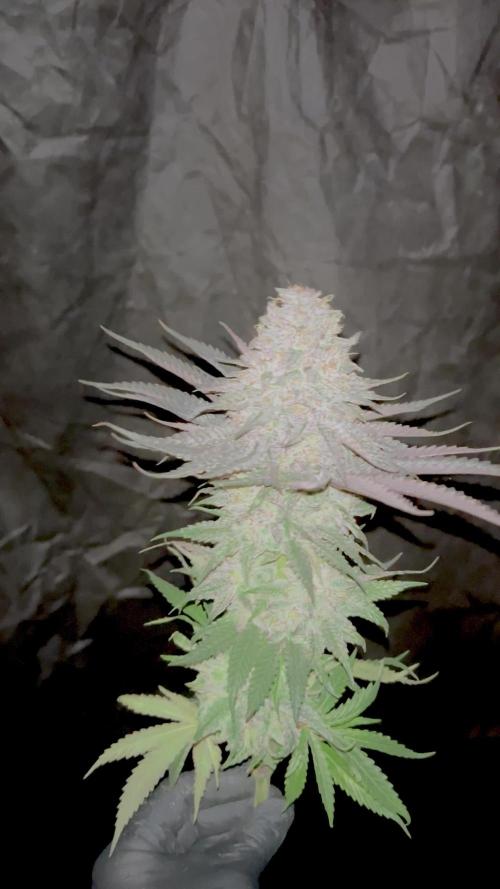
I harvested all the chicks 🐥 and La Bomba was left alone in the coop 😀💣. The aroma is sweet and spicy, hard to describe but very pleasant. The buds are dense and beautifully colored.
I put them to dry in a space at 17 °C and 60% relative humidity.
Peace and happy growing! ✌️


Likes
16
Share


@DaddyPrime
Follow
7/18 so even though shes been flowering for only 5 weeks(starting6) shes looking closer to being done than I had expected. Shes been losing alot of yellow leaves and most of the pistils are orange now. I checked the trichomes as best as I could today and on the main/top cola, I saw some amber but very little. But the rest of the buds were mostly clear I believe. I still want her to keeo going another few weeks but we'll see as time and trichomes progress. I added some extra flowering nutes and a product thats got good stuff like kelp and molasses and crab meal and stuff besides NPK values to help the plants put on some extra weight hopefully.
7/19 just took pictures/videos and checked trichomes
7/22 checked trichomes. The very top nugs have some amber on them and the rest are mostly cloudy. Wish I wouldve been checking the trichomes sooner so I couldve started flushing sooner. I wish i wouldve stopped using open sesame sooner as well. Next time im gonna do some things different with these plants. Once the soils dry probably gonna chop

Likes
53
Share


@Pr3m_85
Follow
More than a day in the drying tent and I'll give you the report on the weight, the taste and the effects!
‐-----------------------------------------------------------------------------
FINAL WEIGHT : 153,5 g
Effect : very pleasant. I have the impression of being in a cotton field.
Taste : cream berries 🍓🍓🍓🍓
Peace to all ✌️🏽✌️🏾✌️✌️🏿✌️🏻✌️🏼
------------------------------------------------------------------------------
✔️Pheno 1 : the appearance of the flower is much more purple than the other two phenotypes. Her effect is much more sativa as well.
✔️Pheno 2 : The strawberry taste is much more pronounced. In this phenotype, there is a not at all unpleasant mint aftertaste !!
✔️Pheno 3 : the effect is felt very quickly. In a few seconds, you find yourself in a state of joy. It's very nice !!!!


Likes
23
Share


Likes
13
Share


@Sieben
Follow
Fullgas , take place and enjoy the ride.
She has grown wide with strong and heavy branches, buds also exploded.
This strain is my personal favorite of this grow, love the added note from Sherbert OG to one of my favorite Cheese strains.
Behind the big Lemon Orange she growed undisturbed, as a Cheese Lover i expected much and are more then satisfied.
The taste is typical Cheese but more creamy with a gassy note, huge buds full of resin. High is uplifting , with a strong body, it really gets u and take u on a ride.
I want to remeber Franco Loja with this Fullgas grow especially, he was part of Greenhouse family and this strain is a hommage to him.
Franco Loja Foundation and strains that support his family are available at Greenhouse Seeds.
I thank Arjan and all Greenhouse employees, especially Georgia from CS , for this wonderful plant.
Likes
14
Share


@MrReeferMadness
Follow
Massive root growth this week!
I Started week 5 on Saturday past, I've let some of the branches that were held Down for a while free, I manipulated some other branches to work on the symmetry as well as some selective de faning on all the gorrila zkittlz. As the three all look like different phinos I've treated them separately to suit the growth of each plant.
The Psychosis was the skiniest and smallest from week 1-4.. Now its the tallest. I had to pin her down harder with the lst this week and she reacted really well growth wise. 3 days later lots of fresh branches shot up so I decided to take clones for a new diary I will be starting next week 😎


Likes
5
Share


@Mr_nugs_lover_David
Follow
So this lady has started Flower on December 22nd that I have changed the light cycle to 12-12 so I'm gonna let flower begin and see what shape ends up with.


Likes
18
Share


@ZombieKushAddicted
Follow
to view this lamp or any other marshydro product go to: https://instagram.com/marshydro_aliexpress?igshid=YmMyMTA2M2Y=



Likes
16
Share


@Dr_Rook
Follow
Ya casi un mes a 12/12 y entrando en su etapa más bonita.
Están resinando muy bien por todos lados y ya cada vez huelen más y mejor. Empiezan a coger color, demasiado pronto ya que a veces pasan más frío de la cuenta.
Esta semana les he alejado el foco unos centímetros. Estaban 3/4 centímetros por debajo de lo mínimo recomendado y no me fío de quemar mis primeras plantas de interior. (Ya habrá tiempo para experimentos)
La semana que entra ya deberían de entrar en la fase de engorde. Toca seguir atentos a ellas
Likes
9
Share


@Canadian
Follow
Finally I discovered why is my critical girl having such a hard time is because we have more gardening in this property tomatoes and other vegetables and my brother decided to add bat guano to all of the plants including the cannabis plant this happened a few months ago without me knowing so I continue to feed liquid nutrients without realizing they was already food in it and not any food slow-release fertilizer so after 3 weeks of intense Flushing I was scratching my head trying to figure out where she's getting nutrients from and boom that my brother told me by the way I add bat guano to all of the plans some months ago and I guess now is becoming available to the plans and causing all sort of problems hopefully with water only she can make it through to the end of the season but she is definitely stunt and is not growing anymore because of this this is my third or fourth week without seeing her stretch at all and I know it is because it has nutrient lockout so for everybody out there please do not mix slow-release fertilizer with liquid fertilizer because you going to cause yourself so much headache and problems because there is no way to control what is in the soil.
And the reason you use Liquid Fertilizer has to have complete control in their intake of nutrients and customize it to their need something my brother does not understand yet thank you for reading I will continue to update have a happy grow

Likes
40
Share


@BudXs
Follow
Explosive growth this week. They are ready for the flip and will be going into 12/12 in two days
This strain is by far and away the fastest and most heavy veg growth in the garden. Seeing some of the harvests on here (AstroBoy) makes me drool.
Big thanks to OSS for the tester beans


Likes
146
Share


@Natrona
Follow
So close to harvest. This week and last I reduced the amount of TPS1 in the feed from 15ml /gal to 10ml/g. Early in the week, Apollo's lower leaves started showing the fade using up the nutrients. Thursday, I did a preliminary trim to remove any fan leaves and feeder leaves with longer stems. just handling the stems and buds my hands, nails and arms were sticky. After the trim, I put Apollo's Friends back in the tent with her. When the plants were in different veg/flower cycles, I separated them into tents. GDP and zkittles grew with in 2-3 inches on the light. I could not raise the lights anymore.
Today, 11/19 is day Apollo's 69 day and 41 in flower. The harvest window per RQS is 70-75 days from seed. Tuesday will be the harvest day. After watering only 2 liters with Vit B, Recharge and Signal yesterday, I put her in the 3#x3tent in the dark.
Apollo's buds are thick, dense, stinky citrus floral and sticky. The sugar leaves are showing color change as she knows her life is ending in glory.
I am so proud of this grow. I didn't overfeed so I have experienced the color fade to yellow as foods are used up and the delicate colors emerge in the sugar leaves. I am very impressed with Royal Queen Seeds F1 genetics. So much so I bought Milky Way F1 and Medusa F1. I will definitely have another Apollo grow in January. Thank you @James at RQS.
Apollo F1 had a huge base stem and was multi branching-even the side stems had side stems. The stems were sturdy. No support is needed for her branches She stayed short at 26 inches tall. I definitely pushed her on the watering.
When I saw no runoff after 2.5 liters of water, I upped to 3 ltr. Then 3.5, then 1 gallon. I watered 2 liters, let the water absorb, then slowly add another 2 liters. There was a small amount of run off at the time of watering but was all gone by the next day. It could have been evaporation, but I really think it was consumption. Consumption is an indicator of yield. As densely bushy as she is, I'm estimating at least 90 grams.
So for future grows, especially for very bushy plants, I will defoliate at least 2x during early and midflower to open up the canopy and let the plants bulk up more. She did show some nutrient (cal-mag) deficiency and for the next Apollo grow, I will push the feed a bit. I'm excited and a bit sad to see this grow come to an end at the same time. I really want to sample the smoke and feel the effect. Apollo is a balanced Hybrid.
Thanks for the visit. Apollo and I appreciate the likes, views and comments. Have wonderful week . Happy growing and have fun.
Natrona
********************************
Apollo F1 is a vigorous auto flowering hybrid that boasts a strong structure and delicious aromas. Created from inbred lines descending from Lemon, Black Domina, and Sugar Magnolia, Apollo F1 inherited premium genetics from her predecessors. Like the ancient Greek deity she's named after, Apollo F1 produces balanced, creative effects that might inspire your perception of music, dance, poetry, and more!
Mature and well-dried Apollo F1 flowers boast an upfront fresh aroma that combines crisp pine and herbal notes with the invigorating kick of ripe citrus peels. Accentuating these notes is a rich backdrop of dark vanilla and hints of lavender, reminiscent of modern cannabis varieties descending from Cookies and other US lineages. Apollo F1 produces a resin loaded with plenty of cannabinoids (predominantly THC) and a complex mix of terpenes including myrcene, terpinolene, farnesene, caryophyllene, ocimene, limonene, and linalool. As a result, Apollo F1 produces a balanced effect very typical of a well-bred hybrid—expect a powerfully relaxing physical sensation (characteristic of myrcene, farnesene, and linalool) mixed with a notable euphoria and motivating kick produced by terpinolene, ocimene, and limonene.
Apollo F1 is a robust cultivar with the telltale compact structure of an indica-dominant hybrid. Plants reach a medium height with many tightly spaced branches that quickly become loaded with bud sites and thick, dark-green foliage. Apollo F1 flowers automatically, and her entire life cycle lasts roughly 80 days. Come harvest time, Apollo F1 will reward you with big, dense flowers bearing a thick layer of trichomes.
Variety: F1 Hybrid auto
Genetic Background: Lemon x Black Domina x Sugar Mangolia
THC: Very high
Yield: XXL
Height: 55 - 75 cm
Flowering time: 45 - 50 days
Harvest: 75 - 80 days after sprouting
Effect: Calming, Creative, Motivating , Physically Relaxing
Flavor: Citrus, Herbal, Lavender, Pine, Vanilla
Major terpenes: Caryophyllene, Farnesene, Myrcene, Terpinolene
Climate: Short Summers
Friends, Royal Queen Seeds Is offering a discount on purchases
👉**GROWERS20** for 20% 👈
Https://www.royalqueenseeds.com
Link to Apollo
https://www.royalqueenseeds.com/us/56-f1-hybrid-cannabis-seeds
====================================
Equipment: AC Infinity
CLOUDLAB 844 – Advance Grow Tent 48”x48”x80”
CONTROLLER 69 PRO – Grow Tent Controller
CLOUDLINE LITE 6 - Inline Fan 6"
IONBOARD S44 – LED Grow Light Board 400W
CLOUDRAY S6 – Oscillating Circulation Clip Fan
Carbon Filter 6”
Pots: 5 gallon Air pots
Soil Fox Farm Happy Frog amended with worm castings, perlite, dolomite lime and mycorrhiza.
Seeds provided by Royal Queen Seeds Check them out 😎
Https://www.royalqueenseeds.com
Link to the seeds
https://www.royalqueenseeds.com/us/56-f1-hybrid-cannabis-seeds
use Discount Code
👉 **GROWERS20** for 20% discount 👈
Nutrients: Total Plant Solution
>TPS1
>Canopy
>Signal
>Recharge
Amended soil recipe #2 used for soil prep.
https://www.paramountseedfarms.com/super-soil-recipes/